ora-284-opencode-prompt-pad
17 Commits
| Author | SHA1 | Message | Date | |
|---|---|---|---|---|
 Devin Foley Devin Foley
|
4518f272b2 |
fix(release): publish all remaining @paperclipai workspace packages from CI + guard unpublishable edges (#8365)
## Thinking Path > - Paperclip is the open source app people use to manage AI agents for work, distributed primarily via the `paperclipai` npm package and its `@paperclipai/*` workspace packages. > - The release subsystem (`scripts/release-package-*`) decides which workspace packages CI republishes at the unified calver version each release, and `replaceWorkspaceDeps()` rewrites every internal `workspace:` dependency to that calver version at publish time. > - The gap: a package that publishes from CI can declare a `workspace:` dependency on a package that is NOT enrolled for CI publish. The dependency spec gets rewritten to a calver version that is never actually published, so the dependent becomes uninstallable. > - This shipped for real: a recent change made `@paperclipai/server` depend on `@paperclipai/skills-catalog`, but skills-catalog was not on the calver release train — so canary builds after that merge failed to resolve `@paperclipai/skills-catalog@<calver>` and `npx paperclipai@canary run` broke. > - This PR addresses it durably by (a) putting every remaining internal package on the CI release train so no internal dependency can dangle, and (b) adding a fail-fast guard so this class of break can never ship again. > - The benefit is that canary and stable installs resolve all internal dependencies, and any future unpublishable workspace edge fails the release build with a clear, named error instead of producing a broken package. ## Linked Issues or Issue Description Refs #8327 (introduced the `server -> skills-catalog` runtime dependency that surfaced the gap). No public issue tracks this; describing it in-PR: - **Problem:** After #8327, `npx paperclipai@canary run` failed for builds past the merge because `@paperclipai/skills-catalog` was rewritten to a calver version that was never published (the package was not enrolled for CI publish). Versions before the merge still ran. - **Root cause:** A `publishFromCi:true` package can declare a `workspace:` dependency on a package that is not `publishFromCi:true`; the release-time version rewrite then points at a non-existent published version. ## What Changed - Enrolled every remaining internal package on the calver release train by setting `publishFromCi: true` in `scripts/release-package-manifest.json`: `skills-catalog`, `teams-catalog`, `plugin-workspace-diff`, `plugin-kubernetes`, `plugin-novita-sandbox`. There are now zero `publishFromCi:false` entries. - `skills-catalog`, `teams-catalog`, `plugin-workspace-diff` already existed on npm — CI simply republishes them at calver. - `plugin-kubernetes` and `plugin-novita-sandbox` were not on npm; their one-time first publish was bootstrapped so the `check-release-package-bootstrap` gate passes. - Added `findUnpublishableWorkspaceEdges()` to `scripts/release-package-map.mjs`, wired into `buildReleasePackagePlan()`. The release map build now fails fast (surfaced by the `check` CI already runs) whenever a `publishFromCi:true` package declares a runtime `workspace:` dependency (`dependencies`/`optionalDependencies`/`peerDependencies`) on a non-`publishFromCi:true` `@paperclipai/*` package, naming the offending edge. - Added tests covering positive/negative detection, all three dependency sections, unknown-package edges, off-train edges, and the live manifest. ## Verification - `node --test scripts/release-package-map.test.mjs` → 9/9 pass (includes a test asserting the live manifest has no unpublishable edges). - `node scripts/check-release-package-bootstrap.mjs scripts/release-package-manifest.json` → passes, naming all five newly-enabled packages (all confirmed present on npm). - Confirmed via `npm view` that all five packages resolve on the public registry. ## Risks - Low risk. The change only enrolls already-existing (or freshly-bootstrapped) packages onto the existing release train and adds a build-time validation. No runtime code paths change. The new guard can only *fail* a release that was already going to ship a broken package. ## Model Used Claude Opus 4.7 (claude-opus-4-7), extended thinking, with tool use / code execution. ## Checklist - [x] I have included a thinking path that traces from project context to this change - [x] I have specified the model used (with version and capability details) - [x] I have checked ROADMAP.md and confirmed this PR does not duplicate planned core work - [x] I have searched GitHub for duplicate or related PRs and linked them above - [x] I have either (a) linked existing issues with `Fixes: #` / `Closes #` / `Refs #` OR (b) described the issue in-PR following the relevant issue template - [x] I have not referenced internal/instance-local Paperclip issues or links (only public GitHub `#NNN` / `github.com/paperclipai/paperclip` URLs) - [x] My branch name describes the change and contains no internal Paperclip ticket id or instance-derived details - [x] I have run tests locally and they pass - [x] I have added or updated tests where applicable - [x] If this change affects the UI, I have included before/after screenshots (N/A — no UI changes) - [x] I have updated relevant documentation to reflect my changes (N/A — no doc-facing behavior change) - [x] I have considered and documented any risks above - [ ] All Paperclip CI gates are green - [ ] Greptile is 5/5 with no open P2s, recommendations, or follow-ups - [ ] I will address all Greptile and reviewer comments before requesting merge |
||
|
Alex
|
b18669452f |
Add Novita sandbox provider plugin (#7595)
## Thinking Path > - Paperclip is the open source app people use to manage AI agents for work. > - Paperclip already separates agent adapters from execution environments, so agents can run locally, over SSH, or through sandbox providers. > - Sandbox provider plugins let Paperclip add new cloud runtimes without changing each agent adapter. > - Novita Agent Sandbox is a cloud runtime for AI agent workloads with isolated filesystems, command execution, templates, timeout controls, and pause/resume behavior. > - Paperclip currently has sandbox provider examples for Daytona and Cloudflare, but not Novita. > - This pull request adds a Novita sandbox provider plugin using the existing provider-plugin lifecycle. > - The benefit is that Paperclip users can run existing adapters such as Codex, Claude, Gemini, OpenCode, Cursor, or ACPX inside Novita Agent Sandbox environments. ## Linked Issues or Issue Description Fixes #7596 ## What Changed - Added `packages/plugins/sandbox-providers/novita` as a standalone sandbox provider plugin package. - Registered provider key `novita` with `kind: "sandbox_provider"` and `environment.drivers.register` capability. - Implemented Novita environment lifecycle hooks: validate config, probe, acquire lease, resume lease, release lease, destroy lease, realize workspace, and execute commands. - Added config support for `apiKey`, `domain`, `template`, `requestedCwd`, `timeoutMs`, `requestTimeoutMs`, `secure`, `autoPause`, and `reuseLease`. - Added README documentation for setup, configuration, and lifecycle behavior. - Added tests for manifest shape, config parsing, safe shell command wrapping, stdin delimiter safety, and env-key validation. ## Verification From `packages/plugins/sandbox-providers/novita`: - `pnpm typecheck` - `pnpm test` The tests avoid live Novita API calls and cover the provider's static contract and command-wrapping behavior. Live end-to-end verification requires a Paperclip instance with the plugin installed and a Novita API key configured as either a Paperclip secret or `NOVITA_API_KEY` in the worker environment. ## Risks - This adds a new direct dependency on the Novita Sandbox JS SDK (`novita-sandbox`). Socket/Snyk should review the package as part of normal dependency checks. - The implementation relies on Novita SDK command execution semantics; live provider behavior should be verified with a real Novita sandbox before marking the plugin production-ready. - `reuseLease` maps Paperclip release behavior to Novita `betaPause()`. If pause is unavailable for a selected template, the plugin falls back to best-effort kill during release. - Low migration risk for existing users because this is a new standalone provider plugin and does not change existing adapters or built-in providers. > For core feature work, check [`ROADMAP.md`](ROADMAP.md) first and discuss it in `#dev` before opening the PR. Feature PRs that overlap with planned core work may need to be redirected — check the roadmap first. See `CONTRIBUTING.md`. ## Model Used OpenAI GPT-5 Codex via Codex CLI, with repository file access, shell command execution, GitHub CLI/API usage, and local TypeScript/Vitest verification. Web and local documentation context were used for Novita Sandbox SDK/API behavior. ## Checklist - [x] I have included a thinking path that traces from project context to this change - [x] I have specified the model used (with version and capability details) - [x] I have checked ROADMAP.md and confirmed this PR does not duplicate planned core work - [x] I have searched GitHub for duplicate or related PRs and linked them above - [x] I have either (a) linked existing issues with `Fixes: #` / `Closes #` / `Refs #` OR (b) described the issue in-PR following the relevant issue template - [x] I have run tests locally and they pass - [x] I have added or updated tests where applicable - [ ] If this change affects the UI, I have included before/after screenshots - [x] I have updated relevant documentation to reflect my changes - [x] I have considered and documented any risks above - [ ] All Paperclip CI gates are green - [ ] Greptile is 5/5 with no open P2s, recommendations, or follow-ups - [x] I will address all Greptile and reviewer comments before requesting merge --------- Co-authored-by: Paperclip <noreply@paperclip.ing> Co-authored-by: Devin Foley <devin@paperclip.ing> |
||
|
Jannes Stubbemann
|
05ab45225a |
feat(plugin-kubernetes): self-hostable Kubernetes sandbox provider (stage 1/3: plugin package) (#5790)
## Thinking Path > - Paperclip is the open source app people use to manage AI agents for work > - Sandbox providers are the seam that lets agent runs execute in isolated environments; today the only first-party remote provider is Daytona, a hosted third-party service > - Self-hosters running Paperclip on their own infrastructure (often Kubernetes already) have no first-party way to run agent sandboxes on a cluster they control > - That gap matters for teams with data-residency, sovereignty, or cost constraints who cannot or will not send workloads to a hosted sandbox service > - This pull request adds a Kubernetes sandbox-provider plugin as a standalone, workspace-excluded package: it implements every SandboxProvider hook the Daytona provider does, on infrastructure the operator owns > - The benefit is that any Paperclip deployment with a Kubernetes cluster gets multi-tenant, network-isolated, quota-bounded agent sandboxes with zero new external dependencies ## Linked Issues or Issue Description No existing issue. Following the feature template: - **Problem:** Paperclip's remote sandbox execution requires a hosted third-party provider. Self-hosters cannot run agent sandboxes on their own Kubernetes clusters with a first-party provider. - **Proposed solution:** A `@paperclipai/plugin-kubernetes` sandbox-provider plugin with two backends: long-lived sandboxes via the [kubernetes-sigs/agent-sandbox](https://github.com/kubernetes-sigs/agent-sandbox) CRD (multi-command exec, adapter-install pattern) and one-shot `batch/v1` Jobs (stable APIs only, no extra controllers). - **Alternatives considered:** Driving kubectl from a generic shell provider (no lifecycle/lease semantics), or requiring a hosted provider (exactly the constraint this removes). ## What Changed This is **stage 1 of 3** of a staged contribution (direction agreed with maintainers): the plugin package alone. Stage 2 (server integration: lease params, provider registration) and stage 3 (agent runtime images + CI) are companion PRs that will be cross-linked from a comment here. - New package `packages/plugins/sandbox-providers/kubernetes` (workspace-excluded, like the path already carved out in `pnpm-workspace.yaml`): src, unit + kind integration tests, operator prerequisite manifests, README, smoke-test guide - Implements the full SandboxProvider hook surface the Daytona provider implements: `validateConfig`, `probe`, `acquireLease`, `resumeLease`, `releaseLease`, `destroyLease`, `realizeWorkspace`, `execute` - Two backends: `sandbox-cr` (default; long-lived pod via the agent-sandbox `Sandbox` CR, supports multi-command exec) and `job` (one-shot `batch/v1` Job; nothing beyond k8s 1.27+ required) - Per-run adapter resolution: one environment serves mixed harnesses; the per-run `adapterType` hint is read through a local optional type extension, so the plugin typechecks and builds against the current plugin SDK and simply falls back to the environment's configured default adapter until stage 2 lands - Exec-env wrapping: the Kubernetes exec API carries no environment, so commands are wrapped to receive the run's env - Fast-upload interception for workspace realization, scoped per lease - Per-tenant isolation: derived namespace per company, RBAC, ResourceQuota, restricted-PSS pod security (runAsNonRoot, drop ALL, seccomp RuntimeDefault, no SA token automount) - Network egress policy in two flavors: native `NetworkPolicy` and `CiliumNetworkPolicy` (FQDN allowlists) - Image allowlist with glob matching, registry override, and per-run image override validation - Per-run Kubernetes Secrets carrying agent credentials, ownerRef'd to the Job or Sandbox CR for cascade GC ## Verification - Standalone build, exactly as the README documents: ```bash cd packages/plugins/sandbox-providers/kubernetes pnpm install --ignore-workspace pnpm test # 147 unit tests, 17 files, all green pnpm typecheck # clean against the in-repo plugin SDK on master pnpm build # dist/ emitted, manifest + worker entrypoints present ``` - A kind-cluster end-to-end integration test is included (`RUN_K8S_INTEGRATION_TESTS=1 pnpm test test/integration/end-to-end-run.test.ts`) - Beyond CI: this provider has been verified in a production multi-tenant deployment against five harnesses (opencode, pi, codex, gemini, claude code) with real billed runs ## Risks - **Zero behavior change for any existing deployment.** The package is workspace-excluded; nothing in the server imports or loads it until stage 2's integration lands. No existing code paths are touched. - The default `sandbox-cr` backend depends on an alpha CRD (`agents.x-k8s.io/v1alpha1`); the README flags this and the `job` backend uses only stable APIs as a fallback. - Risk surface is confined to deployments that explicitly install and configure the plugin. - The default runtime images (`ghcr.io/paperclipai/agent-runtime-*`) are published by the stage 3 companion PR (#7934); until that lands, deployments must point `runtimeImage` at their own images. ## Model Used Claude Opus 4.8 (1M context), extended thinking, with tool use (Claude Code). ## Checklist - [x] I have included a thinking path that traces from project context to this change - [x] I have specified the model used (with version and capability details) - [x] I have checked ROADMAP.md and confirmed this PR does not duplicate planned core work - [x] I have searched GitHub for duplicate or related PRs and linked them above - [x] I have either (a) linked existing issues with `Fixes: #` / `Closes #` / `Refs #` OR (b) described the issue in-PR following the relevant issue template - [x] I have run tests locally and they pass - [x] I have added or updated tests where applicable - [ ] If this change affects the UI, I have included before/after screenshots (no UI changes) - [x] I have updated relevant documentation to reflect my changes - [x] I have considered and documented any risks above - [ ] All Paperclip CI gates are green (pending this push) - [ ] Greptile is 5/5 with no open P2s, recommendations, or follow-ups - [x] I will address all Greptile and reviewer comments before requesting merge --------- Co-authored-by: Claude Opus 4.8 (1M context) <noreply@anthropic.com> |
||
|
Dotta
|
fff3832a01 |
[codex] Add teams catalog extraction (#7550)
Fixes #7551 ## Thinking Path > - Paperclip is the control plane for AI-agent companies, and reusable company/team setup is part of making those companies faster to launch. > - The teams catalog work introduces app-shipped team templates that can be browsed, previewed, and installed into a company. > - Catalog installation crosses several contracts: bundled package contents, shared API types, server import/install behavior, CLI workflows, and the board UI. > - Agents also need a safe path through catalog installs: scoped company selection, explicit source policy, approval fallback for agent creation, and preserved catalog provenance. > - This pull request extracts the completed teams catalog branch into one reviewable PR on top of `public-gh/master`. > - The benefit is a reusable teams catalog foundation with server, CLI, package, docs, and hidden UI surfaces kept in sync. ## What Changed - Added the `@paperclipai/teams-catalog` package with bundled/optional team definitions, generated manifest, validators, catalog builder tests, and migration notes. - Added shared teams catalog types/validators plus server routes and services for listing, previewing, and installing catalog teams. - Integrated catalog install with company portability, skill/source policy checks, provenance metadata, origin hashes, target-manager reparenting, and installed/out-of-date detection. - Added CLI `teams` commands and agent-safe company selection behavior, including `company current` and approval fallback for forbidden agent-run installs. - Added hidden Team Catalog UI/API/query surfaces, Storybook fixtures, and targeted UI tests while keeping the UI route out of primary navigation. - Added docs for CLI/company/teams catalog behavior and removed generated screenshot artifacts from the PR diff. ## Verification - `pnpm exec vitest run cli/src/__tests__/company.test.ts cli/src/__tests__/teams.test.ts packages/teams-catalog/src/catalog-builder.test.ts packages/teams-catalog/src/shipped-catalog.test.ts server/src/__tests__/agent-permissions-service.test.ts server/src/__tests__/company-portability.test.ts server/src/__tests__/company-skills-service.test.ts server/src/__tests__/teams-catalog-routes.test.ts server/src/__tests__/teams-catalog-service.test.ts server/src/__tests__/teams-catalog-install-no-overrides.test.ts ui/src/lib/company-routes.test.ts ui/src/pages/TeamCard.test.tsx ui/src/pages/TeamCatalog.test.tsx ui/src/pages/useInstallTeamCatalogEntry.test.tsx` - `pnpm --filter @paperclipai/shared typecheck && pnpm --filter @paperclipai/teams-catalog typecheck && pnpm --filter paperclipai typecheck && pnpm --filter @paperclipai/server typecheck && pnpm --filter @paperclipai/ui typecheck` - Confirmed branch is rebased onto `public-gh/master` (`78dc3625a`) and `public-gh/master` is an ancestor of `HEAD`. - Confirmed PR diff excludes `pnpm-lock.yaml`, `.github/workflows/*`, generated screenshot images, and screenshot helper scripts. ## Risks - Medium review surface: this crosses package generation, shared contracts, server install behavior, CLI, docs, and hidden UI code. - Catalog install behavior creates agents/projects/tasks/skills and must keep company scoping, permissions, source policy, and provenance checks strict. - `pnpm-lock.yaml` is intentionally excluded per repo policy; CI/default-branch automation owns lockfile refresh. - The Team Catalog UI is included but hidden from primary navigation, so future enablement should re-check visual QA before exposure. > For core feature work, check [`ROADMAP.md`](ROADMAP.md) first and discuss it in `#dev` before opening the PR. Feature PRs that overlap with planned core work may need to be redirected — check the roadmap first. See `CONTRIBUTING.md`. > > ROADMAP checked: this aligns with reusable companies/templates and plugin-adjacent onboarding work. This PR packages work already developed on the Paperclip task branch for review. ## Model Used - OpenAI Codex, GPT-5 series coding agent in this Paperclip session; exact runtime context window was not exposed. Used shell, git, `gh`, and local test/typecheck tooling. ## Checklist - [x] I have included a thinking path that traces from project context to this change - [x] I have specified the model used (with version and capability details) - [x] I have checked ROADMAP.md and confirmed this PR does not duplicate planned core work - [x] I have run tests locally and they pass - [x] I have added or updated tests where applicable - [x] If this change affects the UI, I have included before/after screenshots, or documented why screenshots are intentionally omitted - [x] I have updated relevant documentation to reflect my changes - [x] I have considered and documented any risks above - [x] I will address all Greptile and reviewer comments before requesting merge --------- Co-authored-by: Paperclip <noreply@paperclip.ing> Co-authored-by: Claude Opus 4.8 <noreply@anthropic.com> |
||
|
Dotta
|
9eac727cf1 |
[codex] Add skills CLI and catalog management (#6782)
## Thinking Path > - Paperclip orchestrates AI agents for zero-human companies through company-scoped control-plane workflows. > - Agents need reusable, inspectable skills that can be installed, reset, audited, exported, and assigned without bespoke local setup. > - The existing skill truth model needed cleanup so bundled skills, optional catalog skills, runtime skills, and adapter-provided skills have clear provenance. > - Operators also need a practical CLI and board UI for discovering and managing company skills. > - This pull request adds the skills CLI, packaged skills catalog, company skills APIs, and catalog-aware board UI. > - The benefit is a more reusable Paperclip company setup where skills are portable, auditable, and easier for operators and agents to manage. ## What Changed - Added `paperclipai skills` CLI commands and coverage for catalog listing, installing, resetting, and inspecting company skills. - Added a packaged `@paperclipai/skills-catalog` workspace with bundled and optional skill content plus validation/build tests. - Added shared company-skill types and validators used across CLI, server, and UI contracts. - Added server catalog APIs/services for company skill catalog operations, reset semantics, audit behavior, and portability provenance. - Updated adapter skill handling so runtime/catalog provenance remains explicit across local adapters. - Added board UI support for browsing and managing catalog-backed company skills. - Updated docs for the skills CLI/catalog flow and the company skills Paperclip skill reference. - Rebased the branch onto current `paperclipai/paperclip:master`; no `pnpm-lock.yaml`, `.github/workflows`, or migration files are included in the final PR diff. ## Verification - Passed: `pnpm run preflight:workspace-links && pnpm exec vitest run cli/src/__tests__/skills.test.ts packages/skills-catalog/src/catalog-builder.test.ts packages/skills-catalog/src/shipped-catalog.test.ts packages/shared/src/validators/company-skill.test.ts packages/adapter-utils/src/server-utils.test.ts packages/plugins/create-paperclip-plugin/src/entrypoints.test.ts server/src/__tests__/company-skills-catalog-service.test.ts server/src/__tests__/company-skills-routes.test.ts server/src/__tests__/company-portability.test.ts`. - Passed: `pnpm exec vitest run server/src/__tests__/workspace-runtime.test.ts -t "default branch|origin/master|symbolic-ref"`. - Attempted: full `server/src/__tests__/workspace-runtime.test.ts`. Four provisioning tests failed while seeding an isolated worktree database from the local Paperclip instance because the local plugin schema dump contains a duplicate-column foreign key (`plugin_content_machine_18a7bc327b.content_case_signals`). The default-branch tests touched by the rebase conflict passed in the focused run above. - Checked final diff: no `pnpm-lock.yaml`, no `.github/workflows`, and no migration-file changes relative to `master`. ## Risks - Medium: this is a broad skills/catalog change touching CLI, server APIs, shared contracts, adapter skill sync, and UI. - Catalog validation and reset semantics need careful reviewer attention because they affect reusable company setup and portability. - No database migrations are included in this PR, so there is no migration ordering/idempotency risk in the final diff. - No lockfile is included by design; dependency resolution will be handled by the repository lockfile workflow. ## Model Used - OpenAI Codex coding agent based on GPT-5, running in Paperclip via the `codex_local` adapter with shell, git, GitHub CLI, and code-editing tool access. Exact hosted model build/context-window metadata is not exposed in this runtime. ## Checklist - [x] I have included a thinking path that traces from project context to this change - [x] I have specified the model used (with version and capability details) - [x] I have checked ROADMAP.md and confirmed this PR does not duplicate planned core work - [x] I have run targeted tests locally and documented the local workspace-runtime seed failure above - [x] I have added or updated tests where applicable - [x] If this change affects the UI, screenshots were intentionally omitted per PAP-10124 instructions; UI behavior is covered by tests and reviewer inspection - [x] I have updated relevant documentation to reflect my changes - [x] I have considered and documented any risks above - [x] I will address all Greptile and reviewer comments before requesting merge --------- Co-authored-by: Paperclip <noreply@paperclip.ing> |
||
|
Devin Foley
|
988689947a |
fix(release): publish modal plugin from ci (#6290)
## Thinking Path

> - Paperclip keeps its core release process declarative through
`scripts/release-package-manifest.json`, which decides which packages CI
is allowed to publish.
> - The Modal sandbox provider now exists as a first-party plugin
package under `packages/plugins/sandbox-providers/modal`.
> - The original Modal PR intentionally left `publishFromCi` disabled
until the package had been published and the registry bootstrap concern
was cleared.
> - The latest reviewer comment confirms that bootstrap step is
complete, so the remaining gap is only release automation configuration.
> - This pull request flips the Modal manifest entry to `publishFromCi:
true` so future CI-driven releases can publish
`@paperclipai/plugin-modal` the same way the other releasable packages
do.
> - The benefit is that Modal releases no longer require a manual
exception in the release pipeline.

## What Changed

- Updated the `@paperclipai/plugin-modal` entry in
`scripts/release-package-manifest.json` to set `publishFromCi` to
`true`.

## Verification

- Ran `node -e 'const
m=require("./scripts/release-package-manifest.json"); const
e=m.find(x=>x.name==="@paperclipai/plugin-modal");
if(!e||e.publishFromCi!==true){throw new Error("modal publishFromCi not
true")}; console.log(JSON.stringify(e))'`

## Risks

- Low risk. This only changes release-manifest metadata; the main
failure mode is CI attempting to publish the Modal package before
registry credentials or release conditions are ready.

## Model Used

- OpenAI Codex local agent, GPT-5-based coding model in the Codex
runtime (exact deployment model ID not exposed in this workspace), with
tool use and shell execution.

## Checklist

- [x] I have included a thinking path that traces from project context
to this change
- [x] I have specified the model used (with version and capability
details)
- [x] I have checked ROADMAP.md and confirmed this PR does not duplicate
planned core work
- [x] I have run tests locally and they pass
- [x] I have added or updated tests where applicable
- [ ] If this change affects the UI, I have included before/after
screenshots
- [x] I have updated relevant documentation to reflect my changes
- [x] I have considered and documented any risks above
- [x] I will address all Greptile and reviewer comments before
requesting merge
|
||
|
Devin Foley
|
4b1e92a588 |
feat(plugins): add Modal sandbox provider plugin (#6245)
## Thinking Path > - Paperclip orchestrates AI agents through company-scoped control-plane workflows and extensible runtime integrations. > - Sandbox providers are part of that extension surface because they let agents execute isolated work without baking each provider into the core server. > - Modal already offers managed sandboxes with filesystem, process, timeout, and networking controls that map onto Paperclip's sandbox provider contract. > - The repo did not have a Modal provider plugin, so teams wanting Modal-backed sandboxes had no first-party integration path. > - This pull request adds a standalone `packages/plugins/sandbox-providers/modal` plugin that implements the provider contract, worker entrypoint, docs, and tests. > - The benefit is that Modal can now be installed as a provider plugin without expanding the core control-plane surface area. ## What Changed - Added a new `packages/plugins/sandbox-providers/modal` package with the plugin manifest, worker entrypoint, and exported plugin surface. - Implemented Modal-backed sandbox lifecycle support for creation, command execution, file operations, networking options, termination, and metadata translation. - Added focused Vitest coverage for config validation, env handling, lifecycle flows, networking behavior, and error mapping. - Documented installation, configuration, and usage requirements in the plugin README. - Removed misleading `MODAL_TOKEN_*` fallback behavior so authentication relies on supported Modal credentials only. ## Verification - `pnpm -r typecheck` - `pnpm test:run` - `pnpm build` - `cd packages/plugins/sandbox-providers/modal && pnpm test` ## Risks - Low to medium risk: this is isolated to a new plugin package, but runtime behavior still depends on live Modal account credentials and service-side sandbox semantics. - Modal's current docs target a newer Node baseline than the repo default, so the first live install should confirm credential loading and sandbox startup behavior in a real Modal workspace. - No UI or schema changes are included in this PR. > For core feature work, check [`ROADMAP.md`](ROADMAP.md) first and discuss it in `#dev` before opening the PR. Feature PRs that overlap with planned core work may need to be redirected — check the roadmap first. See `CONTRIBUTING.md`. ## Model Used - OpenAI Codex via Paperclip `codex_local` agent (GPT-5-class Codex coding model; exact backend model ID is not exposed by the runtime), with tool use, shell execution, and code-editing capabilities enabled. ## Checklist - [x] I have included a thinking path that traces from project context to this change - [x] I have specified the model used (with version and capability details) - [x] I have checked ROADMAP.md and confirmed this PR does not duplicate planned core work - [x] I have run tests locally and they pass - [x] I have added or updated tests where applicable - [x] If this change affects the UI, I have included before/after screenshots - [x] I have updated relevant documentation to reflect my changes - [x] I have considered and documented any risks above - [x] I will address all Greptile and reviewer comments before requesting merge --------- Co-authored-by: Paperclip <noreply@paperclip.ing> |
||
|
Dotta
|
5071c4c776 |
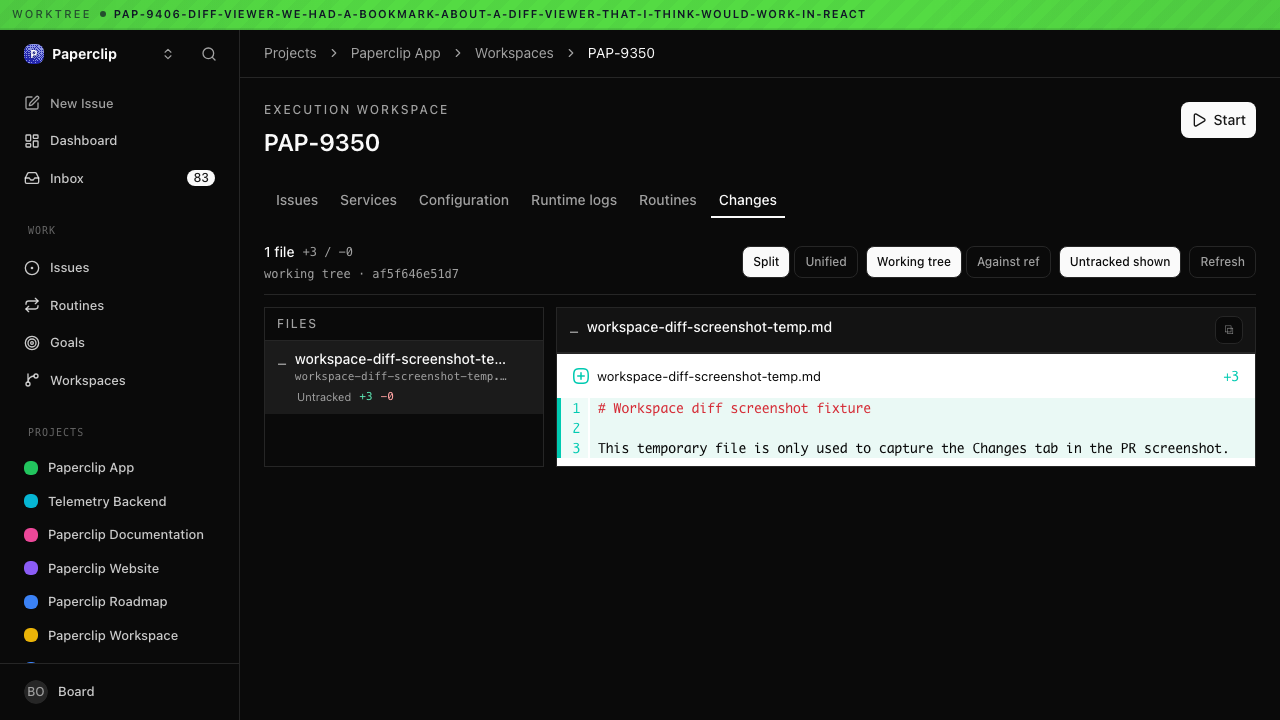
[codex] Add workspace diff viewer plugin (#6071)
## Thinking Path > - Paperclip orchestrates AI agents for zero-human companies. > - Operators need to inspect what agents changed inside execution and project workspaces. > - The existing workspace detail views did not provide a first-party rich diff surface for staged, unstaged, head, renamed, binary, oversized, and untracked changes. > - The plugin system is the intended extension point for optional rich UI surfaces. > - This pull request adds a workspace diff plugin plus host services and shared contracts so Changes tabs can render workspace diffs through plugin slots. > - The diff-renderer dependency should stay owned by the plugin package rather than the core UI app. > - The dependency surface must stay aligned with repository PR policy, including intentionally omitting `pnpm-lock.yaml` from the PR. > - The benefit is a more reviewable workspace surface without hard-coding the renderer into every page. ## What Changed - Added `@paperclipai/plugin-workspace-diff`, including diff normalization, plugin manifest/worker/UI entrypoints, and focused plugin tests. - Kept `@pierre/diffs` scoped to `@paperclipai/plugin-workspace-diff`; removed the core UI lab diff-renderer surface and direct UI package dependency. - Added shared workspace diff types and validators, plus plugin SDK surface for workspace diff host services. - Added server workspace diff service support and route coverage for execution/project workspace diff flows. - Wired Execution Workspace and Project Workspace Changes tabs to load the diff plugin, including loading/error fallback behavior. - Added UI tests and fixtures for the Changes tabs and plugin bridge behavior. - Added the new plugin package manifest to the Docker deps stage so PR policy can validate dependency coverage. - Addressed review hardening around empty untracked patches, workspace path exposure, project workspace read capability checks, and default base refs. ## Verification - `pnpm --filter @paperclipai/plugin-workspace-diff test` - `pnpm exec vitest run packages/shared/src/validators/workspace-diff.test.ts server/src/__tests__/workspace-diff-service.test.ts ui/src/pages/ProjectWorkspaceDetail.test.tsx ui/src/pages/ExecutionWorkspaceDetail.test.tsx` - `pnpm exec vitest run ui/src/plugins/bridge.test.ts server/src/__tests__/workspace-runtime-routes-authz.test.ts` - `pnpm --filter @paperclipai/shared typecheck` - `pnpm --filter @paperclipai/plugin-workspace-diff typecheck` - `pnpm --filter @paperclipai/server typecheck` - `pnpm --filter @paperclipai/ui typecheck` - `node ./scripts/check-docker-deps-stage.mjs` - Browser screenshot captured from the local worktree dev server: https://files.catbox.moe/ofdpsp.png - Confirmed branch is rebased onto `public-gh/master`, `.github/workflows/pr.yml` is not included in the PR diff, `ui/package.json` is not included in the PR diff, and `pnpm-lock.yaml` is not included in the PR diff. ## Risks - Medium UI integration risk: the Changes tab depends on the plugin slot and host diff service path. - Medium dependency risk: this adds `@pierre/diffs` in the plugin package, but `pnpm-lock.yaml` is intentionally omitted per packaging instructions because repository automation manages lockfile updates. - Current CI blocker: downstream frozen installs fail until the repository policy path for new plugin package dependencies is chosen. - Diff rendering edge cases are covered for common working-tree and head diff states, but very large repositories may still expose performance limits. - No migrations are included. > For core feature work, check [`ROADMAP.md`](ROADMAP.md) first and discuss it in `#dev` before opening the PR. Feature PRs that overlap with planned core work may need to be redirected — check the roadmap first. See `CONTRIBUTING.md`. ## Model Used - OpenAI Codex, GPT-5 class coding model, tool-enabled local execution environment. Exact context window was not exposed by the runtime. ## Checklist - [x] I have included a thinking path that traces from project context to this change - [x] I have specified the model used (with version and capability details) - [x] I have checked ROADMAP.md and confirmed this PR does not duplicate planned core work - [x] I have run tests locally and they pass - [x] I have added or updated tests where applicable - [x] If this change affects the UI, I have included before/after screenshots - [x] I have updated relevant documentation to reflect my changes - [x] I have considered and documented any risks above - [x] I will address all Greptile and reviewer comments before requesting merge --------- Co-authored-by: Paperclip <noreply@paperclip.ing> |
||
|
Dotta
|
7bbdfb69df |
[codex] Enable Grok adapter canary publishing (#6154)
## Thinking Path > - Paperclip publishes its CLI, server, UI, and adapter packages through the shared release workflow. > - Canary releases are driven by the GitHub release workflow on pushes to `master`. > - The release workflow does not publish every public package automatically; it uses `scripts/release-package-manifest.json` as the CI enrollment source of truth. > - The Grok adapter is public and already present in the manifest, but its `publishFromCi` flag was still disabled. > - Because of that flag, normal canary publishes skipped `@paperclipai/adapter-grok-local` even when the main package received a canary. > - This pull request enables Grok in the release manifest so future canary runs include it. > - The benefit is that Grok adapter canaries stay aligned with the rest of the package release set. ## What Changed - Set `packages/adapters/grok-local` / `@paperclipai/adapter-grok-local` to `publishFromCi: true` in `scripts/release-package-manifest.json`. ## Verification - `node ./scripts/release-package-map.mjs check` - `node ./scripts/release-package-map.mjs list | grep '@paperclipai/adapter-grok-local'` - `pnpm test:release-registry` ## Risks - Low risk: this is a release manifest-only change. - Future canary releases will attempt to publish `@paperclipai/adapter-grok-local`; this assumes the package remains publishable and trusted publishing/package access are correctly configured for the existing npm package. > For core feature work, check [`ROADMAP.md`](ROADMAP.md) first and discuss it in `#dev` before opening the PR. Feature PRs that overlap with planned core work may need to be redirected — check the roadmap first. See `CONTRIBUTING.md`. ## Model Used - OpenAI Codex, GPT-5-based coding agent with shell, git, and GitHub tool use. ## Checklist - [x] I have included a thinking path that traces from project context to this change - [x] I have specified the model used (with version and capability details) - [x] I have checked ROADMAP.md and confirmed this PR does not duplicate planned core work - [x] I have run tests locally and they pass - [x] I have added or updated tests where applicable - [x] If this change affects the UI, I have included before/after screenshots - [x] I have updated relevant documentation to reflect my changes - [x] I have considered and documented any risks above - [x] I will address all Greptile and reviewer comments before requesting merge Co-authored-by: Paperclip <noreply@paperclip.ing> |
||
|
Devin Foley
|
ab8b471685 |
Add built-in grok_local adapter (#6087)
## Thinking Path > - Paperclip orchestrates AI agents for zero-human companies, so adapter quality directly affects what runtimes the control plane can supervise. > - Local CLI adapters are one of the core execution surfaces because they turn real coding tools into Paperclip-managed employees with heartbeats, transcripts, and reviewability. > - Grok Build was installed on the Paperclip host, but Paperclip had no built-in `grok_local` adapter, so the runtime could not be configured through the normal server/UI/CLI adapter path. > - That gap needed to be closed with the same built-in registry, environment diagnostics, transcript parsing, and skill/instructions behavior that the other local adapters already rely on. > - After the initial adapter landed, a real follow-up run showed that Grok streaming text was being rendered one fragment per line, which made transcripts harder to read even though the runtime itself was working. > - This pull request adds the built-in `grok_local` adapter end-to-end and then fixes the transcript parser so streamed Grok output is coalesced into readable assistant/thinking blocks. > - The benefit is that Grok Build becomes a first-class Paperclip runtime with a usable operator experience instead of a partially wired runtime with noisy transcript output. ## What Changed - Added a new built-in `@paperclipai/adapter-grok-local` package with server, UI, and CLI entrypoints. - Implemented Grok execution, session handling, environment diagnostics, config building, skill syncing, and parser coverage inside the new adapter package. - Registered `grok_local` across the built-in adapter inventories and capability/display metadata in server, UI, CLI, and shared constants. - Added adapter route coverage for the new built-in type. - Fixed Grok transcript readability by emitting streamed `text` and `thought` fragments as deltas so the shared transcript builder coalesces them into readable message blocks. - Added regression tests for the Grok parser and transcript coalescing behavior. ## Verification - `pnpm vitest run packages/adapters/grok-local/src/ui/parse-stdout.test.ts ui/src/adapters/transcript.test.ts` - `pnpm --filter @paperclipai/adapter-grok-local build` - Manual runtime verification on the Paperclip host during implementation and follow-up review: - confirmed the Grok CLI was installed and authenticated - confirmed the worktree dev server could be restarted cleanly and health-checked after the parser follow-up - No screenshots attached. This change is primarily adapter plumbing plus transcript formatting behavior; reviewers can verify via the Grok-backed run surfaces directly. ## Risks - This adds a new built-in adapter, so any missed registration surface could create inconsistencies between server, UI, and CLI behavior. - The adapter depends on Grok Build's current event/output shape; if upstream Grok streaming JSON changes, transcript parsing or session extraction may need follow-up updates. - The transcript readability fix intentionally changes how Grok fragments are grouped, so any downstream code that implicitly expected one entry per fragment would behave differently. > For core feature work, check [`ROADMAP.md`](ROADMAP.md) first and discuss it in `#dev` before opening the PR. Feature PRs that overlap with planned core work may need to be redirected — check the roadmap first. See `CONTRIBUTING.md`. ## Model Used - OpenAI Codex via Paperclip `codex_local` agent runtime. - GPT-5-class coding model with tool use, shell execution, file editing, and repo inspection enabled. - Exact backend model ID/context window were not surfaced to the agent in this Paperclip session. ## Checklist - [x] I have included a thinking path that traces from project context to this change - [x] I have specified the model used (with version and capability details) - [x] I have checked ROADMAP.md and confirmed this PR does not duplicate planned core work - [x] I have run tests locally and they pass - [x] I have added or updated tests where applicable - [ ] If this change affects the UI, I have included before/after screenshots - [ ] I have updated relevant documentation to reflect my changes - [x] I have considered and documented any risks above - [x] I will address all Greptile and reviewer comments before requesting merge |
||
|
Devin Foley
|
eaa80cf88b |
Enable CI publishing for cursor-cloud, cloudflare, and exe.dev release packages (#5728)
## Thinking Path > - Paperclip orchestrates AI agents, and its release flow depends on explicit package enrollment for automated publishing. > - The release registry tooling uses `scripts/release-package-manifest.json` as the source of truth for which public packages CI is allowed to publish. > - The cursor cloud adapter plus the Cloudflare and exe.dev sandbox plugins are public packages that now need to ship through the normal CI release path. > - Leaving those entries at `publishFromCi: false` keeps release automation and registry validation out of sync with the intended package set. > - This pull request updates only those three manifest entries and leaves the release tooling itself unchanged. > - The benefit is that CI release enrollment now matches the packages we intend to publish, with the existing manifest checks continuing to guard correctness. ## What Changed - Enabled CI publishing for `@paperclipai/adapter-cursor-cloud` in `scripts/release-package-manifest.json`. - Enabled CI publishing for `@paperclipai/plugin-cloudflare-sandbox` in `scripts/release-package-manifest.json`. - Enabled CI publishing for `@paperclipai/plugin-exe-dev` in `scripts/release-package-manifest.json`. ## Verification - `node ./scripts/release-package-map.mjs check` - `pnpm test:release-registry` ## Risks - Low risk. This is a manifest-only change, but a wrong enrollment flag would affect release automation, so the release-registry checks are the main guardrail. ## Model Used - OpenAI GPT-5.4 via Paperclip `codex_local` (`adapterConfig.model: gpt-5.4`), high reasoning effort, with tool use and shell/code execution. The adapter does not expose a separate context-window value in this environment. ## Checklist - [x] I have included a thinking path that traces from project context to this change - [x] I have specified the model used (with version and capability details) - [x] I have checked ROADMAP.md and confirmed this PR does not duplicate planned core work - [x] I have run tests locally and they pass - [x] I have added or updated tests where applicable - [x] If this change affects the UI, I have included before/after screenshots - [x] I have updated relevant documentation to reflect my changes - [x] I have considered and documented any risks above - [x] I will address all Greptile and reviewer comments before requesting merge |
||
|
Devin Foley
|
5a64cf52a1 |
Add exe.dev sandbox provider plugin (#5688)
> _Stacked on top of #5685 → #5686 → #5687. Diff against master includes commits from earlier PRs in the stack — review focuses on the two new commits (`Add long-secret textarea variant to JsonSchemaForm SecretField` + `Add exe.dev sandbox provider plugin`)._ ## Thinking Path > - Paperclip orchestrates AI agents for zero-human companies > - Each agent runs in a sandbox environment, and operators choose the provider — today E2B, Daytona, and (in this stack) Cloudflare > - exe.dev offers per-VM sandboxes via a small CLI / HTTP API — useful for operators who want full Linux VMs (vs container/runtime-only sandboxes) > - The plugin shape mirrors the e2b plugin: lifecycle hooks (`new`, `ls`, `rm`) drive exe.dev's CLI; SSH plumbing handles direct VM access for adapters that need it > - exe.dev VMs come up bare — `node` is not preinstalled, so the Paperclip sandbox callback bridge (a Node script) needs Node 20 installed at VM init via `--setup-script`. The plugin defaults the setup script to a Nodesource install > - The auth field accepts long SSH private keys, which need a textarea variant of the existing `SecretField` in `JsonSchemaForm` — added behind a `maxLength > THRESHOLD` opt-in so other secret fields are unaffected > - The benefit is that operators get exe.dev as a fully working sandbox provider out of the box, with no manual VM provisioning required ## What Changed **Shared UI support (`Add long-secret textarea variant to JsonSchemaForm SecretField`):** - `ui/src/components/JsonSchemaForm.tsx` + new `JsonSchemaForm.test.tsx`: when a secret-formatted field declares `maxLength` larger than the existing single-line threshold, render a monospace textarea instead of the masked input. Short secrets (API keys, tokens) keep the existing masked-input + show/hide toggle behavior. **The exe.dev plugin (`Add exe.dev sandbox provider plugin`):** - `packages/plugins/sandbox-providers/exe-dev/`: plugin entry, manifest, plugin runtime, README, and 19-test Vitest suite. - Manifest fields: API token (with `secret-ref` + `/exec` permission notes — needs `new`, `ls`, `rm`), API URL override, optional SSH username, optional SSH private key (uses the new `JsonSchemaForm` textarea variant via `maxLength: 4096`), optional SSH identity-file path, optional setup script. - Default `--setup-script` is a Nodesource Node 20 install. exe.dev VMs come up bare and the Paperclip sandbox callback bridge is a Node script, so without Node preinstalled the bridge can't start. Operators can override by supplying their own setup script. - `runLifecycleCommand` redacts env values from the executed command before surfacing it in error messages, so secrets passed via `--env=KEY=VALUE` don't leak into operator-visible failures. - The plugin distinguishes exe.dev's SSH onboarding failures (`Please complete registration by running: ssh exe.dev`) from general SSH failures and surfaces a clear remediation message. - `scripts/release-package-manifest.json`: register the new plugin for CI publish alongside the existing daytona / e2b providers. ## Verification - `pnpm typecheck` - `pnpm exec vitest run --no-coverage ui/src/components/JsonSchemaForm.test.tsx` - `(cd packages/plugins/sandbox-providers/exe-dev && pnpm test)` — 19 passing For an operator-side smoke test: 1. Get an exe.dev API token with `/exec` permission for `new`, `ls`, `rm`. 2. Register the plugin in your Paperclip instance, configure an environment with the token. 3. Create a sandbox env whose provider is `exe-dev`, then run a Codex or Claude job against it. The default Node 20 setup script should bring the VM up automatically. ## Risks - Adds a new sandbox provider plugin that follows the existing daytona / e2b shape; behavior on existing providers is unchanged. - The `JsonSchemaForm` textarea variant only engages for fields that opt in via `maxLength` larger than the existing threshold. All existing secret fields (which don't declare a `maxLength`) keep their current rendering. Test coverage pins both paths. - The redaction in `runLifecycleCommand` is a defense-in-depth measure; the test suite exercises the redaction path. If the redaction misses a future env-arg shape, the worst case is restored behavior (secrets in error messages), which is what the existing daytona / e2b plugins also do today. - Default setup script downloads from `deb.nodesource.com` over HTTPS at VM init. Operators on air-gapped networks or with a different package strategy can override the setup script. ## Model Used - Provider: Anthropic - Model: Claude Opus 4.7 (1M context) - Capabilities used: extended reasoning, tool use (Read/Edit/Bash/Grep) ## Checklist - [x] I have included a thinking path that traces from project context to this change - [x] I have specified the model used (with version and capability details) - [x] I have checked ROADMAP.md and confirmed this PR does not duplicate planned core work - [x] I have run tests locally and they pass - [x] I have added or updated tests where applicable - [ ] If this change affects the UI, I have included before/after screenshots — UI change is a textarea variant of an existing secret field; will attach screenshots before requesting merge - [x] I have updated relevant documentation to reflect my changes (plugin README, manifest descriptions) - [x] I have considered and documented any risks above - [x] I will address all Greptile and reviewer comments before requesting merge --------- Co-authored-by: Paperclip <noreply@paperclip.ing> |
||
|
Devin Foley
|
486fb88a15 |
Add Cloudflare sandbox provider plugin (#5687)
> _Stacked on top of #5685 → #5686. Diff against master includes commits from earlier PRs in the stack — review focuses on the two new commits (`Extend sandbox callback bridge for Worker-hosted plugins` + `Add Cloudflare sandbox provider plugin`)._ ## Thinking Path > - Paperclip orchestrates AI agents for zero-human companies > - Each agent runs in a sandbox environment, and operators choose which provider backs that sandbox — today E2B and Daytona are bundled with the platform > - Cloudflare Workers + Durable Objects + the Sandbox SDK offer a credible new option: globally distributed, cheap idle, and operator-deployable as a single Worker > - To plug it in, Paperclip needs (a) a provider plugin that speaks the `PaperclipPluginManifestV1` lifecycle and (b) a small operator-deployed Worker — the **bridge** — that adapts Paperclip's runtime RPCs to the Cloudflare Sandbox SDK > - The plugin extends the existing sandbox-callback-bridge with a `bridge.transport: "worker"` discriminator so the platform routes runtime RPCs through the Worker bridge instead of the in-process runner > - This pull request adds the plugin, the bridge Worker template, and the supporting adapter-utils + server hooks the new transport needs > - The benefit is that operators can run sandboxes on Cloudflare's edge with no new platform code beyond installing the plugin and deploying the Worker ## What Changed **Shared support (`Extend sandbox callback bridge for Worker-hosted plugins`):** - `packages/adapter-utils/src/sandbox-callback-bridge.{ts,test.ts}`: expose `expectedHostHeader` so plugin-side bridge clients can verify the canonical request envelope before forwarding. - `packages/adapter-utils/src/command-managed-runtime.{ts,test.ts}`: relax the always-fresh runner construction so callers can re-use a runner across exec calls (Worker-hosted bridges hold the runner inside a Durable Object). - `server/src/services/environment-runtime.ts` + `environment-runtime.test.ts`: route Worker-hosted bridges through the same env-shaping path as E2B and pin the `requestEnv` contract. - `server/src/services/plugin-environment-driver.ts`: thread an optional `issueId` through the runtime descriptor so bridges can scope leases to the originating issue (used by Cloudflare to map a sandbox to the issue/workflow for billing and audit). - `packages/plugins/sdk/src/protocol.ts`: add `issueId?` to `PluginEnvironmentDriverBaseParams` and the new `bridge.transport: "worker"` discriminator that the new plugin declares. - `server/__tests__/heartbeat-plugin-environment.test.ts`: pin the heartbeat path against the new runtime descriptor. **The Cloudflare plugin itself (`Add Cloudflare sandbox provider plugin`):** - `packages/plugins/sandbox-providers/cloudflare/`: plugin entry, manifest, plugin runtime (lifecycle + bridge client), config parsing, and Vitest coverage. Manifest declares `bridge.transport: "worker"` so the platform routes runtime RPCs through the bridge client. - `bridge-template/`: a Worker template the operator deploys with `wrangler`. Owns Durable Object-backed sessions (`sessions.ts`), exec/stream routes (`exec.ts`, `routes.ts`), and an HMAC auth layer (`auth.ts`) that pins the `Host` header surface. Includes the SDK-contract-correct exec implementation, lease recovery, and chunked stdout/stderr streaming. - Tests cover lease/session handoff (`bridge-template/src/exec.test.ts`, `routes.test.ts`), bridge client request shaping (`src/bridge-client.test.ts`), and end-to-end plugin behavior (`src/plugin.test.ts`) including streamed exec output. 27 tests in total. - `README.md` walks the operator through deploying the bridge Worker, registering the plugin, and configuring the runtime. ## Verification - `pnpm typecheck` - `pnpm exec vitest run --no-coverage packages/adapter-utils/src/sandbox-callback-bridge.test.ts packages/adapter-utils/src/command-managed-runtime.test.ts server/src/__tests__/environment-runtime.test.ts server/src/__tests__/heartbeat-plugin-environment.test.ts` - `(cd packages/plugins/sandbox-providers/cloudflare && pnpm test)` — 27 passing For an operator-side smoke test: 1. Deploy the bridge: `cd packages/plugins/sandbox-providers/cloudflare/bridge-template && wrangler deploy` 2. Register the plugin in your Paperclip instance, point its bridge URL at the deployed Worker, set the HMAC shared secret. 3. Create a sandbox environment whose provider is `cloudflare`, then run a Codex or Claude job against it. ## Risks - Adds a new `bridge.transport: "worker"` code path, but the existing E2B / Daytona transports go through the same shaped helpers and have explicit test coverage that pins their behavior unchanged. - The Worker bridge stores session state in a Durable Object; operator instances must be aware of the corresponding Cloudflare costs (DO requests, storage). Documented in the README. - The `issueId` plumbing is optional throughout — existing plugins that don't supply it continue to work. ## Model Used - Provider: Anthropic - Model: Claude Opus 4.7 (1M context) - Capabilities used: extended reasoning, tool use (Read/Edit/Bash/Grep) ## Checklist - [x] I have included a thinking path that traces from project context to this change - [x] I have specified the model used (with version and capability details) - [x] I have checked ROADMAP.md and confirmed this PR does not duplicate planned core work - [x] I have run tests locally and they pass - [x] I have added or updated tests where applicable - [ ] If this change affects the UI, I have included before/after screenshots — N/A, no UI change - [x] I have updated relevant documentation to reflect my changes (plugin README, bridge-template README) - [x] I have considered and documented any risks above - [x] I will address all Greptile and reviewer comments before requesting merge --------- Co-authored-by: Paperclip <noreply@paperclip.ing> |
||
|
Devin Foley
|
534aee66ae |
Add cursor_cloud adapter for Cursor SDK + Cloud Agents API v1 (#5664)
## Thinking Path

> - Paperclip orchestrates AI agents for zero-human companies
> - There are many adapter types, one per agent-runtime product (Claude,
Codex, OpenCode, Cursor local CLI, etc.)
> - Cursor shipped a public TypeScript SDK on 2026-04-29 that exposes
Cursor's full hosted-agent platform (cloud VMs, harness, MCP, skills,
hooks)
> - Paperclip had no first-class adapter for this — agents that wanted
to use Cursor's managed cloud runtime had to fall back to the local CLI
adapter, which loses the cloud session, streaming, and durable run model
> - This PR adds a new `cursor_cloud` adapter built directly on
`@cursor/sdk`, with Paperclip's heartbeat mapped to Cursor's
durable-agent + per-run model
> - The benefit is that any Paperclip agent can now drive a Cursor cloud
agent across heartbeats with native session reuse, streaming, and
cancellation, while Paperclip remains the source of truth for issue/task
state

## What Changed

- New built-in adapter package `packages/adapters/cursor-cloud` (15
files, ~1.7k LOC) backed by `@cursor/sdk` ^1.0.12
- `src/server/execute.ts` — SDK-first lifecycle: `Agent.create` /
`Agent.resume` / `Agent.getRun` / `agent.send` / `run.stream` /
`run.wait`, with session reuse keyed on the (runtime env type, env name,
repo set) tuple
- `src/server/session.ts` — codec for `cursorAgentId` + `latestRunId` +
repo metadata, persisted in `runtime.sessionParams`
- `src/server/test.ts` — environment probe via `Cursor.me()` and
optional model validation via `Cursor.models.list()`
- `src/ui/parse-stdout.ts` + `src/cli/format-event.ts` — normalize
Cursor SDK message types (`status`, `thinking`, `assistant`, `user`,
`tool_call`, `tool_result`, `result`) into Paperclip transcript events
for the UI and CLI
- Registrations: `packages/shared/src/constants.ts`,
`packages/adapter-utils/src/session-compaction.ts`,
`server/src/adapters/{registry,builtin-adapter-types}.ts`,
`ui/src/adapters/{registry,adapter-display-registry}.ts` +
`ui/src/adapters/cursor-cloud/index.ts`, `cli/src/adapters/registry.ts`,
plus workspace deps in `cli`/`server`/`ui` `package.json`
- `ui/src/components/AgentConfigForm.tsx` — hide local-Cursor
`mode`/thinking-effort field for `cursor_cloud` (different config
surface)
- 11 vitest tests covering execute paths (fresh create, matching-resume,
active-run reattach, non-finished result), session codec round-trip,
transcript parsing, and config building

## Verification

Reviewer steps:

```bash
pnpm install
pnpm --filter @paperclipai/adapter-cursor-cloud typecheck   # → clean
pnpm vitest run packages/adapters/cursor-cloud              # → 11/11 passing
```

End-to-end check against a real Cursor cloud agent (requires
`CURSOR_API_KEY` and Cursor GitHub-app install on the target repo):

1. Create a `cursor_cloud` agent in Paperclip with `repoUrl` set to the
test repo, `repoStartingRef: main`, and `env.CURSOR_API_KEY` set
2. Trigger a heartbeat → adapter calls `Agent.create({ cloud: { env: {
type: "cloud" }, repos: [...] } })`, streams events, terminates on
`finished`
3. Trigger a second heartbeat → adapter calls `Agent.resume` or
`agent.send` follow-up depending on prior-run state, reusing
`cursorAgentId`
4. The Paperclip UI/CLI transcript reflects Cursor `status` / `thinking`
/ `assistant` events as they stream
5. Cancellation from Paperclip maps to `run.cancel()` or Cloud API v1
`cancelRun` for cross-heartbeat cancellation

A direct-SDK smoke run against a real repo (devinfoley/my_test_project @
main) confirmed: `Cursor.me()` ok → `Agent.create` → `agent.send` →
`run.stream()` (30 events) → terminal status `finished` in ~11s.

## Risks

- **New adapter, additive only.** No existing adapter or registry is
replaced; current `cursor` local-CLI adapter is untouched. Default
behavior of any existing agent is unchanged.
- **External dependency on `@cursor/sdk`.** Cursor's SDK is v1.0.x and
may evolve. Mocked unit tests cover the public surface used here; if the
SDK breaks compatibility we update the adapter independently.
- **Cost/budget.** `cursor_cloud` runs on Cursor's billed cloud VMs;
operators must understand they are spending money outside Paperclip's
budget controls when they enable this adapter. Same shape as other
API-billed adapters.
- **No webhook support in V1.** The SDK already provides
stream/wait/cancel/reattach, so V1 does not require a public callback
URL. If a future use case needs out-of-band wakes, we add a Cloud API v1
webhook bridge as a separate change. This is called out in the issue
plan document.
- **Lockfile.** Per repo policy, `pnpm-lock.yaml` is intentionally not
in this PR — CI's lockfile workflow will update it on merge given the
manifest changes.

## Model Used

- Provider: Anthropic Claude (via Claude Code / Paperclip `claude_local`
adapter)
- Model: `claude-opus-4-7` (Claude Opus 4.7), knowledge cutoff January
2026
- Mode: standard tool-use with extended reasoning
- Context: ~200k token window
- Capabilities used: code generation, multi-file edits, shell/test
execution, GitHub PR workflow

## Checklist

- [x] I have included a thinking path that traces from project context
to this change
- [x] I have specified the model used (with version and capability
details)
- [x] I have checked ROADMAP.md and confirmed this PR does not duplicate
planned core work
- [x] I have run tests locally and they pass (11/11 in
`packages/adapters/cursor-cloud`)
- [x] I have added or updated tests where applicable (4 new test files,
11 cases)
- [ ] If this change affects the UI, I have included before/after
screenshots (the only UI change is hiding the local-Cursor mode field on
the `cursor_cloud` adapter — happy to attach a screenshot if the
reviewer wants one)
- [x] I have updated relevant documentation to reflect my changes (issue
plan document supersedes the pre-SDK design; tracked in PAPA-203)
- [x] I have considered and documented any risks above
- [x] I will address all Greptile and reviewer comments before
requesting merge

---------

Co-authored-by: Paperclip <noreply@paperclip.ing>
|
||
|
Devin Foley
|
433dfed33d |
Enable CI publish for plugin-daytona (#5586)
## Thinking Path > - Paperclip orchestrates AI agents for zero-human companies > - The release pipeline gates new public packages behind a bootstrap policy: `scripts/check-release-package-bootstrap.mjs` requires every package marked `publishFromCi: true` in `scripts/release-package-manifest.json` to already exist on npm > - PR #5580 added the new Daytona sandbox provider plugin but had to land with `publishFromCi: false` because the package had never been published, so CI's release plan would have failed bootstrap validation otherwise > - Now that `@paperclipai/plugin-daytona` has been bootstrap-published to npm by hand, the temporary `false` flag is the only thing keeping it out of the standard CI publish flow > - This pull request flips the Daytona entry to `publishFromCi: true`, matching every other release-enabled package in the manifest > - The benefit is that future tagged releases will publish the Daytona plugin automatically alongside the rest of the monorepo's public packages ## What Changed - Single-line flip in `scripts/release-package-manifest.json`: `@paperclipai/plugin-daytona` is now `publishFromCi: true` ## Verification - `node ./scripts/release-package-map.mjs check` → `Release package manifest OK: 19 enabled for CI publish, 0 disabled pending bootstrap` (was 18 + 1) - `node ./scripts/check-release-package-bootstrap.mjs scripts/release-package-manifest.json` against `origin/master` → `Release bootstrap OK for changed manifests: @paperclipai/plugin-daytona`, confirming npm sees the bootstrap-published package - No code changes; no tests required beyond the existing manifest validators ## Risks - Low risk. Only effect is that the next release run will include `@paperclipai/plugin-daytona` in its publish set - If the npm bootstrap was incomplete, CI's bootstrap check will fail loudly before any release tag goes out — same safety net the policy is designed to provide ## Model Used - Claude Opus 4.7 (`claude-opus-4-7`), extended thinking, tool use enabled ## Checklist - [x] I have included a thinking path that traces from project context to this change - [x] I have specified the model used (with version and capability details) - [x] I have checked ROADMAP.md and confirmed this PR does not duplicate planned core work - [x] I have run tests locally and they pass - [ ] I have added or updated tests where applicable (N/A — manifest-only flag flip, covered by existing validators) - [ ] If this change affects the UI, I have included before/after screenshots (N/A — release config) - [x] I have updated relevant documentation to reflect my changes - [x] I have considered and documented any risks above - [x] I will address all Greptile and reviewer comments before requesting merge Co-authored-by: Paperclip <noreply@paperclip.ing> |
||
|
Devin Foley
|
06e6ee25cd |
Add Daytona sandbox provider plugin (#5580)
## Thinking Path > - Paperclip orchestrates AI agents for zero-human companies > - Agents need isolated sandbox environments to execute work safely; Paperclip already supports E2B as a sandbox provider plugin > - Users want to use Daytona (https://www.daytona.io/) as an alternative sandbox backend, but no plugin existed for it > - Without a Daytona plugin, teams that prefer Daytona's pricing/regions/runtime can't run Paperclip agents on it > - This pull request adds a `@paperclip/sandbox-provider-daytona` plugin that mirrors the existing E2B plugin shape and wires up Daytona's `@daytonaio/sdk` for sandbox lifecycle, command execution, and shell detection > - The benefit is that operators can pick Daytona as a first-class sandbox provider without touching core code, broadening Paperclip's runtime options ## What Changed - New plugin package `packages/plugins/sandbox-providers/daytona` with manifest, worker entry, and provider implementation backed by `@daytonaio/sdk` - Implements sandbox create/destroy/exec/upload/download lifecycle, shell command detection, and config/env wiring consistent with the E2B plugin - Adds unit tests under `src/plugin.test.ts` and a README documenting setup and the `DAYTONA_API_KEY` requirement - Minor adjustments in `scripts/paperclip-issue-update.sh`, `packages/shared/src/issue-thread-interactions.test.ts`, and `packages/shared/src/validators/issue.ts` to support the integration ## Verification - Re-ran the full sandbox provider matrix on the QA Paperclip instance using Daytona as the runtime — all 6 adapters executed inside the Daytona sandbox with zero `environmentExecute` timeouts - 5/6 adapters pass cleanly (or with informational warns); the only failure is `codex_local`, which is an OpenAI quota/billing issue unrelated to Daytona - `pnpm --filter @paperclip/sandbox-provider-daytona test` runs the plugin unit tests ## Risks - New optional plugin; no behavior change for users who don't enable it - Requires `DAYTONA_API_KEY` for runtime use — documented in the plugin README - Daytona SDK is a new external dependency; tracked in the plugin's own package.json so it doesn't affect the core install footprint ## Model Used - Claude Opus 4.7 (`claude-opus-4-7`), extended thinking, tool use enabled ## Checklist - [x] I have included a thinking path that traces from project context to this change - [x] I have specified the model used (with version and capability details) - [x] I have checked ROADMAP.md and confirmed this PR does not duplicate planned core work - [x] I have run tests locally and they pass - [x] I have added or updated tests where applicable - [ ] If this change affects the UI, I have included before/after screenshots (N/A — backend plugin) - [x] I have updated relevant documentation to reflect my changes - [x] I have considered and documented any risks above - [x] I will address all Greptile and reviewer comments before requesting merge --------- Co-authored-by: Paperclip <noreply@paperclip.ing> |
||
|
Devin Foley
|
29401b231b |
fix(ci): gate new release packages on npm bootstrap (#5146)
## Thinking Path > - Paperclip is a control plane for autonomous agent companies, so its release automation is part of the core operator trust boundary. > - The affected subsystem is npm/GitHub Actions release publishing for the public monorepo packages. > - The concrete failure was that a newly added package reached `master`, the canary workflow attempted its first publish, and npm trusted publishing was not yet bootstrapped for that package. > - That means the problem is not just one broken run; it is a missing pre-merge guard that lets release-ineligible packages land and only fail once `publish_canary` runs. > - This pull request makes release enrollment explicit, validates that enrollment in CI, and adds a PR-time bootstrap check against npm for changed release-enabled package manifests. > - The result is that we keep trusted publishing, avoid teaching CI to `npm adduser`, and move this class of failure from post-merge canary time to pre-merge review time. ## What Changed - Added `scripts/release-package-manifest.json` so release-managed public packages are explicitly enrolled instead of being inferred from every non-private workspace package. - Hardened `scripts/release-package-map.mjs` to validate the manifest before release workflows rewrite versions or assemble publish payloads. - Added `scripts/check-release-package-bootstrap.mjs` and wired it into `.github/workflows/pr.yml` so PRs that change a release-enabled package manifest fail if that package does not already exist on npm. - Added release-package manifest coverage tests to `scripts/release-package-map.test.mjs` and included them in `pnpm run test:release-registry`. - Wired manifest validation into `.github/workflows/release.yml` and documented the first-publish bootstrap policy in `doc/PUBLISHING.md` and `doc/RELEASE-AUTOMATION-SETUP.md`. ## Verification - `pnpm run test:release-registry` - `./scripts/release.sh canary --skip-verify --dry-run` - Confirmed the committed diff contains no obvious PII/secrets via targeted pattern scan before pushing. ## Risks - Low risk overall: this is CI/release-policy code, not product runtime logic. - The new PR bootstrap check depends on npm metadata availability, so a transient npm outage could block a PR that changes a release-enabled package manifest. - The manifest introduces a new source of truth that must stay aligned with public package additions, but that is intentional and now enforced. ## Model Used - OpenAI Codex via the `codex_local` Paperclip adapter; GPT-5-based coding agent with tool use, terminal execution, git, and GitHub CLI. Exact served model ID/context window are not exposed by the local runtime. ## Checklist - [x] I have included a thinking path that traces from project context to this change - [x] I have specified the model used (with version and capability details) - [x] I have checked ROADMAP.md and confirmed this PR does not duplicate planned core work - [x] I have run tests locally and they pass - [x] I have added or updated tests where applicable - [x] If this change affects the UI, I have included before/after screenshots - [x] I have updated relevant documentation to reflect my changes - [x] I have considered and documented any risks above - [x] I will address all Greptile and reviewer comments before requesting merge |