07e98d2b2cf35d380cde5854c9f69b72d2b2617c
64 Commits
| Author | SHA1 | Message | Date | |
|---|---|---|---|---|
 Devin Foley Devin Foley
|
07e98d2b2c |
feat(adapter-utils): add observable sandbox sync progress (#8395)
## Thinking Path > - Paperclip is the control plane for running AI-agent companies, so long-running remote work needs to stay observable to human operators. > - Cloud / sandbox agents are an active roadmap area, and their workspace sync path is part of the runtime substrate every remote coding run depends on. > - In the sandbox and SSH execution-target flows, Paperclip logged that sync had started, then often went silent for the full transfer window. > - That made large remote syncs feel stalled and also hid a real performance problem in the command-managed sandbox upload path. > - The first part of this pull request threads a throttled progress-reporting surface through the adapter execution-target stack so sync and restore work can emit meaningful updates. > - The second part fixes the command-managed sandbox transport itself: it removes the old serial 32KB append bottleneck, but also falls back away from the single-stream path when a provider-backed sandbox runner cannot surface mid-flight stdin progress. > - The result is that sandbox and SSH transfers are both faster and more observable, including the live Daytona-style sandbox case that previously only emitted `0%` and `100%`. ## Linked Issues or Issue Description No public GitHub issue exists for this bug, so it is described inline below following the bug report template. ### What happened - Remote sandbox and SSH workspace syncs could spend a long time transferring data while only logging a start line (`Syncing workspace and runtime assets to sandbox environment`) and, at best, a terminal line. - In the command-managed sandbox path, the original upload implementation also paid a large performance cost by appending base64 data in many small sequential remote writes (thousands of serial 32KB round-trips on a large workspace). - After the initial transport rewrite, live provider-backed sandbox runs still only emitted `0%` and `100%` because the single-stream stdin RPC buffered progress until completion. ### Expected behavior - Long-running sandbox and SSH syncs should periodically report how much of the transfer is complete (a percentage and/or MB transferred) so an operator can tell the run is healthy and making progress rather than stuck. - The main sandbox upload path should not be artificially slow. - A transfer that fails partway should leave an explicit failure marker in the log rather than a dangling intermediate percentage. ### Steps to reproduce 1. Run an agent against a sandbox (command-managed) or SSH (remote-managed) execution target with a non-trivial workspace. 2. Watch the run log during the workspace/runtime asset sync phase. 3. Observe that the log shows the sync start line and then stays silent for the full transfer (live provider-backed sandbox runs only show `0%` then `100%`). ### Paperclip version or commit - Branch `PAPA-825-provide-status-updates-when-syncing-sandboxes` off `master`. ### Deployment mode - Self-hosted / local instance using sandbox (command-managed) and SSH (remote-managed) execution targets, including provider-backed sandbox runners. ## What Changed - Added shared throttled runtime progress reporting and threaded `onProgress` through the adapter execution-target surface and adapter `execute.ts` entrypoints. - Added sync and restore progress reporting for the command-managed sandbox path and the SSH/remote-managed path, including git import/export progress where totals are known. - Reworked command-managed sandbox transfer behavior so uploads use the faster single-stream path when appropriate, but fall back to chunked progress-emitting writes when the runner cannot expose mid-stream stdin progress. - Marked provider-backed environment sandbox runners as not supporting single-stream stdin progress so live sandbox runs emit meaningful intermediate updates instead of only `0%` and `100%`. - Emit an explicit terminal failure marker (`failed at NN% (x/y MB)`) when an SSH/tar transfer rejects, so a failed sync no longer leaves a dangling intermediate percentage in the log. - Run the SSH sync/restore size estimate (local directory walk / remote `du` probe) concurrently with the transfer instead of awaiting it before opening the pipe, so progress instrumentation no longer adds startup latency proportional to workspace file count. - Added and extended focused regression coverage for runtime progress throttling and the new failure marker, command-managed sandbox transfers, sandbox orchestration, SSH transfer progress, and environment execution-target wiring. ## Verification - `pnpm exec vitest run packages/adapter-utils/src/runtime-progress.test.ts packages/adapter-utils/src/ssh-fixture.test.ts packages/adapter-utils/src/command-managed-runtime.test.ts packages/adapter-utils/src/sandbox-managed-runtime.test.ts` - `pnpm exec vitest run packages/adapter-utils/src/command-managed-runtime.test.ts server/src/__tests__/environment-execution-target.test.ts` - `npx tsc --noEmit` for `packages/adapter-utils` ## Risks - The provider-backed sandbox fallback now prefers chunked command-managed writes when progress hooks are active, so small-to-medium uploads may trade some raw throughput for observable intermediate progress on runtimes that cannot surface true mid-stream stdin progress. - Progress percentages on tar-based transfers still depend on estimates in some cases, so operators may briefly see MB-only lines before the estimate resolves, then near-final clamping before the terminal `100%` line. - This PR changes shared execution-target behavior used by multiple adapters, so regressions would most likely appear in remote runtime setup/teardown flows rather than in a single adapter. ## Model Used - Initial implementation: OpenAI GPT-5.4 via Codex local agent (`codex_local`), high reasoning mode. - Observability follow-ups (failure marker, concurrent size estimate, added tests): Claude Opus 4.8 via Claude Code (`claude_local`). ## Checklist - [x] I have included a thinking path that traces from project context to this change - [x] I have specified the model used (with version and capability details) - [x] I have checked ROADMAP.md and confirmed this PR does not duplicate planned core work - [x] I have searched GitHub for duplicate or related PRs and linked them above - [x] I have either (a) linked existing issues with `Fixes: #` / `Closes #` / `Refs #` OR (b) described the issue in-PR following the relevant issue template - [x] I have not referenced internal/instance-local Paperclip issues or links (only public GitHub `#NNN` / `github.com/paperclipai/paperclip` URLs) - [x] I have run tests locally and they pass - [x] I have added or updated tests where applicable - [ ] If this change affects the UI, I have included before/after screenshots - [ ] I have updated relevant documentation to reflect my changes - [x] I have considered and documented any risks above - [ ] All Paperclip CI gates are green - [ ] Greptile is 5/5 with no open P2s, recommendations, or follow-ups - [ ] I will address all Greptile and reviewer comments before requesting merge --------- Co-authored-by: Paperclip <noreply@paperclip.ing> |
||
|
Jannes Stubbemann
|
9e750d3e92 |
feat(codex-local): env-driven gateway routing via PAPERCLIP_CODEX_PROVIDERS config.toml (#7919)
## Thinking Path > - Paperclip is the open source app people use to manage AI agents for work > - The `codex-local` adapter runs the OpenAI Codex CLI; Paperclip already maintains a managed `CODEX_HOME` per company and ships it to remote/sandboxed execution targets > - Deployments increasingly put an OpenAI-compatible LLM gateway between the harness and the model for cost, governance, or data-residency reasons: LiteLLM, OpenRouter, Portkey, Kong, a corporate proxy, self-hosted models (vLLM/Ollama), or region-pinned/sovereign endpoints. But Codex has no CLI flag or env var for a custom endpoint: its only mechanism is `[model_providers.<id>]` tables (with `base_url`, `env_key`, `wire_api`) in `$CODEX_HOME/config.toml`, selected by a root-level `model_provider` key > - Today there is no supported way to get such provider config into the managed `CODEX_HOME`, so gateway routing requires hand-editing files the adapter owns and regenerates > - This pull request adds the codex analogue of #7837's opencode mechanism: a `PAPERCLIP_CODEX_PROVIDERS` JSON env var whose shape maps 1:1 onto codex's TOML schema, merged into the managed `config.toml` so the existing asset-shipping + `env.CODEX_HOME` mechanics deliver it to local and sandboxed runs alike; nothing here is specific to one hosting setup > - The benefit is Codex works behind any OpenAI-compatible gateway with config only; with no env set, behavior is unchanged ## Linked Issues or Issue Description No existing issue; describing in-PR (feature / adapter enhancement). - **Gap:** there is no supported way to register a custom/gateway `[model_providers.*]` endpoint for `codex-local`. Codex's only custom-endpoint mechanism is `config.toml` (`base_url` + `env_key` + `wire_api`, selected via the root `model_provider` key), and the adapter owns/regenerates the managed `CODEX_HOME`, so operators cannot durably hand-edit it. - Related: #7837 (the opencode-local analogue of this change, same env-driven gateway-routing pattern). Searched for duplicate/related PRs: no existing codex-local gateway/provider-routing PR found. > Note on ROADMAP: this is adapter-level, opt-in config (defaults unchanged) that *enables* gateway routing for one harness; it is not the core "Cloud / Sandbox agents" platform work itself. ## What Changed - New `prepareCodexRuntimeConfig()` (`packages/adapters/codex-local/src/server/runtime-config.ts`): reads `PAPERCLIP_CODEX_PROVIDERS` (run env first, then `process.env`), shaped as `{"providers": {"<id>": {base_url, env_key, wire_api, ...}}, "model_provider": "<id>"}`, and merges it into the managed `CODEX_HOME`'s `config.toml`. No-op when unset or empty. - A malformed value (invalid JSON, not a JSON object, no `providers` object, no usable provider entries, or individual entries with empty names or non-object values, which are skipped by name) is never silently dropped: each case surfaces a distinct, user-visible note (via the prepare notes, which flow into command notes + `onLog`) and unusable input leaves `config.toml` untouched. - Merge is marker-delimited and TOML-correct: existing `config.toml` content is preserved between two managed blocks. Root keys (e.g. `model_provider`) are prepended **before the first table header** (TOML root-region rule), `[model_providers.*]` tables are appended. Pre-existing same-name provider sections and root `model_provider` keys are excised so the managed definitions win without duplicate-table parse errors. - `{env:VAR}` placeholders are expanded server-side for literal-credential fields; `env_key` indirection remains the preferred path. - Crash-safe restore: prepare writes a pre-run backup (`config.toml.paperclip-backup`) before the merged file; `cleanup()` restores the original in the execute `finally` and removes the backup. If a run never reaches `cleanup()` (a throw during the setup between prepare and execution, or SIGKILL), the next prepare restores the original from the backup with full fidelity, including user `[model_providers.*]` sections the merge excised (review feedback, P2); plain block-stripping remains the fallback for pre-backup state. - An explicit adapter-config `env.CODEX_HOME` override is treated as user-managed: no merge, surfaced as a command note. - Dependency-free hand-emitted TOML (strings/numbers/booleans, arrays of scalars, plain objects as inline tables); basic strings escape U+0000-U+001F and U+007F per TOML 1.0 (review feedback, P2). Merged output was additionally validated locally with python tomllib during development; the committed tests assert the structural invariants. - `execute.ts` wiring: `prepareCodexRuntimeConfig` runs after `prepareManagedCodexHome` (before the home ships to the remote target), notes surface via `onLog` + command notes, and the `finally` calls `cleanup()`. **Note for reviewers:** current codex removed `wire_api = "chat"` (openai/codex#10157, Feb 2026), so gateway provider configs must use `wire_api = "responses"`, i.e. the gateway must speak `/v1/responses`. The adapter passes the value through verbatim; this is a codex-side constraint worth knowing when configuring it. ## Verification - `pnpm --filter @paperclipai/adapter-codex-local build` and `typecheck`: tsc clean against current `master` - `pnpm exec vitest run packages/adapters/codex-local`: 45 passing (incl. 17 `runtime-config` tests: fresh-merge + cleanup restore, root-region placement, same-name provider override, inline tables/arrays, DEL escaping, `{env:}` expansion from run env + `process.env`, per-case malformed-input notes with `config.toml` untouched, skipped-entry notes alongside a successful merge, silent no-op when unset/empty, explicit-`CODEX_HOME` skip note, backup restore of excised user sections after an interrupted run, backup removal on cleanup, stale-block self-heal, re-run replacement) - Verified end-to-end: a codex agent in a hardened Kubernetes (gVisor) sandbox completed a real task routed through an OpenAI-compatible gateway's `/v1/responses`, with a billed usage row recorded on the gateway. That deployment supplies the verification evidence; the mechanism is gateway-agnostic. ## Risks Low. Entirely env-driven and opt-in; with `PAPERCLIP_CODEX_PROVIDERS` unset the adapter never touches `config.toml` and behavior is byte-identical to before. The merge preserves user content, restores the original file on cleanup, and survives interrupted runs via the pre-run backup; malformed input surfaces a visible note and is ignored without touching `config.toml`. No migration/UI impact. ## Model Used Claude Opus 4.8 (`claude-opus-4-8`, 1M context), extended thinking + tool use, via Claude Code. ## Checklist - [x] I have included a thinking path that traces from project context to this change - [x] I have specified the model used (with version and capability details) - [x] I have checked ROADMAP.md (adapter-level opt-in config enabling gateway routing; not the core sandbox-platform work, noted above) - [x] I have searched GitHub for duplicate or related PRs and linked them above (#7837 is the opencode analogue; no codex-local duplicate found) - [x] I have either (a) linked existing issues OR (b) described the issue in-PR following the relevant issue template - [x] I have run tests locally and they pass - [x] I have added or updated tests where applicable - [ ] If this change affects the UI, I have included before/after screenshots (n/a, no UI) - [ ] I have updated relevant documentation to reflect my changes (env var documented inline; no central doc references the adapter env yet) - [x] I have considered and documented any risks above - [x] All Paperclip CI gates are green (green on the previous head; re-running on the final note-copy polish commit) - [x] Greptile is 5/5 with no open P2s, recommendations, or follow-ups (both review P2s are fixed at head: the interrupted-run restore via the pre-run backup and the U+007F escaping; a re-review is requested for the note-copy polish) - [x] I will address all Greptile and reviewer comments before requesting merge 🤖 Generated with [Claude Code](https://claude.com/claude-code) --------- Co-authored-by: Claude Opus 4.8 (1M context) <noreply@anthropic.com> |
||
|
Devin Foley
|
b24c6909e8 |
Harden remote sandbox runtime probes, timeouts, and installs (#5685)
## Thinking Path > - Paperclip orchestrates AI agents for zero-human companies > - Each agent runs inside a sandbox environment so its CLI is isolated from the host > - Sandbox-backed adapter runs go through a small set of shared helpers — `ensureAdapterExecutionTargetCommandResolvable`, the sandbox callback bridge runner, and per-adapter `SANDBOX_INSTALL_COMMAND` strings > - When standing up new sandbox provider plugins, the existing helpers timed out, missed install fallbacks, or leaned on assumptions that only held for E2B > - Local adapters (`claude-local`, `codex-local`, `gemini-local`, `opencode-local`) needed slightly hardened probes so they could install themselves and validate inside *any* remote sandbox transport, not just E2B > - This pull request bundles those runtime fixes so future sandbox provider plugins inherit a working baseline > - The benefit is that adding a new sandbox provider plugin no longer requires touching adapter-utils or each local-adapter probe — the supporting infra is already correct ## What Changed - `packages/adapter-utils/src/execution-target.ts`: introduce `DEFAULT_REMOTE_SANDBOX_ADAPTER_TIMEOUT_SEC = 1800` and `resolveAdapterExecutionTargetTimeoutSec(...)`. Local and SSH adapters keep the historical "0 means no adapter timeout" behavior; sandbox-backed runs without an explicit `timeoutSec` get an explicit 30-minute default so remote installs and warm-up don't time out at the per-RPC default. Plumbed `timeoutSec` through `ensureAdapterExecutionTargetCommandResolvable` so install probes inside a sandbox honor adapter-level overrides instead of the bridge's 5-minute default. - `packages/adapters/opencode-local/src/index.ts`: switch `SANDBOX_INSTALL_COMMAND` from `npm install -g opencode-ai` to `curl -fsSL https://opencode.ai/install | bash`. The npm package reifies four large prebuilt-binary subpackages in parallel even though only one matches the host arch; on bandwidth-constrained sandboxes that blew through the 240s install budget. The official installer fetches one arch-specific binary and adds `$HOME/.opencode/bin` to PATH via `~/.bashrc`, which the sandbox-callback-bridge login-shell script already sources. - `packages/adapters/{claude,codex,gemini,opencode}-local/`: harden remote-target probes — pass `--skip-git-repo-check` for Codex when probing outside a repo, normalize permission flags for Claude, and add `*.remote.test.ts` coverage that exercises the remote-sandbox path explicitly for each adapter. - `packages/adapter-utils/src/sandbox-install-command.{ts,test.ts}` (new): add `buildSandboxNpmInstallCommand` helper. `server/src/adapters/registry.ts` + new `server/src/__tests__/adapter-registry.test.ts`: wire adapter install commands so they fall back to a writable `$HOME/.local` prefix when global install isn't available. - `server/src/__tests__/plugin-worker-manager.test.ts` + new `server/src/__tests__/fixtures/plugin-worker-delayed.cjs`: pin per-call timeout overrides so plugin worker exec calls honor the caller's timeout instead of the worker's default. ## Verification - `pnpm typecheck` - `pnpm exec vitest run --no-coverage packages/adapter-utils/src/execution-target-sandbox.test.ts packages/adapter-utils/src/sandbox-install-command.test.ts` - `pnpm exec vitest run --no-coverage server/src/__tests__/plugin-worker-manager.test.ts server/src/__tests__/adapter-registry.test.ts server/src/__tests__/claude-local-adapter-environment.test.ts server/src/__tests__/claude-local-execute.test.ts server/src/__tests__/gemini-local-adapter-environment.test.ts` - `pnpm exec vitest run --no-coverage packages/adapters/codex-local/src/server/test.remote.test.ts packages/adapters/opencode-local/src/server/test.remote.test.ts packages/adapters/codex-local/src/server/codex-args.test.ts packages/adapters/codex-local/src/server/execute.remote.test.ts packages/adapters/gemini-local/src/server/execute.remote.test.ts` All passing locally. ## Risks - Touches shared `adapter-utils` and several `*-local` adapters. The 30-minute default applies only when both (a) the target is `remote+sandbox` and (b) no `timeoutSec` is configured — local + SSH paths are unchanged. New test coverage was added alongside each behavior change to pin the contracts. - Switching OpenCode's install command to the official installer is a behavior change for any operator running OpenCode inside a remote sandbox. Local installs are unaffected (the `SANDBOX_INSTALL_COMMAND` only runs when an adapter is being installed inside a sandbox). - Low risk overall — no migrations, no API surface change. ## Model Used - Provider: Anthropic - Model: Claude Opus 4.7 (1M context) - Capabilities used: extended reasoning, tool use (Read/Edit/Bash/Grep), no code execution beyond local repo commands ## Checklist - [x] I have included a thinking path that traces from project context to this change - [x] I have specified the model used (with version and capability details) - [x] I have checked ROADMAP.md and confirmed this PR does not duplicate planned core work - [x] I have run tests locally and they pass - [x] I have added or updated tests where applicable - [ ] If this change affects the UI, I have included before/after screenshots — N/A, no UI change - [x] I have updated relevant documentation to reflect my changes - [x] I have considered and documented any risks above - [x] I will address all Greptile and reviewer comments before requesting merge Co-authored-by: Paperclip <noreply@paperclip.ing> |
||
|
Devin Foley
|
12cb7b40fd |
Harden remote workspace sync and restore flows (#5444)
## Thinking Path

> - Paperclip orchestrates AI agents for zero-human companies
> - When an agent runs against a remote target, Paperclip syncs the
workspace out to the remote at run start and restores changes back to
the local workspace at run end
> - The previous restore flow naïvely overwrote local files with
whatever the remote returned, so files that the remote run never touched
but had timestamp/mode drift could be needlessly rewritten — and a
single static `refs/paperclip/ssh-sync/imported` ref made concurrent SSH
workspace exports race on the same git ref
> - This pull request adds a `workspace-restore-merge` module that diffs
a pre-run snapshot against the post-run remote state and only writes
back files the remote actually changed; SSH workspace exports now use a
per-import unique ref so concurrent runs can't trample each other
> - Every adapter's execute path threads the snapshot through
`prepareAdapterExecutionTargetRuntime` so the merge has the baseline it
needs
> - The benefit is workspace restores no longer churn untouched files,
and concurrent SSH runs no longer collide on the import ref

## What Changed

- `packages/adapter-utils/src/workspace-restore-merge.{ts,test.ts}`: new
module — directory snapshot (kind/mode/sha256/symlink target) plus
snapshot-aware merge that writes only the files the remote changed
- `packages/adapter-utils/src/ssh.ts`: SSH workspace export uses a
per-import unique ref (`refs/paperclip/ssh-sync/imported/<uuid>`);
restore goes through the new merge helper; `ssh-fixture.test.ts` covers
the unique-ref + merge paths
- `packages/adapter-utils/src/sandbox-managed-runtime.ts` +
`remote-managed-runtime.ts`: thread the snapshot/merge through the
sandbox and SSH paths
- `packages/adapter-utils/src/server-utils.{ts,test.ts}` +
`execution-target.ts`: helpers for capturing the pre-run snapshot;
`prepareAdapterExecutionTargetRuntime` gains required `runId` and
optional `workspaceRemoteDir`, and returns the realized
`workspaceRemoteDir`
- Each adapter's `execute.ts` (acpx, claude, codex, cursor, gemini,
opencode, pi) takes the snapshot at run start and passes it through to
the runtime restore
- Remote execute test mocks updated to match the new
`prepareWorkspaceForSshExecution` return shape and the per-run
`${managedRemoteWorkspace}` cwd subdirectory

## Verification

- `pnpm vitest run --no-coverage --project @paperclipai/adapter-utils
--project @paperclipai/adapter-acpx-local --project
@paperclipai/adapter-claude-local --project
@paperclipai/adapter-codex-local --project
@paperclipai/adapter-cursor-local --project
@paperclipai/adapter-gemini-local --project
@paperclipai/adapter-opencode-local --project
@paperclipai/adapter-pi-local` — 196/196 passing
- `pnpm typecheck` clean across the workspace

## Risks

Medium. The restore path now writes a strict subset of what it
previously did — files the remote did not touch are no longer rewritten.
If any flow was relying on a touch-without-content-change being copied
back (timestamp or permission propagation only), that behavior is now
skipped. Snapshot capture adds an O(N-files-in-workspace) hash pass at
run start; the cost is bounded by the existing exclude list. The `runId`
parameter on `prepareAdapterExecutionTargetRuntime` is now required —
every in-tree caller is updated; out-of-tree adapter authors need to
pass it.

## Model Used

Claude Opus 4.7 (1M context)

## Checklist

- [x] I have included a thinking path that traces from project context
to this change
- [x] I have specified the model used (with version and capability
details)
- [x] I have checked ROADMAP.md and confirmed this PR does not duplicate
planned core work
- [x] I have run tests locally and they pass
- [x] I have added or updated tests where applicable — new module +
every adapter execute path covered
- [x] If this change affects the UI, I have included before/after
screenshots — N/A (no UI)
- [x] I have updated relevant documentation to reflect my changes
- [x] I have considered and documented any risks above
- [x] I will address all Greptile and reviewer comments before
requesting merge
|
||
|
Dotta
|
a1b30c9f35 |
Add planning mode for issue work (#5353)
## Thinking Path > - Paperclip is a control plane for autonomous AI companies. > - Issues are the core unit of work, and issue comments are how board users and agents coordinate execution. > - Some issue conversations need to produce plans and approvals instead of immediate implementation work. > - The existing issue contract did not distinguish standard execution comments from planning-oriented issue work. > - This pull request adds an issue work-mode contract and board UI affordances for standard vs planning mode. > - The benefit is that planning-mode issues can be created, displayed, discussed, and carried through agent heartbeat context without losing the normal issue workflow. ## What Changed - Added `standard` / `planning` issue work-mode contracts across DB, shared validators/types, server issue flows, plugin protocol, and adapter heartbeat payloads. - Added an idempotent `0081_optimal_dormammu` migration for `issues.work_mode`, ordered after current `public-gh/master` migrations. - Updated heartbeat/context summaries and issue-thread interaction behavior so planning work mode is preserved when creating suggested follow-up issues. - Added UI support for planning-mode issue creation, issue rows, detail composer styling, and composer work-mode toggles. - Added focused server/shared/UI tests plus a Playwright visual verification spec for planning-mode surfaces. - Rebased the branch onto current `public-gh/master` and added durable planning-mode screenshots under `doc/assets/pap-3368/`. ## Verification - `pnpm --filter @paperclipai/db run check:migrations` - `pnpm exec vitest run --project @paperclipai/shared packages/shared/src/validators/issue.test.ts` - `pnpm exec vitest run --project @paperclipai/server server/src/__tests__/heartbeat-context-summary.test.ts server/src/__tests__/issue-thread-interactions-service.test.ts server/src/__tests__/issues-goal-context-routes.test.ts --pool=forks --poolOptions.forks.isolate=true` - `pnpm exec vitest run --project @paperclipai/ui ui/src/components/IssueChatThread.test.tsx ui/src/components/NewIssueDialog.test.tsx ui/src/components/IssueRow.test.tsx ui/src/pages/IssueDetail.test.tsx` - `pnpm exec vitest run --project @paperclipai/adapter-utils packages/adapter-utils/src/server-utils.test.ts` - `PAPERCLIP_E2E_SKIP_LLM=true npx playwright test --config tests/e2e/playwright.config.ts tests/e2e/planning-mode-visual-verification.spec.ts` ## Screenshots Desktop planning detail: 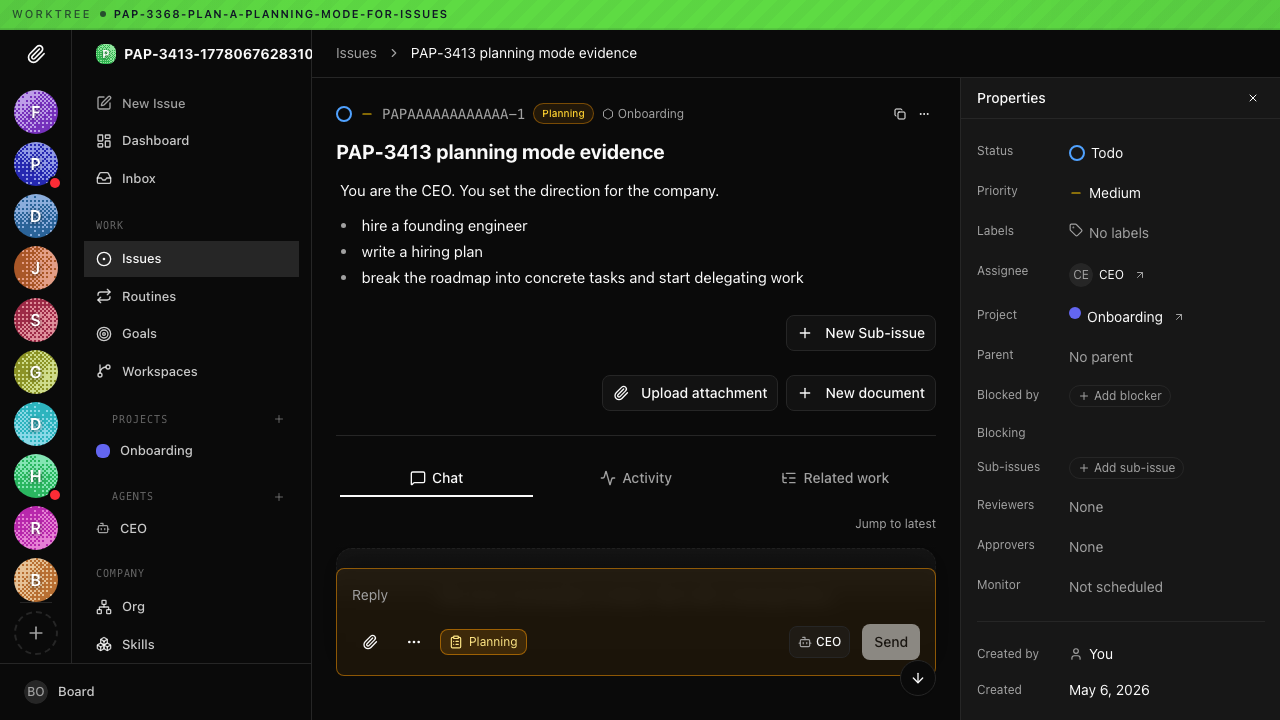 Desktop planning row: 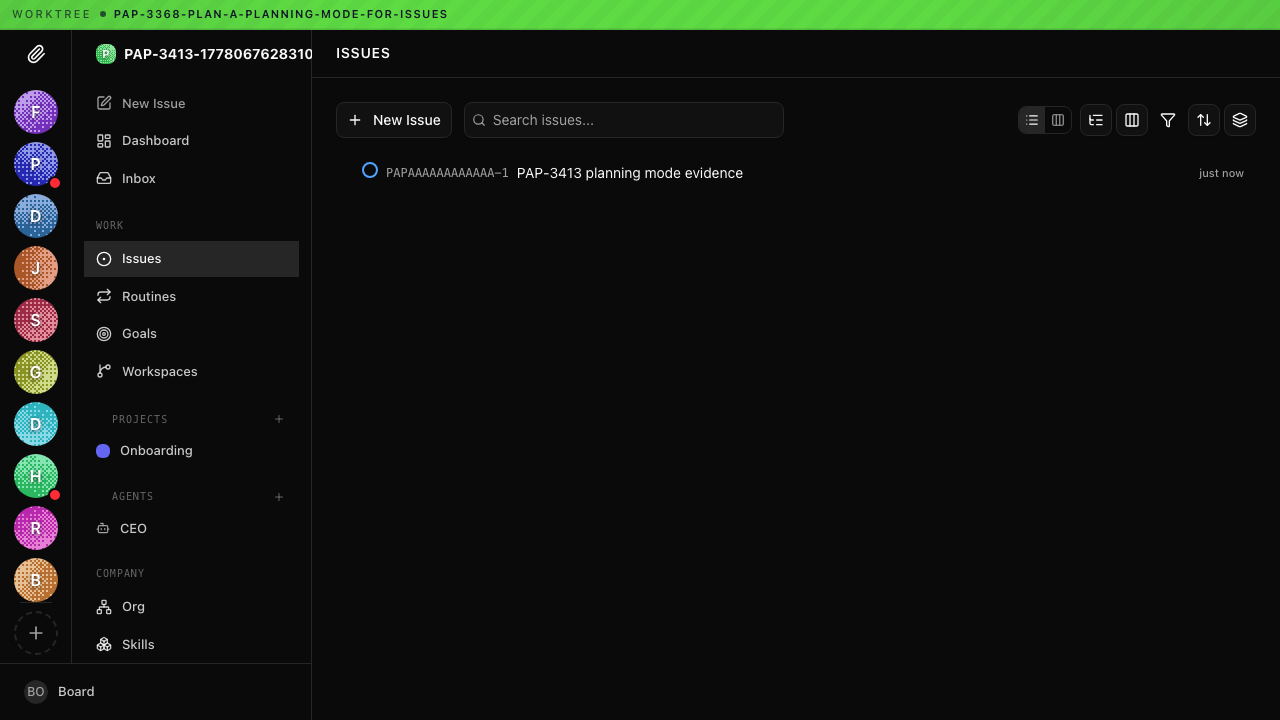 Desktop staged standard toggle: 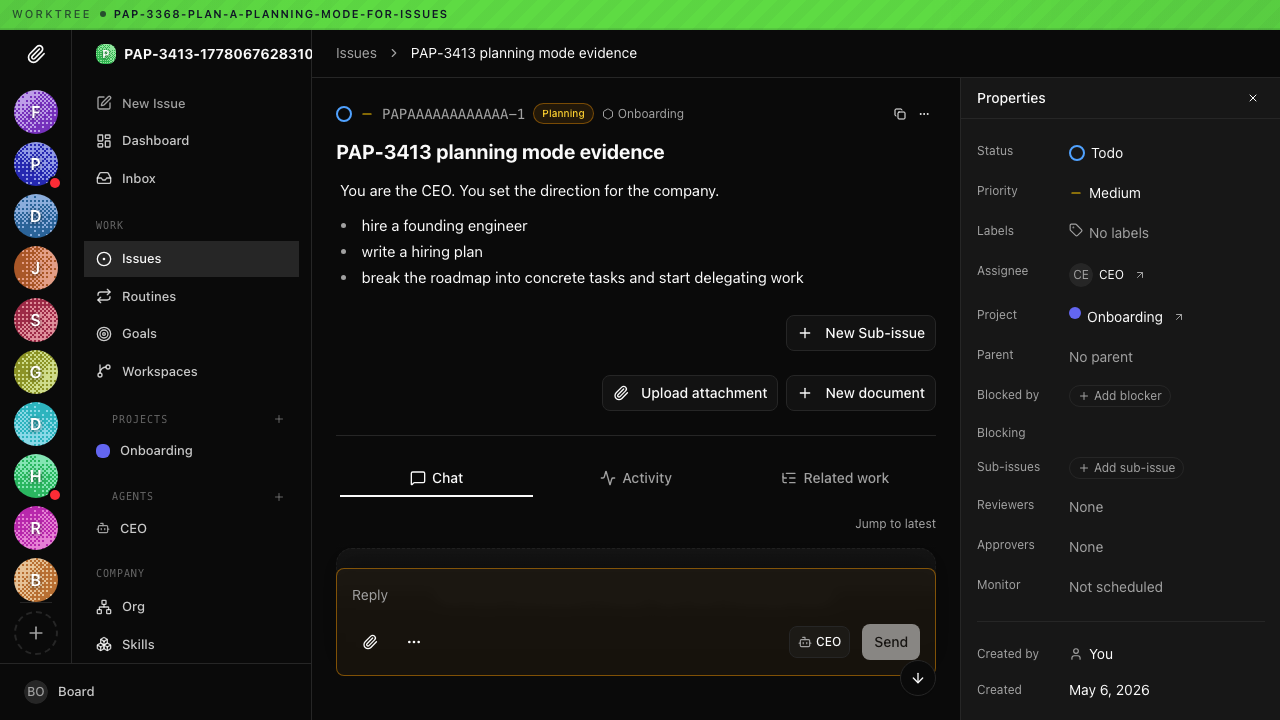 Mobile planning detail: 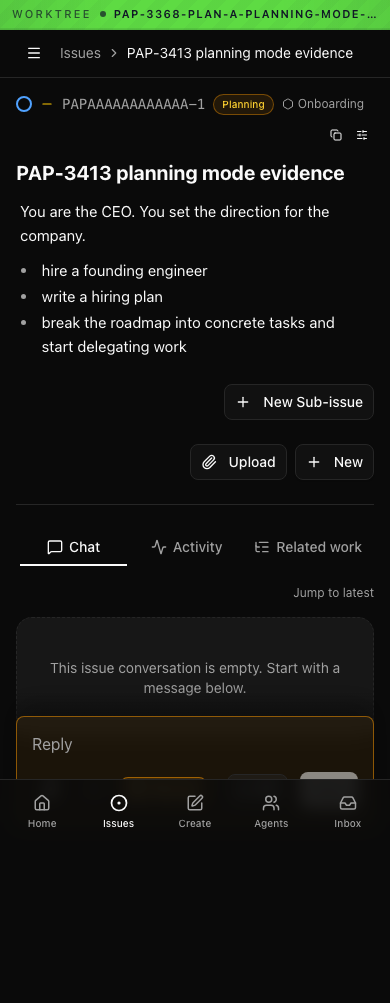 Mobile planning row: 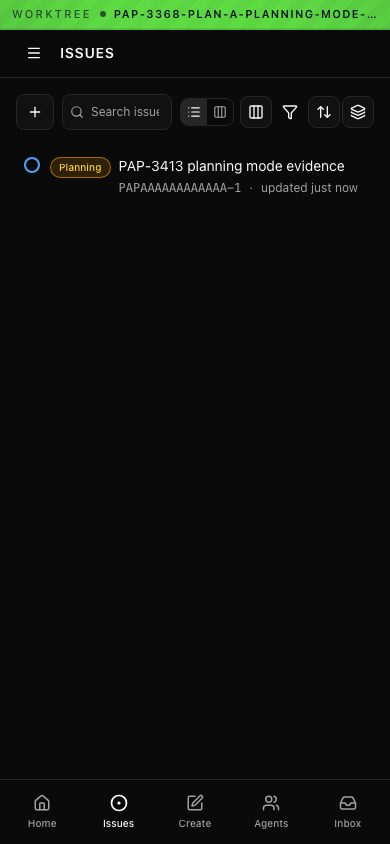 ## Risks - Medium migration risk: this adds a non-null issue column. The migration uses `ADD COLUMN IF NOT EXISTS` so installations that applied an older branch-local migration number can still apply the final numbered migration safely. - Medium contract risk: issue payloads, plugin payloads, and adapter heartbeat payloads now include work mode; compatibility is handled by defaulting missing values to `standard`. - UI risk is moderate because composer controls changed; focused component tests and visual e2e coverage exercise standard vs planning display and toggle behavior. > For core feature work, check [`ROADMAP.md`](ROADMAP.md) first and discuss it in `#dev` before opening the PR. Feature PRs that overlap with planned core work may need to be redirected — check the roadmap first. See `CONTRIBUTING.md`. ## Model Used - OpenAI Codex, GPT-5 coding agent in a local Paperclip worktree, with shell/tool use. Exact context-window size is not exposed in this runtime. ## Checklist - [x] I have included a thinking path that traces from project context to this change - [x] I have specified the model used (with version and capability details) - [x] I have checked ROADMAP.md and confirmed this PR does not duplicate planned core work - [x] I have run tests locally and they pass - [x] I have added or updated tests where applicable - [x] If this change affects the UI, I have included before/after screenshots - [x] I have updated relevant documentation to reflect my changes - [x] I have considered and documented any risks above - [x] I will address all Greptile and reviewer comments before requesting merge --------- Co-authored-by: Paperclip <noreply@paperclip.ing> |
||
|
Devin Foley
|
9578dc3da7 |
Wire per-adapter sandbox install commands through test and execute paths (#5280)
> **Stacked PR.** Sits on top of the e2b sandbox chain — #5278 (stdin staging) and #5279 (honest-resolvability + login-profiles). The cumulative diff against `master` includes both of those PRs' content; the files touched by *this* PR's commit are the new `maybeRunSandboxInstallCommand` helper in `packages/adapter-utils/src/execution-target.ts` and the per-adapter `index.ts`/`server/test.ts`/`server/execute.ts` wiring under `packages/adapters/{claude,codex,cursor,gemini,opencode,pi}-local/`. The honest resolvability check from #5279 is what gives this PR's install command a meaningful "did it actually land on PATH" follow-up. ## Thinking Path > - Paperclip orchestrates AI agents for zero-human companies > - Sandbox execution targets are ephemeral — each fresh lease starts from a template image that may or may not have the agent CLIs preinstalled > - When a CLI isn't preinstalled, the resolvability probe fails at `command -v` and the hello probe never runs > - There's no shared mechanism for "before you probe or provision, install the CLI on this sandbox" > - This pull request adds a `SANDBOX_INSTALL_COMMAND` constant per adapter and a `maybeRunSandboxInstallCommand` helper that runs it via the existing sandbox login shell, captures structured output, and never throws (so the resolvability + hello probe still run after); each adapter's `test()` and `execute()` share the constant so the two callsites can't drift > - The benefit is a fresh sandbox lease without a preinstalled CLI now installs it once via `sh -lc` before the resolvability probe and before managed-runtime provisioning, with a uniform `<adapter>_install_command_run` check on the test report ## What Changed - `packages/adapter-utils/src/execution-target.ts`: add `AdapterSandboxInstallCommandCheck` and `maybeRunSandboxInstallCommand` (runs the install via existing sandbox shell, captures exit/stdout/stderr, returns a structured info/warn check, never throws) - Add `SANDBOX_INSTALL_COMMAND` to each adapter's `index.ts` so `test()` and `execute()` share a single source of truth - Wire each of the 6 affected adapter `testEnvironment()`s to call `maybeRunSandboxInstallCommand` before `ensureAdapterExecutionTargetCommandResolvable` - Pass `installCommand: SANDBOX_INSTALL_COMMAND` through `prepareAdapterExecutionTargetRuntime` in each adapter's `execute()` - Per-adapter install commands use npm globals where possible so binaries land on a PATH segment the template already exports: - claude → `npm install -g @anthropic-ai/claude-code` - codex → `npm install -g @openai/codex` - cursor → `curl https://cursor.com/install -fsS | bash` - gemini → `npm install -g @google/gemini-cli` - opencode → `npm install -g opencode-ai` - pi → `npm install -g @mariozechner/pi-coding-agent` SSH and local targets ignore `installCommand` (SSH runtime takes no such param; local short-circuits before runtime prep), so this is a no-op for non-sandbox environments. ## Verification - `pnpm typecheck` clean - `pnpm vitest run --no-coverage --project @paperclipai/adapter-utils` and per-adapter projects pass - Manual sandbox matrix (claude, codex, cursor, gemini, opencode, pi) — each goes `install_command_run → resolvable → hello_probe_passed` (Codex and Pi land on `hello_probe_auth_required`, which is the configured-credentials problem, not an install issue) - SSH no-regression: SSH Claude still passes; the helper short-circuits on non-sandbox targets ## Risks Medium — adds a network/CPU cost (npm install / curl) on every fresh sandbox lease. Cost is bounded (one-time per lease, typically tens of seconds for npm globals), and the helper never throws so a failing install still lets the report run resolvability and hello probes. If a sandbox image already has the CLI, the install is an idempotent reinstall. ## Model Used Claude Opus 4.7 (1M context) ## Checklist - [x] I have included a thinking path that traces from project context to this change - [x] I have specified the model used (with version and capability details) - [x] I have checked ROADMAP.md and confirmed this PR does not duplicate planned core work - [x] I have run tests locally and they pass - [x] I have added or updated tests where applicable - [x] If this change affects the UI, I have included before/after screenshots — N/A (no UI) - [x] I have updated relevant documentation to reflect my changes - [x] I have considered and documented any risks above - [x] I will address all Greptile and reviewer comments before requesting merge |
||
|
Devin Foley
|
9042b8d042 |
Write apikey-mode auth.json so Codex CLI 0.122+ can authenticate via OPENAI_API_KEY (#5276)
## Thinking Path > - Paperclip orchestrates AI agents for zero-human companies > - The Codex adapter spawns the OpenAI Codex CLI to drive the model > - Codex CLI 0.122 changed how it reads credentials: it ignores `OPENAI_API_KEY` from the environment and reads only `$CODEX_HOME/auth.json` > - Without auth.json, Codex 0.122+ returns 401 "Missing bearer or basic authentication" on `/v1/responses` even when `OPENAI_API_KEY` is forwarded into the sandbox or remote shell > - This pull request materializes an apikey-mode `auth.json` in the managed Codex home (or per-run for the test probe) when an `OPENAI_API_KEY` is configured > - The benefit is configured Codex API keys authenticate correctly with current Codex CLI versions across local, SSH, and sandbox targets ## What Changed - `codex-home.ts`: add `writeApiKeyAuthJson()` and let `prepareManagedCodexHome` accept an `apiKey` override that replaces the symlinked host auth.json with an apikey-mode file - `execute.ts`: pass `envConfig.OPENAI_API_KEY` into `prepareManagedCodexHome` so the managed (and synced-to-remote) Codex home authenticates via the configured key - `test.ts`: when `OPENAI_API_KEY` is available, wrap the hello probe with a small shell that materializes a per-run `$CODEX_HOME/auth.json` before exec'ing codex; key content rides through env to avoid leaking into process listings - Update the `codex_hello_probe_auth_required` hint to explain Codex CLI does not read `OPENAI_API_KEY` from env ## Verification - `pnpm vitest run --no-coverage --project @paperclipai/adapter-codex-local` - `pnpm typecheck` clean - Manual: Codex 0.122.0 with empty `CODEX_HOME` returns 401 with env-only auth; with this change it authenticates cleanly ## Risks Low risk — when no API key is configured, behavior is unchanged (no auth.json written, existing chatgpt-mode flow preserved). Apikey-mode `auth.json` is the upstream-supported format. ## Model Used Claude Opus 4.7 (1M context) ## Checklist - [x] I have included a thinking path that traces from project context to this change - [x] I have specified the model used (with version and capability details) - [x] I have checked ROADMAP.md and confirmed this PR does not duplicate planned core work - [x] I have run tests locally and they pass - [x] I have added or updated tests where applicable - [x] If this change affects the UI, I have included before/after screenshots — N/A (no UI) - [x] I have updated relevant documentation to reflect my changes - [x] I have considered and documented any risks above - [x] I will address all Greptile and reviewer comments before requesting merge |
||
|
Devin Foley
|
90631b09b3 |
Let adapters declare runtime command spec for remote provisioning (#5141)
## Thinking Path

> - Paperclip orchestrates AI agents for zero-human companies, running
adapter
> commands like `claude`, `codex`, `pi` either locally or on remote
runtimes
>   (SSH hosts, sandboxes, etc.)
> - On a fresh remote runtime — particularly an ephemeral sandbox — the
> adapter's CLI may not be installed yet. Today operators handle this
via
> external configuration (e.g. a project-level `provisionCommand` shell
> script) that has to know about every adapter the operator might want
to use
> - This means every adapter has its own well-known npm package, but
operators
>   end up writing duplicate provision shell scripts that paste together
> `npm install -g @anthropic-ai/claude-code`, `npm install -g
@openai/codex`,
>   etc. — knowledge the adapter itself already has
> - This PR moves that knowledge into the adapter modules: each adapter
declares
> how its runtime command should be detected and (if applicable)
installed
> via `getRuntimeCommandSpec(config)`. The execution path runs the
adapter's
> own install command on remote sandbox targets before launching, so a
fresh
> sandbox bootstraps itself instead of requiring a hand-written
provision script
> - The benefit is fewer footguns for operators provisioning remote
runtimes,
>   and a clean place for new adapters to plug in their install recipe

## What Changed

- New types in `packages/adapter-utils/src/types.ts`:
    - `AdapterRuntimeCommandSpec` describing `command`, optional
      `detectCommand`, and optional `installCommand`
    - Optional `getRuntimeCommandSpec(config)` on `ServerAdapterModule`
- Optional `runtimeCommandSpec` on `AdapterExecutionContext` so adapters
      receive the resolved spec at execute time
- New helper `ensureAdapterExecutionTargetRuntimeCommandInstalled(...)`
in
`packages/adapter-utils/src/execution-target.ts` that runs the install
command
on remote targets when `transport === "sandbox"`. SSH and local targets
are
  no-ops. Throws on timeout or non-zero exit so failures surface early.
- Each of `claude-local`, `codex-local`, `cursor-local`, `gemini-local`,
  `opencode-local`, `pi-local`'s `execute.ts` now reads
`ctx.runtimeCommandSpec?.installCommand` and calls the helper before
launching
  the adapter command.
- `server/src/adapters/registry.ts` declares `getRuntimeCommandSpec` for
each
  adapter:
- claude/codex/gemini/opencode/pi-local: `npm install -g <package>`
recipe via
a shared `buildNpmRuntimeCommandSpec` helper, with a defensive guard
that
only auto-installs when the configured `command` matches the well-known
      fallback (custom binaries are left alone).
- cursor-local: declares `command` only; no auto-install (no public npm
      package), preserving the existing manual setup.
- `server/src/services/heartbeat.ts` resolves the spec via
`adapter.getRuntimeCommandSpec?.(runtimeConfig)` and passes it through
to
  `AdapterExecutionContext`.
- Tests added in `execution-target.test.ts` (~75 lines), e2b
`plugin.test.ts` (~32 lines), and `environment-run-orchestrator.test.ts`
  (~76 lines).

## Verification

- `pnpm --filter @paperclipai/adapter-utils test`
- `pnpm --filter @paperclipai/server test --
environment-run-orchestrator`
- `pnpm --filter @paperclipai/sandbox-providers-e2b test`
- Manual QA: run an adapter (claude/codex/etc.) against a fresh
sandbox-backed
environment that does NOT have the adapter CLI pre-installed. Confirm
the
install runs once at the start of the agent run and the adapter then
launches
successfully. Re-run on the same sandbox; confirm the install command is
  idempotent and the second run starts faster.
- Confirm SSH and local execution paths are unaffected (gated by
  `transport === "sandbox"`).

## Risks

- Behavioural shift on sandbox runs: a new install step now runs at the
start
  of every sandbox agent run for adapters with `installCommand` set. The
install commands are idempotent (`if ! command -v X >/dev/null 2>&1;
then
npm install -g <pkg>; fi`), so this is fast on warm sandboxes. On a cold
  sandbox, the first run takes longer.
- Operators who used the legacy project-level `provisionCommand` to
install
adapter CLIs can drop that part of their script; the adapter handles it
now.
  Existing scripts continue to work — installs are idempotent.
- The cursor-local adapter has no auto-install (no public npm package).
  Behaviour for cursor-local on sandboxes is unchanged.
- New optional surface on `ServerAdapterModule`. Plugins that don't
implement
  `getRuntimeCommandSpec` retain previous behaviour (no auto-install).

## Model Used

- OpenAI GPT-5.4 (reasoning effort: high) via Codex CLI
- Provider: OpenAI
- Used to author the code changes in this PR

## Checklist

- [x] I have included a thinking path that traces from project context
to this change
- [x] I have specified the model used (with version and capability
details)
- [x] I have checked ROADMAP.md and confirmed this PR does not duplicate
planned core work
- [x] I have run tests locally and they pass
- [x] I have added or updated tests where applicable
- [ ] If this change affects the UI, I have included before/after
screenshots — N/A
- [ ] I have updated relevant documentation to reflect my changes — N/A
- [x] I have considered and documented any risks above
- [x] I will address all Greptile and reviewer comments before
requesting merge
|
||
|
Devin Foley
|
856c6cb192 |
Fix remote workspace environment shaping (#5118)
> **Stacked PR (part 5 of 7).** Depends on: - PR #5114 - PR #5115 - PR #5116 - PR #5117 > Diff against `master` includes commits from earlier PRs in the stack — the new commit in this PR is the topmost one. ## Thinking Path > - Paperclip orchestrates AI agents for zero-human companies > - Agents run with a Paperclip-shaped environment (`PAPERCLIP_WORKSPACE_CWD`, > worktree path, `PAPERCLIP_WORKSPACES_JSON` hints) so the CLI can locate the > correct project tree > - SSH testing reproduced a real failure: a Codex SSH run wrote to > `/tmp/paperclip-env-matrix-...` (the *host* path) instead of the realized > remote workspace at `/home/<user>/paperclip-env-matrix-ssh-claude/...` > because the adapter injected `PAPERCLIP_WORKSPACE_CWD=/tmp/...` into the > remote env > - Code review on the initial codex-only fix asked to roll the same approach > into every other SSH-capable adapter (claude, acpx, cursor, opencode, gemini, > pi) via a shared helper rather than duplicating per-adapter > - This PR adds `shapePaperclipWorkspaceEnvForExecution` in adapter-utils that, > when the execution target is remote: replaces local cwd with the realized > execution cwd, nulls out worktree path (which has no remote meaning), and > rewrites/strips `cwd` entries in workspace hints based on what was actually > synced. Every adapter calls it before invoking the remote runner > - The benefit is that remote runs see the realized remote workspace, host-local > paths stop leaking into remote env, and the rule is unit-tested in one place ## What Changed - Added `shapePaperclipWorkspaceEnvForExecution` to `packages/adapter-utils/src/server-utils.ts` with full unit coverage (`server-utils.test.ts`) - Each of acpx-local, claude-local, codex-local, cursor-local, gemini-local, opencode-local, pi-local now calls the new shaper before issuing the remote command and feeds the shaped values into `applyPaperclipWorkspaceEnv` - Per-adapter `execute.remote.test.ts` files extended to cover the new shaping behaviour: localhost paths replaced with remote cwd, foreign-cwd hints stripped, worktree path nulled out for remote targets - `acpx-local/src/server/execute.test.ts` extended with shaping coverage ## Verification - `pnpm test -- server-utils execute.remote` - `pnpm --filter @paperclipai/adapter-acpx-local test` - Manual QA reproducing the original failure: 1. Provision an E2B sandbox environment for the Paperclip QA company 2. Assign an issue to a remote-targeted claude-local agent and confirm the run starts in the correct remote cwd (no `/Users/...` path leakage in the run logs) 3. Repeat for opencode-local and pi-local ## Risks - Behavioural shift: hints whose `cwd` doesn't match the workspace cwd are now stripped on remote targets. If any adapter relied on a leaked local hint cwd, it will see a missing `cwd` instead. Reviewed all current callers — none do. - Adds a small per-run cost (path resolve + string normalisation) on every remote execution. Negligible. - Worktree path is now nulled out on remote (it has no meaning there). Adapters that previously read the value defensively will continue to work. ## Model Used - OpenAI GPT-5.4 (reasoning effort: high) via Codex CLI - Provider: OpenAI - Used to author the code changes in this PR ## Checklist - [x] I have included a thinking path that traces from project context to this change - [x] I have specified the model used (with version and capability details) - [x] I have checked ROADMAP.md and confirmed this PR does not duplicate planned core work - [x] I have run tests locally and they pass - [x] I have added or updated tests where applicable - [ ] If this change affects the UI, I have included before/after screenshots — N/A - [ ] I have updated relevant documentation to reflect my changes — N/A - [x] I have considered and documented any risks above - [x] I will address all Greptile and reviewer comments before requesting merge |
||
|
Devin Foley
|
076067865f |
Migrate SSH environment callback to bridge (#5116)
> **Stacked PR (part 3 of 7).** Depends on: - PR #5114 - PR #5115 > Diff against `master` includes commits from earlier PRs in the stack — the new commit in this PR is the topmost one. ## Thinking Path > - Paperclip orchestrates AI agents for zero-human companies > - Agents executing on a remote SSH-backed environment need a way to call back into > the Paperclip control plane (run events, log streaming, signals) > - When the SSH host can't reach the Paperclip host (NAT, firewalls, or simply not > on the same network), the run silently fails or hangs — a recurring class of > failure during SSH testing > - In sandboxed environments we already solved this with a callback bridge that > tunnels back through the existing connection; SSH was the odd one out > - This PR migrates SSH execution to use the same callback bridge, so every > adapter's remote run uses one consistent reverse-channel. Per-adapter SSH glue > is deleted in favour of a shared `CommandManagedRuntimeRunner` built from the > SSH spec > - The benefit is fewer SSH-specific failure modes, a smaller code surface, and > one place to evolve the callback contract going forward ## What Changed - Added `createSshCommandManagedRuntimeRunner` in `packages/adapter-utils/src/ssh.ts` that adapts an SSH spec into a generic command-managed-runtime runner (with cwd, env, and timeout handling) - Removed `paperclipApiUrl` from `SshRemoteExecutionSpec`; the bridge URL now flows through the shared runner - Reworked `execution-target.ts` to use the SSH runner alongside sandbox runners via a unified `CommandManagedRuntimeRunner` interface - Simplified `remote-managed-runtime.ts` and `sandbox-managed-runtime.ts` to consume the shared runner abstraction - Deleted per-adapter SSH callback wiring from claude-local, codex-local, cursor-local, gemini-local, opencode-local, pi-local execute.ts files - Removed `environment-runtime-driver-contract.test.ts` (the contract is now enforced by `environment-execution-target.test.ts`) - Added/updated `execute.remote.test.ts` cases for each adapter to cover the SSH runner path ## Verification - `pnpm --filter @paperclipai/adapter-utils test` - `pnpm test -- execute.remote` (covers all six local adapters' SSH paths) - Manual QA: ran a claude-local agent against an SSH-backed environment, confirmed the agent successfully called back to `/api/agent-callback/*` endpoints during the run ## Risks - Refactor touches all six local adapters. If any adapter had subtle SSH-specific behaviour that wasn't captured in tests, it could regress. Mitigation: each adapter's `execute.remote.test.ts` was extended. - `paperclipApiUrl` removal from `SshRemoteExecutionSpec` is a breaking type change for any internal consumer. Verified no external plugins consume this type. - The new `CommandManagedRuntimeRunner` shape is a public surface in `@paperclipai/adapter-utils`; downstream plugins implementing custom runners may need updates, but no such plugins exist in this repo. ## Model Used - OpenAI GPT-5.4 (reasoning effort: high) via Codex CLI - Provider: OpenAI - Used to author the code changes in this PR ## Checklist - [x] I have included a thinking path that traces from project context to this change - [x] I have specified the model used (with version and capability details) - [x] I have checked ROADMAP.md and confirmed this PR does not duplicate planned core work - [x] I have run tests locally and they pass - [x] I have added or updated tests where applicable - [ ] If this change affects the UI, I have included before/after screenshots — N/A - [ ] I have updated relevant documentation to reflect my changes — N/A - [x] I have considered and documented any risks above - [x] I will address all Greptile and reviewer comments before requesting merge |
||
|
Devin Foley
|
a4ac6ff133 |
Add sandbox callback bridge for remote environment API access (#4801)
## Thinking Path > - Paperclip orchestrates AI agents for zero-human companies > - Agents can run inside sandboxed environments like E2B, which are isolated from the host network > - Sandboxed agents need to call back to the Paperclip API to report progress, post comments, and update issue status > - But sandbox environments cannot reach the Paperclip server directly because they run in isolated network namespaces > - This PR adds a callback bridge that proxies API requests from the sandbox to the Paperclip server, running as a local HTTP server on the host that forwards authenticated requests > - The bridge is started automatically when an adapter launches a sandbox execution, and torn down when the run completes > - The benefit is sandboxed agents can interact with the Paperclip API without requiring network-level access to the host, enabling E2B and similar providers to work end-to-end ## What Changed - Added `sandbox-callback-bridge.ts` in `packages/adapter-utils/` — a lightweight HTTP bridge server that accepts requests from sandbox environments and proxies them to the Paperclip API with authentication - Added request validation and security policy: the bridge only forwards requests to the configured API URL, validates content types, enforces size limits, and rejects non-API paths - Wired the bridge into all remote adapter execute paths (claude, codex, cursor, gemini, pi) — the bridge starts before the agent process and the bridge URL is passed via environment variables - Updated `environment-execution-target.ts` to prefer the explicit API URL from environment lease metadata for sandbox callback routing - Fixed Claude sandbox runtime setup to work with the bridge configuration - Added comprehensive test coverage for bridge request handling, policy enforcement, and sandbox execution integration - Fixed browser bundling — the bridge module is excluded from the frontend bundle via the adapter-utils index export ## Verification - `pnpm test` — all existing and new tests pass, including bridge unit tests and sandbox execution integration tests - `pnpm typecheck` — clean - Manual: configure an E2B environment, run an agent task, verify the agent can post comments and update issue status through the bridge ## Risks - Medium. This is a new network-facing component (HTTP server on localhost). The security policy restricts forwarding to the configured API URL only and validates all requests, but any proxy introduces attack surface. The bridge binds to localhost only and is scoped to the lifetime of a single agent run. ## Model Used Codex GPT 5.4 high via Paperclip. ## Checklist - [x] I have included a thinking path that traces from project context to this change - [x] I have specified the model used (with version and capability details) - [x] I have checked ROADMAP.md and confirmed this PR does not duplicate planned core work - [x] I have run tests locally and they pass - [x] I have added or updated tests where applicable - [ ] If this change affects the UI, I have included before/after screenshots - [x] I have updated relevant documentation to reflect my changes - [x] I have considered and documented any risks above - [x] I will address all Greptile and reviewer comments before requesting merge |
||
|
Devin Foley
|
d47ffa87f0 |
Fix CEO AGENT_HOME paths and centralize workspace env propagation (#4551)
## Thinking Path > - Paperclip orchestrates AI agents for zero-human companies. > - The local adapter layer is responsible for turning Paperclip runtime context into the environment seen by the child agent process. > - The CEO onboarding bundle tells the agent where to read and write its persistent memory and fact files. > - That bundle was using `./memory/...` and `./life/...`, which only works when the process cwd happens to equal the agent home directory. > - At the same time, six local adapters each duplicated the same workspace-env propagation logic, including `AGENT_HOME`, which makes this contract easy to drift. > - This pull request fixes the CEO instructions to use `$AGENT_HOME/...` and centralizes workspace-env propagation in one shared helper with shared tests. > - The benefit is a real bug fix for agent memory paths plus a single tested contract that makes future built-in adapter work less likely to forget `AGENT_HOME`. ## What Changed - Updated `server/src/onboarding-assets/ceo/HEARTBEAT.md` to use `$AGENT_HOME/memory/...` and `$AGENT_HOME/life/...` instead of cwd-relative `./memory/...` and `./life/...`. - Added `applyPaperclipWorkspaceEnv(...)` in `packages/adapter-utils/src/server-utils.ts` to centralize `PAPERCLIP_WORKSPACE_*` and `AGENT_HOME` propagation. - Added shared helper coverage in `packages/adapter-utils/src/server-utils.test.ts` for both populated and skip-empty cases. - Switched the built-in local adapters (`claude_local`, `codex_local`, `cursor_local`, `gemini_local`, `opencode_local`, `pi_local`) over to the shared helper instead of inline env assignment blocks. ## Verification - `pnpm install` - `pnpm exec vitest run packages/adapter-utils/src/server-utils.test.ts packages/adapters/claude-local/src/server/execute.remote.test.ts packages/adapters/codex-local/src/server/execute.remote.test.ts packages/adapters/cursor-local/src/server/execute.remote.test.ts packages/adapters/gemini-local/src/server/execute.remote.test.ts packages/adapters/opencode-local/src/server/execute.remote.test.ts packages/adapters/pi-local/src/server/execute.remote.test.ts` - Result: 7 test files passed, 31 tests passed, 0 failures. ## Risks - Low risk. - The only behavioral surface is the shared env propagation refactor across six adapters; if the helper diverged from prior semantics, an adapter could miss a workspace env var. - The shared helper test plus the affected adapter execute tests reduce that risk, and the helper preserves the prior "set only non-empty strings" behavior. ## Model Used - OpenAI Codex via Paperclip `codex_local` agent runtime; tool-assisted coding workflow with shell execution, file patching, git operations, and API interaction. The exact backend model identifier and context window are not surfaced by this local runtime. ## Checklist - [x] I have included a thinking path that traces from project context to this change - [x] I have specified the model used (with version and capability details) - [x] I have checked ROADMAP.md and confirmed this PR does not duplicate planned core work - [x] I have run tests locally and they pass - [x] I have added or updated tests where applicable - [x] If this change affects the UI, I have included before/after screenshots - [x] I have updated relevant documentation to reflect my changes - [x] I have considered and documented any risks above - [x] I will address all Greptile and reviewer comments before requesting merge |
||
|
Dotta
|
8f1cd0474f |
[codex] Improve transient recovery and Codex model refresh (#4383)
## Thinking Path > - Paperclip orchestrates AI agents for zero-human companies > - Adapter execution and retry classification decide whether agent work pauses, retries, or recovers automatically > - Transient provider failures need to be classified precisely so Paperclip does not convert retryable upstream conditions into false hard failures > - At the same time, operators need an up-to-date model list for Codex-backed agents and prompts should nudge agents toward targeted verification instead of repo-wide sweeps > - This pull request tightens transient recovery classification for Claude and Codex, updates the agent prompt guidance, and adds Codex model refresh support end-to-end > - The benefit is better automatic retry behavior plus fresher operator-facing model configuration ## What Changed - added Codex usage-limit retry-window parsing and Claude extra-usage transient classification - normalized the heartbeat transient-recovery contract across adapter executions and heartbeat scheduling - documented that deferred comment wakes only reopen completed issues for human/comment-reopen interactions, while system follow-ups leave closed work closed - updated adapter-utils prompt guidance to prefer targeted verification - added Codex model refresh support in the server route, registry, shared types, and agent config form - added adapter/server tests covering the new parsing, retry scheduling, and model-refresh behavior ## Verification - `pnpm exec vitest run --project @paperclipai/adapter-utils packages/adapter-utils/src/server-utils.test.ts` - `pnpm exec vitest run --project @paperclipai/adapter-claude-local packages/adapters/claude-local/src/server/parse.test.ts` - `pnpm exec vitest run --project @paperclipai/adapter-codex-local packages/adapters/codex-local/src/server/parse.test.ts` - `pnpm exec vitest run --project @paperclipai/server server/src/__tests__/adapter-model-refresh-routes.test.ts server/src/__tests__/adapter-models.test.ts server/src/__tests__/claude-local-execute.test.ts server/src/__tests__/codex-local-execute.test.ts server/src/__tests__/heartbeat-process-recovery.test.ts server/src/__tests__/heartbeat-retry-scheduling.test.ts` ## Risks - Moderate behavior risk: retry classification affects whether runs auto-recover or block, so mistakes here could either suppress needed retries or over-retry real failures - Low workflow risk: deferred comment wake reopening is intentionally scoped to human/comment-reopen interactions so system follow-ups do not revive completed issues unexpectedly > For core feature work, check [`ROADMAP.md`](ROADMAP.md) first and discuss it in `#dev` before opening the PR. Feature PRs that overlap with planned core work may need to be redirected — check the roadmap first. See `CONTRIBUTING.md`. ## Model Used - OpenAI Codex GPT-5-based coding agent with tool use and code execution in the Codex CLI environment ## Checklist - [x] I have included a thinking path that traces from project context to this change - [x] I have specified the model used (with version and capability details) - [x] I have checked ROADMAP.md and confirmed this PR does not duplicate planned core work - [x] I have run tests locally and they pass - [x] I have added or updated tests where applicable - [ ] If this change affects the UI, I have included before/after screenshots - [ ] I have updated relevant documentation to reflect my changes - [x] I have considered and documented any risks above - [x] I will address all Greptile and reviewer comments before requesting merge --------- Co-authored-by: Paperclip <noreply@paperclip.ing> |
||
|
Devin Foley
|
e4995bbb1c |
Add SSH environment support (#4358)
## Thinking Path > - Paperclip orchestrates AI agents for zero-human companies > - The environments subsystem already models execution environments, but before this branch there was no end-to-end SSH-backed runtime path for agents to actually run work against a remote box > - That meant agents could be configured around environment concepts without a reliable way to execute adapter sessions remotely, sync workspace state, and preserve run context across supported adapters > - We also need environment selection to participate in normal Paperclip control-plane behavior: agent defaults, project/issue selection, route validation, and environment probing > - Because this capability is still experimental, the UI surface should be easy to hide and easy to remove later without undoing the underlying implementation > - This pull request adds SSH environment execution support across the runtime, adapters, routes, schema, and tests, then puts the visible environment-management UI behind an experimental flag > - The benefit is that we can validate real SSH-backed agent execution now while keeping the user-facing controls safely gated until the feature is ready to come out of experimentation ## What Changed - Added SSH-backed execution target support in the shared adapter runtime, including remote workspace preparation, skill/runtime asset sync, remote session handling, and workspace restore behavior after runs. - Added SSH execution coverage for supported local adapters, plus remote execution tests across Claude, Codex, Cursor, Gemini, OpenCode, and Pi. - Added environment selection and environment-management backend support needed for SSH execution, including route/service work, validation, probing, and agent default environment persistence. - Added CLI support for SSH environment lab verification and updated related docs/tests. - Added the `enableEnvironments` experimental flag and gated the environment UI behind it on company settings, agent configuration, and project configuration surfaces. ## Verification - `pnpm exec vitest run packages/adapters/claude-local/src/server/execute.remote.test.ts packages/adapters/cursor-local/src/server/execute.remote.test.ts packages/adapters/gemini-local/src/server/execute.remote.test.ts packages/adapters/opencode-local/src/server/execute.remote.test.ts packages/adapters/pi-local/src/server/execute.remote.test.ts` - `pnpm exec vitest run server/src/__tests__/environment-routes.test.ts` - `pnpm exec vitest run server/src/__tests__/instance-settings-routes.test.ts` - `pnpm exec vitest run ui/src/lib/new-agent-hire-payload.test.ts ui/src/lib/new-agent-runtime-config.test.ts` - `pnpm -r typecheck` - `pnpm build` - Manual verification on a branch-local dev server: - enabled the experimental flag - created an SSH environment - created a Linux Claude agent using that environment - confirmed a run executed on the Linux box and synced workspace changes back ## Risks - Medium: this touches runtime execution flow across multiple adapters, so regressions would likely show up in remote session setup, workspace sync, or environment selection precedence. - The UI flag reduces exposure, but the underlying runtime and route changes are still substantial and rely on migration correctness. - The change set is broad across adapters, control-plane services, migrations, and UI gating, so review should pay close attention to environment-selection precedence and remote workspace lifecycle behavior. ## Model Used - OpenAI Codex via Paperclip's local Codex adapter, GPT-5-class coding model with tool use and code execution in the local repo workspace. The local adapter does not surface a more specific public model version string in this branch workflow. ## Checklist - [x] I have included a thinking path that traces from project context to this change - [x] I have specified the model used (with version and capability details) - [x] I have checked ROADMAP.md and confirmed this PR does not duplicate planned core work - [x] I have run tests locally and they pass - [x] I have added or updated tests where applicable - [ ] If this change affects the UI, I have included before/after screenshots - [x] I have updated relevant documentation to reflect my changes - [x] I have considered and documented any risks above - [x] I will address all Greptile and reviewer comments before requesting merge |
||
|
Dotta
|
09d0678840 |
[codex] Harden heartbeat scheduling and runtime controls (#4223)
## Thinking Path > - Paperclip orchestrates AI agents through issue checkout, heartbeat runs, routines, and auditable control-plane state > - The runtime path has to recover from lost local processes, transient adapter failures, blocked dependencies, and routine coalescing without stranding work > - The existing branch carried several reliability fixes across heartbeat scheduling, issue runtime controls, routine dispatch, and operator-facing run state > - These changes belong together because they share backend contracts, migrations, and runtime status semantics > - This pull request groups the control-plane/runtime slice so it can merge independently from board UI polish and adapter sandbox work > - The benefit is safer heartbeat recovery, clearer runtime controls, and more predictable recurring execution behavior ## What Changed - Adds bounded heartbeat retry scheduling, scheduled retry state, and Codex transient failure recovery handling. - Tightens heartbeat process recovery, blocker wake behavior, issue comment wake handling, routine dispatch coalescing, and activity/dashboard bounds. - Adds runtime-control MCP tools and Paperclip skill docs for issue workspace runtime management. - Adds migrations `0061_lively_thor_girl.sql` and `0062_routine_run_dispatch_fingerprint.sql`. - Surfaces retry state in run ledger/agent UI and keeps related shared types synchronized. ## Verification - `pnpm exec vitest run server/src/__tests__/heartbeat-retry-scheduling.test.ts server/src/__tests__/heartbeat-process-recovery.test.ts server/src/__tests__/routines-service.test.ts` - `pnpm exec vitest run src/tools.test.ts` from `packages/mcp-server` ## Risks - Medium risk: this touches heartbeat recovery and routine dispatch, which are central execution paths. - Migration order matters if split branches land out of order: merge this PR before branches that assume the new runtime/routine fields. - Runtime retry behavior should be watched in CI and in local operator smoke tests because it changes how transient failures are resumed. > For core feature work, check [`ROADMAP.md`](ROADMAP.md) first and discuss it in `#dev` before opening the PR. Feature PRs that overlap with planned core work may need to be redirected — check the roadmap first. See `CONTRIBUTING.md`. ## Model Used - OpenAI Codex, GPT-5-based coding agent runtime, shell/git tool use enabled. Exact hosted model build and context window are not exposed in this Paperclip heartbeat environment. ## Checklist - [x] I have included a thinking path that traces from project context to this change - [x] I have specified the model used (with version and capability details) - [x] I have checked ROADMAP.md and confirmed this PR does not duplicate planned core work - [x] I have run tests locally and they pass - [x] I have added or updated tests where applicable - [ ] If this change affects the UI, I have included before/after screenshots - [x] I have updated relevant documentation to reflect my changes - [x] I have considered and documented any risks above - [x] I will address all Greptile and reviewer comments before requesting merge |
||
|
Dotta
|
236d11d36f |
[codex] Add run liveness continuations (#4083)
## Thinking Path > - Paperclip orchestrates AI agents for zero-human companies. > - Heartbeat runs are the control-plane record of each agent execution window. > - Long-running local agents can exhaust context or stop while still holding useful next-step state. > - Operators need that stop reason, next action, and continuation path to be durable and visible. > - This pull request adds run liveness metadata, continuation summaries, and UI surfaces for issue run ledgers. > - The benefit is that interrupted or long-running work can resume with clearer context instead of losing the agent's last useful handoff. ## What Changed - Added heartbeat-run liveness fields, continuation attempt tracking, and an idempotent `0058` migration. - Added server services and tests for run liveness, continuation summaries, stop metadata, and activity backfill. - Wired local and HTTP adapters to surface continuation/liveness context through shared adapter utilities. - Added shared constants, validators, and heartbeat types for liveness continuation state. - Added issue-detail UI surfaces for continuation handoffs and the run ledger, with component tests. - Updated agent runtime docs, heartbeat protocol docs, prompt guidance, onboarding assets, and skills instructions to explain continuation behavior. - Addressed Greptile feedback by scoping document evidence by run, excluding system continuation-summary documents from liveness evidence, importing shared liveness types, surfacing hidden ledger run counts, documenting bounded retry behavior, and moving run-ledger liveness backfill off the request path. ## Verification - `pnpm exec vitest run packages/adapter-utils/src/server-utils.test.ts server/src/__tests__/run-continuations.test.ts server/src/__tests__/run-liveness.test.ts server/src/__tests__/activity-service.test.ts server/src/__tests__/documents-service.test.ts server/src/__tests__/issue-continuation-summary.test.ts server/src/services/heartbeat-stop-metadata.test.ts ui/src/components/IssueRunLedger.test.tsx ui/src/components/IssueContinuationHandoff.test.tsx ui/src/components/IssueDocumentsSection.test.tsx` - `pnpm --filter @paperclipai/db build` - `pnpm exec vitest run server/src/__tests__/activity-service.test.ts ui/src/components/IssueRunLedger.test.tsx` - `pnpm --filter @paperclipai/ui typecheck` - `pnpm --filter @paperclipai/server typecheck` - `pnpm exec vitest run server/src/__tests__/activity-service.test.ts server/src/__tests__/run-continuations.test.ts ui/src/components/IssueRunLedger.test.tsx` - `pnpm exec vitest run server/src/__tests__/heartbeat-process-recovery.test.ts -t "treats a plan document update"` - `pnpm exec vitest run server/src/__tests__/activity-service.test.ts server/src/__tests__/heartbeat-process-recovery.test.ts -t "activity service|treats a plan document update"` - Remote PR checks on head `e53b1a1d`: `verify`, `e2e`, `policy`, and Snyk all passed. - Confirmed `public-gh/master` is an ancestor of this branch after fetching `public-gh master`. - Confirmed `pnpm-lock.yaml` is not included in the branch diff. - Confirmed migration `0058_wealthy_starbolt.sql` is ordered after `0057` and uses `IF NOT EXISTS` guards for repeat application. - Greptile inline review threads are resolved. ## Risks - Medium risk: this touches heartbeat execution, liveness recovery, activity rendering, issue routes, shared contracts, docs, and UI. - Migration risk is mitigated by additive columns/indexes and idempotent guards. - Run-ledger liveness backfill is now asynchronous, so the first ledger response can briefly show historical missing liveness until the background backfill completes. - UI screenshot coverage is not included in this packaging pass; validation is currently through focused component tests. > For core feature work, check [`ROADMAP.md`](ROADMAP.md) first and discuss it in `#dev` before opening the PR. Feature PRs that overlap with planned core work may need to be redirected — check the roadmap first. See `CONTRIBUTING.md`. ## Model Used - OpenAI Codex, GPT-5.4, local tool-use coding agent with terminal, git, GitHub connector, GitHub CLI, and Paperclip API access. ## Checklist - [x] I have included a thinking path that traces from project context to this change - [x] I have specified the model used (with version and capability details) - [x] I have checked ROADMAP.md and confirmed this PR does not duplicate planned core work - [x] I have run tests locally and they pass - [x] I have added or updated tests where applicable - [x] If this change affects the UI, I have included before/after screenshots - [x] I have updated relevant documentation to reflect my changes - [x] I have considered and documented any risks above - [x] I will address all Greptile and reviewer comments before requesting merge Screenshot note: no before/after screenshots were captured in this PR packaging pass; the UI changes are covered by focused component tests listed above. --------- Co-authored-by: Paperclip <noreply@paperclip.ing> |
||
|
Dotta
|
2d8f97feb0 | feat(codex-local): add fast mode support | ||
|
dotta
|
b9b2bf3b5b | Trim resumed comment wake prompts | ||
|
dotta
|
91e040a696 |
Batch inline comment wake payloads
Co-Authored-By: Paperclip <noreply@paperclip.ing> |
||
|
dotta
|
cadfcd1bc6 |
Log resolved adapter command in run metadata
Co-Authored-By: Paperclip <noreply@paperclip.ing> |
||
|
Devin Foley
|
80766e589c |
Clarify docs: skills go to the effective CODEX_HOME, not ~/.codex
The previous documentation parenthetical "(defaulting to ~/.codex/skills/)" was misleading because Paperclip almost always sets CODEX_HOME to a per-company managed home. Update index.ts docs, skills.ts detail string, and execute.ts inline comment to make the runtime path unambiguous. Co-Authored-By: Paperclip <noreply@paperclip.ing> |
||
|
Devin Foley
|
4c6b9c190b |
Fix stale reference to resolveCodexSkillsHome in fallback path
The default fallback in ensureCodexSkillsInjected still referenced the old function name. Updated to use resolveCodexSkillsDir with shared home as fallback. Co-Authored-By: Paperclip <noreply@paperclip.ing> |
||
|
Devin Foley
|
623ab1c3ea |
Fix skill injection to use effective CODEX_HOME, not shared home
The previous commit incorrectly used resolveSharedCodexHomeDir() (~/.codex) but Codex runs with CODEX_HOME set to a per-company managed home under ~/.paperclip/instances/. Skills injected into ~/.codex/skills/ would not be discoverable by Codex. Now uses effectiveCodexHome directly. Co-Authored-By: Paperclip <noreply@paperclip.ing> |
||
|
Devin Foley
|
eeec52ad74 |
Fix Codex skill injection to use ~/.codex/skills/ instead of cwd
The Codex adapter was the only one injecting skills into <cwd>/.agents/skills/, polluting the project's git repo. All other adapters (Gemini, Cursor, etc.) use a home-based directory. This changes the Codex adapter to inject into ~/.codex/skills/ (resolved via resolveSharedCodexHomeDir) to match the established pattern. Co-Authored-By: Paperclip <noreply@paperclip.ing> |
||
|
dotta
|
67841a0c6d |
Remove noisy "Loaded agent instructions file" log from all adapters
Loading an instructions file is normal, expected behavior — not worth logging to stdout/stderr on every run. Warning logs for failed reads are preserved. Co-Authored-By: Paperclip <noreply@paperclip.ing> |
||
|
dotta
|
19154d0fec |
Clarify Codex instruction sources
Co-Authored-By: Paperclip <noreply@paperclip.ing> |
||
|
dotta
|
d53714a145 | fix: manage codex home per company by default | ||
|
dotta
|
07757a59e9 |
Ensure agent home directories exist before use
mkdir -p the CODEX_HOME directory in codex-local adapter and the agentHome directory in the heartbeat service before passing them to adapters. This prevents CLI tools from erroring when their home directory hasn't been created yet. Covers all local adapters that set AGENT_HOME. Co-Authored-By: Paperclip <noreply@paperclip.ing> |
||
|
dotta
|
d07d86f778 | Merge public-gh/master into paperclip-company-import-export | ||
|
dotta
|
c844ca1a40 |
Improve orphaned local heartbeat recovery
Persist child-process metadata for local adapter runs, keep detached runs alive when their pid still exists, queue a single automatic retry when the pid is confirmed dead, and clear detached warnings when the original run reports activity again. Co-Authored-By: Paperclip <noreply@paperclip.ing> |
||
|
dotta
|
58a3cbd654 |
Route non-fatal adapter notices to stdout
Co-Authored-By: Paperclip <noreply@paperclip.ing> |
||
|
dotta
|
b4e06c63e2 | Refine codex runtime skills and portability assets | ||
|
dotta
|
3b03ac1734 | Scope Codex local skills home by company | ||
|
dotta
|
3689992965 |
Prune stale Codex skill symlinks
Co-Authored-By: Paperclip <noreply@paperclip.ing> |
||
|
Dotta
|
b5aeae7e22 | Merge public-gh/master into paperclip-company-import-export | ||
|
Dotta
|
5890b318c4 |
Namespace company skill identities
Persist canonical namespaced skill keys, split adapter runtime names from skill keys, and update portability/import flows to carry the canonical identity end-to-end. Co-Authored-By: Paperclip <noreply@paperclip.ing> |
||
|
Dotta
|
bb788d8360 |
Treat Codex bootstrap logs as stdout
Co-Authored-By: Paperclip <noreply@paperclip.ing> |
||
|
Dotta
|
cca086b863 | Merge public-gh/master into paperclip-company-import-export | ||
|
Dotta
|
76e6cc08a6 | feat(costs): add billing, quota, and budget control plane | ||
|
Dotta
|
7675fd0856 | Fix runtime skill injection across adapters | ||
|
Dotta
|
2c35be0212 | Merge public-gh/master into paperclip-company-import-export | ||
|
Devin Foley
|
d671a59306 |
fix: set AGENT_HOME env var for agent processes
The $AGENT_HOME environment variable was referenced by skills (e.g. para-memory-files) but never actually set, causing runtime errors like "/HEARTBEAT.md: No such file or directory" when agents tried to resolve paths relative to their home directory. Add agentHome to the paperclipWorkspace context in the heartbeat service and propagate it as the AGENT_HOME env var in all local adapters. Co-Authored-By: Paperclip <noreply@paperclip.ing> |
||
|
Dotta
|
56a34a8f8a | Add adapter skill sync for codex and claude | ||
|
Dotta
|
a393db78b4 |
fix: address greptile follow-up
Co-Authored-By: Paperclip <noreply@paperclip.ing> |
||
|
Dotta
|
528505a04a | fix: isolate codex home in worktrees | ||
|
Dotta
|
7d1748b3a7 |
feat: optimize heartbeat token usage
Co-Authored-By: Paperclip <noreply@paperclip.ing> |
||
|
Dotta
|
29a743cb9e |
fix: keep runtime skills scoped to ./skills
Co-Authored-By: Paperclip <noreply@paperclip.ing> |
||
|
Dotta
|
4e759da070 | fix: prefer .agents skills and repair codex symlink targets\n\nCo-Authored-By: Paperclip <noreply@paperclip.ing> | ||
|
Dotta
|
3120c72372 | Add worktree-aware workspace runtime support | ||
|
Dotta
|
f4a5b00116 |
fix: bundle skills directory into npm packages for runtime discovery
The claude-local, codex-local adapters and the server all resolve a skills/ directory using __dirname-relative paths that only work inside the monorepo. When installed from npm the paths point outside the package and cause ENOENT on readdir/readFile. - Update both adapter execute.ts files to try a published-path candidate (../../skills from dist/) before falling back to the monorepo dev path (../../../../../skills from src/). - Update server readSkillMarkdown() to try the published path first. - Add "skills" to the files array in server, claude-local, and codex-local package.json so npm includes them. - Update release.sh to copy the repo-root skills/ into each package before publish, and clean up after. Co-Authored-By: Claude Opus 4.6 <noreply@anthropic.com> |




