## Thinking Path
> - Paperclip is the open source app people use to manage AI agents for
work
> - The first-run experience (onboarding wizard) and the chat surfaces
(conference-room/board chat, task threads, composers) are the product's
front door — they decide whether a new operator understands "hire
agents, give them work, review results" in the first five minutes
> - Today those surfaces feel ticket-y and form-like: the wizard is a
static multi-step form that ends in an anticlimactic "Launch" screen,
the task composer and board chat behave differently from each other, and
agent-feed issue quicklooks misbehave (multiple flyouts open at once,
cards jump on hover)
> - We wanted to iterate toward a conversational, team-centric NUX — but
without risking the workflows of everyone already running Paperclip
> - This PR reworks the NUX behind a new default-OFF
`enableConferenceRoomChat` experimental flag: a capsule-motif onboarding
wizard that builds your team as you answer, a conference-room chat
surface, one shared ChatComposer across surfaces, brand-accurate status
chips, and feed-quicklook fixes — with the pre-existing UI
fork-and-frozen as `*Classic` components that flag-OFF users keep
> - The benefit is a complete, testable modern NUX that anyone can opt
into from Settings → Experimental, with zero default behavior change and
a clean path to either graduate or drop the experiment
## Linked Issues or Issue Description
No pre-existing GitHub issue — feature description per
`feature_request.yml`:
- **Problem / motivation:** Paperclip's onboarding wizard and chat
surfaces grew up as separate ticket-centric forms. New users get a
form-filling experience rather than the feeling of standing up a team;
the board chat and task threads use different composers with different
affordances; the agent feed's issue quicklook can stack multiple
popovers and shifts cards on hover.
- **Proposed solution:** A coherent NUX experiment behind one
experimental flag (`enableConferenceRoomChat`, Settings → Experimental,
default OFF): capsule onboarding wizard with an evolving team capsule,
conference-room chat, unified `ChatComposer`, team-centric copy, brand
status chips, quicklook single-flight fix. Flag-OFF users get the exact
pre-experiment UI via frozen `*Classic` forks, verified by an on/off
parity test matrix.
- **Alternatives considered:** (a) incremental unflagged restyling —
rejected: the changes interlock across surfaces and would drip risk into
every release; (b) a separate app shell / route for the new NUX —
rejected: too much divergence, the flag + classic-fork pattern keeps the
diff reviewable and reversible.
- **Roadmap alignment:** `ROADMAP.md` lists **CEO Chat** ("a
lighter-weight way to talk to leadership agents... should still resolve
to real work objects"). This experiment is groundwork in that direction
(conference-room chat resolves to issues/tasks via the same composer
used in task threads) and does not change the core task-and-comments
model.
Related PRs found in the dedup search (same area, none duplicate this
work — they target the classic wizard, which this PR intentionally
leaves intact and mergeable):
- #5385 — Coach-driven onboarding: conversational entry +
agent-companies package import
- #5378 — Onboarding wizard: reusable adapter picker + probe card
- #6636 — ui(onboarding): friendly error surface + retry for the wizard
- #7005 — fix(onboarding): explicitly await first-task wake
- #2616 — fix: restore workspace directory config in onboarding wizard
## What Changed
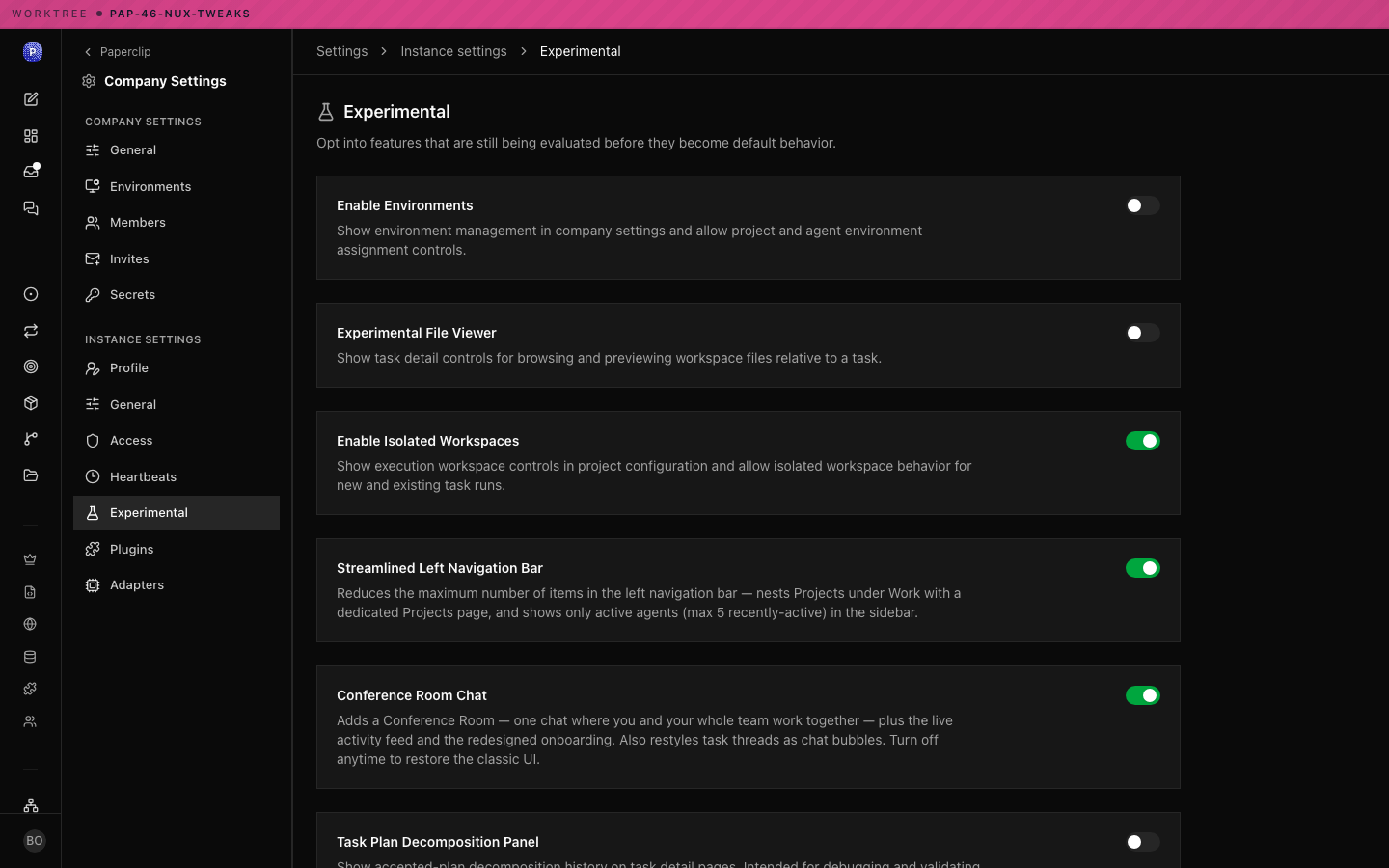
- **Experimental flag plumbing** — `enableConferenceRoomChat` in shared
types/validators, server instance-settings service + API, Settings →
Experimental card with explicit enable/disable copy
- **Onboarding wizard** — classic wizard forked and frozen
(`OnboardingWizardClassic`); flag-ON variant is a 5-step capsule wizard
with a persistent evolving `AgentCapsule` (gradient/glow motif),
team-centric reframed copy, and a typing-dots intro (hardened with
fake-timer tests)
- **Conference-room chat** — flag-ON board-chat surface with agent
bubble name/icon headers and copy/vote/timestamp action rows
(`AgentBubbleActionRow`)
- **Unified composer** — shared `ChatComposer` adopted across surfaces;
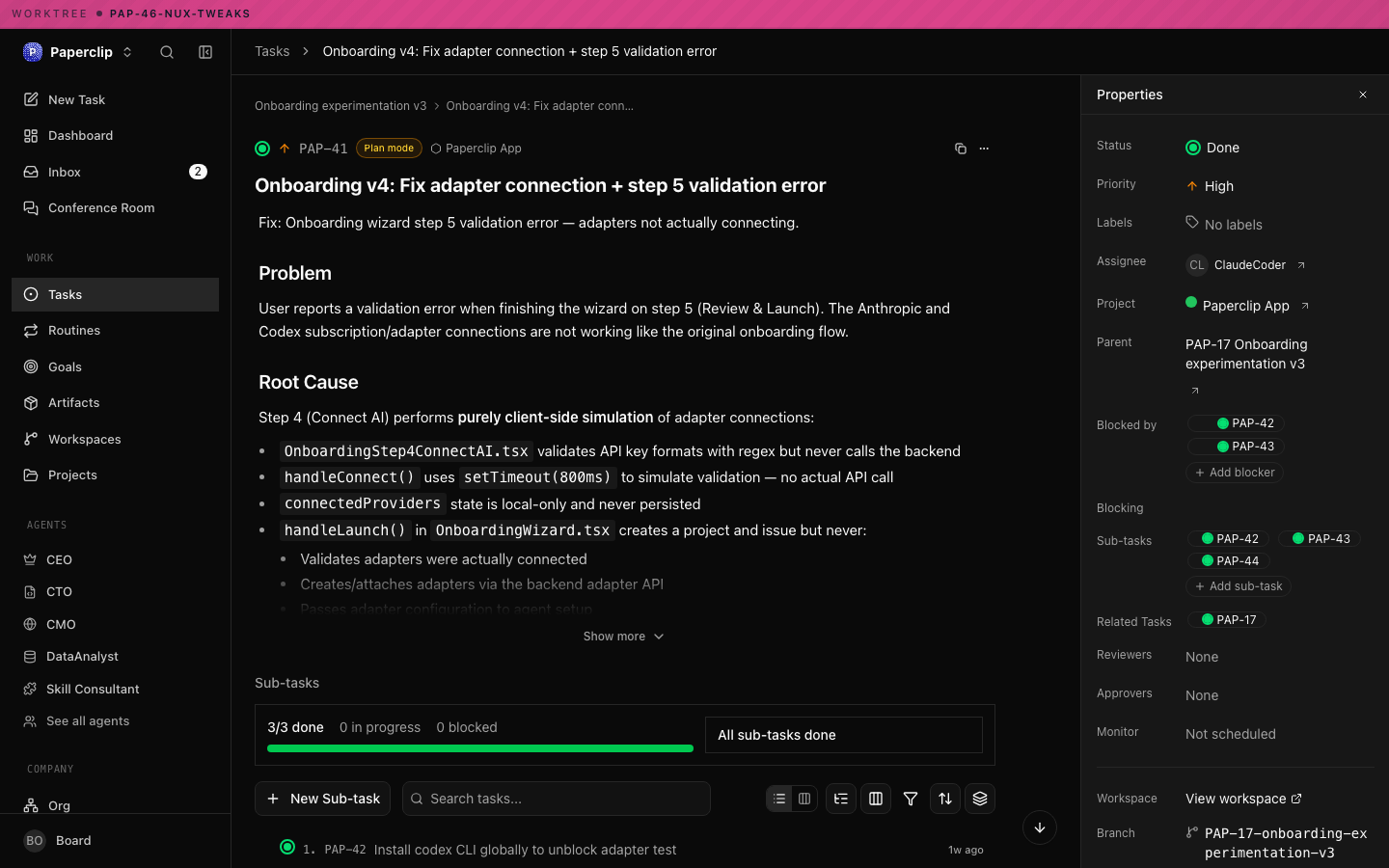
translucent surface + scroll-mask removal; "Agent mode"/"Plan mode"
relabels; no-assignee confirmation `AlertDialog` (new
`ui/alert-dialog.tsx` primitive); `@task` reference picker +
linkification in mentions
- **Agent feed** — single-flight issue-quicklook store (one popover at a
time), flyouts open to the left, removed hover translate-y jitter
- **Status chips** — brand-accurate task status chips behind the flag
(light/dark, 1px borders per paperclip.ing/brand)
- **Tests** — flag on/off parity matrix across IssueDetail,
NewIssueDialog, Sidebar, wizard, gate components; component tests for
all new pieces
- **Merge with `master`** — one conflict in
`ui/src/components/IssueChatThread.tsx`, resolved by keeping master's
new `AssigneeChip`/`HandoffWakeRow`/`RunStatusBadge` components inside
the flag-gated metadata-row chrome (details in commit `21a5642a`);
post-merge fixes: vitest 4 mock typing in `MarkdownEditor.test.tsx`,
flag hook made safe for provider-less mounts (master's new isolated
component tests)
- **Branch hygiene** — internal design wireframes/mockups stripped
before the PR (they live in the Paperclip issue threads)
- No user-facing documentation changes required: the flag is
intentionally experimental and self-described in the Settings card; no
existing docs reference the affected surfaces
## Verification
- `pnpm run typecheck` — green across the workspace (ui, server, shared,
plugins)
- Full UI suite (`vitest run` in `ui/`, clean worktree at this HEAD):
**1593/1595 passing, 223/224 files** — the 2 remaining failures are in
`src/components/artifacts/ArtifactCard.test.tsx` and **fail identically
on pristine `origin/master`** (pre-existing upstream, unrelated to this
branch)
- Full server suite (`vitest run` in `server/`, same clean worktree):
results in PR checks; flag plumbing covered by instance-settings tests
- Targeted post-merge resolution check: `IssueChatThread`,
`IssueChatThreadSystemNotice`, `IssueDetail`, `Sidebar`,
`ConferenceRoomChatGate`, `OnboardingWizardVariant`, `NewIssueDialog`,
`InstanceExperimentalSettings`, `MarkdownEditor` — 172/172 passing
- Manual walkthrough: flag OFF (default) → onboarding wizard, task
thread, board chat, composer all render the classic UI; flag ON via
Settings → Experimental → capsule wizard, conference-room chat, unified
composer, status chips active
- Screenshots: see below
**Flag on/off screenshots** (committed on this branch under
`screenshots/PR-8000-*`):
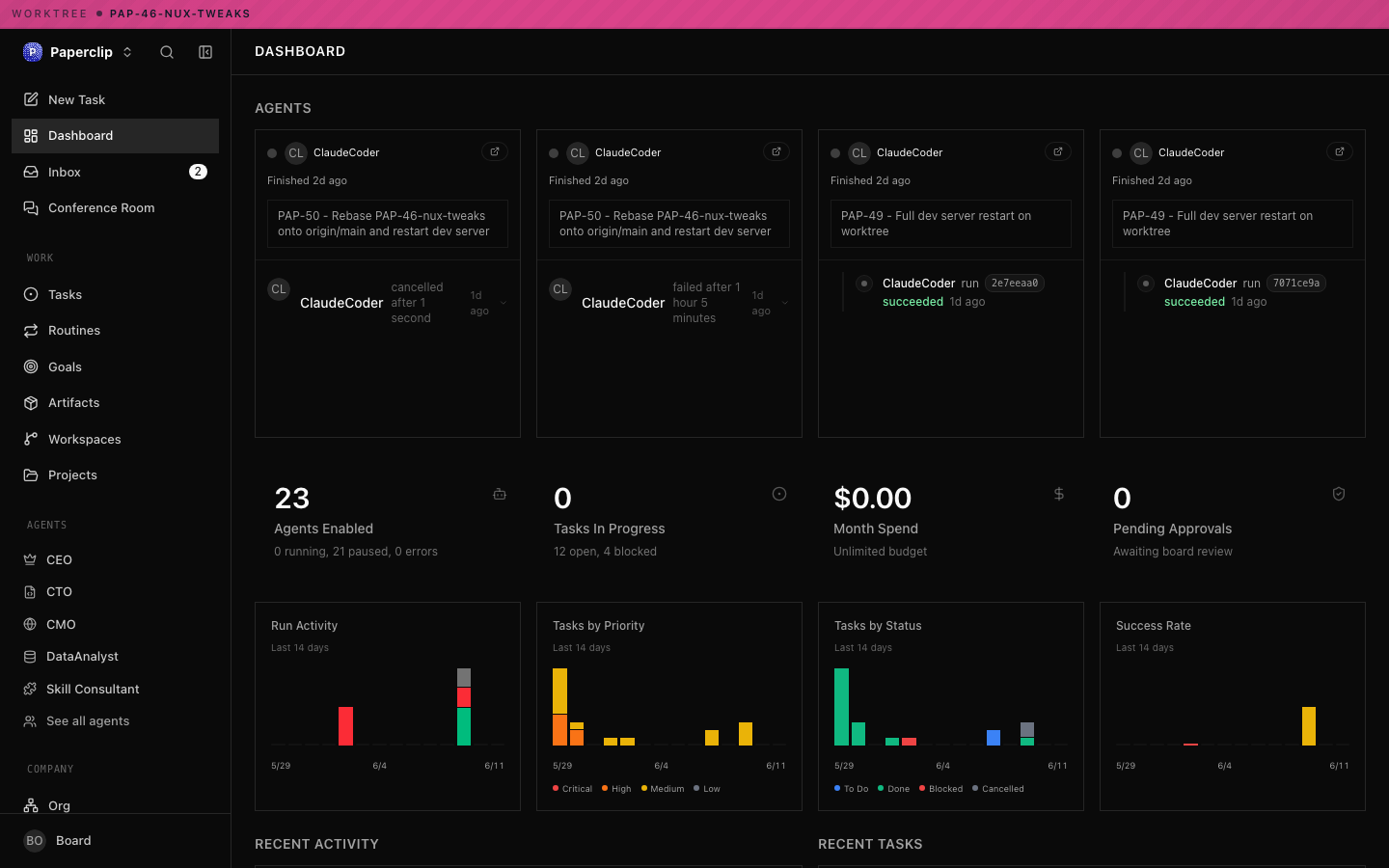
| Surface | Flag OFF (classic, default) | Flag ON (experimental) |
| --- | --- | --- |
| Settings → Experimental | 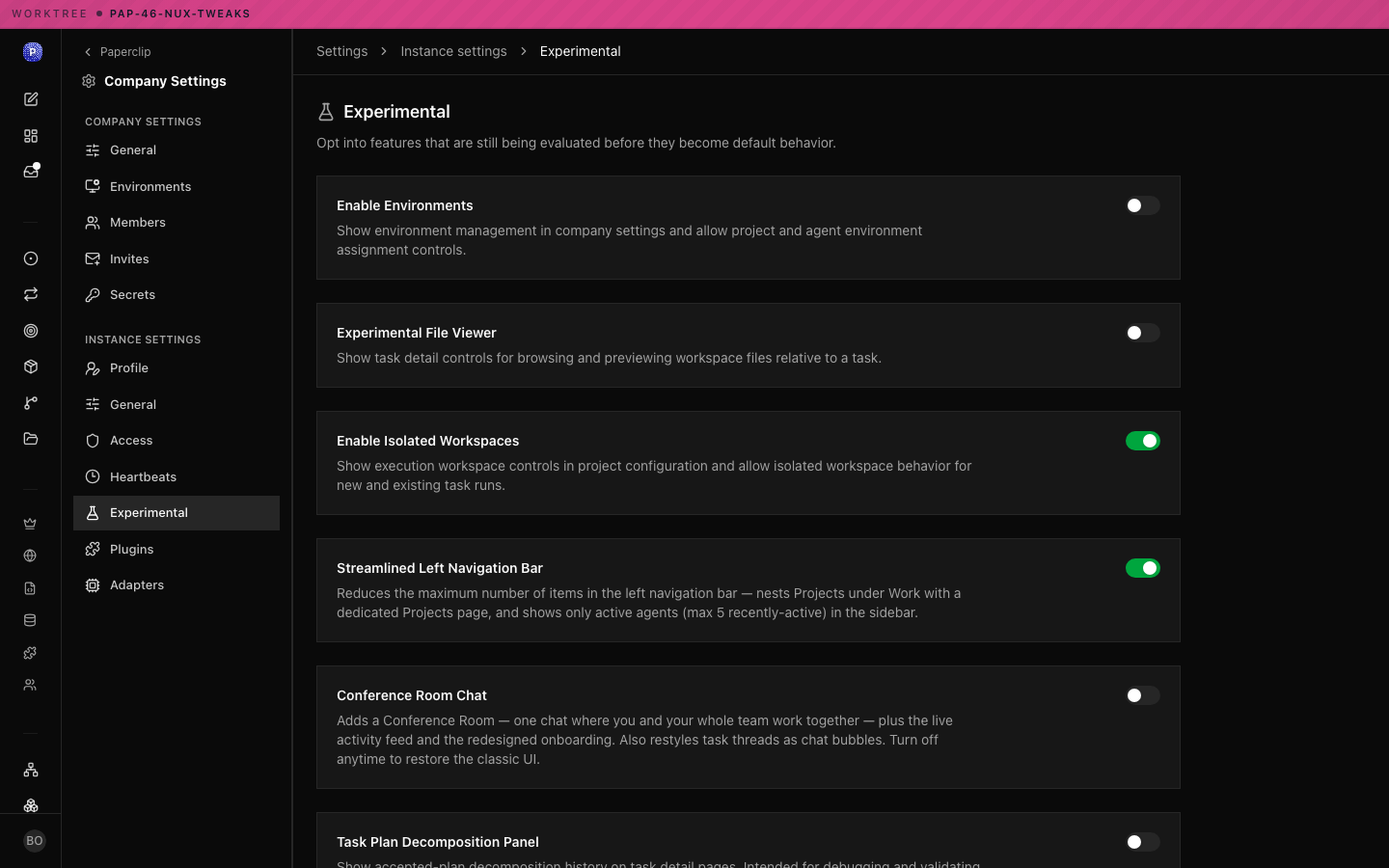
| 
|
| Task thread | 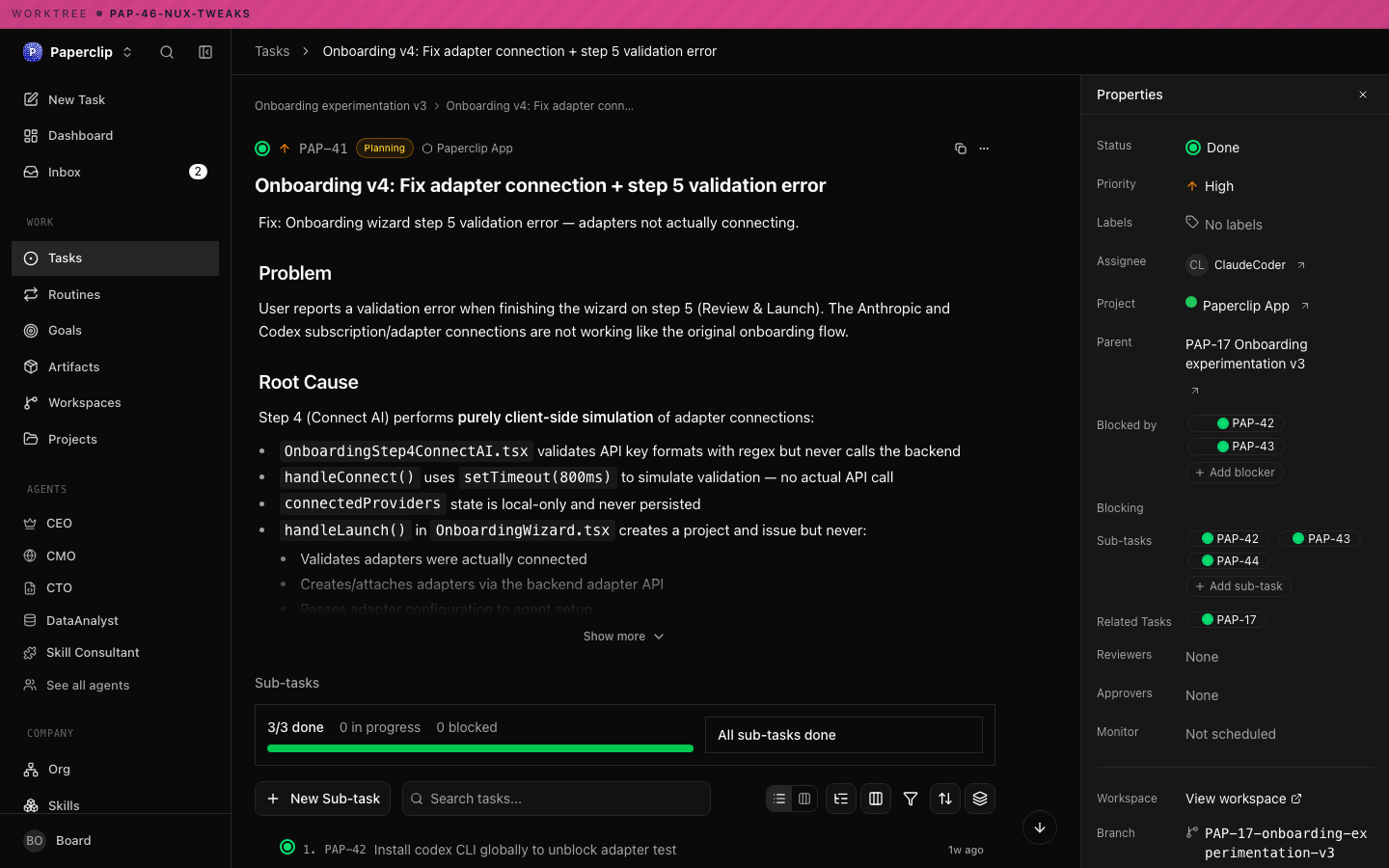
| 
|
| Home / nav | 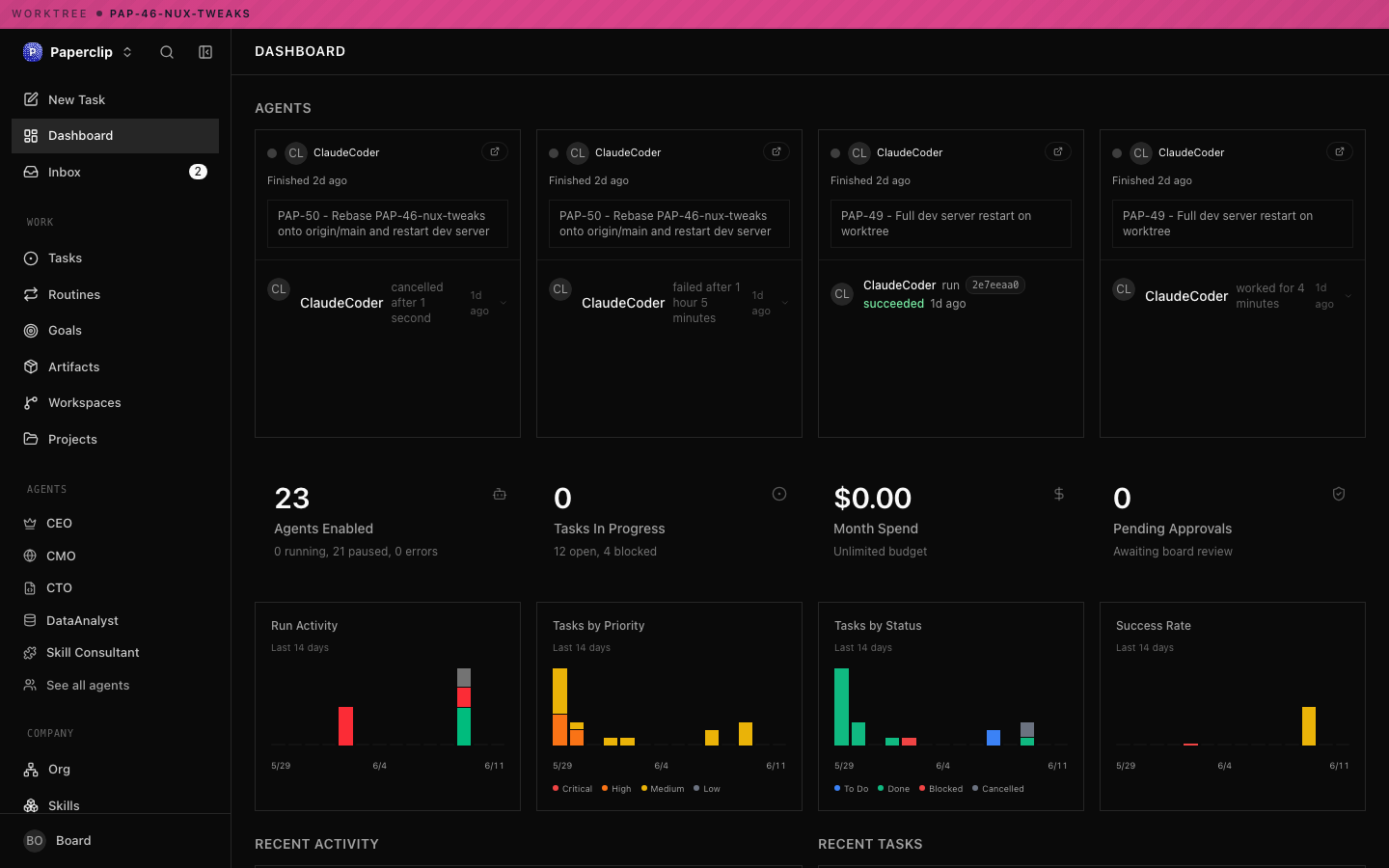
| 
|
| Conference Room (flag-ON only surface) | — | 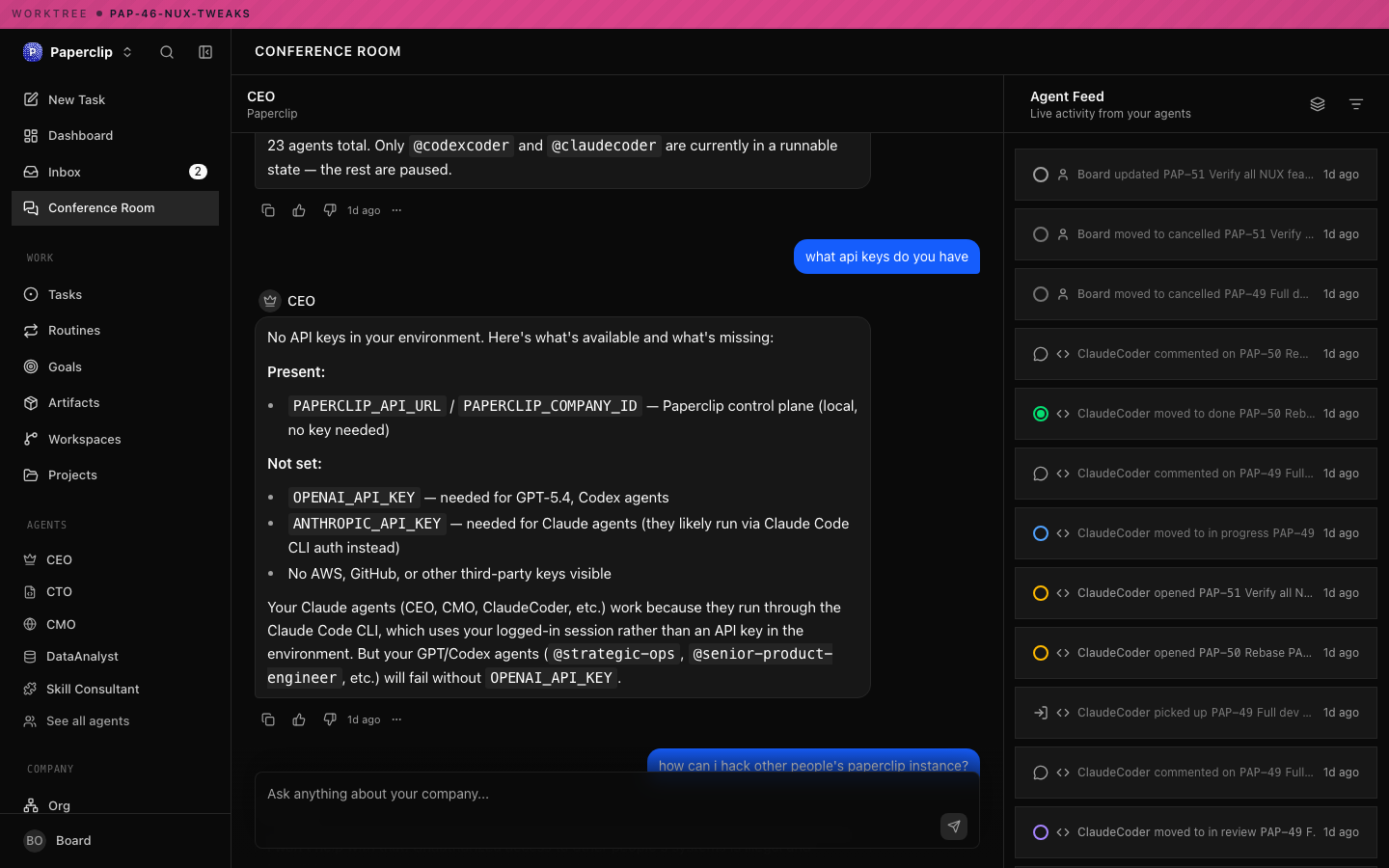
|
Capsule onboarding wizard walkthrough screenshots (flag ON) are attached
to the Paperclip design/implementation threads; the wizard requires a
fresh instance so it is captured via the e2e harness
(`tests/e2e/nux-phase4-screenshots.spec.ts`).
## Risks
- **Large surface, but gated:** all new behavior sits behind
`enableConferenceRoomChat`, default OFF; flag-OFF rendering is locked by
frozen `*Classic` forks plus an on/off parity test suite
- **Classic forks are frozen at the fork point (`e3aada1d`):** master
features added to the live thread component after that point (assignee
handoff chips, run status badge, composer mention coach) render in the
flag-ON path; the flag-OFF task thread keeps the fork-point behavior
until the experiment graduates (forks deleted) or is dropped (forks
restored as canonical). Called out for reviewer attention.
- **Merge-conflict resolution in `IssueChatThread.tsx`** (commit
`21a5642a`) deserves reviewer eyes: master's new handoff/run-status
components were kept; the base toast-style no-assignee flow remains
replaced by the AlertDialog flow introduced on this branch
- Schema/server changes are additive (one optional boolean instance
setting); no migrations of existing data
## Model Used
- Claude (Anthropic) via Claude Code running in the Paperclip agent
harness (agent: ClaudeCoder)
- Branch implemented across multiple agent sessions on Claude Opus-class
models with extended thinking + tool use (file edits, shell, Playwright
screenshots); merge/PR session model ID as reported by the harness:
`claude-fable-5` (Claude Code CLI)
- All code was agent-authored and board-reviewed through Paperclip issue
threads (plans, wireframes, confirmations) before merging
## Checklist
- [x] I have included a thinking path that traces from project context
to this change
- [x] I have specified the model used (with version and capability
details)
- [x] I have checked ROADMAP.md and confirmed this PR does not duplicate
planned core work
- [x] I have searched GitHub for duplicate or related PRs and linked
them above
- [x] I have either (a) linked existing issues with `Fixes: #` / `Closes
#` / `Refs #` OR (b) described the issue in-PR following the relevant
issue template
- [x] I have run tests locally and they pass
- [x] I have added or updated tests where applicable
- [x] If this change affects the UI, I have included before/after
screenshots
- [x] I have updated relevant documentation to reflect my changes (none
required — experimental flag, self-documenting Settings card; noted
above)
- [x] I have considered and documented any risks above
- [x] All Paperclip CI gates are green (run 3 on `8af3041a`: all 16
gates SUCCESS, incl. e2e and all 4 serialized-suite shards)
- [x] Greptile is 5/5 with no open P2s, recommendations, or follow-ups
(re-review verdict: Confidence 5/5, “Safe to merge”; all 4 round-1
findings fixed + confirmed resolved; both summary notes addressed in
`8af3041a`)
- [x] I will address all Greptile and reviewer comments before
requesting merge
---------
Co-authored-by: Paperclip <noreply@paperclip.ing>
Co-authored-by: Claude Opus 4.8 <noreply@anthropic.com>
## Thinking Path
> - Paperclip orchestrates AI agents through pluggable local adapters;
codex_local wraps OpenAI's `codex` CLI.
> - The codex_local adapter declares a hard-coded
`DEFAULT_CODEX_LOCAL_MODEL = "gpt-5.3-codex"` and multiple Paperclip
consumers (UI build-config, server route, OnboardingWizard, NewAgent
form, AgentConfigForm) fall back to it when the operator doesn't pick a
model.
> - That model — and every `*-codex` model plus the older
`gpt-5/5.1/5.2` lines — is API-key-only. Codex CLI rejects them on
ChatGPT subscription auth with "The 'gpt-5.3-codex' model is not
supported when using Codex with a ChatGPT account."
> - Every codex_local agent created through the default onboarding path
inherits this pin and breaks on its first heartbeat for any user authed
via `codex login` (ChatGPT).
> - claude_local already takes the right shape: its build-config only
sets `adapterConfig.model` when the operator actually picked one, and
falls through to whatever default `claude` CLI uses.
> - Codex CLI's own default is auth-mode-aware. ChatGPT-subscription
accounts get `gpt-5.5`; API-key accounts get the codex-tuned default. A
Paperclip-side pin masks this and downgrades whichever group it wasn't
built for.
> - This PR makes codex_local match claude_local's shape: omit
`adapterConfig.model` when the user picks "default," and let the CLI
choose. Subscription users stop breaking; API-key users stop getting
downgraded.
> - The benefit is auth-mode-correct defaults with no Paperclip-side
hard pin, plus future-proofing: when OpenAI bumps the CLI default we
inherit it for free.
## What Changed
- `packages/adapters/codex-local/src/ui/build-config.ts` — only set
`adapterConfig.model` when the operator picked one (parity with
`packages/adapters/claude-local/src/ui/build-config.ts`).
- `server/src/routes/agents.ts` — drop the codex_local-specific
`next.model = DEFAULT_CODEX_LOCAL_MODEL` fallback in
`applyCreateDefaultsByAdapterType`. Bypass-sandbox default is left in
place (security posture, not a model choice).
- `ui/src/pages/NewAgent.tsx`, `ui/src/components/AgentConfigForm.tsx`,
`ui/src/components/OnboardingWizard.tsx` — stop pre-populating the model
field with `DEFAULT_CODEX_LOCAL_MODEL` when the user selects the Codex
adapter. Other adapters' defaults (gemini_local, cursor, opencode_local)
are unchanged.
- `DEFAULT_CODEX_LOCAL_MODEL` is preserved as an exported constant for
downstream consumers / plugin authors who want to opt in to a pin; we
just stop forcing it on operators who didn't ask for one.
- Test: assert `buildCodexLocalConfig` omits `model` when input is
blank.
## Verification
- `pnpm exec vitest run
packages/adapters/codex-local/src/ui/build-config.test.ts
packages/adapters/codex-local/src/server/codex-args.test.ts
server/src/__tests__/adapter-registry.test.ts
server/src/__tests__/heartbeat-model-profile.test.ts
server/src/__tests__/agent-permissions-routes.test.ts` → 74/74 passing
- `pnpm exec vitest run ui/src/lib/duplicate-agent-payload.test.ts
ui/src/lib/acpx-model-filter.test.ts` → passing
- `pnpm tsc --noEmit -p .` → clean
- Live: I separately verified live during initial investigation that on
ChatGPT-subscription auth, `gpt-5.3-codex` is rejected and `gpt-5.5` is
what Codex CLI picks by default. Omitting model lets the CLI handle
that.
## Risks
- Telemetry: any sink that reads `adapterConfig.model` for cost
attribution will now see the empty/omitted case more often. The CLI
emits the actually-used model in its event stream; downstream telemetry
should already read from there for accuracy, but worth a check.
- Operator UX: "default" now means "whatever the CLI picks" instead of a
Paperclip-known model. The selectable catalog still includes `gpt-5.5`,
`gpt-5.4`, `gpt-5.3-codex`, etc. for operators who want to pin
explicitly.
- Existing agents are unaffected — their `adapterConfig.model` is
already set; this only changes the *new-agent* default flow.
## Related work
- Depends on: an open catalog-add PR adding `gpt-5.5` to the selectable
model list and to `CODEX_LOCAL_FAST_MODE_SUPPORTED_MODELS`. Operators
who want to switch to `gpt-5.5` explicitly need that PR merged first;
this PR is the structural change that makes "default" mean "let the CLI
choose."
- Closes#5371 — codex_local default model selection persists
`gpt-5.3-codex` instead of adapter default (this PR is the exact fix
#5371 proposes).
- Related: #5132 (opencode-local: hire-time default model fails on
ChatGPT-OAuth accounts) — same problem shape on a sibling adapter; not
fixed here but worth tracking for a parallel.
- Related: #5939 (codex_local adapter hardcodes `gpt-5.3-codex-spark`
validation, fails on ChatGPT OAuth accounts regardless of configured
model) — separate validation-path bug; not fixed here.
## Model Used
Claude (Sonnet-class), running inside Paperclip as a claude_local
executor.
## Checklist
- [x] I have included a thinking path that traces from project context
to this change
- [x] I have specified the model used (with version and capability
details)
- [x] I have checked ROADMAP.md and confirmed this PR does not duplicate
planned core work
- [x] I have searched GitHub for duplicate or related PRs and linked
them above
- [x] I have either (a) linked existing issues with `Fixes: #` / `Closes
#` / `Refs #` OR (b) described the issue in-PR following the relevant
issue template
- [x] I have run tests locally and they pass
- [x] I have added or updated tests where applicable
- [x] If this change affects the UI, I have included before/after
screenshots
- [x] I have updated relevant documentation to reflect my changes
- [x] I have considered and documented any risks above
- [x] All Paperclip CI gates are green
- [x] Greptile is 5/5 with no open P2s, recommendations, or follow-ups
- [x] I will address all Greptile and reviewer comments before
requesting merge
Co-authored-by: Paperclip <noreply@paperclip.ing>
## Thinking Path

> - Paperclip is the open source app people use to manage AI agents for
work.
> - The board UI is the operator surface where users create, assign,
monitor, and review work items.
> - The product language is moving toward "tasks" for user-facing work
items while the internal API and database still use "issues".
> - PR #7543 bundled this copy migration with broader
information-architecture work, which made the branch too large for
Greptile review.
> - This pull request peels the Issue-to-Task copy migration into a
smaller, independently reviewable change.
> - The benefit is clearer user-facing terminology, less agent confusion
via the Paperclip skill note, and a smaller PR that Greptile can review.

## Linked Issues or Issue Description

Refs #7645
Refs #7543
Refs PAP-10430

This PR was split out of #7543 so the Issue-to-Task copy migration can
be reviewed separately and the remaining IA PR can fall under Greptile's
file limit.

## What Changed

- Preserves Scott Tong's original `PAP-57` copy-only commit, with author
and co-author credit intact, to rename user-facing "Issues" copy to
"Tasks" across the UI while keeping routes/API/internal symbols as
`issue`.
- Updates onboarding and release-smoke browser selectors from `Create &
Open Issue` to `Create & Open Task`.
- Adds a terminology note to `skills/paperclip/SKILL.md` clarifying that
task and issue refer to the same Paperclip work item.
- Resolves the only cherry-pick conflict by keeping current search
artifacts support and changing visible search copy to "tasks".

## Verification

- `pnpm --filter @paperclipai/ui build` passed.
- `NODE_ENV=test pnpm exec vitest run
ui/src/components/IssuesList.test.tsx ui/src/components/Sidebar.test.tsx
ui/src/components/NewIssueDialog.test.tsx
ui/src/pages/IssueDetail.test.tsx` passed: 4 files, 66 tests.
- `git diff --check origin/master...HEAD` passed.
- Diff is 80 files, below Greptile's 100-file limit.
- Before/after UI copy examples: "Issues" -> "Tasks", "New Issue" ->
"New Task", "Create & Open Issue" -> "Create & Open Task".

## Risks

- Medium copy-risk: this intentionally changes user-facing terminology
broadly while keeping internal issue identifiers and routes unchanged.
- Some docs and APIs still say `issue`; the skill note clarifies this so
agents do not treat task and issue as separate entities.
- Browser-level visual validation is expected from CI because this local
container is missing usable browser dependencies.

> For core feature work, check [`ROADMAP.md`](ROADMAP.md) first and
discuss it in `#dev` before opening the PR. Feature PRs that overlap
with planned core work may need to be redirected — check the roadmap
first. See `CONTRIBUTING.md`.

## Model Used

Scott Tong authored the original `PAP-57` copy migration, assisted by
Claude Opus 4.8 and Paperclip agents per the preserved commit metadata.
Codex / GPT-5-class coding agent with shell, GitHub CLI, and repository
access performed the PR split, conflict resolution, skill note, and
verification.

## Checklist

- [x] I have included a thinking path that traces from project context
to this change
- [x] I have specified the model used (with version and capability
details)
- [x] I have checked ROADMAP.md and confirmed this PR does not duplicate
planned core work
- [x] I have searched GitHub for duplicate or related PRs and linked
them above
- [x] I have either (a) linked existing issues with `Fixes: #` / `Closes
#` / `Refs #` OR (b) described the issue in-PR following the relevant
issue template
- [x] I have run tests locally and they pass
- [x] I have added or updated tests where applicable
- [x] If this change affects the UI, I have included before/after
screenshots
- [x] I have updated relevant documentation to reflect my changes
- [x] I have considered and documented any risks above
- [x] All Paperclip CI gates are green
- [x] Greptile is 5/5 with no open P2s, recommendations, or follow-ups
- [x] I will address all Greptile and reviewer comments before
requesting merge

---------

Co-authored-by: scotttong <scott.tong@gmail.com>
Co-authored-by: Claude Opus 4.8 <noreply@anthropic.com>
Co-authored-by: Paperclip <noreply@paperclip.ing>
> **Stacked PR (part 4 of 7).** Depends on:
  - PR #5114
  - PR #5115
  - PR #5116
> Diff against `master` includes commits from earlier PRs in the stack —
the new commit in this PR is the topmost one.

## Thinking Path

> - Paperclip orchestrates AI agents for zero-human companies
> - When creating an OpenCode-local agent, Paperclip currently validates
> `adapterConfig.model` against the *Paperclip host's* `opencode models`
output
> - SSH testing surfaced that this blocks creating an OpenCode agent for
an SSH
> environment: the model that exists on the SSH target isn't visible to
the
> host, so creation fails with "OpenCode requires `adapterConfig.model`
in
> provider/model format" even when the operator picked a real remote
model
> - The initial direction was environment-aware model discovery; the
final
> decision was to keep OpenCode on the same explicit-model pattern as
other
> adapters (default + curated list + manual override) and stop blocking
>   creation on host-side discovery
> - This PR does both: the adapter-models endpoint now accepts
`environmentId` and
> probes against the target environment, and the create-time hard gate
is
> replaced by `requireOpenCodeModelId` which validates `provider/model`
*format*
> without requiring host-local discovery. Test/run-time still surfaces
real
>   auth/availability problems
> - The benefit is that operators can create OpenCode agents for remote
> environments without out-of-band setup, and the model picker in the UI
>   reflects the actually-targeted environment

## What Changed

- Added `requireOpenCodeModelId(input)` in
`opencode-local/src/server/models.ts`,
  exported it from the adapter index
- `ensureOpenCodeModelConfiguredAndAvailable` now delegates the format
check to
  `requireOpenCodeModelId`
- `agentsApi.adapterModels(companyId, adapterType, { environmentId })`
now accepts
  an environment ID and passes it as a query parameter
- `queryKeys.agents.adapterModels` now keys on `(companyId, adapterType,
environmentId)`
- `server/src/routes/agents.ts` reads and validates the new query
parameter,
  forwarding it to the adapter's model probe
- `AgentConfigForm.tsx` and `OnboardingWizard.tsx` build the model query
key from
the currently selected default environment ID and disable autodetect for
  `opencode_local` (model selection is explicit)
- `NewAgent.tsx` simplified — no longer special-cases OpenCode
autodetect
- `company-portability.ts` no longer needs OpenCode-specific autodetect
handling
- Tests added/updated:
  `adapter-model-refresh-routes.test.ts`, `adapter-models.test.ts`,
`agent-permissions-routes.test.ts`,
`opencode-local/src/server/models.test.ts`

## Verification

- `pnpm --filter @paperclipai/server test -- adapter-models
adapter-model-refresh agent-permissions`
- `pnpm --filter @paperclipai/adapter-opencode-local test`
- `pnpm --filter @paperclipai/ui test -- AgentConfigForm
OnboardingWizard NewAgent`
- Manual QA in browser:
1. Boot Paperclip on Tailscale-bound port (so it's reachable from
another
machine), create an OpenCode-local agent, switch the default environment
between two installed sandboxes, and confirm the model list refreshes
     per-environment
  2. Submit with a malformed `provider/model` string and verify the new
     `requireOpenCodeModelId` error surfaces
- Before/after screenshots attached for `AgentConfigForm` model picker

## Risks

- Behavioural shift: switching default environment now triggers a model
refetch.
Should be cheap but introduces a new UI loading state for OpenCode
users.
- Removing dynamic autodetect for OpenCode: if any user configured an
agent
without specifying `model` and relied on autodetect populating it, that
agent
will now fail at submit time. Mitigation: validation error is explicit
and
  actionable.
- New query string parameter on `/api/companies/:id/adapter-models` —
older
clients that omit it still work (parameter is optional and defaults to
null).

## Model Used

- OpenAI GPT-5.4 (reasoning effort: high) via Codex CLI
- Provider: OpenAI
- Used to author the code changes in this PR

## Checklist

- [x] I have included a thinking path that traces from project context
to this change
- [x] I have specified the model used (with version and capability
details)
- [x] I have checked ROADMAP.md and confirmed this PR does not duplicate
planned core work
- [x] I have run tests locally and they pass
- [x] I have added or updated tests where applicable
- [x] If this change affects the UI, I have included before/after
screenshots
- [ ] I have updated relevant documentation to reflect my changes — N/A
- [x] I have considered and documented any risks above
- [x] I will address all Greptile and reviewer comments before
requesting merge
## Thinking Path
> - Paperclip orchestrates AI-agent companies through a control plane
that can start, supervise, and recover agent runs.
> - Local adapters are the bridge between Paperclip issues and concrete
agent runtimes such as Claude, Codex, and other ACP-compatible tools.
> - The roadmap calls out broader “bring your own agent” and claw-style
agent support, and ACPX gives Paperclip one path to normalize multiple
ACP agents behind a single adapter.
> - The branch needed to become one reviewable PR against current
`paperclipai/paperclip:master`, without carrying stale base conflicts or
generated lockfile churn.
> - This pull request adds an experimental built-in `acpx_local`
adapter, integrates it through the server/CLI/UI adapter surfaces, and
adds regression coverage for runtime execution, skill sync, stream
parsing, diagnostics, and log redaction.
> - The benefit is that Paperclip can run Claude/Codex/custom ACP agents
through ACPX while keeping operator configuration, skills, logging, and
transcript rendering inside the existing adapter model.
## What Changed
- Added `@paperclipai/adapter-acpx-local` with server execution, config
schema, ACPX session handling, CLI formatting, UI config helpers, and
stdout parsing.
- Registered `acpx_local` across CLI, server, shared constants, UI
adapter metadata, adapter capabilities, and agent creation/editing
surfaces.
- Added ACPX runtime execution support with persistent sessions,
local-agent JWT environment handling, skill snapshots, runtime skill
materialization, and isolation/security regressions.
- Added ACPX adapter diagnostics and marked the adapter experimental in
the UI.
- Added command/env secret redaction for resolved command metadata in
adapter-utils, server event storage, and the Agent Detail invocation UI.
- Added Storybook coverage for ACPX config, transcript rendering, and
skill states, plus PR screenshots under `docs/pr-screenshots/pap-2944/`.
- Rebased the branch onto current `public-gh/master`; `pnpm-lock.yaml`
is intentionally not included and there are no migration/schema changes.
## Verification
- `pnpm exec vitest run
packages/adapters/acpx-local/src/server/execute.test.ts
packages/adapters/acpx-local/src/server/test.test.ts
packages/adapters/acpx-local/src/cli/format-event.test.ts
packages/adapters/acpx-local/src/ui/parse-stdout.test.ts
packages/adapter-utils/src/server-utils.test.ts
server/src/__tests__/redaction.test.ts
server/src/__tests__/acpx-local-execute.test.ts
server/src/__tests__/acpx-local-skill-sync.test.ts
server/src/__tests__/acpx-local-adapter-environment.test.ts
server/src/__tests__/adapter-routes.test.ts
server/src/__tests__/agent-skills-routes.test.ts
ui/src/adapters/metadata.test.ts` — 12 files, 87 tests passed.
- `pnpm --filter @paperclipai/adapter-acpx-local typecheck` — passed.
- `pnpm --filter @paperclipai/server typecheck` — passed.
- `pnpm --filter @paperclipai/ui typecheck` — passed.
- Confirmed PR diff does not include `pnpm-lock.yaml`, database schema
files, or migrations.
Screenshots:


## Risks
- Medium risk: this introduces a new built-in adapter package and
touches runtime execution, adapter registration, agent config, skills,
and transcript rendering.
- ACPX and ACP agent behavior can vary by installed tool versions; the
adapter is marked experimental to set operator expectations.
- `pnpm-lock.yaml` is excluded per repository PR policy, so dependency
lock refresh must be handled by the repo’s automation or maintainers.
- No database migration risk: no schema or migration files changed.
> For core feature work, check [`ROADMAP.md`](ROADMAP.md) first and
discuss it in `#dev` before opening the PR. Feature PRs that overlap
with planned core work may need to be redirected — check the roadmap
first. See `CONTRIBUTING.md`.
## Model Used
- OpenAI Codex coding agent based on GPT-5, with repository tool use,
shell execution, git operations, and local verification. Exact hosted
context window was not exposed in this environment.
## Checklist
- [x] I have included a thinking path that traces from project context
to this change
- [x] I have specified the model used (with version and capability
details)
- [x] I have checked ROADMAP.md and confirmed this PR does not duplicate
planned core work
- [x] I have run tests locally and they pass
- [x] I have added or updated tests where applicable
- [x] If this change affects the UI, I have included before/after
screenshots
- [x] I have updated relevant documentation to reflect my changes
- [x] I have considered and documented any risks above
- [x] I will address all Greptile and reviewer comments before
requesting merge
---------
Co-authored-by: Paperclip <noreply@paperclip.ing>
## Thinking Path

> - Paperclip orchestrates AI agents for zero-human companies.
> - The REST API is the control-plane boundary for companies, agents,
plugins, adapters, costs, invites, and issue mutations.
> - Several routes still relied on broad board or company access checks
without consistently enforcing the narrower actor, company, and
active-checkout boundaries those operations require.
> - That can allow agents or non-admin users to mutate sensitive
resources outside the intended governance path.
> - This pull request hardens the route authorization layer and adds
regression coverage for the audited API surfaces.
> - The benefit is tighter multi-company isolation, safer plugin and
adapter administration, and stronger enforcement of active issue
ownership.

## What Changed

- Added route-level authorization checks for budgets, plugin
administration/scoped routes, adapter management, company import/export,
direct agent creation, invite test resolution, and issue mutation/write
surfaces.
- Enforced active checkout ownership for agent-authenticated issue
mutations, while preserving explicit management overrides for permitted
managers.
- Restricted sensitive adapter and plugin management operations to
instance-admin or properly scoped actors.
- Tightened company portability and invite probing routes so agents
cannot cross company boundaries.
- Updated access constants and the Company Access UI copy for the new
active-checkout management grant.
- Added focused regression tests covering cross-company denial, agent
self-mutation denial, admin-only operations, and active checkout
ownership.
- Rebased the branch onto `public-gh/master` and fixed validation
fallout from the rebase: heartbeat-context route ordering and a company
import/export e2e fixture that now opts out of direct-hire approval
before using direct agent creation.
- Updated onboarding and signoff e2e setup to create seed agents through
`/agent-hires` plus board approval, so they remain compatible with the
approval-gated new-agent default.
- Addressed Greptile feedback by removing a duplicate company export API
alias, avoiding N+1 reporting-chain lookups in active-checkout override
checks, allowing agent mutations on unassigned `in_progress` issues, and
blocking NAT64 invite-probe targets.

## Verification

- `pnpm exec vitest run
server/src/__tests__/issues-goal-context-routes.test.ts
cli/src/__tests__/company-import-export-e2e.test.ts`
- `pnpm exec vitest run server/src/__tests__/plugin-routes-authz.test.ts
server/src/__tests__/adapter-routes-authz.test.ts
server/src/__tests__/agent-permissions-routes.test.ts
server/src/__tests__/company-portability-routes.test.ts
server/src/__tests__/costs-service.test.ts
server/src/__tests__/invite-test-resolution-route.test.ts
server/src/__tests__/issue-agent-mutation-ownership-routes.test.ts
server/src/__tests__/agent-adapter-validation-routes.test.ts`
- `pnpm exec vitest run
server/src/__tests__/issue-agent-mutation-ownership-routes.test.ts`
- `pnpm exec vitest run
server/src/__tests__/invite-test-resolution-route.test.ts`
- `pnpm -r typecheck`
- `pnpm --filter server typecheck`
- `pnpm --filter ui typecheck`
- `pnpm build`
- `pnpm test:e2e -- tests/e2e/onboarding.spec.ts
tests/e2e/signoff-policy.spec.ts`
- `pnpm test:e2e -- tests/e2e/signoff-policy.spec.ts`
- `pnpm test:run` was also run. It failed under default full-suite
parallelism with two order-dependent failures in
`plugin-routes-authz.test.ts` and `routines-e2e.test.ts`; both files
passed when rerun directly together with `pnpm exec vitest run
server/src/__tests__/plugin-routes-authz.test.ts
server/src/__tests__/routines-e2e.test.ts`.

## Risks

- Medium risk: this changes authorization behavior across multiple
sensitive API surfaces, so callers that depended on broad board/company
access may now receive `403` or `409` until they use the correct
governance path.
- Direct agent creation now respects the company-level board-approval
requirement; integrations that need pending hires should use
`/api/companies/:companyId/agent-hires`.
- Active in-progress issue mutations now require checkout ownership or
an explicit management override, which may reveal workflow assumptions
in older automation.

> For core feature work, check [`ROADMAP.md`](ROADMAP.md) first and
discuss it in `#dev` before opening the PR. Feature PRs that overlap
with planned core work may need to be redirected — check the roadmap
first. See `CONTRIBUTING.md`.

## Model Used

OpenAI Codex, GPT-5 coding agent, tool-using workflow with local shell,
Git, GitHub CLI, and repository tests.

## Checklist

- [x] I have included a thinking path that traces from project context
to this change
- [x] I have specified the model used (with version and capability
details)
- [x] I have checked ROADMAP.md and confirmed this PR does not duplicate
planned core work
- [ ] I have run tests locally and they pass
- [x] I have added or updated tests where applicable
- [x] If this change affects the UI, I have included before/after
screenshots
- [x] I have updated relevant documentation to reflect my changes
- [x] I have considered and documented any risks above
- [x] I will address all Greptile and reviewer comments before
requesting merge

---------

Co-authored-by: Paperclip <noreply@paperclip.ing>
## Thinking Path

> - Paperclip orchestrates AI agents via adapters (`claude_local`,
`codex_local`, etc.)
> - Each adapter type has different capabilities — instructions bundles,
skill materialization, local JWT — but these were gated by 5 hardcoded
type lists scattered across server routes and UI components
> - External adapter plugins (e.g. a future `opencode_k8s`) cannot add
themselves to those hardcoded lists without patching Paperclip source
> - The existing `supportsLocalAgentJwt` field on `ServerAdapterModule`
proves the right pattern already exists; it just wasn't applied to the
other capability gates
> - This pull request replaces the 4 remaining hardcoded lists with
declarative capability flags on `ServerAdapterModule`, exposed through
the adapter listing API
> - The benefit is that external adapter plugins can now declare their
own capabilities without any changes to Paperclip source code

## What Changed

- **`packages/adapter-utils/src/types.ts`** — added optional capability
fields to `ServerAdapterModule`: `supportsInstructionsBundle`,
`instructionsPathKey`, `requiresMaterializedRuntimeSkills`
- **`server/src/routes/agents.ts`** — replaced
`DEFAULT_MANAGED_INSTRUCTIONS_ADAPTER_TYPES` and
`ADAPTERS_REQUIRING_MATERIALIZED_RUNTIME_SKILLS` hardcoded sets with
capability-aware helper functions that fall back to the legacy sets for
adapters that don't set flags
- **`server/src/routes/adapters.ts`** — `GET /api/adapters` now includes
a `capabilities` object per adapter (all four flags + derived
`supportsSkills`)
- **`server/src/adapters/registry.ts`** — all built-in adapters
(`claude_local`, `codex_local`, `process`, `cursor`) now declare flags
explicitly
- **`ui/src/adapters/use-adapter-capabilities.ts`** — new hook that
fetches adapter capabilities from the API
- **`ui/src/pages/AgentDetail.tsx`** — replaced hardcoded `isLocal`
allowlist with `capabilities.supportsInstructionsBundle` from the API
- **`ui/src/components/AgentConfigForm.tsx`** /
**`OnboardingWizard.tsx`** — replaced `NONLOCAL_TYPES` denylist with
capability-based checks
- **`server/src/__tests__/adapter-registry.test.ts`** /
**`adapter-routes.test.ts`** — tests covering flag exposure,
undefined-when-unset, and per-adapter values
- **`docs/adapters/creating-an-adapter.md`** — new "Capability Flags"
section documenting all flags and an example for external plugin authors

## Verification

- Run `pnpm test --filter=@paperclip/server -- adapter-registry
adapter-routes` — all new tests pass
- Run `pnpm test --filter=@paperclip/adapter-utils` — existing tests
still pass
- Spin up dev server, open an agent with `claude_local` type —
instructions bundle tab still visible
- Create/open an agent with a non-local type — instructions bundle tab
still hidden
- Call `GET /api/adapters` and verify each adapter includes a
`capabilities` object with the correct flags

## Risks

- **Low risk overall** — all new flags are optional with
backwards-compatible fallbacks to the existing hardcoded sets; no
adapter behaviour changes unless a flag is explicitly set
- Adapters that do not declare flags continue to use the legacy lists,
so there is no regression risk for built-in adapters
- The UI capability hook adds one API call to AgentDetail mount; this is
a pre-existing endpoint, so no new latency path is introduced

## Model Used

- Provider: Anthropic
- Model: Claude Sonnet 4.6 (`claude-sonnet-4-6`)
- Context: 200k token context window
- Mode: Agentic tool use (code editing, bash, grep, file reads)

## Checklist

- [x] I have included a thinking path that traces from project context
to this change
- [x] I have specified the model used (with version and capability
details)
- [x] I have run tests locally and they pass
- [x] I have added or updated tests where applicable
- [ ] If this change affects the UI, I have included before/after
screenshots
- [x] I have updated relevant documentation to reflect my changes
- [x] I have considered and documented any risks above
- [x] I will address all Greptile and reviewer comments before
requesting merge

---------

Co-authored-by: Pawla Abdul (Bot) <pawla@groombook.dev>
Co-authored-by: Paperclip <noreply@paperclip.ing>
- Plugin loader: install/reload/remove/reinstall external adapters
  from npm packages or local directories
- Plugin store persisted at ~/.paperclip/adapter-plugins.json
- Self-healing UI parser resolution with version caching
- UI: Adapter Manager page, dynamic loader, display registry
  with humanized names for unknown adapter types
- Dev watch: exclude adapter-plugins dir from tsx watcher
  to prevent mid-request server restarts during reinstall
- All consumer fallbacks use getAdapterLabel() for consistent display
- AdapterTypeDropdown uses controlled open state for proper close behavior
- Remove hermes-local from built-in UI (externalized to plugin)
- Add docs for external adapters and UI parser contract
- When the adapter probe passes, show a clean animated "Passed" badge with
  a checkmark icon instead of verbose check details
- Only show the "Manual debug" section when the test fails, reducing noise
  for successful flows

Co-Authored-By: Paperclip <noreply@paperclip.ing>
In the onboarding wizard step 2 ("Create your first agent"), Claude Code and
Codex are now shown prominently as recommended options. Other adapter types
(OpenCode, Pi, Cursor, OpenClaw Gateway) are hidden behind a collapsible
"More Agent Adapter Types" toggle to reduce visual noise for new users.

Co-Authored-By: Paperclip <noreply@paperclip.ing>
When on the Company step (step 1), the form takes up the left half with
ASCII art on the right. Switching to Agent or any other step smoothly
animates the form to full width while fading out the ASCII art panel.
Switching back reverses the animation.

Co-Authored-By: Paperclip <noreply@paperclip.ing>
Co-Authored-By: Claude Opus 4.6 <noreply@anthropic.com>
Replace the progress bar dots with labeled tab buttons (Company, Agent,
Task, Launch) that allow clicking directly to any step. This makes it
easy to debug/preview individual onboarding screens without stepping
through the full flow.

Co-Authored-By: Paperclip <noreply@paperclip.ing>
Co-Authored-By: Claude Opus 4.6 <noreply@anthropic.com>
- Set animation panel (right half) background to #1d1d1d
- Add more margin above Company name form label
- Make form labels white when input is focused or has value
  using Tailwind group/focus-within pattern

Co-Authored-By: Paperclip <noreply@paperclip.ing>
Co-Authored-By: Claude Opus 4.6 <noreply@anthropic.com>
After onboarding, the wizard navigated to the newly created issue
(e.g. /JAR/issues/JAR-1). useCompanyPageMemory then saved this path,
causing every subsequent company switch to land on that stale issue
instead of the dashboard.

Remove the issue-specific navigation branch so handleLaunch always
falls through to the dashboard route.

Co-Authored-By: Claude Opus 4.6 <noreply@anthropic.com>
New adapter type for invoking OpenClaw agents via the gateway protocol.
Registers in server, CLI, and UI adapter registries. Adds onboarding
wizard support with gateway URL field and e2e smoke test script.

Co-Authored-By: Claude Opus 4.6 <noreply@anthropic.com>
- Remove duplicate opencode_local adapter entry in OnboardingWizard
  (old Code-icon version), keeping only the OpenCodeLogoIcon entry
- Extract resolveOpenCodeCommand() helper to deduplicate the
  PAPERCLIP_OPENCODE_COMMAND env-var fallback logic in models.ts
- Bump @types/node from ^22.12.0 to ^24.6.0 to match the monorepo

Co-Authored-By: Claude Opus 4.6 <noreply@anthropic.com>
PR #62 uses strict model selection with no default — the merge
conflict resolution incorrectly kept HEAD's references to this
removed constant. Also remove dead opencode_local branch in
OnboardingWizard (already handled by prior condition).

Co-Authored-By: Claude Opus 4.6 <noreply@anthropic.com>
Merges paperclipai/paperclip#62 onto latest master (494448d).
Adds complete OpenCode provider with strict model selection,
dynamic model discovery, CLI/server/UI adapter registration.

Resolved conflicts with master's cursor adapter additions,
node v24 typing, and containerized opencode support (201d91b).

Co-Authored-By: Claude Opus 4.6 <noreply@anthropic.com>
Shows a green pill badge on the Claude Code and Codex adapter cards
during CEO agent configuration in the onboarding flow.

Co-Authored-By: Claude Opus 4.6 <noreply@anthropic.com>
Radix's DialogOverlay wraps content in RemoveScroll, which blocks wheel
events on elements not registered as DialogPrimitive.Content. Since the
onboarding wizard uses a custom layout (not DialogContent), scroll events
on the form container were being swallowed. Replacing with a plain div
preserves the background appearance without the scroll-locking behavior.

Co-Authored-By: Claude Opus 4.6 <noreply@anthropic.com>
 scotttong









