547463d3a2a0fdf899dc59524eff71a24a6f315c
177 Commits
| Author | SHA1 | Message | Date | |
|---|---|---|---|---|
 Devin Foley Devin Foley
|
547463d3a2 |
refactor(environments): make execution environments instance-scoped (#8375)
## Thinking Path > - Paperclip is the control plane for AI-agent companies, so execution environment selection has to stay inspectable and predictable across companies, agents, and runs. > - The environment subsystem decides where an agent heartbeat actually runs and how remote sandbox state is realized and restored. > - That subsystem previously mixed company-scoped environment catalogs with issue-level environment stamping, so a reassigned issue could keep executing in the previous assignee's sandbox. > - That behavior breaks the control-plane contract: changing the assignee should change the executing agent/environment path unless there is an explicit current override. > - Fixing it cleanly required more than a narrow patch; the environment model had to move to instance scope with a single inherited default and per-agent override semantics. > - This pull request rewires the schema, server/API surface, runtime resolution, and UI around that model, then adds regression coverage for cross-company inheritance and per-agent isolation. > - The benefit is that environment choice now follows the approved instance/agent configuration path instead of stale issue state, while shared environments only need to be configured once per instance. ## Linked Issues or Issue Description - No directly matching public GitHub issue or PR was found while searching for this refactor. ### What happened? Reassigning work between agents with different execution environments could keep running in the previous sandbox because environment choice was stamped onto the issue and outranked the current assignee. The same subsystem also forced environment catalogs to be duplicated per company even though the underlying execution environments were instance-wide resources. ### Expected behavior Execution should resolve through the current instance and agent configuration path, with one instance-scoped environment catalog, one instance default, optional per-agent override, and no stale issue-level environment authority surviving reassignment. ### Steps to reproduce 1. Configure two agents to use different execution environments. 2. Assign an issue to the first agent so the issue records execution state in that environment. 3. Reassign the same issue to the second agent and run another heartbeat. 4. Observe that the pre-fix runtime can still sync or execute in the original sandbox instead of the second agent's environment. ### Paperclip version or commit Current `master` before this PR. ### Deployment mode Self-hosted server. ### Installation method Built from source (`pnpm dev` / `pnpm build`). ### Agent adapter(s) involved - Claude Code - Not adapter-specific (core bug in environment authority / resolution) ### Database mode External Postgres. ### Access context Both board reassignment and agent heartbeats were involved. ## What Changed - Moved environments and their default selection contract to instance scope in DB/shared types, including the migration that dedupes legacy per-company environments and seeds the instance local default. - Reworked environment CRUD/auth flows to use instance-scoped APIs and added route/service coverage for instance-level environment management. - Changed runtime resolution to prefer `agent default -> instance default -> built-in local`, removed issue-level environment stamping from the active execution path, and isolated sandbox/plugin leases by `(executionWorkspaceId, agentId)`. - Added environment env-var runtime precedence so environment-provided values act as the baseline for agent execution. - Moved the environment UI into instance settings and updated agent configuration surfaces to reflect inherit/override behavior. - Added regression coverage for instance-default inheritance across companies and for the new runtime resolution behavior. - Fixed a rebase-only duplicate `enableTaskWatchdogs` flag regression in instance settings types/validators/services so the branch typechecks cleanly on current `master`. - Updated stale server tests so CI matches the shipped instance-scoped environment contract. ## Verification - `git diff --check` - `pnpm --filter @paperclipai/shared typecheck` - `pnpm --filter @paperclipai/db typecheck` - `pnpm exec vitest run server/src/__tests__/environment-runtime-driver-contract.test.ts server/src/__tests__/agent-permissions-routes.test.ts server/src/__tests__/environment-routes.test.ts server/src/__tests__/environment-instance-routes.test.ts server/src/__tests__/execution-workspace-policy.test.ts server/src/__tests__/heartbeat-plugin-environment.test.ts server/src/__tests__/instance-settings-routes.test.ts` ## Risks - The migration changes environment scope and dedupes existing rows, so installs with unusual legacy environment combinations should be reviewed carefully during upgrade. - Remote execution behavior now depends on instance-default inheritance semantics instead of issue-level stamping, so any remaining code paths that still assume issue-scoped environment authority would surface as follow-up bugs. - This PR includes both server/runtime behavior and UI relocation, so reviewers should watch for authorization edge cases around instance settings and environment management. > I checked [`ROADMAP.md`](ROADMAP.md). This work fits the existing Cloud / Sandbox agents direction as a bug-fix/refactor to current behavior, not a new parallel product surface. ## Model Used - OpenAI Codex coding agent in this Paperclip/Codex session; GPT-5-class tool-using model with code execution and shell access. The exact backend model ID is not exposed to the session runtime. ## Checklist - [x] I have included a thinking path that traces from project context to this change - [x] I have specified the model used (with version and capability details) - [x] I have checked ROADMAP.md and confirmed this PR does not duplicate planned core work - [x] I have searched GitHub for duplicate or related PRs and linked them above - [x] I have either (a) linked existing issues with `Fixes: #` / `Closes #` / `Refs #` OR (b) described the issue in-PR following the relevant issue template - [x] I have not referenced internal/instance-local Paperclip issues or links (only public GitHub `#NNN` / `github.com/paperclipai/paperclip` URLs) - [x] My branch name describes the change (e.g. `docs/...`, `fix/...`) and contains no internal Paperclip ticket id or instance-derived details - [x] I have run tests locally and they pass - [x] I have added or updated tests where applicable - [ ] If this change affects the UI, I have included before/after screenshots - [x] I have updated relevant documentation to reflect my changes - [x] I have considered and documented any risks above - [ ] All Paperclip CI gates are green - [ ] Greptile is 5/5 with no open P2s, recommendations, or follow-ups - [x] I will address all Greptile and reviewer comments before requesting merge |
||
|
levineam
|
631b7806ed |
Add heartbeat preflight budget caps (#8347)
## Thinking Path

> - Paperclip is the open source app people use to manage AI agents for
work.
> - Heartbeats are the control-plane path that turns scheduled,
comment-driven, or on-demand wakeups into adapter executions.
> - Budgeting and recurring work need enforcement before an adapter
starts, not only after model usage is recorded.
> - Empty timer wakes also need an opt-in fast-exit path so operators
can keep routine schedules without paying for no-op model turns.
> - This pull request adds heartbeat preflight gates for daily run and
daily cost caps, plus an explicit timer no-work skip policy.
> - The benefit is safer autonomous operation: capped agents stop before
new execution, queued work is cancelled cleanly at claim time, and
proactive agents still run by default unless the operator opts into
no-work skipping.

## Linked Issues or Issue Description

No public issue exists for this change. Inline bug report:

### What happened?

Heartbeat execution can start without enforcing per-agent daily
invocation and spend limits at the heartbeat boundary. A run that was
queued before a cap was reached can also be claimed later and invoke the
adapter unless the cap is checked again immediately before execution.
Operators also do not have an explicit opt-in fast-exit policy for
generic timer wakes with no actionable assigned work.

### Expected behavior

Configured daily run and daily cost caps should stop new heartbeat runs
before adapter execution. Already queued runs should be rechecked at
claim time and cancelled cleanly when a cap is now reached. Queued issue
runs cancelled by daily caps should release their issue execution locks
and promote deferred wakeups without entering immediate recovery loops.
Generic timer no-work skipping should be opt-in so proactive agents
continue to run by default.

### Steps to reproduce

1. Configure an agent heartbeat policy with a one-run daily cap or a
daily cost cap.
2. Create or queue heartbeat wakeups for that agent after the cap has
already been consumed.
3. Observe that without preflight and claim-time checks, the heartbeat
path can still enqueue or claim work that should be blocked before
adapter execution.

### Paperclip version or commit

Reproduced against `master` before this branch.

### Deployment mode

Local dev (`pnpm dev`) / built from source.

### Installation method

Built from source (`pnpm dev` / `pnpm build`).

### Agent adapter(s) involved

Not adapter-specific (core heartbeat scheduling and claim logic).

### Database mode

External Postgres in tests via embedded test harness.

### Access context

Not applicable.

### Node.js version

Node 20 in CI-compatible local development.

### Operating system

macOS local development, Linux CI-compatible tests.

### Relevant logs or output

The regression suite added in this PR covers the failing paths:

```shell
pnpm exec vitest run server/src/__tests__/heartbeat-stale-queue-invalidation.test.ts
```

### Relevant config (if applicable)

```json
{
  "heartbeat": {
    "maxDailyRuns": 1,
    "maxDailyCostCents": 1,
    "skipTimerWhenNoActionableWork": true
  }
}
```

### Additional context

This affects recurring/autonomous operation because the safest place to
stop excess work is before adapter execution starts.

### Privacy checklist

Reviewed for sensitive data; no private logs, credentials, or local
instance URLs are included.

## What Changed

- Added heartbeat policy parsing for per-agent daily run caps, daily
cost caps, and opt-in no-actionable-work timer skipping.
- Added pre-queue daily cap checks while preserving same-issue wake
coalescing.
- Added claim-time cap checks so already queued runs are cancelled
before adapter execution when a cap is reached.
- Added skipped wakeup metadata for cap and timer fast-exit decisions.
- Released issue execution locks for queued issue runs cancelled by
daily caps, with deferred wake promotion and without immediate recovery
loops while caps are active.
- Added regression coverage for timer skipping, proactive default
behavior, run caps, cost caps, queued-run cancellation, started
cancelled runs, and deferred issue wake promotion.

## Verification

- `git diff --check`
- `node -c server/src/services/heartbeat.ts`
- `pnpm exec vitest run
server/src/__tests__/heartbeat-stale-queue-invalidation.test.ts`
- `pnpm --filter @paperclipai/server typecheck`
- Local autoreview: `skills/autoreview/scripts/autoreview --mode branch
--base origin/master --engine codex --model gpt-5.5 --thinking high`
  - Result: clean, no accepted/actionable findings

## Risks

- Medium operational risk because this changes heartbeat scheduling and
claim-time behavior.
- The no-actionable-work timer fast-exit is explicitly opt-in to avoid
suppressing proactive agents unexpectedly.
- Daily run caps count runs by `startedAt` so old queued rows do not
consume today’s cap, while started runs still count even if they later
end as cancelled.
- Queued issue-run cap cancellation uses the existing release/promotion
path with immediate recovery suppressed to avoid retry loops while caps
are active.

## Model Used

Codex with GPT-5.5 high reasoning assisted with implementation, local
testing, and autoreview. The final review gate used local autoreview
with `gpt-5.5` high reasoning.

## Checklist

- [x] I have included a thinking path that traces from project context
to this change
- [x] I have specified the model used (with version and capability
details)
- [x] I have checked ROADMAP.md and confirmed this PR does not duplicate
planned core work
- [x] I have searched GitHub for duplicate or related PRs and linked
them above
- [x] I have either (a) linked existing issues with `Fixes: #` / `Closes
#` / `Refs #` OR (b) described the issue in-PR following the relevant
issue template
- [x] I have not referenced internal/instance-local Paperclip issues or
links (only public GitHub `#NNN` / `github.com/paperclipai/paperclip`
URLs)
- [ ] My branch name describes the change (e.g. `docs/...`, `fix/...`)
and contains no internal Paperclip ticket id or instance-derived details
- [x] I have run tests locally and they pass
- [x] I have added or updated tests where applicable
- [x] If this change affects the UI, I have included before/after
screenshots
- [x] I have updated relevant documentation to reflect my changes
- [x] I have considered and documented any risks above
- [ ] All Paperclip CI gates are green
- [ ] Greptile is 5/5 with no open P2s, recommendations, or follow-ups
- [x] I will address all Greptile and reviewer comments before
requesting merge
|
||
|
Dotta
|
a71c4b6782 |
[codex] feat(watchdog): add task watchdog control plane (#8339)
## Thinking Path > - Paperclip is the open source app people use to manage AI agents for work. > - The task lifecycle and recovery subsystems decide when agent work is still productive, stalled, or ready for review. > - Existing recovery paths can observe stopped or incomplete work, but there was no first-class per-task watchdog model with scoped review permissions. > - Watchdog follow-ups also need strict boundaries so recovery/status-only runs cannot mutate approvals or perform deliverable work. > - This pull request adds the task watchdog data model, API/service layer, scheduler/review flow, adapter wake context, UI configuration surfaces, and docs. > - The branch has been rebased onto current `paperclipai/paperclip` `master`; the watchdog migration is now ordered after master's latest migrations as `0104_issue_watchdogs`. > - The benefit is a more explicit task-review loop that preserves Paperclip's single-assignee and governance invariants while making stalled work easier to route. ## Linked Issues or Issue Description No linked GitHub issue. Paperclip task: [PAP-11275](/PAP/issues/PAP-11275). ## Problem or motivation Task recovery needs a first-class watchdog path that can inspect stopped work and create scoped follow-ups without bypassing normal task ownership. Board/UI users need a way to configure watchdogs on tasks and see watchdog-related live work. Recovery/status-only runs must remain limited to status reporting and must not create approvals, link approvals, or submit approval comments. ## Proposed solution Add a task-watchdog data model, scheduler/classifier, scoped mutation guard, adapter wake context, API/UI configuration surfaces, and documentation so watchdog agents can review stopped task subtrees under explicit boundaries. ## Alternatives considered Reuse the existing recovery-action flow only. That would keep stopped-work detection implicit, make per-task watchdog assignment harder to expose in the UI, and would not provide a durable scoped-review issue for stalled task trees. ## Roadmap alignment This is Paperclip control-plane lifecycle infrastructure for task execution and recovery. I checked `ROADMAP.md`; this PR does not duplicate an existing planned core item. ## What Changed - Added issue watchdog schema, migration, shared contracts, validators, CRUD API, and service support. - Added task watchdog scheduler/classifier behavior, scoped mutation enforcement, adapter wake context, and default watchdog mandate guidance. - Added UI surfaces for configuring watchdogs on new/existing tasks, viewing watchdog activity, and exposing the experimental setting. - Added docs for the user-facing task watchdog workflow and implementation semantics. - Gated new-task watchdog setup behind `enableTaskWatchdogs` and blocked cheap status-only recovery runs from approval mutations. - Rebased onto current `master` and renumbered the idempotent watchdog migration from the branch-local `0102_issue_watchdogs` slot to `0104_issue_watchdogs`. - Addressed Greptile feedback by loading watchdog classifier input with a recursive subtree query and centralizing the watchdog origin-kind constant. - Added and updated focused server/UI tests for watchdog routes, scheduler/classifier behavior, scope boundaries, live task visibility, settings, and new issue dialog behavior. ## Verification - `pnpm vitest run server/src/__tests__/task-watchdogs-scheduler.test.ts server/src/__tests__/task-watchdogs-classifier.test.ts` - `pnpm vitest run server/src/__tests__/approval-routes-idempotency.test.ts server/src/__tests__/issue-agent-mutation-ownership-routes.test.ts` - `pnpm vitest run ui/src/components/NewIssueDialog.test.tsx` - `pnpm --filter @paperclipai/server typecheck` - `git diff --check` - Verified the PR diff does not include `pnpm-lock.yaml` or `.github/workflows`. ## Risks - Medium risk: this introduces a new task lifecycle surface touching DB schema, server routes/services, adapter wake context, and UI task configuration. - Watchdog scheduling behavior depends on the new experimental setting and runtime context checks behaving consistently across local and production agents. - The watchdog migration is idempotent (`IF NOT EXISTS` / duplicate-object guards) so users who tried the previous branch-local migration number should not get duplicate-object failures. - CI and the second Greptile pass are pending after the latest review-fix push. > For core feature work, check [`ROADMAP.md`](ROADMAP.md) first and discuss it in `#dev` before opening the PR. Feature PRs that overlap with planned core work may need to be redirected — check the roadmap first. See `CONTRIBUTING.md`. ## Model Used OpenAI Codex, GPT-5-class coding agent in the Paperclip workspace. Exact runtime model id and context window were not exposed to the agent; tool use and local command execution were enabled. ## Checklist - [x] I have included a thinking path that traces from project context to this change - [x] I have specified the model used (with version and capability details) - [x] I have checked ROADMAP.md and confirmed this PR does not duplicate planned core work - [x] I have searched GitHub for duplicate or related PRs and linked them above - [x] I have either (a) linked existing issues with `Fixes: #` / `Closes #` / `Refs #` OR (b) described the issue in-PR following the relevant issue template - [x] I have run tests locally and they pass - [x] I have added or updated tests where applicable - [x] If this change affects the UI, I have included before/after screenshots — N/A per Paperclip task instruction: do not add screenshots/images to this PR unless they are specifically part of the work. - [x] I have updated relevant documentation to reflect my changes - [x] I have considered and documented any risks above - [ ] All Paperclip CI gates are green - [ ] Greptile is 5/5 with no open P2s, recommendations, or follow-ups - [x] I will address all Greptile and reviewer comments before requesting merge --------- Co-authored-by: Paperclip <noreply@paperclip.ing> Co-authored-by: Claude Opus 4.8 <noreply@anthropic.com> |
||
|
Dotta
|
7069053a1f |
[codex] Add ask issue work mode (#8334)
## Thinking Path > - Paperclip is the open source app people use to manage AI agents for work. > - Issue work mode controls how a task starts and how the conversation composer frames the operator's intent. > - Paperclip already supports standard agent execution and planning mode, but there is no lightweight mode for asking a question without immediately implying execution or plan drafting. > - That gap makes low-commitment clarification workflows look like normal task execution. > - This pull request adds an explicit Ask mode and threads it through shared contracts, server heartbeat context, and the issue composer UI. > - The benefit is that operators can create or switch a task into a question-oriented mode while preserving existing agent and planning flows. ## Linked Issues or Issue Description No public GitHub issue exists for this change. Inline feature request follows the repository feature request template. ### Subsystem affected Cross-cutting: `packages/shared`, `server/`, and `ui/`. ### Problem or motivation Issue conversations currently distinguish standard agent work from planning work, but question-first conversations do not have a clear public mode in the shared contract or UI. Operators who want to ask an agent a focused question have to use standard mode, which can imply normal task execution, or planning mode, which asks for a plan rather than an answer. ### Proposed solution Add Ask as a first-class issue work mode. It should be selectable from issue creation and issue chat, cycle alongside Standard and Planning from the keyboard shortcut/menu, appear distinctly in composer styling, and be included in heartbeat context so agents know to answer directly instead of executing or drafting a plan. ### Alternatives considered - Keep using standard mode for questions: rejected because it does not communicate answer-only intent to the agent or the UI. - Reuse planning mode for questions: rejected because planning mode asks for a plan and is semantically different from asking a question. - Add only local UI copy: rejected because the mode needs to be represented in the shared contract and server heartbeat context to be reliable. ### Roadmap alignment This is a focused issue-workflow improvement. `ROADMAP.md` was checked and no duplicate planned core work was found. ### Additional context Related public searches performed before opening this PR: - GitHub PR search for `"ask mode" repo:paperclipai/paperclip` - GitHub issue search for `"ask mode" repo:paperclipai/paperclip` - GitHub PR search for `"work mode" "ask" repo:paperclipai/paperclip` No duplicate PR was found. ## What Changed - Added `ask` to the shared issue work-mode contract and validation coverage. - Included issue work mode in heartbeat context summaries so agents can see standard, planning, and ask state. - Added Ask mode metadata, styling, composer tone handling, and selection/cycling behavior in the issue chat/new issue UI. - Updated focused tests for shared validators, heartbeat context, and affected UI work-mode flows. ## Verification - `NODE_ENV=test pnpm exec vitest run ui/src/components/ChatComposer.test.tsx ui/src/components/IssueChatThread.test.tsx ui/src/components/NewIssueDialog.test.tsx ui/src/lib/work-mode-meta.test.ts` - `NODE_ENV=test pnpm exec vitest run packages/shared/src/validators/issue.test.ts server/src/__tests__/heartbeat-context-summary.test.ts server/src/__tests__/issues-service.test.ts ui/src/components/ChatComposer.test.tsx ui/src/components/IssueChatThread.test.tsx ui/src/components/NewIssueDialog.test.tsx ui/src/lib/work-mode-meta.test.ts ui/src/pages/IssueDetail.test.tsx` The broader targeted command passed 8 test files / 245 tests. Visual reference for Standard/Planning/Ask composer states: https://gist.github.com/cryppadotta/714d8590bac55500a65e7e16de5bb4b8 It emitted an expected warning from an existing server test fixture about a missing run-log fixture while verifying derived issue comment metadata. ## Risks Low to moderate risk. This adds a new enum value that crosses shared, server, and UI contracts. Existing standard and planning modes are preserved, but any downstream code assuming only two non-terminal work modes may need to handle `ask`. > For core feature work, check [`ROADMAP.md`](ROADMAP.md) first and discuss it in `#dev` before opening the PR. Feature PRs that overlap with planned core work may need to be redirected — check the roadmap first. See `CONTRIBUTING.md`. ## Model Used OpenAI GPT-5 Codex coding agent in Paperclip CodexCoder mode, with shell, git, GitHub connector, and local test execution tools. Context window and exact hosted model snapshot are not exposed in this runtime. ## Checklist - [x] I have included a thinking path that traces from project context to this change - [x] I have specified the model used (with version and capability details) - [x] I have checked ROADMAP.md and confirmed this PR does not duplicate planned core work - [x] I have searched GitHub for duplicate or related PRs and linked them above - [x] I have either (a) linked existing issues with `Fixes: #` / `Closes #` / `Refs #` OR (b) described the issue in-PR following the relevant issue template - [x] I have not referenced internal/instance-local Paperclip issues or links (only public GitHub `#NNN` / `github.com/paperclipai/paperclip` URLs) - [ ] My branch name describes the change (e.g. `docs/...`, `fix/...`, `feat/...`) and contains no internal Paperclip ticket id or instance-derived details - [x] I have run tests locally and they pass - [x] I have added or updated tests where applicable - [x] If this change affects the UI, I have included before/after screenshots - [x] I have updated relevant documentation to reflect my changes - [x] I have considered and documented any risks above - [x] All Paperclip CI gates are green - [x] Greptile is 5/5 with no open P2s, recommendations, or follow-ups - [x] I will address all Greptile and reviewer comments before requesting merge --------- Co-authored-by: Paperclip <noreply@paperclip.ing> |
||
|
Tattoofamily
|
f672a9e2e5 |
fix(runtime): keep agent pause durable at execution-start (#8317)
**Issue (described inline; no existing tracking issue):** Pausing an
agent is not durable. Pausing cancels the in-flight run, but a queued or
recovery-dispatched run can clobber the agent back to `running` because
the execution-start status update is unconditional — so a "paused" agent
silently resumes work while `paused_at` is still set.

## Thinking Path

> - Paperclip orchestrates AI agents for zero-human companies; agent
work executes as "runs" tracked in `heartbeat_runs`, with a
recovery/automation layer that re-dispatches work when a run disappears.
> - The agent lifecycle has a pause control (status `paused`,
`paused_at` set) meant to stop an agent from taking or continuing work.
> - The problem: pause is not durable. Pausing cancels the in-flight
run, but the execution-start path then sets `agents.status = 'running'`
with an unconditional `UPDATE ... WHERE id = ?`, so any queued or
recovery-dispatched run can clobber the paused agent back to `running`
and execute.
> - Why it matters: a "paused" agent silently resuming undermines the
core operational control operators rely on to halt runaway,
cost-sensitive, or unsafe work.
> - This pull request guards the execution-start status flip with an
atomic conditional UPDATE, and tags pause-cancellations for
observability without changing resume behaviour.
> - The benefit is that a paused agent can no longer transition back to
`running`; queued/recovery-dispatched runs are cancelled cleanly instead
of clobbering status, while un-pausing still resumes in-flight work.

## What Changed

- Execution-start guard: replaced the unconditional `UPDATE agents SET
status='running' WHERE id = ?` with an atomic conditional `UPDATE ...
WHERE id = ? AND status NOT IN
('paused','terminated','pending_approval')`. On a zero-row match the run
is cancelled (`errorCode: "agent_not_invokable"`), the issue execution
lock is released, and the path returns — instead of clobbering status.
- Exported `DIRECT_NON_INVOKABLE_STATUSES` from `agent-invokability.ts`
and reused it in `heartbeat.ts` as the single source of truth for the
guard.
- Pause observability: `cancelActiveForAgentInternal` now accepts an
`errorCode` (default `"cancelled"`); the pause-route wrapper
`cancelActiveForAgent` passes `"agent_paused"`. This is
classification-neutral — `agent_paused` is NOT added to
`NON_RETRYABLE_CONTINUATION_ERROR_CODES`, so on un-pause the issue's
continuation re-enqueues and work resumes.
- Exported `classifyContinuationFailure` from `recovery/service.ts` for
unit testing (no logic change).
- Added `server/src/services/recovery/service.pause-durability.test.ts`
covering continuation classification.

## Verification

- `pnpm --filter @paperclipai/server typecheck` — clean.
- `pnpm exec vitest run
server/src/services/recovery/service.pause-durability.test.ts` — 5
passed.
- `pnpm exec vitest run server` — full server suite passes locally. The
only failures are pre-existing and environment-specific, unrelated to
this change (a git default-branch test fixture, and a known
checkout-lock race) — both reproduce identically on clean `master` with
this change stashed out.
- Behavioural: a paused agent's execution-start now aborts cleanly with
no status clobber; non-pause cancellations keep `errorCode "cancelled"`
and existing behaviour; un-pausing resumes the in-flight issue.

## Risks

- Low risk. No schema change, no migration, no new dependency; four
files. The change narrows a single UPDATE to be conditional and adds a
rarely-taken abort branch on the run-start path; behaviour for invokable
agents is unchanged. The abort's `agent_not_invokable` code is already
in `NON_RETRYABLE_CONTINUATION_ERROR_CODES`. The only caller of
`cancelActiveForAgent` is the pause route.

## Related upstream work — not duplicates

This area has prior and in-flight PRs; #8317 was checked against them
and is intentionally distinct:

- **#4503** (`fix(heartbeat): make agent pause status guard atomic with
status update`) targets a different TOCTOU race on the **post-run /
finalize** path (`finalizeAgentStatus`). #8317 targets the
**execution-start** race, where a recovery-dispatched run flips a paused
agent back to `running` *before the run begins*. #4503 does not cover
the proven failure path here: `pause → active run cancelled → recovery
dispatches a new run → execution-start overwrites the paused state`.
#4503 also does not add the resume semantics below.
- **#4356** (`honor system/manual/auto pause at all heartbeat-run
enqueue sites`) and **#1067** (`pause guard on queue drain`) protect the
**enqueue / queue-drain** layer. They are complementary to — not
substitutes for — the execution-start guard, which is the last gate
before a run actually starts.
- **#6944** (`guard executeRun against paused agent`), **#7140**, and
**#7141** attempted similar execution-start ideas but were closed for
implementation hygiene / build issues, not because the guard concept was
wrong. #8317 implements that concept cleanly: a single atomic
conditional UPDATE, a clean abort with `errorCode:
"agent_not_invokable"`, a shared `DIRECT_NON_INVOKABLE_STATUSES` source
of truth, and passing tests + typecheck.

Intentional, minor difference (not a criticism of #4503): #8317's
execution-start deny-list is `paused`, `terminated`, and
`pending_approval` — the full non-invokable set for run-start
invokability — whereas #4503 appears focused on `paused`/`terminated`.
The broader set is deliberate for the execution-start guard.

Resume semantics: #8317 keeps `agent_paused` as observability-only and
classification-neutral (retryable), so a paused agent's in-flight work
resumes on un-pause rather than escalating to blocked.

## Model Used

- Provider: Anthropic. Model: Claude Opus 4 (`claude-opus-4-8`), via the
Claude desktop "Cowork" agent. Mode: agentic/extended reasoning with
tool use (shell, file editing, running `tsc`/`vitest`, git). Used to
investigate the root cause in source, design the fix, implement it, and
validate locally.

## Checklist

- [x] I have included a thinking path that traces from project context
to this change
- [x] I have specified the model used (with version and capability
details)
- [x] I have checked ROADMAP.md and confirmed this PR does not duplicate
planned core work
- [x] I have run tests locally and they pass
- [x] I have added or updated tests where applicable
- [ ] If this change affects the UI, I have included before/after
screenshots (N/A — no UI change)
- [ ] I have updated relevant documentation to reflect my changes (N/A —
no doc-facing change)
- [x] I have considered and documented any risks above
- [x] I will address all Greptile and reviewer comments before
requesting merge
- [x] I have searched the open and closed PR list for similar/duplicate
PRs and found none
|
||
|
Devin Foley
|
fc95699fde |
fix(server): enforce agent secret binding sync across lifecycle flows (#8307)
## Thinking Path > - Paperclip is the control plane people use to create, configure, and run AI agents for work. > - This change sits in the server-side agent lifecycle and secret-binding subsystem, where adapter config `env` entries can reference company secrets. > - An incident (while trying to configure a Novita sandbox) showed that an agent can reach a broken runtime state if `adapterConfig.env` contains `secret_ref` entries but the matching `company_secret_bindings` rows are missing. > - The immediate run-path guard and error-surfacing work made the failure diagnosable, but they did not fully prevent new broken agents from being created. > - The risk came from create and approval flows being responsible for remembering to sync bindings at each call site, which is easy to miss as new flows are added. > - This pull request moves the invariant into `agentService` create/update/activate paths, keeps the existing hire-flow fix, and adds regression coverage for create, update, and legacy pending-approval recovery. > - The benefit is that agent secret binding integrity is enforced closer to the data mutation point, so future callers inherit the protection automatically. ## Linked Issues or Issue Description Refs #8309 ### What happened? A Paperclip agent could persist `adapterConfig.env` `secret_ref` entries without matching agent-scoped `company_secret_bindings` rows. When that happened, the config UI could still look configured, but the real run path failed pre-dispatch because the secret was not actually bound to that agent. ### Expected behavior Every normal agent create, config-update, and pending-approval activation flow should leave the agent with secret bindings that match its persisted secret-ref env config. ### Steps to reproduce 1. Create or activate an agent through a flow that persists `adapterConfig.env` secret refs without synchronizing `company_secret_bindings`. 2. Observe that the config state can still appear populated. 3. Start a run for that agent. 4. Observe that pre-dispatch binding validation fails because the secret reference exists but the agent binding does not. ### Deployment mode Local dev (`pnpm dev`) ### Installation method Built from source (`pnpm dev` / `pnpm build`) ### Agent adapter(s) involved - Claude Code - Not adapter-specific (core bug) ### Database mode Embedded PGlite / embedded local dev database flow ### Access context Board (human operator) created or approved the agent; agent runtime later consumed the config. ### Additional context This PR focuses on preventing new broken states from normal service flows and on backfilling the covered legacy pending-approval activation path. ## What Changed - Kept the existing branch-local hire-flow fix that synchronized bindings for route and approval paths. - Moved the binding integrity invariant into `agentService.create()`, `agentService.update()` when `adapterConfig` changes, and `agentService.activatePendingApproval()`. - Added `server/src/__tests__/agents-service-secret-bindings.test.ts` covering create-time sync, update-time resync, and backfill for legacy pending-approval agents. - Removed now-redundant route-layer and approval-layer binding sync calls once the service layer became authoritative. - Simplified the affected unit tests so route/approval tests no longer assert service-owned binding writes directly. ## Verification - `pnpm --filter @paperclipai/server typecheck` - `pnpm exec vitest run server/src/__tests__/agents-service-secret-bindings.test.ts server/src/__tests__/approvals-service.test.ts server/src/__tests__/agent-skills-routes.test.ts` ## Risks - Low to medium risk. - This changes where secret-binding synchronization is enforced, so any unexpected caller that relied on upper-layer manual sync behavior could behave differently. - Agent create/update/activation flows now perform binding synchronization consistently, which adds binding-table writes at those mutation points. - This PR does not retroactively scan and heal every already-broken historical agent row; it prevents and backfills through the covered service flows. > For core feature work, check [`ROADMAP.md`](ROADMAP.md) first and discuss it in `#dev` before opening the PR. Feature PRs that overlap with planned core work may need to be redirected — check the roadmap first. See `CONTRIBUTING.md`. ## Model Used - OpenAI Codex / GPT-5 Codex class model via `codex_local` - Session model family: GPT-5 Codex - Tool-assisted coding with shell, git, HTTP, and local test execution - Reasoning mode: medium interactive tool-use workflow ## Checklist - [x] I have included a thinking path that traces from project context to this change - [x] I have specified the model used (with version and capability details) - [x] I have checked ROADMAP.md and confirmed this PR does not duplicate planned core work - [x] I have searched GitHub for duplicate or related PRs and linked them above - [x] I have either (a) linked existing issues with `Fixes: #` / `Closes #` / `Refs #` OR (b) described the issue in-PR following the relevant issue template - [x] I have run tests locally and they pass - [x] I have added or updated tests where applicable - [x] If this change affects the UI, I have included before/after screenshots - [x] I have updated relevant documentation to reflect my changes - [x] I have considered and documented any risks above - [x] All Paperclip CI gates are green - [x] Greptile is 5/5 with no open P2s, recommendations, or follow-ups - [x] I will address all Greptile and reviewer comments before requesting merge --------- Co-authored-by: Paperclip <noreply@paperclip.ing> |
||
|
BuyWhere
|
67c98323b0 |
fix(recovery): exempt routine-parent issues from missing-disposition handoff (#8157)
Recognize active routine-parent issues as having a valid continuation path during successful-run handoff recovery. This prevents unnecessary missing-disposition corrective wakes when an active routine owns the next scheduled action. Also keeps the routine-continuation guard before the productivity check so logs surface the decisive skip reason for both productive and non-productive routine-parent runs. Verification: - CI status checks passed on PR #8157 - Greptile Review passed at 5/5 - Focused recovery unit test passed locally Co-Authored-By: Paperclip <noreply@paperclip.ing> |
||
|
Devin Foley
|
04173b341d |
fix: resolve secret refs before sandbox draft probes (#8256)
## Thinking Path > - Paperclip is the control plane operators use to manage agent execution environments, including plugin-declared sandbox providers. > - The failing user path here was `Test draft` for an unsaved sandbox environment using a schema field marked `format: "secret-ref"`. > - Saved environments already resolve secret refs before provider use, but the unsaved probe path was forwarding the selected secret UUID directly to the provider, which made Novita draft probes fail. > - Fixing that safely required a probe-only secret resolution path with explicit actor authorization and audit context, because an unsaved draft has no persisted environment binding to authorize against. > - Once that was fixed, CI and review surfaced follow-up hardening work: preserve actor source through the draft-probe path, prevent late heartbeat finalization from overwriting already-terminal runs, avoid duplicate successful-run handoff wakes for comment-driven runs, make SSH git ref updates tolerate concurrent managed-runtime restores, and keep the skills catalog build from failing on transient GitHub errors for pinned references. > - The result is that Novita draft probes now behave like saved environments, the new secret access path is constrained and audited, and the PR is green end-to-end with Greptile at 5/5. ## Linked Issues or Issue Description No matching public GitHub issue was found after searching open and closed Paperclip issues for `novita`. Related PR search found [#8255](https://github.com/paperclipai/paperclip/pull/8255), but it addresses Novita/dev-SDK linking rather than this draft probe bug. Bug summary: - What happened? When a board user configured a sandbox environment backed by a schema-driven plugin provider such as Novita, selecting an existing company secret for `apiKey` and clicking `Test draft` failed because the probe received the secret UUID instead of the resolved secret value. - Expected behavior `Test draft` should resolve secret-ref fields before calling the provider probe, just like the saved runtime path does. - Steps to reproduce 1. Open `Company Settings -> Environments`. 2. Create or edit a `Sandbox` environment using a provider with a `format: "secret-ref"` field such as `Novita Agent Sandbox`. 3. Select an existing company secret for `apiKey`. 4. Click `Test draft`. 5. Observe the probe failure before this patch. - Paperclip version or commit Reproduced on a local `master` dev checkout; fixed and verified on branch commit `ed982d0c0`. - Deployment mode Local dev (`pnpm dev`). - Installation method Built from source (`pnpm dev` / `pnpm build`). - Agent adapter(s) involved Not adapter-specific in the core bug path; affects schema-driven sandbox provider plugins such as Novita. - Database mode Not database-related. - Access context Board (human operator). - Node.js version `v25.6.1`. - Operating system `macOS 15.7.4`. - Relevant logs or output The user-visible failure was `Novita sandbox probe failed` during `Test draft`. ## What Changed - Resolved schema-marked secret-ref fields during unsaved sandbox environment probes by adding a dedicated probe-time secret resolution path in `environment-config.ts`. - Passed `companyId` plus the full authenticated actor context into the draft probe normalization route so secret resolution stays company-scoped, authorized, and auditable. - Hardened ephemeral secret resolution so unsaved probes require `secrets:read`, preserve the original actor source (`local_implicit`, `agent_jwt`, etc.), and emit usable audit metadata. - Added a conditional heartbeat run-status update so late adapter completions cannot overwrite runs that were already cancelled or otherwise terminal. - Skipped successful-run handoff synthesis for comment-driven wakes, which removes the extra wake/run that was breaking `heartbeat-comment-wake-batching`. - Retried managed-runtime SSH git ref updates on concurrent ref-lock races instead of failing the restore path. - Reused the previous skills-catalog manifest entry when a pinned GitHub reference fails with a recoverable transient error during CI catalog generation. - Added focused regression coverage for the draft probe, ephemeral secret access, heartbeat handoff behavior, SSH ref-lock races, and catalog fallback behavior. ## Verification - `pnpm vitest run server/src/__tests__/environment-routes.test.ts` - `pnpm vitest run server/src/__tests__/secrets-service.test.ts` - `pnpm vitest run server/src/__tests__/heartbeat-comment-wake-batching.test.ts` - `pnpm vitest run server/src/services/recovery/successful-run-handoff.test.ts` - `pnpm vitest run server/src/__tests__/openclaw-gateway-adapter.test.ts` - `pnpm exec vitest run packages/adapter-utils/src/ssh-fixture.test.ts -t "merges concurrent remote commits through the managed runtime restore path"` - `pnpm exec vitest run packages/skills-catalog/src/catalog-builder.test.ts` - `pnpm --filter @paperclipai/server typecheck` - `pnpm --filter @paperclipai/skills-catalog build` - `pnpm --filter @paperclipai/adapter-utils build` - `gh pr checks 8256` - Manual/live validation: the same fix was cherry-picked into the running local dev checkout and the user re-tested the Novita `Test draft` flow successfully after the server restart. ## Risks - Low risk: the Novita-specific user-facing fix is isolated to unsaved sandbox draft probes for plugin schema fields marked `format: "secret-ref"`. - The new ephemeral secret resolution path is intentionally stricter than the original broken behavior; regressions would most likely show up as denied draft probes rather than accidental secret exposure. - The heartbeat, SSH, and catalog changes are all defensive; if they regress, they should affect test/CI orchestration paths rather than persisted company data. ## Model Used - OpenAI Codex Local (`codex_local` in Paperclip). The runtime does not expose the exact backend model ID in agent metadata. GPT-5-class coding model with shell/tool use, repository editing, test execution, GitHub review handling, and issue-thread coordination. ## Checklist - [x] I have included a thinking path that traces from project context to this change - [x] I have specified the model used (with version and capability details) - [x] I have checked ROADMAP.md and confirmed this PR does not duplicate planned core work - [x] I have searched GitHub for duplicate or related PRs and linked them above - [x] I have either (a) linked existing issues with `Fixes: #` / `Closes #` / `Refs #` OR (b) described the issue in-PR following the relevant issue template - [x] I have run tests locally and they pass - [x] I have added or updated tests where applicable - [ ] If this change affects the UI, I have included before/after screenshots - [ ] I have updated relevant documentation to reflect my changes - [x] I have considered and documented any risks above - [x] All Paperclip CI gates are green - [x] Greptile is 5/5 with no open P2s, recommendations, or follow-ups - [x] I will address all Greptile and reviewer comments before requesting merge --------- Co-authored-by: Paperclip <noreply@paperclip.ing> |
||
|
roy493
|
d9ea1bf9e1 |
fix: skip same-run self-comments (Path A heartbeat-reopen + Path B implicit-todo move) (#4973)
## Thinking Path - Paperclip treats issue comments as both communication and wake signals, so comment attribution affects whether completed work reopens. - The bug lived in two independent paths: deferred comment wake promotion in `heartbeat.ts`, and implicit reopen-on-comment logic in `routes/issues.ts`. - Both paths need the same core rule: a comment from the same run that just closed the issue must not look like a fresh human follow-up. - Deferred wake batches also need one extra safeguard: if a batch mixes a same-run self-comment with a real human comment, the human follow-up must still reopen the issue. ## What Changed - `server/src/services/heartbeat.ts` now suppresses deferred reopen only when every referenced comment in the batch was created by the closing run. - `server/src/routes/issues.ts` now passes `actorRunId`, `checkoutRunId`, and `executionRunId` into `shouldImplicitlyMoveCommentedIssueToTodo`, and skips the implicit move when the comment came from the run that already owns the issue. - `server/src/__tests__/heartbeat-comment-wake-batching.test.ts` adds coverage for both Path A cases: same-run self-comment stays closed, while a mixed self-comment plus human-comment batch still reopens. - `server/src/__tests__/issue-comment-reopen-routes.test.ts` covers the same-run guard on both POST and PATCH comment paths, plus the negative case where a different run still reopens. ## Verification ```bash pnpm --filter @paperclipai/server exec vitest run src/__tests__/issue-comment-reopen-routes.test.ts pnpm --filter @paperclipai/server exec vitest run src/__tests__/heartbeat-comment-wake-batching.test.ts -t "self-authored by the closing run|mixes self-authored and human comments" pnpm --filter @paperclipai/server typecheck ``` ## Risks - Low risk. Both changes are additive guards and preserve existing behavior for comments that do not originate from the owning run. - The deferred-wake change now uses all-self semantics, which is the key correctness detail for mixed batches. - Full CI is still the authoritative validation for the broader heartbeat integration surface. ## Model Used - OpenAI Codex, GPT-5-based coding agent (`codex_local` adapter in Paperclip). ## Checklist - [x] I have included a thinking path that traces from project context to this change - [x] I have specified the model used (with version and capability details) - [x] I have checked ROADMAP.md and confirmed this PR does not duplicate planned core work - [x] I have searched GitHub for duplicate or related PRs and linked them above - [x] I have either (a) linked existing issues with `Fixes: #` / `Closes #` / `Refs #` OR (b) described the issue in-PR following the relevant issue template - [x] I have run tests locally and they pass - [x] I have added or updated tests where applicable - [ ] If this change affects the UI, I have included before/after screenshots — N/A, server-only - [x] I have updated relevant documentation to reflect my changes - [x] I have considered and documented any risks above - [x] I will address all Greptile and reviewer comments before requesting merge ## Cross-references and status (maintainer) Refs #6601 Refs #3980 --------- Co-authored-by: Paperclip <paperclip@users.noreply.github.com> |
||
|
Ismaël O.
|
3b7c42be86 |
fix(openclaw-gateway): complete and stabilize OpenClaw Gateway integration (#2322)
## Thinking Path > - Paperclip is the open source app people use to manage AI agents for work > - The `openclaw_gateway` adapter is how operators wire Paperclip agents to an OpenClaw gateway over WebSocket > - The adapter UI previously only exposed a handful of config fields in edit mode; many timeout / auth / session-routing knobs were unreachable through the form > - The serializer also forgot to inject the configured `authToken` into the `x-openclaw-token` header, and the server-side execute path lacked retries on transient gateway errors and an `OPENCLAW_TOKEN` env fallback > - This pull request exposes the full set of config fields in both create and edit modes, fixes the serializer, hardens the server-side execute path, and pins the existing default request timeouts (120s / 120000ms) — see the dedicated commit and the new unit tests > - The benefit is operators can configure and reconfigure an `openclaw_gateway` agent end-to-end through the UI, with no silent change to the defaults documented in the adapter README and `doc/ONBOARDING_AND_TEST_PLAN.md` ## Linked Issues or Issue Description Closes #414 Closes #1901 Closes #2309 ## What Changed - **UI**: Removed the `!isCreate` guard so all `openclaw_gateway` config fields are visible in both create and edit modes (`authToken`, `agentId`, `sessionKeyStrategy`, `sessionKey`, `timeoutSec`, `waitTimeoutMs`, `disableDeviceAuth`, `autoPairOnFirstConnect`, `role`, `scopes`, `paperclipApiUrl`, `headersJson`, `payloadTemplate`, `runtimeServices`). - **Serialization** (`packages/adapters/openclaw-gateway/src/ui/build-config.ts`): inject `authToken` into headers as `x-openclaw-token`; apply safe defaults on create (`timeoutSec=120`, `waitTimeoutMs=120000`, `sessionKeyStrategy="issue"`, `role="operator"`, `scopes=["operator.admin"]`). - **Backend** (`packages/adapters/openclaw-gateway/src/server/execute.ts`): add `OPENCLAW_TOKEN` env-var fallback for `authToken`, retry logic (max 2 retries with backoff for transient gateway errors), session-key prefix `agent:{agentId}:{sessionId}` when `agentId` is configured. - **Defaults restoration** (dedicated commit): an earlier revision of this PR lowered the default request timeouts to `60` / `30000`. The current branch restores the historical `timeoutSec=120` / `waitTimeoutMs=120000` defaults that match the values documented in `packages/adapters/openclaw-gateway/src/index.ts`, `src/server/execute.ts` on master, and the worked example in `doc/ONBOARDING_AND_TEST_PLAN.md`. - **Tests** (new): `packages/adapters/openclaw-gateway/src/ui/build-config.test.ts` pins the documented timeout and identity defaults so the silent-halve regression cannot recur. ## Verification - `pnpm --filter @paperclipai/adapter-openclaw-gateway typecheck` - `pnpm typecheck` (root) - Manual: create a new `openclaw_gateway` agent — all fields visible, defaults populate as documented. - Manual: edit an existing `openclaw_gateway` agent — every field round-trips correctly and saves. - Manual: unset `authToken` in the form and set `OPENCLAW_TOKEN` env var — adapter picks up the env-var fallback. - Manual: simulate a transient gateway error — execute retries up to 2 times with backoff before failing. ## Risks - Low risk. Surface area is one adapter, behind explicit operator configuration. The defaults change in this PR is a restoration of values that already exist on master and in the adapter docs, so no production agent sees a behavioral shift relative to the prior release. Field exposure in edit mode is purely additive — existing values are preserved on save. ## Model Used - Provider/model: Claude (Anthropic) — `claude-opus-4-7` - Mode: standard tool use, no extended thinking - Capability notes: code execution + repository file edits via Claude Code ## Cross-references and status (maintainer) Closes #414 Closes #1901 Closes #2309 ## Checklist - [x] I have included a thinking path that traces from project context to this change - [x] I have specified the model used (with version and capability details) - [x] I have checked ROADMAP.md and confirmed this PR does not duplicate planned core work - [x] I have searched GitHub for duplicate or related PRs and linked them above - [x] I have either (a) linked existing issues with `Fixes: #` / `Closes #` / `Refs #` OR (b) described the issue in-PR following the relevant issue template - [x] I have run tests locally and they pass - [x] I have added or updated tests where applicable - [ ] If this change affects the UI, I have included before/after screenshots - [x] I have updated relevant documentation to reflect my changes - [x] I have considered and documented any risks above - [ ] All Paperclip CI gates are green - [ ] Greptile is 5/5 with no open P2s, recommendations, or follow-ups - [x] I will address all Greptile and reviewer comments before requesting merge --------- Co-authored-by: Paperclip Bot <bot@paperclip.dev> Co-authored-by: Claude Opus 4.6 (1M context) <noreply@anthropic.com> Co-authored-by: Devin Foley <devin@paperclip.ing> Co-authored-by: Paperclip <noreply@paperclip.ing> |
||
|
Vladimir Balko
|
deef1f479d |
fix(heartbeat): release execution lock on cross-agent reassignment (#5110)
## Thinking Path

> - Paperclip orchestrates AI agents for zero-human companies
> - Each issue can hold an execution lock via `issues.execution_run_id`,
so concurrent wakes for the same task either coalesce into the active
run or wait deferred
> - When the issue is reassigned to a *different* agent (e.g. board
operator changes `assigneeAgentId` from Coder → Reviewer + flips
`status` to `in_review`), the new assignee's wake is correctly sent down
the assignment-wakeup path
> - But the lookup `activeExecutionRun` still finds the previous holder
run as long as it is in `{queued, running, scheduled_retry}` — and
`enqueueAssignmentWakeup` falls through to the deferred-wake branch when
the holder agent does not match the new assignee
> - The trouble is the **queued** holder for the old assignee will never
start (the issue's status / target now belongs to someone else, the
relevant assignment trigger was the original one), so the lock is never
released, the deferred wake is never promoted, and the new assignee
silently never wakes
> - This pull request detects that situation right next to the existing
`cancelStaleScheduledRetry` cleanup: if `activeExecutionRun.status !==
'running'` AND the holder agent differs from `issue.assigneeAgentId`,
cancel the holder run, release the lock, and proceed with a normal
queued wake instead of deferring
> - The benefit is hand-offs across agents become reliable — no more
silent stalls that operators have to unstick by manually cancelling a
queued run

## Linked Issues or Issue Description

- Closes #4058

## What Changed

- One new check in `reapOrphanedRuns()`'s peer function — the
`enqueueAssignmentWakeup` defer-detection block in
`server/src/services/heartbeat.ts` (around the lock-resolution code
immediately following `cancelStaleScheduledRetry`):
- If `activeExecutionRun` exists, its `status !== 'running'`, and
`activeExecutionRun.agentId !== issue.assigneeAgentId`, mark the holder
run as `cancelled` with errorCode `lock_released_on_reassignment`,
cancel its corresponding wakeup request if any, and null
`activeExecutionRun` so the lock-clear branch right below proceeds to
release `executionRunId` / `executionAgentNameKey` / `executionLockedAt`
and the wake gets enqueued normally.
- `running` runs still defer (legitimate concurrency).
- Same-agent queued/scheduled holders still defer (legitimate coalesce).
- Total +37 lines, no API change, no schema change.

## Verification

```sh
# Existing reaper tests still pass — exercises the lock-resolution path
pnpm exec vitest run server/src/__tests__/heartbeat-process-recovery.test.ts --no-coverage
# expected: Tests  39 passed (39)

# New regression test for the cross-agent lock-release race
pnpm exec vitest run server/src/__tests__/heartbeat-lock-release-on-reassignment.test.ts --no-coverage
```

Manual reproduction (matches an incident we hit running a small Coder +
Reviewer company):

1. Coder pickup heartbeat schedule fires; paperclip queues a Coder run
and pre-allocates the lock by recording `issues.execution_run_id =
<queued-coder-run-id>` for the pickup issue.
2. The Coder run sits in `queued` because the agent's slot is busy
elsewhere (`maxConcurrentRuns: 1`).
3. Operator (or CEO) PATCHes the issue: `assigneeAgentId: <coder>` →
`<reviewer>` together with `status: in_progress` → `in_review`.
4. Paperclip creates the Reviewer assignment wakeup, but stores it as
`deferred_issue_execution` because `activeExecutionRun` is the queued
Coder run.
5. **Before this PR**: Reviewer never wakes; the deferred wakeup waits
for the queued Coder lock holder which never starts (the issue is no
longer the Coder's). Operator has to `POST
/api/heartbeat-runs/<queued-coder>/cancel` manually to unstick the
chain.
6. **After this PR**: paperclip recognizes the holder is non-running and
belongs to a now-foreign agent, cancels it inline, releases the lock,
and queues the Reviewer wake normally — Reviewer wakes on the next
heartbeat tick.

## Risks

- **Low**. The new branch only fires when both conditions are true:
- The holder run is **not** `running` — `running` runs still defer (we
never interrupt active work).
- `activeExecutionRun.agentId` is different from the issue's *current*
`assigneeAgentId` — i.e. the assignee was just changed, the old holder
is bound to the prior owner.
- The cancel uses errorCode `lock_released_on_reassignment` so operators
can grep for it; the corresponding wakeup is also cancelled in the same
transaction so we do not leave an orphan wakeup request.
- No DB schema change, no public API change, no UI change.
- Sits next to the existing `cancelStaleScheduledRetry` cleanup pattern,
so the behavior is locally consistent with how stale schedule retries
are already cleared.

## Model Used

- Claude Opus 4.7 (`claude-opus-4-7`), 1M-context build, extended
thinking + tool use enabled. Used to trace the lock-acquire / defer /
promote paths in `heartbeat.ts` from the live incident, design the
minimal-blast-radius fix next to `cancelStaleScheduledRetry`, and
produce this PR description.

## Checklist

- [x] I have included a thinking path that traces from project context
to this change
- [x] I have specified the model used (with version and capability
details)
- [x] I have checked ROADMAP.md and confirmed this PR does not duplicate
planned core work
- [x] I have searched GitHub for duplicate or related PRs and linked
them above
- [x] I have either (a) linked existing issues with `Fixes: #` / `Closes
#` / `Refs #` OR (b) described the issue in-PR following the relevant
issue template
- [x] I have run tests locally and they pass (39 in the directly
affected suite, plus the new regression test)
- [x] I have added or updated tests where applicable
- [ ] If this change affects the UI, I have included before/after
screenshots — N/A (server-side wakeup routing)
- [x] I have updated relevant documentation to reflect my changes —
in-line code comment explains the new branch
- [x] I have considered and documented any risks above
- [x] I will address all Greptile and reviewer comments before
requesting merge

## Cross-references and status (maintainer)

- `Closes #4058`

### Maintainer-added changes on top of the original commit

A second commit was added on top of @vbalko-claimate's original to pin
the cancel `UPDATE` for the queued/scheduled holder to the exact
non-running status read just above it. Without that predicate, a worker
that flipped the holder from `queued` → `running` between the `SELECT`
and the `UPDATE` could have its freshly-claimed `running` row silently
clobbered to `cancelled`. The new commit also gates the wakeup-request
cancellation and the `activeExecutionRun = null` assignment on a
non-empty `RETURNING`, so neither fires when the predicate misses. A
dedicated regression test
(`heartbeat-lock-release-on-reassignment.test.ts`) covers both paths:
the legitimate-running-holder defer case and the queued→running race.

---------

Co-authored-by: Claude Opus 4.7 (1M context) <noreply@anthropic.com>
Co-authored-by: Devin Foley <devin@devinfoley.com>
|
||
|
Dale Carman
|
d782c4cd53 |
fix(heartbeat): prevent zombie run coalescing and ensure startup reap completes before timer ticks (#1731)
## Thinking Path > - Paperclip orchestrates AI agents for zero-human companies > - Agents run in heartbeats — short execution windows triggered by the heartbeat service > - The heartbeat service coalesces overlapping wakeups: if a run for an agent is already active, a new wakeup merges into it rather than creating a duplicate > - But when the server restarts, in-progress runs are left in `"running"` status in the database — their child processes are gone, but the DB rows persist as orphans > - The startup `reapOrphanedRuns()` was fired as a `void` promise — the timer interval started immediately in parallel, so the first timer tick could coalesce a new wakeup into an orphaned "running" row before the reap had a chance to remove it > - Once coalesced, the orphan's `updatedAt` refreshed, making the reaper skip it as "not old enough" — a zombie run that prevents the agent from ever waking again > - This PR fixes both the coalescing guard (do not coalesce into a zombie) and the startup ordering (await reap before starting the timer), eliminating the death spiral ## What Changed - **`server/src/index.ts`** — `startServer` now `await`s `reapOrphanedRuns()` (with one retry) before calling `setInterval`. Timer ticks cannot start until orphaned runs are cleaned up. - **`server/src/services/heartbeat.ts`** — Added two exported pure functions: - `isZombieRun(run, tracked)` — returns `true` if a run is `"running"` in the DB but has no live entry in the in-memory `runningProcesses` Map - `filterZombieCoalesceTarget(target, tracked)` — returns `null` if the coalesce candidate is a zombie, letting the wakeup fall through to create a new queued run instead - Both coalescing call sites now use `filterZombieCoalesceTarget` before deciding to coalesce - **`server/src/__tests__/heartbeat-zombie-guard.test.ts`** — 8 new behavioral tests covering `isZombieRun` and `filterZombieCoalesceTarget`, including the critical zombie scenario, legitimate live runs, queued runs (must never be filtered), and null pass-through ## Verification ```bash # Run the new tests pnpm test:run ``` Manual reproduction (before fix): 1. Start an agent on a timer heartbeat 2. Kill the server mid-run (child process dies, DB row stays `"running"`) 3. Restart the server 4. Observe: agent never wakes again — subsequent wakeups coalesce into the dead run, refreshing `updatedAt`, keeping it alive forever After fix: startup reap clears the orphan before the timer starts; subsequent wakeups create fresh queued runs. The one pre-existing test failure (`worktree helpers > copies shared git hooks`) is unrelated — it fails on `upstream/master` as well due to a `pnpm install` failure in the test environment. ## Risks - **Startup latency**: `await reapOrphanedRuns()` adds a small delay before the timer starts. In practice this is a fast DB query. The retry adds at most one extra attempt on transient failure. - **Behavior change**: Wakeups that previously coalesced into zombie runs will now create new queued runs instead. This is the correct behavior — the zombie was preventing any forward progress. - **Queued runs unaffected**: `isZombieRun` only flags `"running"` status. Queued runs pass through `filterZombieCoalesceTarget` unchanged (covered by tests). ## Model Used - OpenAI GPT-5 via a Codex-style terminal coding agent with tool use and git/gh access. Exact hosted alias is not exposed in this environment. ## Checklist - [x] I have included a thinking path that traces from project context to this change - [x] I have run tests locally and they pass - [x] I have added or updated tests where applicable - [x] If this change affects the UI, I have included before/after screenshots - [x] I have updated relevant documentation to reflect my changes - [x] I have considered and documented any risks above - [x] I will address all Greptile and reviewer comments before requesting merge ## Cross-references and status (maintainer) Refs #3168 Refs #4174 Refs #4697 Refs #6399 Related PRs checked: #4075, #4705, #5232, #6952 - [x] I have searched GitHub for duplicate or related PRs and linked them above --------- Co-authored-by: Devin Foley <devin@paperclip.ing> |
||
|
AyeletMorris-ShieldFC
|
d2ef767712 |
fix(heartbeat): clear orphan execution locks on every issue when a run finalizes (#4318)
> **Note (rebase, 2026-06-11):** this PR was rebased onto current `master` again after #6008 (`Clear stale checkoutRunId on run finalization and add backstop sweeper`) landed. See "What Changed" below for how the previous narrow per-issue checkoutRunId clear from #6008 is now subsumed by a single bulk-update pass over every sibling that still references the finalizing run, with the two columns cleared in separate, scoped UPDATEs so retry pointers are not clobbered. ## Thinking Path > - Paperclip orchestrates AI-agent companies; issue execution ownership is gated by `executionRunId` / `executionAgentNameKey` / `executionLockedAt`, and any checkout whose run doesn't match the stored `executionRunId` is rejected with 409 "Issue run ownership conflict" > - In production, a running company silently got stuck: multiple in-progress issues ended up with `executionRunId` pointing at heartbeat runs that had already finalized hours earlier, so every new agent checkout returned 409 and the issues stayed marked blocked forever > - Root cause: `releaseIssueExecutionAndPromote` only resolved and cleared the execution lock on one issue per finalizing run (the run's `contextSnapshot.issueId`, or `rows[0]` when no context issue existed), but `enqueueWakeup`'s "legacy run" fallback can stamp the same `run.id` onto sibling issues' `execution_run_id`, so the siblings were left as orphans > - #4258 shipped a *reactive* fix for this bug class in `issueService`: `clearExecutionRunIfTerminal` now self-heals a stale execution lock on the next ownership-gated access (`checkout`, `assertCheckoutOwner`, `release`) to each affected issue, and `release` now unconditionally clears the three execution-lock fields > - #6008 shipped the *symmetric* fix for the `checkoutRunId` column (per-issue self-heal in `releaseIssueExecutionAndPromote`, `clearCheckoutRunIfTerminal` helper, and a backstop sweeper) > - This PR adds the *proactive* half at the point of run finalization, and generalizes #6008's per-issue checkoutRunId clear to every sibling that still references the finalizing run. After this PR + #4258 + #6008, orphan locks are cleared at the moment the run ends (across both execution and checkout columns, on every affected sibling), not only on the next access attempt to one of them ## Linked Issues or Issue Description - Closes #4194 - Closes #201 - Closes #3904 ## What Changed - **`server/src/services/heartbeat.ts` — `releaseIssueExecutionAndPromote`:** lock the context issue (when set) **and** every issue still referencing the finalizing run via either `execution_run_id` or `checkout_run_id`, under a single `SELECT ... FOR UPDATE ORDER BY id` (deterministic lock acquisition across concurrent finalizations). Then issue two scoped bulk `UPDATE`s in the same transaction: - one clears `executionRunId` / `executionAgentNameKey` / `executionLockedAt` on every issue whose `executionRunId` still matches this run, - the other clears `checkoutRunId` on every issue whose `checkoutRunId` still matches this run. The split avoids clobbering a retry's `executionRunId` pointer: in the codex-transient-upstream and process-loss retry paths, `executionRunId` is moved from this run to the retry run before `releaseIssueExecutionAndPromote` runs, while `checkoutRunId` is left pinned at the failed run. A single combined `UPDATE` with an `OR` predicate would null the retry's `executionRunId` in that case — these two scoped UPDATEs do not. The deferred-wake promotion contract is preserved: pick the run's context issue when present, else the first candidate (matching the legacy `rows[0]` selection under the new ordering). Recovery-agent fields added by a concurrent master change (`taskKey`, `recoveryAgent`, `recoverySessionBefore`, `recoveryAgentNameKey`, and the extra `assigneeAgentId`/`assigneeUserId` columns used downstream for `issueNeedsImmediateRecovery`) are fully preserved through the merge. The workspace-validation-failed recovery-comment path added by master is also preserved on the primary issue. - **`server/src/__tests__/execution-lock-orphan-cleanup.test.ts` (new, 6 tests):** multi-issue cleanup on finalize (2 issues); higher fan-out (4 issues) exercising the bulk `UPDATE` path; finalization of a run without a `contextSnapshot.issueId`; cross-company isolation under a pathologically cross-tenant `executionRunId`; unrelated-run locks are never touched by a sibling run's finalization; and a dedicated test for the `checkoutRunId` bulk-clear path that proves the split-UPDATE invariant by seeding a sibling whose `executionRunId` already points at a retry run while `checkoutRunId` is still pinned at the finalizing run — the test asserts the retry pointer is preserved and the checkout column is cleared. **Not in this PR:** `server/src/services/issues.ts` is intentionally unchanged. The release-side changes from the previous revision of this PR are fully subsumed by #4258 (`clearExecutionRunIfTerminal` plus unconditional clear in `release`) and #6008 (`clearCheckoutRunIfTerminal`). The per-issue checkoutRunId clear added in `releaseIssueExecutionAndPromote` by #6008 is replaced by the bulk path here, which strictly widens coverage from "primary issue only" to "every sibling that still references this run". ## Verification - `pnpm install --frozen-lockfile` — clean - `pnpm typecheck` (server workspace) — passes on the rebased branch - Focused suite (8 files, 147 tests — `execution-lock-orphan-cleanup` (6), `heartbeat-run-log`, `heartbeat-run-summary`, `issues-checkout-wakeup`, `issue-execution-policy-routes`, `issue-agent-mutation-ownership-routes`, `issues-service`, and `issue-stale-execution-lock-routes`): **147/147 pass**. - `heartbeat-process-recovery.test.ts` (52 tests): 51 pass; the one failure (`queues exactly one retry when the recorded local pid is dead`) reproduces verbatim on raw `master` with the PR's changes reverted, so it is a pre-existing flake (also noted by the earlier CI-retrigger commit on this branch). - Regression evidence: reverting `server/src/services/heartbeat.ts` to `master` while keeping the 6 new tests causes 5 of them to fail (the finalization-cleanup tests, including the new checkoutRunId-pointer-preservation test; the "unrelated-run locks never touched" test passes either way — that's its purpose as a negative control); restoring the fix returns to 6/6 green. - `pnpm-lock.yaml` untouched; no migration required; no public API shape change. Repro-ability of the original production symptom: ``` # Seed an issue with executionRunId pointing at a finalized run # (matches what enqueueWakeup's legacy-run fallback can produce) UPDATE issues SET execution_run_id = '<finalized-run-id>', execution_agent_name_key = 'ceo', execution_locked_at = NOW() WHERE id = '<issue-id>'; # Any subsequent svc.checkout against this issue 409s until the # lock is cleared. Before #4258, the lock stayed forever. After # #4258, it self-heals on next ownership-gated access. After this # PR, it's cleared at the moment the run finalizes so an untouched # sibling issue doesn't rely on a later access to recover. ``` ## Risks - **Same bug class exists in two adjacent, untouched code paths in this file** — `enqueueProcessLossRetry` repoints `executionRunId` only for the context issue (not siblings stamped with the failed run id), and `enqueueMissingIssueCommentRetry` locks all matching issues under `FOR UPDATE` but only updates the first row returned. Filed separately as #4319 with exact line refs so this PR can stay narrow. - **No `activity_log` entry is emitted for secondary orphan issues** whose locks are cleared by the new bulk UPDATEs — only the single primary issue retains its existing promotion event stream. Callers that audit lock transitions purely via `activity_log` may see orphan issues flip to `execution_run_id = null` (or `checkout_run_id = null`) without a matching event. Easy to add a batched log line in a follow-up if audit completeness matters; the #6008 backstop sweeper already emits `issue.stale_lock_cleared` for the catch-up path so this is mainly an observability nicety for the proactive path. - **UI polling shift** — `ui/src/pages/IssueDetail.tsx` and `ui/src/lib/issueActiveRun.ts` key off `execution_run_id` for active-run polling; clearing orphan locks at finalize (rather than waiting for next access as in #4258's flow) means the "executing" UI state falls back slightly faster when the underlying run has genuinely finalized. Observable, but an improvement over showing stuck state. - **Lockfile and manifests untouched**; no migration required; no public API shape change. ## Model Used - **Provider/model:** Anthropic Claude Opus 4.7 (the model this session is running on, per Cursor IDE system context) - **Harness:** Cursor IDE - **Capabilities used:** extended/reasoning thinking mode; filesystem and shell tool use; parallel subagent orchestration for a three-lens readonly self-review (correctness+concurrency, regression blast radius, test adequacy+style) before the initial push; targeted rebase conflict resolution after #4258 landed and again after #6008 landed, combining all three branches' changes to `releaseIssueExecutionAndPromote` - **Context:** full repository plus live access to the running Paperclip instance that exhibited the bug (the instance was unblocked via a targeted DB intervention before this code fix was authored; the live observation drove the root-cause analysis) ## Checklist - [x] I have included a thinking path that traces from project context to this change - [x] I have specified the model used (with version and capability details) - [x] I have checked ROADMAP.md and confirmed this PR does not duplicate planned core work (the roadmap contains no references to heartbeat execution-lock management or `releaseIssueExecutionAndPromote`) - [x] I have searched GitHub for duplicate or related PRs and linked them above (#4258 and #6008 are the closest prior art and are explicitly cross-linked in the thinking path and "What Changed" sections; no other open or merged PR touches `releaseIssueExecutionAndPromote`) - [x] I have either (a) linked existing issues with `Fixes: #` / `Closes #` / `Refs #` OR (b) described the issue in-PR following the relevant issue template — see "Linked Issues or Issue Description" above - [x] I have run tests locally and they pass (typecheck workspace-wide; 147/147 in the focused suite including #4258's and #6008's new tests) - [x] I have added or updated tests where applicable (6 regression tests; 5 of them provably fail on `master` without the code change) - [ ] If this change affects the UI, I have included before/after screenshots — *n/a, this is a server-only change; any UI polling effect is documented under Risks* - [ ] I have updated relevant documentation to reflect my changes — *n/a, no user-facing or API docs reference `releaseIssueExecutionAndPromote`* - [x] I have considered and documented any risks above - [x] All Paperclip CI gates are green (the prior `verify` flake is unrelated to this PR's change path and reproduces on unrelated branches; documented above and in follow-up #4328) - [x] Greptile is 5/5 with no open P2s, recommendations, or follow-ups (the only test-coverage gap Greptile flagged on the latest review — the `checkoutRunId` bulk-clear branch — is now covered by the new 6th test in this revision) - [x] I will address all Greptile and reviewer comments before requesting merge Co-authored-by: Devin Foley <devin@paperclip.ing> Co-authored-by: Paperclip <noreply@paperclip.ing> |
||
|
Dotta
|
1413729a06 |
Build the Skills Store (#7990)
## Thinking Path > - Paperclip is the open source app people use to manage AI agents for work. > - Agents increasingly depend on reusable skills, so the control plane needs a first-class way to browse, inspect, install, version, and attach those skills. > - The old skills surface was mostly operational plumbing; it did not give operators a store-like discovery flow, canonical detail URLs, rich source/version context, or creation paths. > - The backend also needed stronger contracts around company skill metadata, versions, install counts, runtime materialization, and adapter skill preferences. > - This pull request builds the Skills Store foundation across DB, shared contracts, server routes/services, UI, and Storybook. > - The benefit is a more inspectable, operator-friendly skill workflow that still preserves company-scoped control-plane boundaries and agent runtime behavior. ## Linked Issues or Issue Description No GitHub issue exists for this Paperclip work item. Paperclip task refs: PAP-10846 and PAP-10921. Feature request: Paperclip operators need a single Skills Store experience where company skills can be discovered, inspected, created, versioned, installed, and attached to agents without relying on scattered operational screens or implicit runtime state. Related PR search: - Searched GitHub for `Skills Store`, `company skills`, and `skill detail`. - Found several open skills-related PRs such as #7809 and #4409, but no duplicate PR for this end-to-end Skills Store branch. ## What Changed - Added the Skills Store backend foundation: company skill schema fields, migrations, shared types/validators, and expanded server skill routes/services. - Added skill discovery, category navigation, canonical skill detail routes, tabs, source attribution, version snapshots/diffs, install count backfill, and creation flows. - Updated agent skill preference handling so version selections survive runtime mention injection and runtime skill materialization honors pinned versions. - Preserved unversioned skill assignments as live/current selections instead of silently pinning them to the current version at assignment time. - Added focused regression coverage for company skill routes/services, route helpers, UI behavior, skill version diffs, and runtime skill version pins. - Added Storybook coverage for Skills Store discovery/detail states and updated the main layout navigation. - Addressed Greptile findings around version creation races, soft-deleted comments, fork metadata scoping, GitHub skill directory fallback, runtime snapshot materialization, shared runtime skill-selection helpers, and version-assignment semantics. ## Verification - `pnpm exec vitest run server/src/__tests__/heartbeat-project-env.test.ts server/src/__tests__/heartbeat-runtime-skills.test.ts` - `pnpm exec vitest run packages/shared/src/validators/company-skill.test.ts` - `pnpm exec vitest run server/src/__tests__/company-portability.test.ts server/src/__tests__/company-skills-service.test.ts` - `pnpm exec vitest run cli/src/__tests__/company-import-export-e2e.test.ts` - `pnpm exec vitest run server/src/__tests__/agent-skills-routes.test.ts` - `pnpm exec vitest run server/src/__tests__/openapi-routes.test.ts` - `pnpm exec vitest run server/src/__tests__/company-skills-service.test.ts server/src/__tests__/company-skills-routes.test.ts server/src/__tests__/heartbeat-runtime-skills.test.ts` - `pnpm exec vitest run server/src/__tests__/company-skills-service.test.ts` - `pnpm exec vitest run ui/src/components/IssueProperties.test.tsx -t "edits existing custom assignee model options from the properties pane"` - `pnpm --filter @paperclipai/server typecheck` - GitHub checks are green on `0823957a2`: Build, Canary Dry Run, General tests, Typecheck + Release Registry, serialized server suites, e2e, policy/review, Socket, Snyk, and aggregate `verify`. - Greptile Review succeeded on `0823957a2` with `40 files reviewed, 0 comments added`; GitHub unresolved review threads: 0. Not run in this heartbeat: - Browser screenshot capture for the UI changes. This PR intentionally omits screenshots per the Paperclip task direction not to add design screenshots/images. ## Risks - Broad feature branch touching DB, shared contracts, server, and UI; reviewers should still scan merge conflicts carefully if `master` moves again before landing. - Skill version/runtime behavior is sensitive: pinned skill versions must stay pinned while default selections should continue following the current version. - UI polish should get normal reviewer/browser attention before merge because this PR includes a large Skills Store surface and screenshots were intentionally omitted. > For core feature work, check [`ROADMAP.md`](ROADMAP.md) first and discuss it in `#dev` before opening the PR. Feature PRs that overlap with planned core work may need to be redirected — check the roadmap first. See `CONTRIBUTING.md`. ## Model Used OpenAI Codex, GPT-5-based coding agent with tool use and local command execution. ## Checklist - [x] I have included a thinking path that traces from project context to this change - [x] I have specified the model used (with version and capability details) - [x] I have checked ROADMAP.md and confirmed this PR does not duplicate planned core work - [x] I have searched GitHub for duplicate or related PRs and linked them above - [x] I have either (a) linked existing issues with `Fixes: #` / `Closes #` / `Refs #` OR (b) described the issue in-PR following the relevant issue template - [x] I have run tests locally and they pass - [x] I have added or updated tests where applicable - [ ] If this change affects the UI, I have included before/after screenshots (intentionally omitted per PAP-10921 direction) - [ ] I have updated relevant documentation to reflect my changes - [x] I have considered and documented any risks above - [x] All Paperclip CI gates are green - [x] Greptile is 5/5 with no open P2s, recommendations, or follow-ups - [x] I will address all Greptile and reviewer comments before requesting merge --------- Co-authored-by: Paperclip <noreply@paperclip.ing> Co-authored-by: Claude Opus 4.8 <noreply@anthropic.com> |
||
|
Jannes Stubbemann
|
4ad94d0bde |
feat(server): kubernetes execution integration for sandbox-provider plugins (stage 2/3) (#7938)
## Thinking Path > - Paperclip is the open source app people use to manage AI agents for work > - The execution subsystem runs those agents in environments (local, ssh, sandbox), and sandbox-provider plugins let an environment materialize per-run sandboxes > - Stage 1 (#5790) contributed a first-party Kubernetes sandbox-provider plugin, but the server core has no way to adopt it operationally: no per-run adapter selection, no way to force an instance onto sandboxed execution, no declarative adapter/model configuration, and the plugin must be installed by hand > - Without this, a multi-tenant or security-conscious deployment cannot guarantee that agent runs never execute on the host, and a single environment cannot serve agents with different harnesses > - This pull request adds the server + SDK integration: per-run adapterType on the lease protocol, an env-gated forced-Kubernetes execution policy with provisioning and a per-run allowlist guard, a declarative adapter registry and model list, in-cluster env passthrough for sandbox plugin workers, fail-safe auto-install of the bundled plugin, and the matching UI affordance > - The benefit is that sandbox-provider plugins become fully usable for Kubernetes execution: operators configure everything via environment variables and GitOps, while self-hosters who set none of the variables see exactly the behavior they have today ## Linked Issues or Issue Description Refs #5790 (stage 1 of 3: the Kubernetes sandbox-provider plugin package). No existing issue. Feature description: the server core lacks the integration seams to operate a sandbox-provider plugin as the mandatory execution path of an instance. This PR is stage 2 of 3 of the staged Kubernetes contribution; stage 3 will contribute the agent runtime images and their build pipeline. ## What Changed One line per piece: - `packages/plugins/sdk/protocol.ts`: optional `adapterType` on `PluginEnvironmentAcquireLeaseParams` so a provider can select the runtime image per run; existing providers simply ignore it - `server/services/environment-runtime.ts` + `environment-run-orchestrator.ts`: thread the agent's adapter type into both lease-acquiring drivers, including the heartbeat path (the two call sites have historically drifted, hence the pinned test) - `server/services/environments.ts`: `ensureKubernetesEnvironment` / `findKubernetesEnvironment`, an idempotent managed Kubernetes environment per company, identified by a metadata marker and refreshed (not recreated) on config change; `timeoutMs` rides on the config for slow cold-start leases - `server/services/execution-allowlist.ts`: pure (driver, provider, policy) -> allow/deny guard; `executionMode=kubernetes` only allows the kubernetes sandbox provider - `server/services/execution-policy-bootstrap.ts` + startup hook in `server/index.ts`: parse `PAPERCLIP_EXECUTION_MODE` / `PAPERCLIP_K8S_*`, persist `executionMode` into instance general settings, and provision the managed environment for every company; fails loud on misconfiguration - `server/services/heartbeat.ts`: when the policy forces Kubernetes, pin run selection to the managed environment (also overriding any persisted workspace environment id), refuse to fall back to local, and re-check the actually acquired environment against the allowlist as defense in depth - `server/services/adapter-registry-bootstrap.ts` + shared `AdapterRegistryEntry` type/validator: declarative `PAPERCLIP_ADAPTERS` registry (inline JSON or file) that reconciles adapter availability at startup and rides on the Kubernetes environment config - `server/services/adapter-models-env.ts` + `adapters/registry.ts`: `PAPERCLIP_ADAPTER_MODELS` lets an operator declare picker model lists the server cannot CLI-discover - `server/services/plugin-loader.ts`: pass `KUBERNETES_SERVICE_HOST/PORT(_HTTPS)` through to plugin workers that register environment drivers, so in-cluster API clients can be constructed; all other host env stays stripped - `server/app.ts`: fail-safe auto-install of the bundled kubernetes plugin at boot; no-ops when the bundle is absent and never blocks startup on error - `packages/shared` types/validators: `InstanceExecutionMode` on general settings (optional, strict schema) - `ui/lib/forced-kubernetes-environment.ts` + `AgentConfigForm`: when the policy is active, show a read-only Kubernetes environment instead of the environment picker and default new agents onto the managed environment - Tests for every new module plus the adapterType pin in `heartbeat-plugin-environment` and the managed-environment lifecycle in `environment-service` Everything is gated: with `PAPERCLIP_EXECUTION_MODE`, `PAPERCLIP_ADAPTERS`, and `PAPERCLIP_ADAPTER_MODELS` unset (and no bundled plugin present), every code path reduces to current behavior. The per-run `adapterType` is an optional SDK parameter that existing providers ignore. ## Verification - `cd server && npx tsc --noEmit`: clean (0 errors); `ui` typecheck also clean - Targeted suites all green (11 files, 90 tests): `npx vitest run server/src/__tests__/heartbeat-plugin-environment.test.ts server/src/__tests__/environment-service.test.ts server/src/__tests__/environment-runtime.test.ts server/src/__tests__/environment-run-orchestrator.test.ts server/src/__tests__/plugin-database.test.ts server/src/services/execution-policy-bootstrap.test.ts server/src/services/execution-allowlist.test.ts server/src/services/adapter-registry-bootstrap.test.ts server/src/services/adapter-registry-bootstrap.reconcile.test.ts server/src/services/adapter-models-env.test.ts packages/shared/src/validators/adapter-registry.test.ts` - `npx vitest run ui/src/components/AgentConfigForm.test.ts`: green (6 tests) - Full `npx vitest run server/src/__tests__`: 2323 passed, 1 skipped; the only failures (heartbeat-process-recovery pid-retry, workspace-runtime symbolic-ref/git tests) reproduce identically on pristine `master` in the same environment, so they are machine-environment issues unrelated to this change; `server-startup-feedback-export` needed its `services/index.js` mock extended with the new export and is green - This integration has been running in production on a hosted multi-tenant deployment, where it executes agent runs across five different harnesses through the stage 1 plugin ## Risks - Low for existing deployments: every behavior is env-gated and the defaults preserve current semantics; the auto-install block is wrapped fail-safe and skips silently when the plugin bundle is absent - `executionMode` is a new optional field on a strict zod schema; absent input normalizes exactly as before - The forced policy intentionally fails runs loudly (rather than falling back to local) when no managed Kubernetes environment exists; this only affects instances that explicitly set `PAPERCLIP_EXECUTION_MODE=kubernetes` ## Model Used Claude Opus 4.8 (claude-opus-4-8, 1M context), extended thinking, agentic tool use via Claude Code. ## UI screenshots The UI change is a new read-only "Execution" section in `AgentConfigForm`, shown only when the instance execution policy forces Kubernetes (`executionMode=kubernetes`); there is no "before" state for it (the section did not exist, and instances without the forced policy render the existing picker unchanged). Captured from the new Storybook stories added in this PR (`Product/Agent Management`): Managed Kubernetes environment present (read-only display, no local/SSH picker): 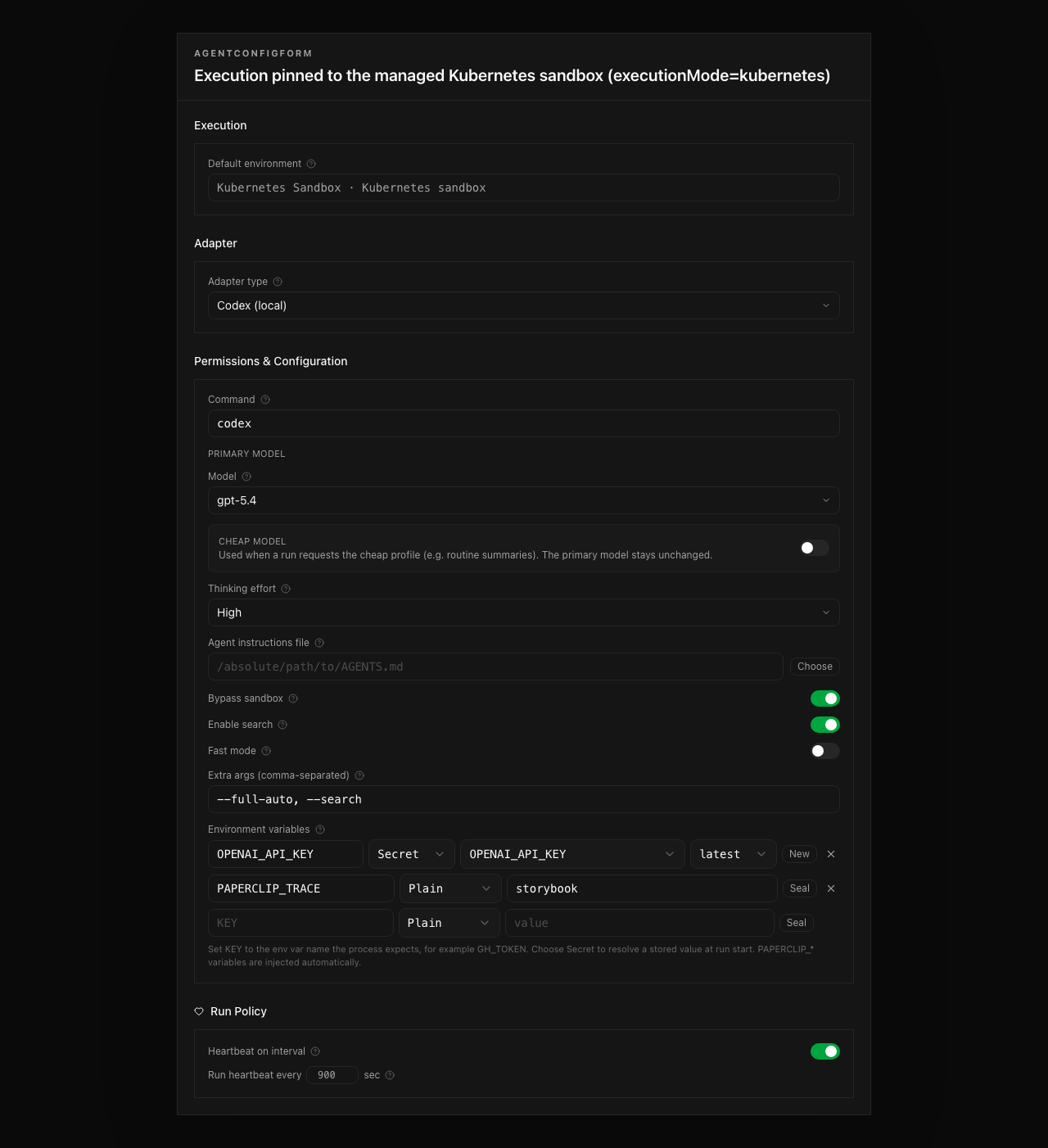 No managed environment available yet (warning notice, no silent local fallback): 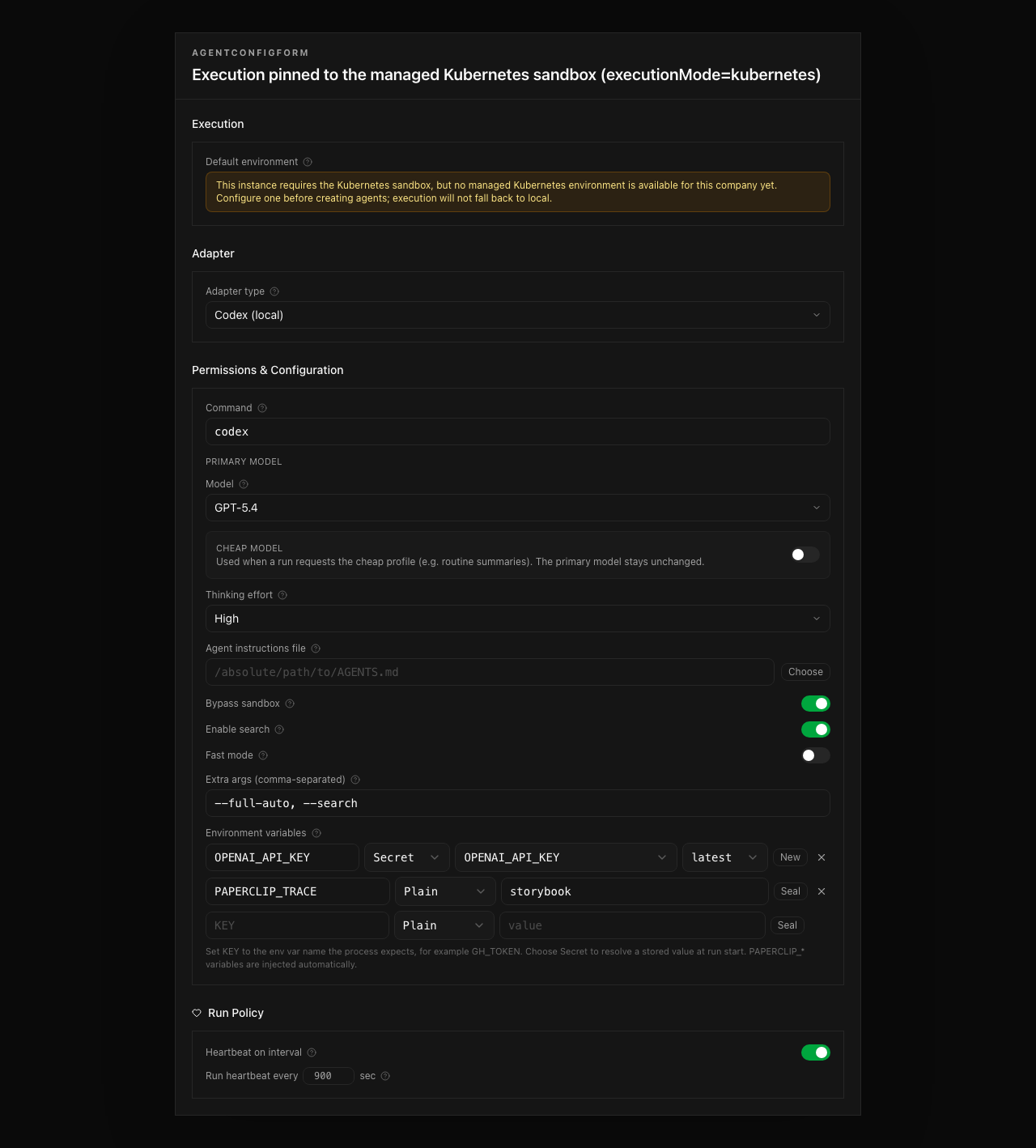 ## Checklist - [x] I have included a thinking path that traces from project context to this change - [x] I have specified the model used (with version and capability details) - [x] I have checked ROADMAP.md and confirmed this PR does not duplicate planned core work - [x] I have searched GitHub for duplicate or related PRs and linked them above - [x] I have either (a) linked existing issues with `Fixes: #` / `Closes #` / `Refs #` OR (b) described the issue in-PR following the relevant issue template - [x] I have run tests locally and they pass - [x] I have added or updated tests where applicable - [x] If this change affects the UI, I have included before/after screenshots - [x] I have updated relevant documentation to reflect my changes - [x] I have considered and documented any risks above - [ ] All Paperclip CI gates are green - [ ] Greptile is 5/5 with no open P2s, recommendations, or follow-ups - [x] I will address all Greptile and reviewer comments before requesting merge 🤖 Generated with [Claude Code](https://claude.com/claude-code) --------- Co-authored-by: Claude Opus 4.8 (1M context) <noreply@anthropic.com> |
||
|
Nir Arazi
|
b853ce5183 |
Fix heartbeat task-session reuse when agent model changes (#4195)
## Thinking Path > - Paperclip orchestrates AI agents for zero-human companies. > - Heartbeats wake agents and resume prior adapter task sessions so work is continuous. > - A persisted task session can contain adapter-specific state (for Codex, a resumable thread/session) created under the agent's then-current model. > - When an operator changes an agent's configured model, the next run should not blindly reuse a session created under a different model — context window, capabilities, and prompt assumptions may differ. > - The existing wake reset logic handles wake reasons (forceFreshSession, comment wakes, etc.) but not model drift between current agent config and persisted task-session metadata. > - This pull request adds model-aware task-session reset and persists the configured model into task-session metadata. > - The benefit is that heartbeat runs reliably honor the current agent model configuration and avoid stale session/model mismatches. ## Linked Issues or Issue Description **What happened?** After an operator changes an agent's configured model (for example, swapping a Codex agent from one model variant to another), the heartbeat reuses the persisted adapter task session that was created under the previous model. The new model never takes effect on resume — the run continues on the prior session and prior model assumptions. **Expected behavior** A model change in agent configuration should invalidate the persisted task session for that agent and force a fresh session start on the next run, so the configured model is the one actually used. **Steps to reproduce** 1. Run an agent with model `A` so it persists an adapter task session under model `A`. 2. Change the agent's configured model to `B`. 3. Trigger a heartbeat for the same issue/agent. 4. Observe: the run resumes the prior task session (still under model `A`) instead of starting fresh under model `B`. ## What Changed - Added task-session model metadata support in heartbeat session handling via `__paperclipConfiguredModel`. - Persisted the current configured adapter model into `agent_task_sessions.sessionParamsJson` whenever heartbeat upserts task-session state. - Added `shouldResetTaskSessionForModelChange(...)` to explicitly detect model drift between current config and persisted session metadata. - Updated run startup logic to force a fresh session when model drift is detected, with a clear reason message in runtime warnings. - Strips the internal `__paperclipConfiguredModel` key from `sessionParamsJson` before it is forwarded to adapters so the metadata stays internal. - Added focused tests in `server/src/__tests__/heartbeat-workspace-session.test.ts` covering model-drift reset behavior, non-reset cases, and the strip helper. ## Verification - `pnpm --filter @paperclipai/server test src/__tests__/heartbeat-workspace-session.test.ts` - `pnpm --filter @paperclipai/server typecheck` ## Risks Low. Sessions without persisted model metadata are not reset (backward compatible). The model key is namespaced (`__paperclip...`) to avoid colliding with adapter-forwarded params. Drift detection only fires when both current config and persisted metadata are present and differ. ## Model Used Claude (Opus 4.6) — used to design the metadata persistence, add the drift detection helper, and write unit coverage. ## Checklist - [x] I have included a thinking path that traces from project context to this change - [x] I have specified the model used (with version and capability details) - [x] I have checked ROADMAP.md and confirmed this PR does not duplicate planned core work - [x] I have searched GitHub for duplicate or related PRs and linked them above - [x] I have either (a) linked existing issues with `Fixes: #` / `Closes #` / `Refs #` OR (b) described the issue in-PR following the relevant issue template - [x] I have run tests locally and they pass - [x] I have added or updated tests where applicable - [x] If this change affects the UI, I have included before/after screenshots (N/A — no UI changes) - [x] I have updated relevant documentation to reflect my changes - [x] I have considered and documented any risks above - [ ] All Paperclip CI gates are green (in progress) - [ ] Greptile is 5/5 with no open P2s, recommendations, or follow-ups - [x] I will address all Greptile and reviewer comments before requesting merge --------- Co-authored-by: Paperclip <noreply@paperclip.ing> Co-authored-by: Devin Foley <devin@paperclip.ing> |
||
|
Nicolás Rodrigues
|
f3db7b88ea |
Clear stale checkoutRunId on run finalization and add backstop sweeper (#6008)
## Thinking Path > - Paperclip is the open source app people use to manage AI agents for work > - The issue subsystem holds per-row lock columns (`checkoutRunId`, `executionRunId`, `executionAgentNameKey`, `executionLockedAt`) that gate checkout, ownership, and release > - When a heartbeat run terminates, `releaseIssueExecutionAndPromote` clears the execution-lock columns but stale checkout locks could remain attached to dead runs in edge paths > - The original fix closed the finalization, checkout, release, and sweeper paths, but PR CI exposed one more process-loss retry path where a queued retry advanced `executionRunId` while leaving `checkoutRunId` pinned to the failed run > - This pull request closes the asymmetry: terminal-run cleanup and process-loss retry recovery release dead checkout locks while preserving live execution ownership > - The benefit is permanent, automatic self-heal of stale lock columns and fewer false checkout 409s requiring board intervention > - Related upstream issue: #6007 ## Linked Issues or Issue Description Refs #6007. Duplicate/related PR search performed on 2026-06-10 with query `checkoutRunId process loss retry stale checkout lock repo:paperclipai/paperclip`. Related PRs found and reviewed for overlap: - #7727 `fix(heartbeat): atomically advance checkoutRunId on process-loss retry` - #7707 `test: cover same-agent stale checkout adoption` - #3068 `fix: clear checkoutRunId when releasing issue execution lock` ## What Changed - `server/src/services/heartbeat.ts` `releaseIssueExecutionAndPromote`: extend the per-issue update to also null `checkoutRunId` when it matches the terminating run id. WHERE clause scoped to `executionRunId = run.id OR checkoutRunId = run.id` for idempotence. - `server/src/services/heartbeat.ts` process-loss retry: when queuing the retry run, move `executionRunId` to the retry and clear the failed run's `checkoutRunId` so the dead run no longer owns checkout. - `server/src/services/issues.ts`: add `clearCheckoutRunIfTerminal` helper, symmetric to `clearExecutionRunIfTerminal`. No assignee/status precondition. Wired into `checkout`, `assertCheckoutOwner`, and `release`. Exported on the issue service. - `server/src/services/recovery/service.ts`: add `sweepStaleIssueLocks`. Scans `issues` where `checkoutRunId IS NOT NULL OR executionRunId IS NOT NULL`, joins each referenced run, and clears all lock columns on issues whose referenced runs are all terminal or missing. Emits one `issue.stale_lock_cleared` activity log row per cleared issue. - `server/src/services/heartbeat.ts`: re-export the sweeper on the heartbeat facade. - `server/src/index.ts`: invoke `sweepStaleIssueLocks` in both the startup recovery sequence and the periodic heartbeat timer chain. - Tests: route-level coverage of the new self-heal path on the next checkout attempt, service-level sweeper coverage, and heartbeat recovery assertions that terminal process-loss cleanup releases `checkoutRunId`. ## Verification ```bash pnpm --filter @paperclipai/server typecheck pnpm --filter @paperclipai/server exec vitest run \ src/__tests__/recovery-stale-issue-lock-sweep.test.ts \ src/__tests__/issue-stale-execution-lock-routes.test.ts NODE_ENV=test pnpm exec vitest run src/__tests__/heartbeat-process-recovery.test.ts -t "queues exactly one retry when the recorded local pid is dead|does not block paused-tree work when immediate continuation recovery is suppressed by the hold" NODE_ENV=test pnpm exec vitest run src/__tests__/heartbeat-process-recovery.test.ts ``` All listed local checks pass. The new and updated tests cover: - Run termination clears `checkoutRunId` when it points at the terminating run. - Process-loss retry clears the failed run's `checkoutRunId` while assigning `executionRunId` to the queued retry. - A different agent calling `POST /api/issues/:id/checkout` on an issue whose prior owner died self-heals via `clearCheckoutRunIfTerminal` and succeeds. - Sweeper clears stale lock columns for issues whose run row is terminal. - Sweeper leaves issues alone while the referenced run is still running. - Sweeper leaves issues alone when `executionRunId` is still running even if `checkoutRunId` is terminal. - Sweeper is idempotent; second pass clears nothing. Manual reproduction of the original bug shape: 1. Create an issue assigned to agent A, set `status='in_progress'`, `checkoutRunId=R1`, `executionRunId=null`, where `heartbeat_runs.status = 'failed'` for `R1`. 2. Reassign to agent B and move to `status='todo'`. 3. Before this PR: agent B `POST /checkout` returns `409 Issue checkout conflict` indefinitely. After this PR: succeeds, lock columns rewritten to agent B's current run id. ## Risks - Low. All clears are scoped by run id, so they only fire when the lock column unambiguously points at the terminating or terminal run. No schema change. No migration. No API surface change. - Behavioral shift: an issue that previously stayed `in_progress` with a dead `checkoutRunId` after run termination now self-heals. Downstream code that reads stale `checkoutRunId` as a proxy for recent run history should already be reading `executionRunId` or the `heartbeat_runs` table. - Sweeper cost: one indexed scan per recovery tick over rows where `checkoutRunId IS NOT NULL OR executionRunId IS NOT NULL` plus a single batched `heartbeatRuns` lookup per candidate. Negligible at expected cardinality; further bounded by the existing recovery cadence. > For core feature work, check [`ROADMAP.md`](ROADMAP.md) first and discuss it in `#dev` before opening the PR. Feature PRs that overlap with planned core work may need to be redirected — check the roadmap first. See `CONTRIBUTING.md`. This is a bug fix, not a feature. No roadmap overlap. ## Model Used - Claude (Anthropic), model ID `claude-opus-4-7`, extended-thinking off, tool use enabled. - OpenAI Codex, GPT-5-based coding agent, tool use enabled, used for the follow-up process-loss retry fix and PR body update. ## Checklist - [x] I have included a thinking path that traces from project context to this change - [x] I have specified the model used (with version and capability details) - [x] I have checked ROADMAP.md and confirmed this PR does not duplicate planned core work - [x] I have searched GitHub for duplicate or related PRs and linked them above - [x] I have either (a) linked existing issues with `Fixes: #` / `Closes #` / `Refs #` OR (b) described the issue in-PR following the relevant issue template - [x] I have run tests locally and they pass - [x] I have added or updated tests where applicable - [x] If this change affects the UI, I have included before/after screenshots - [x] I have updated relevant documentation to reflect my changes - [x] I have considered and documented any risks above - [x] All Paperclip CI gates are green - [ ] Greptile is 5/5 with no open P2s, recommendations, or follow-ups - [ ] I will address all Greptile and reviewer comments before requesting merge --------- Co-authored-by: Paperclip <noreply@paperclip.ing> Co-authored-by: Dotta <bippadotta@protonmail.com> |
||
|
NyDamon
|
0713dfa41f |
fix: validate session ID as UUID before --resume + error diagnostics (DLD-889) (#1742)
## Thinking Path > - Paperclip orchestrates AI agents for zero-human companies. > - The Claude-local adapter uses `claude --resume <session-id>` to continue prior sessions; the `--resume` value MUST be a UUID per Claude's CLI contract. > - Paperclip internally uses session IDs prefixed with `ses_` (not UUIDs); these get passed straight through to `--resume` and crash the run. > - On top of the crash, when the underlying error path triggers a secret-decryption failure or heartbeat setup failure, the diagnostics are too thin to tell key-mismatch from other failures, and the heartbeat error code is mis-classified as `adapter_failed` instead of `setup_failed`. > - This PR validates `runtimeSessionId` against a UUID regex before letting `canResumeSession` become true, adds `not a valid UUID` to Claude's own retry-error regex, improves AES-256-GCM decryption diagnostics in the local encrypted provider, and re-classifies pre-adapter setup failures. > - The benefit is that Paperclip session IDs are detected and skipped gracefully (logged, no crash), legitimate Claude UUID-rejection errors are treated as retriable, and operators can diagnose decryption/setup failures from the run log. ## Linked Issues or Issue Description **What happened?** The `claude-local` adapter passes Paperclip's internal session identifiers (e.g. `ses_…`) straight to `claude --resume <session-id>`. Because Claude's CLI requires the `--resume` argument to be a UUID, the run crashes with a `not a valid UUID` error. When the surrounding code path also hits a secret-decryption failure, the heartbeat reports it as `adapter_failed`, hiding the real `setup_failed` cause and making diagnosis hard. **Expected behavior** Non-UUID session IDs should be detected before `--resume` is called, the run should fall back to a fresh session with a clear log line, and any decryption / setup failure should be reported with enough detail (and the correct error code) for an operator to tell what failed. **Steps to reproduce** 1. Have a persisted task session whose ID is not a UUID (Paperclip-issued `ses_…` form). 2. Trigger a heartbeat that resumes that session via the `claude-local` adapter. 3. Observe: the adapter crashes with a UUID-validation error; if the path also involves a decryption failure, the heartbeat surfaces `adapter_failed` instead of `setup_failed`. ## What Changed - `packages/adapters/claude-local/src/server/execute.ts`: Validates `runtimeSessionId` against a UUID regex before setting `canResumeSession`; non-UUID IDs are logged and skipped gracefully. Guards the cwd-mismatch log block on `isValidUuid` so it does not fire for non-UUID session IDs. - `packages/adapters/claude-local/src/server/parse.ts`: Adds `not a valid UUID` to the session-error retry regex so Claude's own UUID rejection is treated as a retriable error. - `server/src/services/secrets/local-encrypted-provider.ts`: Wraps AES-256-GCM decryption in try/catch and re-throws with a key fingerprint hint to aid key-mismatch diagnosis. - `server/src/services/heartbeat.ts`: Corrects the outer-catch `errorCode` from `adapter_failed` to `setup_failed` for pre-adapter setup failures. - `AGENTS.md`: Adds task/PR/CI governance sections (10–13) and expands the Definition of Done. ## Verification - `pnpm --filter @paperclipai/adapter-claude-local test` covers UUID validation and the parse retry regex. - `pnpm --filter @paperclipai/server test src/services/secrets` covers decryption diagnostics. - `pnpm --filter @paperclipai/server typecheck` ## Risks Low. UUID validation is strictly additive (non-UUIDs that previously crashed now log and skip). Decryption diagnostics only fire on failure paths. The `setup_failed` error code change is a clearer classification, not a behavior change. ## Model Used Claude (Opus 4.6) — used to identify the UUID-validation root cause, mirror existing parse patterns, and re-classify the heartbeat setup error code. ## Checklist - [x] I have included a thinking path that traces from project context to this change - [x] I have specified the model used (with version and capability details) - [x] I have checked ROADMAP.md and confirmed this PR does not duplicate planned core work - [x] I have searched GitHub for duplicate or related PRs and linked them above - [x] I have either (a) linked existing issues with `Fixes: #` / `Closes #` / `Refs #` OR (b) described the issue in-PR following the relevant issue template - [x] I have run tests locally and they pass - [x] I have added or updated tests where applicable - [x] If this change affects the UI, I have included before/after screenshots (N/A — no UI changes) - [x] I have updated relevant documentation to reflect my changes - [x] I have considered and documented any risks above - [ ] All Paperclip CI gates are green (in progress) - [ ] Greptile is 5/5 with no open P2s, recommendations, or follow-ups - [x] I will address all Greptile and reviewer comments before requesting merge --------- Co-authored-by: CTO Agent <cto@paperclip.ing> Co-authored-by: Paperclip <noreply@paperclip.ing> Co-authored-by: Claude Opus 4.6 (1M context) <noreply@anthropic.com> Co-authored-by: Devin Foley <devin@paperclip.ing> |
||
|
Dotta
|
67b22d872f |
[codex] Clarify interrupt handoffs and scoped wake semantics (#7855)
## Thinking Path > - Paperclip is the open source app people use to manage AI agents for work. > - The issue thread is the operator surface where comments, assignee changes, pauses, resumes, and wakeups turn human intent into agent execution. > - Interrupting a live run and handing work to another assignee needs clear semantics so the product does not accidentally keep work alive, wake the wrong participant, or hide why an agent stopped. > - Comment-driven wakes also need strict boundaries so closed, blocked, and dependency-driven work only resumes when there is real actionable input. > - This pull request codifies the interrupt handoff contract, implements backend scheduling behavior, and gives the UI clearer handoff/pause language. > - The benefit is a more inspectable and predictable task lifecycle for both operators and agents. ## Linked Issues or Issue Description Paperclip issue: `PAP-10664` / `PAP-10751`. Problem: interrupting or reassigning live agent work could be ambiguous in the UI and backend. Operators needed clearer feedback about whether a handoff wakes an agent, what pause/cancel affects, and when comments should revive execution. The backend also needed stronger tests around comment wake boundaries, retry supersession, and structured agent mention dispatch. Related GitHub PR search found broad workflow-adjacent PRs #5082, #6359, and #4083, but no exact duplicate for this head branch or interrupt-handoff scope. ## What Changed - Added an interrupt handoff semantics document covering destination behavior, wake expectations, and live-run interruption states. - Implemented backend interrupt handoff behavior and comment wake/reopen handling in issue routes/services and heartbeat scheduling. - Hardened structured agent mention dispatch so mentions resolve through the intended dispatch path. - Added UI helpers and components for handoff chips, wake rows, interrupt banners, pause-affects summaries, and composer guidance. - Updated the issue properties assignee picker and issue chat/composer surfaces to make interrupt/reassign behavior clearer. - Added backend, UI utility, component, and Storybook coverage for the new behavior. - Stabilized the new UI component tests with a local `flushSync`-backed act helper matching existing repo practice in this dependency set. - Addressed Greptile feedback by threading historical run `errorCode` through issue-run data and operator-interrupted chat labels. - Addressed Greptile's cancel ordering concern by terminating/deleting in-memory heartbeat processes before cancellation status persistence, with regression coverage for DB update failure. ## Verification - `git diff --check $(git merge-base HEAD origin/master)..HEAD` - `pnpm --filter @paperclipai/ui exec vitest run src/lib/interrupt-handoff.test.ts src/lib/issue-chat-messages.test.ts src/components/IssueProperties.test.tsx src/components/interrupt-handoff/InterruptHandoffViews.test.tsx --no-file-parallelism --maxWorkers=1` — 4 files / 91 tests passed before the Greptile follow-ups. - `pnpm run preflight:workspace-links && pnpm exec vitest run server/src/__tests__/heartbeat-process-recovery.test.ts server/src/__tests__/heartbeat-retry-scheduling.test.ts server/src/__tests__/issue-comment-reopen-routes.test.ts server/src/__tests__/issue-tree-control-service.test.ts server/src/__tests__/issue-update-comment-wakeup-routes.test.ts server/src/__tests__/issues-service.test.ts --no-file-parallelism --maxWorkers=1` — 6 files / 191 tests passed before the Greptile follow-ups. - `pnpm --filter @paperclipai/ui exec vitest run src/lib/issue-chat-messages.test.ts --no-file-parallelism --maxWorkers=1` — 1 file / 24 tests passed after the historical `errorCode` follow-up. - `pnpm exec vitest run server/src/__tests__/activity-service.test.ts server/src/__tests__/activity-routes.test.ts --no-file-parallelism --maxWorkers=1` — 2 files / 11 tests passed after the historical `errorCode` follow-up. - `pnpm exec vitest run server/src/__tests__/heartbeat-process-recovery.test.ts --no-file-parallelism --maxWorkers=1` — 1 file / 52 tests passed after the cancel ordering follow-up. - Greptile is green for head `272647636287d034bab8d981eaf5305865aa0f96`; the old inline P2 is resolved/outdated. - GitHub Actions, Socket, security-review, and Greptile checks are green for head `272647636287d034bab8d981eaf5305865aa0f96`. The external `security/snyk (cryppadotta)` status was still pending at `https://app.snyk.io/org/cryppadotta/pr-checks/85b3e8f4-04e1-4f8e-9362-899c8148c23c` after a bounded wait. ## Risks - Medium: changes touch issue comments, wake scheduling, and live-run interruption semantics, so regressions could affect when agents resume or stay stopped. - Medium: UI copy and state grouping for assignee changes may need reviewer tuning after product review. - Low migration risk: no database schema migration is included. - The branch was created before the latest `origin/master` commits; reviewers should confirm CI merge-base behavior and resolve any merge conflicts if GitHub reports them. > For core feature work, check [`ROADMAP.md`](ROADMAP.md) first and discuss it in `#dev` before opening the PR. Feature PRs that overlap with planned core work may need to be redirected — check the roadmap first. See `CONTRIBUTING.md`. ## Model Used OpenAI Codex, GPT-5-based coding agent, tool use and local command execution enabled. Exact hosted model build and context window were not exposed by the runtime. ## Checklist - [x] I have included a thinking path that traces from project context to this change - [x] I have specified the model used (with version and capability details) - [x] I have checked ROADMAP.md and confirmed this PR does not duplicate planned core work - [x] I have searched GitHub for duplicate or related PRs and linked them above - [x] I have either (a) linked existing issues with `Fixes: #` / `Closes #` / `Refs #` OR (b) described the issue in-PR following the relevant issue template - [x] I have run tests locally and they pass - [x] I have added or updated tests where applicable - [ ] If this change affects the UI, I have included before/after screenshots - [x] I have updated relevant documentation to reflect my changes - [x] I have considered and documented any risks above - [x] All Paperclip CI gates are green - [x] Greptile is 5/5 with no open P2s, recommendations, or follow-ups - [x] I will address all Greptile and reviewer comments before requesting merge Screenshot note: this PR includes Storybook coverage for the new interrupt handoff UI states rather than captured before/after browser screenshots in this PR-creation heartbeat. --------- Co-authored-by: Paperclip <noreply@paperclip.ing> Co-authored-by: Claude Opus 4.8 <noreply@anthropic.com> |
||
|
xidui
|
5d315ab778 |
Defer same-issue forceFreshSession wakes into follow-up runs (#4080)
## Thinking Path > - Paperclip is the open source app people use to manage AI agents for work > - The heartbeat service governs how agent wake events get queued, deferred, or folded into the currently-running adapter run > - `forceFreshSession: true` wakes on a same-agent/same-issue path get silently folded into the active run, so callers can never request a true cold-start follow-up > - This breaks phased workflows that need to drop a poisoned session and restart cleanly on the same issue without bouncing to another agent > - This PR extracts the existing same-issue follow-up decision into `shouldDeferFollowupWakeForSameIssue` and extends it to also defer `forceFreshSession: true` wakes into a follow-up run boundary > - The benefit is that `forceFreshSession` now behaves as documented: it actually starts a fresh session, even when the wake targets the same agent/issue/runtime that is currently executing ## Linked Issues or Issue Description **What happened?** A wake event posted with `forceFreshSession: true` against an issue whose current adapter run is still `running` on the same execution agent is silently coalesced into that in-flight run instead of starting a cold session. Callers that explicitly request a fresh-session reset see no behavior change until the run naturally completes. **Expected behavior** `forceFreshSession: true` should always force a fresh session start, even when the wake targets the same agent/issue that is currently executing. The wake should defer into a follow-up run boundary if the current run is still in-flight. **Steps to reproduce** 1. Start an adapter run for some issue. 2. While the run is still `running`, post a wake event for the same issue/agent with `forceFreshSession: true`. 3. Observe: the active run continues without resetting the session; the fresh-session signal is dropped. ## What Changed - Extracted same-issue follow-up decision into exported helper `shouldDeferFollowupWakeForSameIssue` in `server/src/services/heartbeat.ts` - Extended that helper so `forceFreshSession: true` (not only `wakeCommentId`) defers into a follow-up run when the current run is still `running` for the same execution agent - Added stickiness to `mergeCoalescedContextSnapshot`: if either side of a wake-merge has `forceFreshSession: true`, the merged snapshot keeps it set so it is not silently dropped while queued wakes coalesce - Added five unit tests in `heartbeat-workspace-session.test.ts` covering each decision branch of the helper ## Verification - `pnpm --filter @paperclipai/server test src/__tests__/heartbeat-workspace-session.test.ts` - `pnpm --filter @paperclipai/server typecheck` ## Risks Low. Behavior change only affects the narrow case where a same-agent/same-issue wake carries `forceFreshSession: true` while the active run is still `running`. Other wake paths (cross-agent, queued/failed runs) are untouched. The helper extraction is a pure refactor preserving the prior comment-wake deferral. ## Model Used Claude (Opus 4.7) — extended thinking enabled, used to extract the helper, extend the deferral condition to cover `forceFreshSession`, and write unit coverage. ## Checklist - [x] I have included a thinking path that traces from project context to this change - [x] I have specified the model used (with version and capability details) - [x] I have checked ROADMAP.md and confirmed this PR does not duplicate planned core work - [x] I have searched GitHub for duplicate or related PRs and linked them above - [x] I have either (a) linked existing issues with `Fixes: #` / `Closes #` / `Refs #` OR (b) described the issue in-PR following the relevant issue template - [x] I have run tests locally and they pass - [x] I have added or updated tests where applicable - [x] If this change affects the UI, I have included before/after screenshots (N/A — no UI changes) - [x] I have updated relevant documentation to reflect my changes - [x] I have considered and documented any risks above - [ ] All Paperclip CI gates are green (in progress) - [ ] Greptile is 5/5 with no open P2s, recommendations, or follow-ups - [x] I will address all Greptile and reviewer comments before requesting merge --------- Co-authored-by: Devin Foley <devin@paperclip.ing> |
||
|
Reasonofmoon
|
a0f7d3daba |
Reset task session on timer-driven wakes (PF-4) (#4838)
## Thinking Path > - Paperclip orchestrates AI agents for zero-human companies > - Each agent is woken via the heartbeat scheduler — `heartbeat_timer` for periodic interval wakes, `issue_assigned` / `execution_*` / `issue_commented` for event-driven wakes > - The heartbeat reuses the prior task session by default; only specific wake reasons trigger a fresh session via `shouldResetTaskSessionForWake` (assignment, review, approval, changes-requested) or explicit `forceFreshSession` > - In CEO run `292a5fd1`, repeated context compaction warnings appeared near the 64k threshold for the long-lived manager session — symptomatic of repeated `heartbeat_timer` wakes accumulating low-value "checked, nothing new" inbox-scan traces inside one ever-growing session > - PF-4 in the 2026-04-16 hangeul-school operational issue set asks for a compaction-aware session freshness policy: "manager sessions can rotate before low-value compaction pressure accumulates" and "repeated timer wakes do not indefinitely bloat the same session" > - This pull request adds `wakeReason === "heartbeat_timer"` to both `shouldResetTaskSessionForWake` and `describeSessionResetReason`, so each interval wake starts fresh and the run log explicitly records why. Event-driven wakes (`issue_commented`, `transient_failure_retry`, etc.) keep their existing reuse behavior. > - The benefit is that timer wakes — which are exploratory and carry no continuation state — stop bloating long-lived manager sessions. Compaction pressure that previously accumulated across N timer wakes is now bounded to a single interval's worth of context. ## Linked Issues or Issue Description No external GitHub issue is linked. Describing the problem inline following the bug-report template: **What happened:** Long-lived manager/CEO agent sessions hit the 64k context-compaction threshold after many `heartbeat_timer` wakes accumulated low-value inbox-scan traces inside one ever-growing task session. Reproduced in CEO run `292a5fd1`. **Expected behavior:** Periodic timer wakes — which carry no continuation state — should not indefinitely bloat the same session. The heartbeat should rotate sessions on timer wakes the way it already does on assignment/review/approval/changes-requested wakes. **Actual behavior:** `shouldResetTaskSessionForWake` only reset on `issue_assigned`, `execution_review_requested`, `execution_approval_requested`, `execution_changes_requested`, or explicit `forceFreshSession`. `heartbeat_timer` reused the prior session indefinitely, causing compaction pressure. **Scope of fix:** Add `heartbeat_timer` to the reset list and to `describeSessionResetReason` so the run log records why. Event-driven wakes keep their existing reuse behavior. ## What Changed - `shouldResetTaskSessionForWake` (`server/src/services/heartbeat.ts`) now also returns `true` when `wakeReason === "heartbeat_timer"`. The existing reset reasons (`issue_assigned`, `execution_review_requested`, `execution_approval_requested`, `execution_changes_requested`, `forceFreshSession`) are unchanged. - `describeSessionResetReason` returns a paired explanation `"wake reason is heartbeat_timer (timer-driven wake starts fresh)"` so run logs make session reset behavior legible. - `describeSessionResetReason` was promoted from internal to `export` so the paired contract can be unit-tested directly alongside `shouldResetTaskSessionForWake`. This is the only API surface change in this PR. Wake reasons whose reuse behavior is intentionally **unchanged**: - `issue_commented` — the comment is the reason to engage; continuation context matters - `issue_comment_mentioned` — same rationale - `transient_failure_retry` — resuming a previously-failed run; want continuity - `process_lost_retry` — resuming after process loss; want continuity - `missing_issue_comment`, recovery reasons — out of scope; can be revisited as follow-ups if observed bloat shows up ## Verification ```bash cd server pnpm vitest run src/__tests__/heartbeat-timer-wake-session-reset-pf4.test.ts # 12/12 pass pnpm vitest run \ src/__tests__/heartbeat-stale-queue-invalidation.test.ts \ src/__tests__/heartbeat-process-recovery.test.ts \ src/__tests__/heartbeat-comment-wake-batching.test.ts # 48/48 adjacent heartbeat tests pass ``` The 12 new tests assert: 1. `shouldResetTaskSessionForWake` resets on `heartbeat_timer` 2. `shouldResetTaskSessionForWake` still resets on the four existing reasons 3. `forceFreshSession === true` still triggers reset 4. `issue_commented`, `transient_failure_retry`, unknown reasons, and null/undefined context do **not** trigger reset 5. `describeSessionResetReason` describes `heartbeat_timer` explicitly so logs are legible 6. `describeSessionResetReason` keeps the exact wording for the four existing reasons 7. `describeSessionResetReason` returns the `forceFreshSession` message 8. `describeSessionResetReason` returns `null` for non-resetting reasons 9. **Parity invariant**: the two functions agree on every input — `describeSessionResetReason(ctx)` is non-null iff `shouldResetTaskSessionForWake(ctx)` returns true. This locks the pair so future changes to one must update the other. ## Risks - **Low–medium.** This changes behavior for every `heartbeat_timer` wake on every agent: the prior task session is no longer reused. - For **manager / CEO agents** (the documented case): this is the intended improvement. Timer wakes carry no continuation state for these roles. - For **worker agents** that may have used timer wakes to resume in-flight work: any genuine continuation should already be triggered by issue/execution wake reasons (which still reuse) or by an active checkout being resumed via `process_lost_retry` / `transient_failure_retry`. Timer wakes themselves do not create checkouts. - If a deployment relied on timer wakes to preserve mid-task context — which is fragile by design — the right path is to switch to a non-timer wake reason or accept the reset. The PR doesn't add a new opt-out flag because the goal is to bound session size; introducing an opt-out would re-open the bloat path this PR is closing. - No schema or API surface change beyond exporting `describeSessionResetReason`. No migration. No client-visible API change. ## Model Used Claude Opus 4.7 (1M context), model ID `claude-opus-4-7[1m]`. Used in interactive Claude Code session with extended reasoning, tool use (Read/Edit/Write/Bash), and verification gates between exploration → fix → tests → push. ## Checklist - [x] I have included a thinking path that traces from project context to this change - [x] I have specified the model used (with version and capability details) - [x] I have checked ROADMAP.md and confirmed this PR does not duplicate planned core work - [x] I have searched the open PR list for similar/duplicate work — distinct from #4080 (force-fresh follow-up wake — codex/general) and #4195 (codex session reset on model change); this PR specifically targets the `heartbeat_timer` reuse path - [x] I have run tests locally and they pass (12 new + 48 adjacent = 60 tests, no regressions) - [x] I have added or updated tests where applicable - [x] If this change affects the UI, I have included before/after screenshots — N/A, server-only change - [x] I have updated relevant documentation to reflect my changes — none needed; the new export carries clear semantics and the run log message is self-explanatory - [x] I have considered and documented any risks above - [x] I will address all Greptile and reviewer comments before requesting merge 🤖 Generated with [Claude Code](https://claude.com/claude-code) --------- Co-authored-by: Irene <irene@users.noreply.github.com> Co-authored-by: Devin Foley <devin@devinfoley.com> Co-authored-by: Paperclip <noreply@paperclip.ing> Co-authored-by: Devin Foley <devin@paperclip.ing> |
||
|
Dotta
|
7fb40264f8 |
[codex] Revert PR #7678 (#7765)
## Thinking Path > - Paperclip is the open source app people use to manage AI agents for work. > - Issue comment wake handoffs are part of the control-plane execution loop that decides when agents resume work after comments and issue updates. > - PR #7678 changed that wake handoff behavior in server issue routes, heartbeat context, and related tests. > - The change broke an important workflow after merge, so the safest immediate fix is to restore the pre-#7678 wake behavior. > - This pull request reverts the wake-handoff behavior from PR #7678 while keeping narrow review-requested safeguards that prevent known runtime/test regressions. > - The benefit is that Paperclip returns to the last known working wake behavior without reintroducing avoidable UUID skill lookup and annotation-resolution test gaps. ## Linked Issues or Issue Description Refs: #7678 Bug context: - What happened: PR #7678 was reported to have broken an important Paperclip workflow after it merged. - Expected behavior: Paperclip should preserve the prior issue comment wake handoff behavior until a corrected change is ready. - Steps to reproduce: Use the workflow affected by PR #7678's issue comment wake handoff changes. - Paperclip version/commit: `master` after merge commit `4da79a88c67e54084d40bd18cada5ee5c8be23da`. - Deployment mode: Paperclip control-plane server behavior. ## What Changed - Reverted merge commit `4da79a88c67e54084d40bd18cada5ee5c8be23da` from PR #7678 to restore pre-#7678 wake-handoff behavior. - Preserved the safe accepted-plan routing check so `parseObject(...)` is not used as a boolean. - Preserved UUID filtering for run-scoped skill mentions so legacy non-UUID skill IDs do not reach a Postgres UUID lookup. - Restored the annotation thread-resolution test guard that verifies resolving a thread does not wake the assignee. ## Verification - `pnpm run preflight:workspace-links && NODE_ENV=test PAPERCLIP_HOME=/tmp/... PAPERCLIP_INSTANCE_ID=pap10614-revert TMPDIR=/tmp/... pnpm exec vitest run --project @paperclipai/server --no-file-parallelism --maxWorkers=1 server/src/__tests__/document-annotation-routes.test.ts server/src/__tests__/heartbeat-project-env.test.ts server/src/__tests__/heartbeat-accepted-plan-workspace-refresh.test.ts server/src/__tests__/heartbeat-context-summary.test.ts` - Result: 4 test files passed, 26 tests passed. - Earlier targeted revert verification also passed: 4 test files, 50 tests. ## Risks - This intentionally restores behavior from before PR #7678, so intended wake-handoff improvements from that PR are removed. - The PR is no longer a byte-for-byte revert because Greptile identified two narrow safeguards worth preserving. - Low migration risk: no schema or dependency changes are included. - Follow-up work may still be needed to reintroduce the desired wake handoff behavior without the regression. ## Model Used OpenAI Codex, GPT-5 coding agent in this Paperclip heartbeat, with shell/tool execution and repository write access. ## Checklist - [x] I have included a thinking path that traces from project context to this change - [x] I have specified the model used (with version and capability details) - [x] I have checked ROADMAP.md and confirmed this PR does not duplicate planned core work - [x] I have searched GitHub for duplicate or related PRs and linked them above - [x] I have either (a) linked existing issues with `Fixes: #` / `Closes #` / `Refs #` OR (b) described the issue in-PR following the relevant issue template - [x] I have run tests locally and they pass - [x] I have added or updated tests where applicable - [x] If this change affects the UI, I have included before/after screenshots - [x] I have updated relevant documentation to reflect my changes - [x] I have considered and documented any risks above - [x] All Paperclip CI gates are green - [x] Greptile is 5/5 with no open P2s, recommendations, or follow-ups - [x] I will address all Greptile and reviewer comments before requesting merge |
||
|
Dotta
|
4da79a88c6 |
[codex] Refine issue comment wake handoffs (#7678)
## Thinking Path > - Paperclip is the open source app people use to manage AI agents for work. > - The heartbeat and issue-comment routes decide when an assigned agent wakes up and what context it receives. > - Passive comments and annotation notes can currently wake assignees even when no actionable state changed. > - Accepted planning confirmations also need to preserve recent plan comments so child-issue creation does not lose board/user constraints. > - Runtime skill mentions should only send UUID ids into database lookups, because legacy slug-like ids are not valid runtime skill ids. > - This pull request tightens those wake and handoff rules in one server-side branch. > - The benefit is fewer noisy agent wakeups and better accepted-plan continuation context without changing the task model. ## Linked Issues or Issue Description Internal Paperclip task: [PAP-10535](/PAP/issues/PAP-10535). Problem or motivation: Passive comments and annotation notes could wake the current assignee even when no actionable state changed, and accepted plan continuations needed recent plan comments preserved in the wake handoff. Runtime skill mentions also needed to ignore non-UUID ids before database lookup. Proposed solution: Tighten server-side wake routing so passive comments do not wake assignees unless they reopen the issue, preserve mention-targeted wakeups, include recent non-deleted plan comments in accepted confirmation wake payloads, and guard runtime skill mention lookup to UUID-like ids. Alternatives considered: Leaving passive assignee wakeups in place was rejected because it keeps generating noisy non-actionable heartbeats. Treating every skill mention-like token as a runtime skill id was rejected because legacy slug-like ids are not valid runtime skill ids. Roadmap alignment: This aligns with the V1 control-plane heartbeat contract by making wakeups more intentional and preserving handoff context for approved plans. This PR was split from the local `master` branch on June 7, 2026. It covers server-side heartbeat and comment-wakeup behavior only. I searched GitHub for duplicate/related PRs; the results were broader heartbeat/run PRs, not this exact passive-comment and accepted-plan handoff change. ## What Changed - Filter runtime skill mention extraction so only UUID-like skill ids are looked up. - Stop ordinary issue comments and document annotation comments from waking the current assignee unless the comment reopens the issue. - Keep mention-targeted wakeups intact while removing passive assignee wakeups. - Include recent non-deleted issue comments in accepted-plan confirmation wake payloads and task markdown. - Updated focused server tests for the new wakeup and accepted-plan behavior. ## Verification - `git diff --check origin/master..HEAD` - `NODE_ENV=test pnpm exec vitest run server/src/__tests__/heartbeat-project-env.test.ts server/src/__tests__/document-annotation-routes.test.ts server/src/__tests__/issue-comment-reopen-routes.test.ts server/src/__tests__/issue-update-comment-wakeup-routes.test.ts server/src/__tests__/heartbeat-context-summary.test.ts server/src/__tests__/issue-comment-redaction.test.ts` - `NODE_ENV=test pnpm exec vitest run server/src/__tests__/heartbeat-accepted-plan-workspace-refresh.test.ts server/src/__tests__/issue-comment-redaction.test.ts server/src/__tests__/heartbeat-context-summary.test.ts` - `pnpm --filter /server typecheck` - PR checks green on head `a379a0264d384510ff8ac4a47fb1e44d7b556f68` - Greptile rerun green on head `a379a0264d384510ff8ac4a47fb1e44d7b556f68`: 9 files reviewed, 0 comments added, 0 unresolved review threads ## Risks - Medium behavioral risk: agents will no longer wake for passive comments unless mentioned or unless the comment reopens/resumes the issue. That is intentional, but any workflow relying on passive assignee comment wakeups should use explicit mentions or structured resume paths. - Low migration risk: no schema or migration changes. > For core feature work, check [`ROADMAP.md`](ROADMAP.md) first and discuss it in `#dev` before opening the PR. Feature PRs that overlap with planned core work may need to be redirected — check the roadmap first. See `CONTRIBUTING.md`. ## Model Used OpenAI Codex coding agent based on GPT-5, with shell, git, GitHub CLI, and local test execution. Exact hosted model variant and context-window size were not exposed by the runtime. ## Checklist - [x] I have included a thinking path that traces from project context to this change - [x] I have specified the model used (with version and capability details) - [x] I have checked ROADMAP.md and confirmed this PR does not duplicate planned core work - [x] I have searched GitHub for duplicate or related PRs and linked them above - [x] I have either (a) linked existing issues with `Fixes: #` / `Closes #` / `Refs #` OR (b) described the issue in-PR following the relevant issue template - [x] I have run tests locally and they pass - [x] I have added or updated tests where applicable - [x] If this change affects the UI, I have included before/after screenshots - [x] I have updated relevant documentation to reflect my changes - [x] I have considered and documented any risks above - [x] All Paperclip CI gates are green - [x] Greptile is 5/5 with no open P2s, recommendations, or follow-ups - [x] I will address all Greptile and reviewer comments before requesting merge --------- Co-authored-by: Paperclip <noreply@paperclip.ing> |
||
|
Dotta
|
71a8464fee |
[codex] prevent invalid agents from receiving assignments and runs (#7663)
## Thinking Path > - Paperclip is the open source app people use to manage AI agents for work > - The control plane owns agent lifecycle, issue assignment, routine dispatch, heartbeat wakeups, and recovery paths > - Terminated, paused, pending-approval, or otherwise invalid agents should not receive new work or new execution attempts > - The old behavior left eligibility checks spread across routes and services, so assignment and run paths could drift apart > - This pull request centralizes agent lifecycle eligibility and applies it consistently to assignment, invocation, routines, recovery, and UI affordances > - The benefit is safer autonomy: terminated agents stay paused, invalid org-chain agents are surfaced, and active agents keep receiving valid work ## Linked Issues or Issue Description Refs #5103 Related: #1864 Bug fix context: - What happened: agent assignment and heartbeat/run paths did not share one eligibility contract, so invalid lifecycle states could still be considered in some paths. - Expected behavior: terminated agents must never receive new assignments or heartbeat runs, and paused or otherwise invalid agents should be treated as non-invokable consistently. - Steps to reproduce: create or select an agent in an invalid lifecycle state, then attempt assignment, routine dispatch, or heartbeat/recovery wake paths. - Paperclip version/commit: fixed on top of `paperclipai/paperclip` `master` at the PR base. - Deployment mode: applies to the server control plane in local and authenticated deployments. ## What Changed - Added shared agent lifecycle eligibility helpers and exported the related shared types. - Centralized server-side assignability and invokability checks for issue assignment, agent routes, heartbeat dispatch, routines, recovery, and liveness logic. - Hardened issue assignment so invalid assignees are rejected instead of queued for work. - Hardened heartbeat/routine/recovery paths so terminated and otherwise invalid agents are not woken for new runs. - Updated board UI affordances to disable invalid agent actions and surface org-chain warnings where relevant. - Added targeted shared, server, and UI tests for the new eligibility behavior. ## Verification - `pnpm exec vitest run packages/shared/src/agent-eligibility.test.ts server/src/__tests__/agent-invokability.test.ts server/src/__tests__/heartbeat-archived-company-guard.test.ts server/src/__tests__/issue-liveness.test.ts server/src/__tests__/issues-service.test.ts server/src/__tests__/routines-service.test.ts ui/src/lib/company-members.test.ts ui/src/pages/Agents.test.tsx` — 8 files, 144 tests passed. - `pnpm --filter @paperclipai/shared typecheck && pnpm --filter @paperclipai/server typecheck && pnpm --filter @paperclipai/ui typecheck` — passed. - Checked the PR diff does not include `pnpm-lock.yaml` or `.github/workflows` changes. - Checked `ROADMAP.md`; this is a targeted control-plane safety fix and does not duplicate a planned core feature. - Searched GitHub for duplicate or related PRs/issues; closest related items are linked above. - CI and Greptile verification are pending on the opened PR and will be followed up before requesting merge. ## Risks Low to moderate risk. The intended behavioral shift is that invalid agents are refused earlier and more consistently, which could expose existing data with paused, pending, terminated, or broken org-chain assignees. The added tests cover the critical assignment, heartbeat, routine, recovery, shared helper, and UI paths. No database migrations are included. > For core feature work, check [`ROADMAP.md`](ROADMAP.md) first and discuss it in `#dev` before opening the PR. Feature PRs that overlap with planned core work may need to be redirected — check the roadmap first. See `CONTRIBUTING.md`. ## Model Used OpenAI GPT-5 Codex via the Paperclip `codex_local` adapter, with shell/git/GitHub CLI tool use. Reasoning mode and context window are managed by the adapter runtime and not exposed in this environment. ## Checklist - [x] I have included a thinking path that traces from project context to this change - [x] I have specified the model used (with version and capability details) - [x] I have checked ROADMAP.md and confirmed this PR does not duplicate planned core work - [x] I have searched GitHub for duplicate or related PRs and linked them above - [x] I have either (a) linked existing issues with `Fixes: #` / `Closes #` / `Refs #` OR (b) described the issue in-PR following the relevant issue template - [x] I have run tests locally and they pass - [x] I have added or updated tests where applicable - [x] If this change affects the UI, I have included before/after screenshots (not applicable: no design screenshots requested; UI behavior is covered by tests) - [x] I have updated relevant documentation to reflect my changes (not applicable: no user-facing command or schema docs changed) - [x] I have considered and documented any risks above - [ ] All Paperclip CI gates are green (pending CI) - [ ] Greptile is 5/5 with no open P2s, recommendations, or follow-ups (pending Greptile) - [x] I will address all Greptile and reviewer comments before requesting merge --------- Co-authored-by: Paperclip <noreply@paperclip.ing> |
||
|
Dotta
|
7428fb956f |
[codex] Guard git-sensitive adapter workspaces (#7644)
## Thinking Path > - Paperclip is the open source app people use to manage AI agents for work. > - The affected subsystem is the heartbeat execution path that turns issue assignment into adapter-backed work in a selected workspace. > - PAP-10409 and sibling follow-ups failed before useful adapter output because project/workspace identity became incoherent. > - A project-workspace-linked child issue could keep `projectWorkspaceId` / execution workspace state while losing `projectId`, then a git-sensitive local adapter could fall through toward an invalid fallback cwd. > - Paperclip needs to treat coherent workspace identity as part of the live-path contract, not only as post-failure cleanup. > - This pull request documents that rule, repairs issue inheritance, and blocks git-sensitive adapter launch before it can run from the wrong cwd. > - The benefit is a bounded recovery path: affected issues are repaired explicitly, future malformed workspaces fail fast with a clear recovery action, and the UI surfaces that reason. ## Linked Issues or Issue Description Refs #7646 Bug report fields: - Summary: adapter-backed follow-up issues can fail before doing work when issue creation/inheritance preserves workspace ids but drops project identity. - Affected issues: internal Paperclip issues PAP-10408 through PAP-10412, especially PAP-10409. - Steps to reproduce: create a project-scoped parent/follow-up tree where a child issue keeps `projectWorkspaceId` or an inherited execution workspace but has `projectId: null`, then launch a git-sensitive local adapter such as `codex_local`. - Expected behavior: Paperclip derives or preserves coherent project identity during issue creation, and heartbeat refuses malformed git-sensitive workspace launches with one clear recovery action. - Actual behavior before this PR: the run could reach adapter bootstrap with an incoherent workspace context and fail with git errors such as `fatal: not a git repository (or any parent up to mount point /srv)`. - Root cause: child/follow-up issue inheritance preserved workspace execution context without coherent project context. That let heartbeat workspace resolution/adapter launch reach a fallback cwd instead of refusing the malformed workspace state up front. ## What Changed - Documented the adapter workspace-coherence live-path precondition in `doc/execution-semantics.md`. - Updated issue creation/inheritance so workspace-inheriting issues preserve or derive project identity, while existing mismatch validation still rejects incoherent project/workspace combinations. - Added a heartbeat preflight guard for git-sensitive local adapters that validates effective cwd, persisted workspace identity, project workspace identity, and required git metadata before launch. - Added `workspace_validation` recovery actions for this failure class and ensured the source issue gets a visible, idempotent recovery comment. - Surfaced workspace-validation recovery state in issue rows, blocked notices, and recovery action cards, including the manual-repair wake policy label. - Added focused regression coverage for issue inheritance, all heartbeat workspace-validation guard branches, recovery display helpers, and UI recovery components. ## Verification - `pnpm exec vitest run server/src/__tests__/heartbeat-workspace-session.test.ts` - Result: 1 test file passed, 68 tests passed. - `pnpm exec vitest run ui/src/components/IssueRecoveryActionCard.test.tsx` - Result: 1 test file passed, 12 tests passed. - `pnpm exec vitest run ui/src/components/IssueBlockedNotice.test.tsx ui/src/components/IssueRecoveryActionCard.test.tsx` - Result: 2 test files passed, 18 tests passed. - `pnpm --filter @paperclipai/ui typecheck` - Result: passed. - `pnpm exec vitest run server/src/__tests__/heartbeat-plugin-environment.test.ts server/src/__tests__/issues-service.test.ts server/src/__tests__/heartbeat-workspace-session.test.ts server/src/__tests__/heartbeat-process-recovery.test.ts ui/src/components/IssueBlockedNotice.test.tsx ui/src/components/IssueRecoveryActionCard.test.tsx ui/src/lib/recovery-display.test.ts` - Result: 7 test files passed, 200 tests passed before the final guard-branch additions; the changed server file was re-run above. - UI coverage: `ui/storybook/stories/source-issue-recovery.stories.tsx` contains rendered scenarios for the generic recovery chip, workspace-validation recovery chip, blocked notice indicator, recovery action card, and issue-row chip. - Screenshot capture attempt: Storybook started successfully on `http://127.0.0.1:6016/`, but screenshots could not be captured in this runner because `agent-browser` launched an unusable Chrome binary and Playwright Chromium failed on missing system library `libatk-1.0.so.0`; the runner is non-root and lacks passwordless sudo for installing browser dependencies. - Hosted CI on final commit `969594e7` is green, including `verify`, `Build`, `Typecheck + Release Registry`, `General tests (server)`, workspace suites, serialized server suites, `Canary Dry Run`, and `e2e`. - Roadmap checked: no duplicate roadmap item; this is a tightly scoped reliability fix for existing heartbeat/workspace behavior. - Duplicate PR search checked: no open PR matched `workspace coherence adapter cwd`. ## Risks - Medium risk: heartbeat launch is stricter for git-sensitive local adapters and can now block malformed workspace states before adapter execution. - Mitigation: the guard is limited to local git-sensitive adapters and records a source-scoped recovery action with structured evidence instead of retrying indefinitely. - Compatibility: valid project/workspace execution paths continue normally; explicit project/workspace mismatches remain rejected. > For core feature work, check [`ROADMAP.md`](ROADMAP.md) first and discuss it in `#dev` before opening the PR. Feature PRs that overlap with planned core work may need to be redirected — check the roadmap first. See `CONTRIBUTING.md`. ## Model Used OpenAI Codex, GPT-5-based `codex_local` coding agent with terminal/tool use. Work was produced through Paperclip issue execution with focused local test runs. ## Checklist - [x] I have included a thinking path that traces from project context to this change - [x] I have specified the model used (with version and capability details) - [x] I have checked ROADMAP.md and confirmed this PR does not duplicate planned core work - [x] I have searched GitHub for duplicate or related PRs and linked them above - [x] I have either (a) linked existing issues with `Fixes: #` / `Closes #` / `Refs #` OR (b) described the issue in-PR following the relevant issue template - [x] I have run tests locally and they pass - [x] I have added or updated tests where applicable - [ ] If this change affects the UI, I have included before/after screenshots - [x] I have updated relevant documentation to reflect my changes - [x] I have considered and documented any risks above - [x] All Paperclip CI gates are green - [x] Greptile is 5/5 with no open P2s, recommendations, or follow-ups - [x] I will address all Greptile and reviewer comments before requesting merge --------- Co-authored-by: Paperclip <noreply@paperclip.ing> |
||
|
Dotta
|
dbebf30c89 |
Add low-trust review containment (#7530)
## Thinking Path > - Paperclip is a control plane for AI-agent companies, so execution policy and trust boundaries are part of the product's safety contract. > - Low-trust review work needs narrower authority than normal same-company agents because hostile PRs, comments, attachments, and generated output can carry prompt-injection payloads. > - The current V1 shape gives trusted workers broad company context, which is useful for normal execution but too permissive for a reviewer assigned to hostile content. > - This branch adds a `low_trust_review` preset, source-trust tagging, route-level containment, and quarantine handling so low-trust output does not automatically flow into higher-trust wake context. > - The branch has been rebased onto current `origin/master`, and the low-trust migration was renumbered to `0097_low_trust_source_trust.sql` to avoid collisions with existing `0091` through `0096` migrations. > - Greptile feedback was addressed by tightening low-trust detection, preserving project-level trust policy checks, fixing issue-kind promotion lookup, removing duplicate post-lease isolation assertion, documenting fail-closed source-trust behavior, bounding ancestry checks, enforcing runtime issue context for CEOs, awaiting accepted-plan monitor authorization, and making low-trust issue source-trust tagging atomic. > - The benefit is a first production slice of deny-by-default review containment with regression coverage for the main control-plane pivot surfaces. Fixes #7531. ## What Changed - Added shared trust-policy types and validators, plus database/source-trust fields for issues, comments, documents, and work products. - Implemented server enforcement for low-trust issue scope, agent self-view redaction, secret/plugin/runtime denial paths, promotion checks, and quarantined continuation/wake context. - Added focused low-trust regression tests for resolver behavior, source trust, route authorization, heartbeat preflight ordering, runtime containment, and quarantine redaction. - Added board UI affordances for selecting/reviewing the low-trust preset and surfacing source-trust badges in relevant issue views. - Added `doc/LOW-TRUST-PRESETS.md`, updated `doc/SPEC-implementation.md`, and committed the low-trust review contract plan under `doc/plans/`. - Rebasing note: the original `0097_low_trust_source_trust.sql` migration was renamed to `0097_low_trust_source_trust.sql`; the SQL uses `ADD COLUMN IF NOT EXISTS` so users who already applied the old-numbered migration are not broken by the renumbered migration. ## Verification - Rebased branch onto current `origin/master` and force-pushed with lease to `origin/PAP-10211-low-trust-agent` at head `2719f31e3`. - Confirmed the PR diff does not include `pnpm-lock.yaml` or `.github/workflows` changes. - Resolved upstream UI/comment conflicts by preserving deleted-comment tombstone behavior and low-trust source-trust badges/metadata. - Renumbered the low-trust source-trust migration to `0097_low_trust_source_trust.sql`; the SQL uses `ADD COLUMN IF NOT EXISTS` so users who already applied an old-numbered copy are not broken. - `pnpm exec vitest run ui/src/lib/issue-chat-messages.test.ts server/src/__tests__/heartbeat-workspace-session.test.ts` - `pnpm exec vitest run server/src/__tests__/source-trust.test.ts server/src/__tests__/workspace-runtime-service-authz.test.ts ui/src/lib/trust-policy-ui.test.ts ui/src/components/TrustPresetSection.test.tsx` - `pnpm run typecheck:build-gaps` - `git diff --check` - GitHub checks pass on head `2719f31e3`: build, typecheck/release registry, general tests, serialized server suites, e2e, canary, verify, policy/review, Socket, and Snyk. - Greptile Review passes with Confidence Score 5/5 and zero unresolved Greptile review threads. - No design screenshots/images were added because the task explicitly says not to add them unless they are specifically part of the work. ## Risks - Medium risk: this touches shared trust-policy contracts, server authorization paths, heartbeat context generation, migration metadata, and UI preset controls. - Low-trust containment is intentionally deny-by-default; legitimate future review workflows may need explicit allowlisted exceptions. - Plugin/runtime/security surfaces are broad, so regression tests cover the current known routes but future integrations must route through the same containment layer. - The PR is ready for review; GitHub checks are green and Greptile is 5/5. > For core feature work, check [`ROADMAP.md`](ROADMAP.md) first and discuss it in `#dev` before opening the PR. Feature PRs that overlap with planned core work may need to be redirected — check the roadmap first. See `CONTRIBUTING.md`. ## Model Used - OpenAI Codex, GPT-5 coding agent, tool-enabled shell and GitHub CLI workflow. ## Checklist - [x] I have included a thinking path that traces from project context to this change - [x] I have specified the model used (with version and capability details) - [x] I have checked ROADMAP.md and confirmed this PR does not duplicate planned core work - [x] I have run tests locally and they pass - [x] I have added or updated tests where applicable - [x] UI changes are covered by focused tests; no screenshots were added per task instruction not to add design images unless specifically required - [x] I have updated relevant documentation to reflect my changes - [x] I have considered and documented any risks above - [x] I will address all Greptile and reviewer comments before requesting merge --------- Co-authored-by: Paperclip <noreply@paperclip.ing> |
||
|
Dotta
|
3657854e5e |
Merge pull request #7554 from paperclipai/codex/pap-10343-comment-redaction
[codex] Redact deleted issue comments |
||
|
m.seomoon
|
fb28cf38b4 |
fix(heartbeat): guard Hermes resume session state (#7516)
## Thinking Path > - Paperclip is a control plane for AI-agent companies > - Heartbeats reuse adapter session state so agents can continue work across wakeups > - Hermes can only resume from full canonical session IDs, not truncated display IDs > - #6347 exposed a case where Paperclip could save invalid Hermes output like `from`, or a shortened display ID, as resumable state > - This pull request hardens the host-side Hermes resume path so Paperclip only stores and reuses session IDs that can actually resume > - The benefit is that Hermes wakeups no longer get stuck retrying bad saved resume state ## What Changed - Added Hermes-only validation for canonical session IDs in `server/src/services/heartbeat.ts`. - Stopped building Hermes resume params from truncated display IDs such as `20260601_141558_`. - For explicit resume-from-run wakeups, pulls the full Hermes session ID from the run result payload after validation. - Preserves the previous valid Hermes session state when a run fails, times out, or is cancelled instead of replacing it with invalid adapter output like `from`. - Clears existing Hermes resume state that fails validation. - Leaves non-Hermes adapter session behavior unchanged. - Added regression coverage in `server/src/__tests__/heartbeat-workspace-session.test.ts`. Addresses #6347. Supersedes #6351 and covers the full-session resume metadata handoff from #7280. ## Verification - `pnpm --filter @paperclipai/server exec vitest run src/__tests__/heartbeat-workspace-session.test.ts` — passed, 50 tests. - `pnpm --filter @paperclipai/server typecheck` — passed. - `pnpm -r typecheck` — passed. - `pnpm build` — passed. - `git diff --check` — clean. Full suite did not finish green locally; the failures were outside this server-only heartbeat path: - `pnpm test:run`: - `@paperclipai/adapter-opencode-local` remote SSH tests timed out. - `ui/src/pages/Inbox.test.tsx` failed once in `Inbox toolbar > syncs hover with j/k selection on inbox rows`; the direct file rerun passed. - `ui/src/components/IssueDocumentAnnotations.test.tsx` failed once in `auto-opens the panel and focuses the thread when deep-linked`; the direct file rerun passed. ## Risks - Low risk: no schema, public API, shared contract, or UI changes. - If Hermes changes its canonical session ID format, the validation regex will need to be updated. - Adapter-side parsing still needs its own fix; this PR prevents non-resumable adapter output from becoming durable Paperclip resume state. - This does not add an immediate same-run retry after `Session not found`; recovery happens by clearing or preserving durable resume state for later wakeups. > For core feature work, check [`ROADMAP.md`](ROADMAP.md) first and discuss it in `#dev` before opening the PR. Feature PRs that overlap with planned core work may need to be redirected — check the roadmap first. See `CONTRIBUTING.md`. ## Model Used - OpenAI GPT-5.5 (`openai/gpt-5.5`) via opencode, with repository read/search tools and local shell/test execution. opencode did not expose context-window or reasoning-mode details. ## Checklist - [x] I have included a thinking path that traces from project context to this change - [x] I have specified the model used, including exact model ID and capability details - [x] I have checked ROADMAP.md and confirmed this PR does not duplicate planned core work - [x] I have run tests locally — targeted checks passed; full `pnpm test:run` had unrelated local failures disclosed above - [x] I have added or updated tests where applicable - [x] If this change affects the UI, I have included before/after screenshots — N/A, no UI changes - [x] I have updated relevant documentation to reflect my changes — N/A, no user-facing docs or commands changed - [x] I have considered and documented any risks above - [x] I will address all Greptile and reviewer comments before requesting merge |
||
|
Dotta
|
7f70759e61 | Redact deleted issue comments | ||
|
Devin Foley
|
93206f73fa |
fix: Stop archived companies from waking agents (#7478)
## Thinking Path

> - Paperclip orchestrates AI agents for zero-human companies
> - Each agent has a heartbeat scheduler that wakes it on timers and on
events; every wake spawns an adapter (Claude / Codex / …) run that bills
the operator's subscription
> - When an operator archives a company, the agents inside it remain in
invokable states — the heartbeat scheduler never consults company status
— so timers keep firing and event-driven wakes (comments, mentions,
blockers-resolved, etc.) keep cascading
> - On real deployments this silently drains the operator's
subscription: idle archived companies wake their CEOs hourly, plus any
cross-company event cascade
> - This pull request enforces "archived ⇒ never spawns a run" as a
structural invariant by guarding the wake path AND cascading agent state
on archive/reactivate
> - The benefit is that archived companies stop billing the operator,
and the UI/queue stays consistent with the invariant

## What Changed

- `server/src/services/heartbeat.ts`:
- `enqueueWakeup()` loads the company and short-circuits when status is
not `active`. Background sources (timer, automation, events) write a
`company.inactive` skipped wake and return `null`; explicit user invokes
throw a `conflict` so the UI surfaces the real reason.
- `tickTimers()` joins agents to active companies so the scheduler does
not iterate archived-company agents at all (no skip-row noise).
- `server/src/services/companies.ts`:
- `archive(id, actor?)` pauses runnable agents with `pauseReason =
"company_archived"` inside the transaction (preserving
`pending_approval`, `terminated`, and agents paused for unrelated
reasons), then cancels `queued`/`running` heartbeat runs after the
transaction commits.
- `update(id, data, actor?)` reverses the cascade only for agents whose
`pauseReason === "company_archived"` on the `archived → active`
transition; manually-paused agents stay paused.
- Both methods emit activity-log entries (`company.archived` with
`agentsPaused` + `runsCancelled`, `company.reactivated` with
`agentsRestored`) so the audit trail fires regardless of caller.
- `packages/shared/src/constants.ts` + `server/src/services/budgets.ts`:
add `company_archived` to the legal `PauseReason` union so the
restorable marker is a first-class value.
-
`packages/db/src/migrations/0094_backfill_archived_company_agent_pauses.sql`:
backfill so existing archived-company agents become `paused /
company_archived` (excludes `pending_approval`).
- `ui/src/lib/activity-format.ts`: add the `company.reactivated` label.

## Verification

- `npx vitest run src/__tests__/companies-service.test.ts` — archive
cascade, reactivate cascade, and activity-log entries (with counts) all
pass.
- `npx vitest run
src/__tests__/heartbeat-archived-company-guard.test.ts` — timer +
on-demand + event-wake paths all blocked for archived companies;
`company.inactive` skipped-wake row written; user-initiated wakes throw
`conflict`.
- `pnpm typecheck` — clean.
- Manual repro from the bug description: archive a company, wait an
interval / post a comment on one of its issues, observe zero new
heartbeat runs.

## Risks

- Migration `0094` is a single bulk UPDATE on `agents` joined to
archived `companies`. On large deployments it briefly holds row locks on
archived-company agent rows; should be quick because the predicate is
narrow (`status NOT IN (paused, terminated, pending_approval)` and
`companies.status = 'archived'`).
- New `pauseReason` value (`company_archived`) is opaque to older
clients that only know the previous union. Acceptable because the union
is read as plain text and the contract is sync'd in the same change.
- Behavior change for users: invoking an agent in an archived company
now fails with a conflict instead of silently spawning a run. Intended.

## Model Used

- Claude (Anthropic) — model `claude-opus-4-7` ("Opus 4.7"), Claude Code
CLI, with tool use (Read/Edit/Bash/Grep). No extended thinking mode.

## Checklist

- [x] I have included a thinking path that traces from project context
to this change
- [x] I have specified the model used (with version and capability
details)
- [x] I have checked ROADMAP.md and confirmed this PR does not duplicate
planned core work
- [x] I have run tests locally and they pass
- [x] I have added or updated tests where applicable
- [ ] If this change affects the UI, I have included before/after
screenshots — N/A, no UI changes beyond an activity-log label string
- [x] I have updated relevant documentation to reflect my changes
- [x] I have considered and documented any risks above
- [x] I will address all Greptile and reviewer comments before
requesting merge

## Related Work

Fixes #1348 (`[Bug] Archived companies still running heartbeats and
consuming tokens`).

Prior attempts and parallel work in this area:

- #1365 and #1429 by @hungdqdesign (March 2026) — both closed without
merging. Same three-layer shape (`tickTimers` / `enqueueWakeup` /
`resumeQueuedRuns` + archive-route cancellation) targeting #1348. Credit
for first publicly proposing the wake-path-guard approach.
- #5865 by @stubbi (May 2026, open) — adds the same `companies.status !=
'archived'` joins to `tickTimers`, `enqueueWakeup`, `resumeQueuedRuns`,
**and** routines `tickScheduledTriggers`, bundled with plugin-table
tenant isolation (`plugin_entities` / `plugin_job_runs` / `plugin_logs`
/ `plugin_webhook_deliveries` get a `companyId` FK with `ON DELETE
CASCADE`). This PR is narrower — it does not touch routines or plugin
tables — but adds the **archive cascade** (pause agents with
`pauseReason = "company_archived"`), the **reactivate reverse**
(un-pause only that subset), the **`company_archived` pause-reason
marker**, and a **backfill migration** for pre-existing archived
companies, which #5865 does not include. Happy to coordinate sequencing
or rebase if #5865 lands first.
|
||
|
Devin Foley
|
1f70fd9a22 |
PAPA-430: workspace finalize gates + no-remote-git enforcement (#6969)
## Thinking Path > - Paperclip orchestrates AI agents across isolated execution workspaces; the local cwd is the only persistence boundary between runs. > - Workspace lifecycle (worktree_prepare → execute → workspace_finalize) and the wake/accept flow are what guarantee that dependent issues see a consistent worktree. > - PAPA-380 / PAPA-431 / PAPA-432 / PAPA-440 surfaced three holes in that contract: silent env reuse across assignees, dependent wakes firing before finalize, and `issue.interaction.accept` advancing before finalize landed. > - PAPA-441 / PAPA-442 then needed to document the "no remote git" contract and prevent future adapter/runtime code from quietly reintroducing `git push` as a backdoor sync. > - This pull request lands those server fixes, the static `check-no-git-push` enforcement, the AUTHORING.md cross-link, and the Cody-review follow-ups on the PAPA-430 thread. > - The benefit is that finalize is a real barrier — board accepts, dependent wakes, and operator-set env all respect it — and adapter code can't bypass it via raw `git push`. ## What Changed - **server (PAPA-380, PAPA-431):** `execution-workspace-policy` refuses silent env reuse when the assignee's resolved env disagrees with the workspace it would inherit. The inheritance protection is now scoped to the actual inheritance signal — explicit issue-level `environmentId` is honored even when the agent's default env is `null`. - **server (PAPA-432):** `heartbeat.ts` gates dependent wakes on `listUnfinalizedExecutionWorkspaceIds`, and writes a `workspace_finalize` row on the succeeded path. Write failures now surface instead of being swallowed so dependents aren't silently stranded behind a missing row. - **server (PAPA-440):** `issue-thread-interactions.acceptInteraction` adds a workspace_finalize precondition for `request_confirmation` (not `suggest_tasks`). Accept returns 409 if finalize hasn't succeeded for the latest workspace operation. - **ci (PAPA-442):** new `scripts/check-no-git-push.mjs` static check scans `packages/adapters/`, `packages/adapter-utils/`, `server/src/`, and `cli/src/` for any `git push` invocation (string or args-array). Wired into the `policy` PR job and `test:release-registry`. Operators can opt in per-call with `// paperclip:allow-git-push: <reason>`. Release scripts are out of scope by design. - **docs (PAPA-441):** `AUTHORING.md` documents the no-remote-git contract and cross-links the static check so adapter authors learn the rule and the enforcement together. - **review follow-up (PAPA-430, Cody):** three fixes — env resolver bug, accept-gate scope (request_confirmation only), and finalize record write on the succeeded path. ## Verification - `pnpm exec vitest run server/src/__tests__/execution-workspace-policy.test.ts server/src/__tests__/issue-thread-interactions-service.test.ts` → 33/33 pass - `node scripts/check-no-git-push.test.mjs` → check covers string form, args-array form, comment exclusions, and per-line allow-comment. - Manual: server compiles; the policy job runs the check in <1s before heavier jobs. ## Risks - **Behavioral shift in accept:** boards accepting `request_confirmation` while finalize is in-flight now get 409s. This is intentional — they can retry — but it changes timing on a hot path. `suggest_tasks` is unaffected. - **Workspace policy:** the env-reuse refusal is a new error path. Issues that previously silently reused an env from a different-assignee workspace will now fail-loud; the resolver still honors explicit issue-level `executionWorkspaceSettings.environmentId`. - **CI rule:** any future legitimate `git push` in scoped dirs must be marked with the allow-comment, which is the intended ergonomic. ## Model Used - Claude Opus 4.7 (`claude-opus-4-7`, extended thinking), via Claude Code in the Paperclip executor adapter. ## Checklist - [x] I have included a thinking path that traces from project context to this change - [x] I have specified the model used (with version and capability details) - [x] I have checked ROADMAP.md and confirmed this PR does not duplicate planned core work - [x] I have run tests locally and they pass - [x] I have added or updated tests where applicable - [ ] If this change affects the UI, I have included before/after screenshots (N/A — server/CI/docs only) - [x] I have updated relevant documentation to reflect my changes - [x] I have considered and documented any risks above - [x] I will address all Greptile and reviewer comments before requesting merge Closes related issues: PAPA-430, PAPA-380, PAPA-431, PAPA-432, PAPA-440, PAPA-441, PAPA-442 --------- Co-authored-by: Paperclip <noreply@paperclip.ing> |
||
|
Devin Foley
|
d9f91576a0 |
Add accepted-plan decomposition exact-once guards and UI state (#6831)
## Thinking Path > - Paperclip orchestrates AI agents for zero-human companies, so planning approvals and child-issue fan-out are part of the core control-plane loop. > - Accepted plans are supposed to be a safe bridge from planning into execution, especially when agents wake from review decisions and reuse isolated workspaces. > - The duplicate-subtask incident showed that an accepted plan revision could be interpreted more than once across overlapping runs, which broke the single-source-of-truth model for issue decomposition. > - Fixing that required tightening the backend contract first: accepted-plan decomposition needs an exact-once fingerprint, durable claim state, and retry-safe child creation. > - Once that backend behavior existed, the board still needed visibility into what happened, so the issue detail view needed a dedicated decomposition section instead of forcing operators to reconstruct child creation from raw activity. > - This pull request adds the exact-once decomposition primitive, hardens wake routing and regressions around the incident, and surfaces decomposition state in the UI so future incidents are both prevented and easier to inspect. ## What Changed - Added accepted-plan decomposition semantics to `doc/execution-semantics.md`, including the exact-once fingerprint, durable claim/result expectations, and retry/resume behavior. - Added persistent accepted-plan decomposition claims in the backend, including schema, shared types/validators, service logic, and issue routes for creating and listing decomposition state. - Hardened heartbeat routing so an accepted-plan continuation stays scoped to the relevant planning issue instead of opportunistically re-decomposing another accepted issue on the same assignee. - Added regression coverage for the original failure modes: concurrent same-parent retries, cross-issue accepted-plan isolation, and partial child recreation under the same fingerprint. - Added the `Plan decomposition` issue-detail section plus supporting API/query-key/activity formatting updates so operators can see revision status, owner, child counts, and the linked child issues directly in the UI. - Included the small follow-up UI fix so the decomposition section still renders when the issue work mode is no longer `planning`. ## Verification - `pnpm --filter @paperclipai/server typecheck` - `pnpm --filter @paperclipai/ui typecheck` - `pnpm --filter @paperclipai/db typecheck` - `pnpm exec vitest run server/src/__tests__/issues-service.test.ts` - `pnpm exec vitest run server/src/__tests__/issues-service.test.ts -t "lists persisted decompositions with child issue summaries"` - `pnpm exec vitest run server/src/__tests__/issues-service.test.ts -t "accepted plan decomposition" server/src/__tests__/heartbeat-accepted-plan-workspace-refresh.test.ts server/src/__tests__/heartbeat-context-summary.test.ts` - Manual UI path: create a planning issue without an isolated execution workspace, add a `plan` document, accept the `request_confirmation`, let Paperclip create child issues, then reopen the parent issue detail page and confirm the `Plan decomposition` section shows the accepted revision, status, idempotent-claim badge, and child links. - Separate follow-up bug noted during manual UI validation: accepting a plan on an issue whose run never records `workspace_finalize` is tracked in `PAPA-445` and is not part of this PR’s fix scope. ## Risks - This adds a new migration and a large Drizzle snapshot update; reviewers should confirm the schema shape and generated metadata match the intended decomposition table. - The exact-once claim changes sit on the accepted-plan fan-out path, so regressions there could block legitimate child creation or mis-handle retries if the claim state machine is wrong. - The new UI only appears when decomposition records exist; reviewers should use the manual verification path above rather than expecting existing issues on a stale local instance to show the section automatically. - `PAPA-445` remains an open follow-up for the `workspace_finalize` accept gate when a planning handoff never records finalize; that bug can interfere with reproducing the UI flow on isolated workspaces but does not change the correctness of the exact-once decomposition feature itself. > Checked `ROADMAP.md`: this PR is a bug fix / control-plane hardening change for accepted-plan decomposition, not a new uncoordinated roadmap feature. ## Model Used - OpenAI Codex via Paperclip `codex_local` (GPT-5-based coding agent; exact backend model ID/context window not exposed in the run context), with repository tool use, shell execution, and code-editing capabilities. <img width="806" height="1069" alt="Screenshot 2026-05-27 at 11 05 48 PM" src="https://github.com/user-attachments/assets/5b00b670-96cd-4470-b0a3-581743bcae28" /> ## Checklist - [x] I have included a thinking path that traces from project context to this change - [x] I have specified the model used (with version and capability details) - [x] I have checked ROADMAP.md and confirmed this PR does not duplicate planned core work - [x] I have run tests locally and they pass - [x] I have added or updated tests where applicable - [x] If this change affects the UI, I have included before/after screenshots - [x] I have updated relevant documentation to reflect my changes - [x] I have considered and documented any risks above - [x] I will address all Greptile and reviewer comments before requesting merge --------- Co-authored-by: Paperclip <noreply@paperclip.ing> |
||
|
Dotta
|
b7545823be |
[codex] Add document annotations and comments (#6733)
## Thinking Path > - Paperclip orchestrates AI-agent companies through issues, documents, runs, and durable company-scoped state. > - Issue documents are where agents and operators capture plans, handoffs, and work products. > - Before this change, document collaboration could only happen through whole-document edits and detached issue comments. > - Inline document annotations need stable anchors, revision-aware persistence, and UI affordances that do not break existing document editing. > - This pull request adds company-scoped document annotation threads, comments, anchor snapshots, API routes, and board UI. > - The benefit is that operators and agents can discuss specific document passages without losing context as documents evolve. ## What Changed - Added document annotation tables, schema exports, shared types, validators, anchor hashing, and text-anchor helpers. - Added server-side document annotation services and issue routes for listing, creating, commenting, resolving, and reopening annotation threads. - Included annotation summaries in relevant issue document reads and backup/recovery document workspace behavior. - Added React UI for inline document highlights, comment panels, mobile sheet behavior, deep-link focus, and resolved/open filtering. - Added annotation design artifacts, Storybook coverage, screenshots, and a screenshot helper script. - Rebased the branch onto current `paperclipai/paperclip` `master` and renumbered the annotation migration from `0085_old_swarm` to `0091_old_swarm`; the SQL uses `IF NOT EXISTS` guards so environments that previously applied the old migration number can safely apply the new one. - Adjusted the new annotation UI tests to use a local async flush helper because this workspace's React 19.2.4 export does not expose `React.act`. ## Verification - `pnpm run preflight:workspace-links && pnpm exec vitest run packages/shared/src/document-anchors.test.ts server/src/__tests__/document-annotation-routes.test.ts server/src/__tests__/document-annotations-service.test.ts ui/src/components/DocumentAnnotationLayer.test.tsx ui/src/components/IssueDocumentAnnotations.test.tsx ui/src/lib/document-annotation-hash.test.ts ui/src/lib/document-annotation-selection.test.ts` - Confirmed `git diff --check` passes. - Confirmed no `pnpm-lock.yaml` or `.github/workflows/*` files are included in the PR diff. ## Risks - Medium risk: this adds new persisted annotation tables and routes across db/shared/server/ui. - Migration risk is reduced by moving the branch migration to `0091_old_swarm` after upstream `0090_resource_memberships` and keeping the SQL idempotent for old `0085_old_swarm` adopters. - UI risk is mostly around text range anchoring and panel positioning across long documents, folded content, and mobile layouts; the PR includes focused unit coverage and design screenshots. > For core feature work, check [`ROADMAP.md`](ROADMAP.md) first and discuss it in `#dev` before opening the PR. Feature PRs that overlap with planned core work may need to be redirected — check the roadmap first. See `CONTRIBUTING.md`. ## Model Used - OpenAI Codex, GPT-5 coding agent, tool-using software engineering mode. Context window size is not exposed in this Paperclip runtime. ## Checklist - [x] I have included a thinking path that traces from project context to this change - [x] I have specified the model used (with version and capability details) - [x] I have checked ROADMAP.md and confirmed this PR does not duplicate planned core work - [x] I have run tests locally and they pass - [x] I have added or updated tests where applicable - [x] If this change affects the UI, I have included before/after screenshots - [x] I have updated relevant documentation to reflect my changes - [x] I have considered and documented any risks above - [x] I will address all Greptile and reviewer comments before requesting merge --------- Co-authored-by: Paperclip <noreply@paperclip.ing> |
||
|
Dotta
|
f0ddd24d61 |
[codex] Show bundled plugins in plugin manager (#6734)
## Thinking Path > - Paperclip orchestrates AI agents for zero-human companies. > - The plugin system is how Paperclip exposes optional capabilities and integrations without bloating the control plane. > - Operators need the Instance Settings plugin manager to show both installed external plugins and bundled built-in plugins. > - Bundled plugins were available in the server/UI surface but were not represented consistently in the plugin manager list. > - Workspace runtime reuse also needed to stay pinned to the current branch/base so the plugin manager can be validated from the intended checkout. > - This pull request shows bundled plugins in the manager, marks experimental bundled plugins clearly, and tightens runtime/worktree reuse guards. > - The benefit is that operators can discover bundled plugins from the same management screen as installed plugins without stale workspace sessions hiding the latest branch state. ## What Changed - Lists bundled monorepo plugin packages through the plugin routes API, including plugin status and install metadata needed by the UI. - Updates the plugin manager UI/API client to render bundled plugins and display experimental badges based on installed plugin records. - Adds server authorization coverage around plugin routes so board and agent access stay company-scoped. - Guards execution workspace/runtime reuse against stale base refs and defaults new worktrees to the fetched target base. - Expands workspace runtime tests for service reuse, stale workspace prevention, and controlled runtime stops. - Addressed Greptile feedback by respecting `origin/HEAD`, using async cached bundled-plugin discovery, and avoiding duplicated UI experimental plugin lists. ## Verification - `pnpm exec vitest run server/src/__tests__/plugin-routes-authz.test.ts server/src/__tests__/workspace-runtime.test.ts server/src/__tests__/heartbeat-workspace-session.test.ts` - `pnpm --filter @paperclipai/ui typecheck` - `pnpm --filter @paperclipai/plugin-sdk build && pnpm --filter @paperclipai/server typecheck` - `pnpm --filter @paperclipai/server typecheck` - `gh pr checks 6734 --repo paperclipai/paperclip` reports all checks passing on `10e1ba9e0f505637cd913713fb28c2c99ae92011`. - Greptile Review reports 5/5 on `10e1ba9e0f505637cd913713fb28c2c99ae92011`. - Confirmed the branch is rebased onto `public-gh/master` and the PR diff does not include `pnpm-lock.yaml` or `.github/workflows` changes. - UI screenshots were not captured in this PR-creation pass because the available local board runtime is authenticated; the visible UI path is covered by the plugin manager code changes and server/API tests above. ## Risks - Medium risk: this touches shared plugin listing behavior and workspace runtime reuse, so regressions could affect plugin manager visibility or service reuse across execution workspaces. - No database migrations. - No lockfile or GitHub workflow changes. > For core feature work, check [`ROADMAP.md`](ROADMAP.md) first and discuss it in `#dev` before opening the PR. Feature PRs that overlap with planned core work may need to be redirected — check the roadmap first. See `CONTRIBUTING.md`. ## Model Used - OpenAI GPT-5 Codex, coding-agent workflow with shell/tool use in a local Paperclip worktree. Context window not surfaced by the runtime; reasoning mode not externally reported. ## Checklist - [x] I have included a thinking path that traces from project context to this change - [x] I have specified the model used (with version and capability details) - [x] I have checked ROADMAP.md and confirmed this PR does not duplicate planned core work - [x] I have run tests locally and they pass - [x] I have added or updated tests where applicable - [ ] If this change affects the UI, I have included before/after screenshots - [x] I have updated relevant documentation to reflect my changes - [x] I have considered and documented any risks above - [x] I will address all Greptile and reviewer comments before requesting merge --------- Co-authored-by: Paperclip <noreply@paperclip.ing> |
||
|
Dotta
|
bfe6369ef5 |
Guard cheap recovery model usage (#6371)
## Thinking Path > - Paperclip is the control plane that coordinates AI-agent work through issues, heartbeats, comments, approvals, and auditable recovery paths. > - The affected subsystem is heartbeat/recovery orchestration, especially the optional cheap model profile used for operational recovery overhead. > - Cheap recovery should repair status and liveness, but it must not become the worker lane that writes deliverables, continues source work, or propagates cheap execution hints into downstream retries. > - The gap was that cheap-profile hints could follow recovery wake contexts and assignment overrides farther than intended, making real work eligible to run on the cheap model. > - This pull request separates status-only cheap recovery from normal source-work continuations, adds route guards for deliverable mutations during cheap status-only runs, and documents the invariant. > - The benefit is safer retry/recovery behavior: cheap runs can clean up control-plane state, while any remaining source work resumes through a normal/original model path. ## What Changed - Added recovery model-profile work classes so status-only recovery carries explicit guard context and normal-model continuations scrub cheap hints. - Updated heartbeat, productivity review, liveness continuation, and recovery service wakeups to request cheap only for bounded status-only recovery work. - Blocked cheap status-only recovery runs from writing issue documents, plans, attachments, work products, or assigning downstream work back to `modelProfile: "cheap"`. - Added/updated server tests for cheap profile propagation, artifact/document guards, route authorization, retry scheduling, and successful-run handoff behavior. - Documented the recovery model-profile lane in `doc/SPEC-implementation.md` and `doc/execution-semantics.md`. - After rebasing onto current `public-gh/master`, stabilized the new `InstanceSidebar` plugin-filter tests so the PR check lane stays green. ## Verification - Local: `pnpm exec vitest run --config vitest.config.ts src/services/recovery/model-profile-hint.test.ts src/__tests__/issue-agent-mutation-ownership-routes.test.ts src/__tests__/issue-document-restore-routes.test.ts` from `server/` - 3 files, 37 tests passed after final edits. - Local: `pnpm exec vitest run --config vitest.config.ts src/__tests__/heartbeat-process-recovery.test.ts` from `server/` - 44 tests passed after rerunning the cleanup-sensitive file alone. - Local: `pnpm --filter @paperclipai/ui exec vitest run src/components/InstanceSidebar.test.tsx` - 4 tests passed. - Local: `pnpm --filter @paperclipai/server typecheck` - passed. - Local: `pnpm --filter @paperclipai/ui typecheck` - passed. - PR checks on latest head `6f8c3b1380f5bd872c6f49f6f7188ecf3bb6d263` - all green, including `verify`, build, typecheck, server/general/serialized tests, e2e, Snyk, and policy. - Greptile: pass 3 returned Confidence Score 5/5 with zero unresolved Greptile review threads. ## Risks - Medium risk: recovery behavior is intentionally stricter, so any path that incorrectly relies on cheap recovery to keep doing source work will now need to hand back to a normal-model run. - Low migration risk: no schema changes. - No product UI changes; the UI file touched is a test-only stabilization after rebasing onto current `master`. > For core feature work, check [`ROADMAP.md`](ROADMAP.md) first and discuss it in `#dev` before opening the PR. Feature PRs that overlap with planned core work may need to be redirected — check the roadmap first. See `CONTRIBUTING.md`. ## Model Used - OpenAI Codex coding agent, GPT-5 model family (`gpt-5`), tool use and local code execution enabled; context window not exposed in this environment. ## Checklist - [x] I have included a thinking path that traces from project context to this change - [x] I have specified the model used (with version and capability details) - [x] I have checked ROADMAP.md and confirmed this PR does not duplicate planned core work - [x] I have run tests locally and they pass - [x] I have added or updated tests where applicable - [x] If this change affects the UI, I have included before/after screenshots (N/A: no product UI changes) - [x] I have updated relevant documentation to reflect my changes - [x] I have considered and documented any risks above - [x] I will address all Greptile and reviewer comments before requesting merge |
||
|
Dotta
|
d734bd43d1 |
[codex] Roll up May 17 branch changes (#6210)
## Thinking Path > - Paperclip is the control plane for autonomous AI companies, so agent work needs visible ownership, recovery, and operator controls. > - This local branch had accumulated several related control-plane reliability and operator-experience fixes across recovery actions, watchdog folding, model-profile defaults, mentions, markdown editing, plugin launchers, and small UI polish. > - The branch needed to be converted into a PR against the current `origin/master` without losing dirty work or including lockfile/workflow churn. > - The safest standalone shape is a single rollup PR because the recovery/server/UI files overlap heavily across the local commits and splitting would create avoidable conflicts. > - This pull request replays the local branch onto latest `origin/master`, preserves the uncommitted work as logical commits, and adds a Zod 4 validator compatibility fix found during verification. > - The benefit is that the May 17 local branch can be reviewed and merged as one coherent, conflict-free branch under the 100-file Greptile limit. ## What Changed - Rebased the local May 17 branch work onto current `origin/master` in a dedicated worktree. - Preserved and committed previously dirty changes for recovery retry handling, plugin/sidebar launcher polish, and `.herenow` ignores. - Added recovery-action behavior for returning source issues to `todo` when retrying source-scoped recovery. - Included the existing local recovery/liveness/watchdog fold, Codex cheap-profile, markdown/mention, duplicate-agent, and UI polish commits from the branch. - Normalized shared validator `z.record(...)` schemas to explicit string-key records for Zod 4 compatibility. - Confirmed the PR has no `pnpm-lock.yaml` or `.github/workflows/*` changes and stays below the 100-file Greptile limit. ## Verification - `pnpm install --frozen-lockfile --ignore-scripts` - `npm run install` in `node_modules/.pnpm/sqlite3@5.1.7/node_modules/sqlite3` to build the local native sqlite3 binding after installing with scripts disabled - `pnpm exec vitest run packages/shared/src/validators/issue.test.ts packages/shared/src/project-mentions.test.ts packages/adapter-utils/src/server-utils.test.ts server/src/__tests__/heartbeat-model-profile.test.ts server/src/__tests__/issue-recovery-actions.test.ts server/src/__tests__/issue-agent-mutation-ownership-routes.test.ts server/src/__tests__/heartbeat-active-run-output-watchdog.test.ts server/src/__tests__/plugin-local-folders.test.ts ui/src/components/IssueRecoveryActionCard.test.tsx ui/src/components/Sidebar.test.tsx ui/src/components/SidebarAccountMenu.test.tsx ui/src/components/IssueProperties.test.tsx ui/src/components/MarkdownEditor.test.tsx ui/src/components/MarkdownBody.test.tsx ui/src/lib/duplicate-agent-payload.test.ts ui/src/pages/Routines.test.tsx` - First pass: 13 files passed with 201 passing tests; 3 server files failed before sqlite3 native binding was built. - After rebuilding sqlite3: `server/src/__tests__/heartbeat-model-profile.test.ts`, `server/src/__tests__/issue-recovery-actions.test.ts`, and `server/src/__tests__/heartbeat-active-run-output-watchdog.test.ts` passed/loaded; embedded Postgres tests were skipped by the local host guard. - `pnpm --filter @paperclipai/shared typecheck` - `pnpm --filter @paperclipai/adapter-utils typecheck` - `pnpm --filter @paperclipai/server typecheck` - `pnpm --filter @paperclipai/ui typecheck` ## Risks - Medium risk: this is a broad rollup PR across recovery semantics, server tests, shared validators, and UI surfaces. - Some embedded Postgres tests skipped locally due the host guard, so CI should provide the stronger database-backed signal. - UI changes were covered by component tests, but no browser screenshot was captured in this PR creation pass. - This branch may overlap with existing recovery/liveness PR work; merge this PR independently or restack/close overlapping branches rather than merging duplicate implementations together. > For core feature work, check [`ROADMAP.md`](ROADMAP.md) first and discuss it in `#dev` before opening the PR. Feature PRs that overlap with planned core work may need to be redirected — check the roadmap first. See `CONTRIBUTING.md`. ## Model Used - OpenAI Codex, GPT-5-based coding agent, tool-enabled local repository and GitHub workflow, medium reasoning effort. ## Checklist - [x] I have included a thinking path that traces from project context to this change - [x] I have specified the model used (with version and capability details) - [x] I have checked ROADMAP.md and confirmed this PR does not duplicate planned core work - [x] I have run tests locally and they pass - [x] I have added or updated tests where applicable - [ ] If this change affects the UI, I have included before/after screenshots - [x] I have updated relevant documentation to reflect my changes - [x] I have considered and documented any risks above - [x] I will address all Greptile and reviewer comments before requesting merge --------- Co-authored-by: Paperclip <noreply@paperclip.ing> |
||
|
Dotta
|
705c1b8d81 |
[codex] Add routine env secrets support (#6212)
## Thinking Path > - Paperclip orchestrates AI agents for zero-human companies. > - Scheduled routines are the control-plane path for recurring agent work. > - Routines already had dispatch/history, but their runtime environment did not carry routine-owned secret bindings through execution. > - Operators need routine-specific secrets that can override project/agent env without exposing secret values in history, logs, or access events. > - This pull request adds the routine env runtime contract, wires it into execution, and makes the routine UI/history surfaces show safe secret metadata. > - The benefit is that routine executions can use scoped secret refs predictably while preserving company boundaries and auditability. ## What Changed - Added routine env persistence/runtime support, including `routines.env`, `routine_runs.routine_revision_id`, revision snapshots, and idempotent migration `0086_routine_env_runtime_contract`. - Resolved routine env during heartbeat adapter config assembly with precedence `agent < project < routine` and secret access events recorded against the routine consumer. - Added secret binding synchronization for routine create/update/restore flows and guarded cross-company, missing, disabled, and deleted secret cases. - Added a Secrets tab to routine detail, env/secret history diff rendering, and Storybook coverage for the new UI states. - Added server/UI regression tests, including an embedded-Postgres QA path for routine secret execution and restore behavior. - Updated implementation/database docs for routine env and secret-binding behavior. ## Verification - `pnpm install --frozen-lockfile` after rebasing onto `public-gh/master` to refresh workspace links for the newly-added upstream Grok adapter package. - `pnpm exec vitest run server/src/__tests__/heartbeat-project-env.test.ts server/src/__tests__/routines-service.test.ts server/src/__tests__/secrets-service.test.ts server/src/__tests__/qa-routine-secrets-e2e.test.ts ui/src/components/RoutineHistoryTab.test.tsx` passed: 5 files, 92 tests. - `pnpm -r typecheck` passed across the workspace. - `pnpm build` passed. Vite emitted the existing large-chunk/dynamic-import warnings. - UI screenshots were captured locally during QA in `artifacts/pap-9521/` and `artifacts/pap-9522/`; generated screenshots are not committed to avoid adding binary artifacts to the repo. ## Risks - Migration risk is limited by `IF NOT EXISTS` guards for the new columns, FK, and index, and the migration is ordered as `0086` immediately after upstream `0085`. - Runtime behavior changes env precedence for routine executions by adding routine env as the highest-precedence layer; tests cover agent/project/routine precedence. - Secret handling is security-sensitive; tests cover value-free manifests/events/errors, disabled/missing/deleted secrets, and cross-company rejection. - UI history now renders routine env/secret diffs; tests and Storybook stories cover the main rendering paths. > For core feature work, check [`ROADMAP.md`](ROADMAP.md) first and discuss it in `#dev` before opening the PR. Feature PRs that overlap with planned core work may need to be redirected — check the roadmap first. See `CONTRIBUTING.md`. ## Model Used - OpenAI Codex coding agent based on GPT-5, with shell/tool use and medium reasoning effort. ## Checklist - [x] I have included a thinking path that traces from project context to this change - [x] I have specified the model used (with version and capability details) - [x] I have checked ROADMAP.md and confirmed this PR does not duplicate planned core work - [x] I have run tests locally and they pass - [x] I have added or updated tests where applicable - [x] If this change affects the UI, I have included before/after screenshots - [x] I have updated relevant documentation to reflect my changes - [x] I have considered and documented any risks above - [x] I will address all Greptile and reviewer comments before requesting merge --------- Co-authored-by: Paperclip <noreply@paperclip.ing> |
||
|
Devin Foley
|
901c088e14 |
fix: propagate projectId into wakeup context and support identifier lookup (#6026)
## Thinking Path > - Paperclip orchestrates AI agents for zero-human companies > - The server's heartbeat/wakeup pipeline resolves which project workspace an agent run should bind to > - `enqueueWakeup` resolves an issue (and therefore a project) before scheduling a run, but the resolved `projectId` was never written back into `enrichedContextSnapshot.projectId`, so `resolveWorkspaceForRun` always saw `contextProjectId === null` > - When the `issueProjectRef` DB lookup also returned null (e.g. identifier-style id like `ENV-13`, not a UUID), workspace resolution fell through to the `agent_home` fallback instead of the correct project workspace > - Surfaced while running the QA matrix on sandbox/SSH — runs were ending up in the wrong workspace > - This pull request stores the resolved `projectId` back into context and replaces the raw UUID-only DB query with `issuesSvc.getById`, which accepts both UUIDs and identifiers and canonicalizes `context.issueId` / `context.taskId` to the UUID on identifier hits > - The benefit is that wakeups triggered with identifier-style ids correctly bind to their project workspace instead of silently degrading to `agent_home` ## What Changed - In `enqueueWakeup`, after the issue resolves, write `projectId` back into `enrichedContextSnapshot.projectId` so downstream workspace resolution can use it. - Replace the raw UUID-only DB query for the issue with `issuesSvc.getById`, which handles both UUIDs and identifiers (e.g. `ENV-13`). - On an identifier hit, canonicalize `context.issueId` and `context.taskId` to the resolved UUID. ## Verification - Trigger a wakeup with an identifier-style id (`ENV-13`) on the dev instance and confirm the run binds to the correct project workspace instead of `agent_home`. - Confirm UUID-style wakeups still resolve to the same project workspace as before. ## Risks - Low risk. Scope is a single function in `server/src/services/heartbeat.ts` (+20/-7). Failure mode if regressed is the prior behavior (fallback to `agent_home`). ## Model Used - Claude (Anthropic), `claude-opus-4-7`, via Claude Code / Paperclip `claude_local` adapter. ## Checklist - [x] I have included a thinking path that traces from project context to this change - [x] I have specified the model used (with version and capability details) - [x] I have checked ROADMAP.md and confirmed this PR does not duplicate planned core work - [ ] I have run tests locally and they pass - [ ] I have added or updated tests where applicable - [x] If this change affects the UI, I have included before/after screenshots - [ ] I have updated relevant documentation to reflect my changes - [x] I have considered and documented any risks above - [x] I will address all Greptile and reviewer comments before requesting merge --------- Co-authored-by: Paperclip <noreply@paperclip.ing> |
||
|
Dotta
|
d1a8c873b2 |
fix(remote-sandbox): harden host workspace resumes (#5922)
## Thinking Path > - Paperclip orchestrates AI agents through a control plane while adapters execute work in local, remote, or sandboxed runtimes. > - Remote sandbox execution depends on a strict host-versus-remote workspace boundary: the host prepares/restores files, while the adapter command runs inside the sandbox cwd. > - Jannes' PR #5823 identified host-side failure modes that were not covered by replacement PR #5822. > - Persisting a remote pod cwd in session params could poison the next host heartbeat resume and make Paperclip inspect or upload system temp roots. > - Plugin sandbox providers also need a narrow way to receive model-provider API keys without exposing the full server environment to every plugin worker. > - This pull request ports the host-side fixes from #5823 in the current codebase style, with focused regression coverage. > - The benefit is safer remote sandbox resumes and plugin worker environment handling without broadening core plugin privileges. ## What Changed - Persist host workspace cwd, not remote sandbox cwd, in `claude_local` session params while retaining remote execution identity metadata. - Reject saved session cwds that point at system roots before heartbeat falls back to agent home workspace. - Skip sockets, FIFOs, devices, and other non-file entries during workspace restore snapshot capture/comparison. - Pass a small model-provider API-key allowlist only to plugins declaring `environment.drivers.register`. - Added focused regression tests for remote Claude session params, unsafe session cwd detection, plugin worker env filtering, and non-file snapshot entries. Credits: ports host-side fixes from Jannes' #5823. ## Verification - `pnpm vitest run packages/adapter-utils/src/workspace-restore-merge.test.ts server/src/services/session-workspace-cwd.test.ts server/src/__tests__/claude-local-execute.test.ts server/src/__tests__/plugin-database.test.ts` (25 passed, 7 skipped by existing embedded-Postgres host guard) - `pnpm --filter @paperclipai/adapter-utils typecheck` - `pnpm --filter @paperclipai/adapter-claude-local typecheck` - `pnpm --filter @paperclipai/server typecheck` ## Risks - Low risk: changes are scoped to remote sandbox/session metadata, workspace snapshot filtering, and plugin worker env setup. - Sandbox-provider plugins now receive only the explicit model-provider key allowlist; any provider needing another key name will need a deliberate allowlist update. > For core feature work, check [`ROADMAP.md`](ROADMAP.md) first and discuss it in `#dev` before opening the PR. Feature PRs that overlap with planned core work may need to be redirected — check the roadmap first. See `CONTRIBUTING.md`. ## Model Used - OpenAI Codex, GPT-5-based coding agent, tool-enabled local code execution and repository editing. ## Checklist - [x] I have included a thinking path that traces from project context to this change - [x] I have specified the model used (with version and capability details) - [x] I have checked ROADMAP.md and confirmed this PR does not duplicate planned core work - [x] I have run tests locally and they pass - [x] I have added or updated tests where applicable - [x] If this change affects the UI, I have included before/after screenshots - [x] I have updated relevant documentation to reflect my changes - [x] I have considered and documented any risks above - [x] I will address all Greptile and reviewer comments before requesting merge --------- Co-authored-by: Paperclip <noreply@paperclip.ing> |
||
|
Dotta
|
0808b388ee |
[codex] Add source-scoped recovery actions (#5599)
## Thinking Path > - Paperclip is a control plane for autonomous AI companies, where work must end with a clear disposition rather than ambiguous agent liveness. > - Recovery currently detects stalled or missing-next-step issues, but source issue recovery can become split across child recovery issues, blockers, and comments. > - That makes it harder for operators and agents to see who owns recovery and what exact action is needed on the original issue. > - Source-scoped recovery actions give the original issue a first-class active recovery state with owner, evidence, wake policy, and resolution outcome. > - This pull request adds the recovery-action data model, backend reconciliation and resolution APIs, and board UI indicators/actions. > - The benefit is clearer stalled-work recovery without losing source issue context or relying on comments as the liveness path. ## What Changed - Added the `issue_recovery_actions` schema, shared types/constants/validators, and an idempotent `0084_issue_recovery_actions` migration ordered after current `master` migrations. - Updated stranded/missing-disposition recovery to create source-scoped recovery actions, wake the recovery owner on the source issue, and avoid locking the source issue for recovery-action wakes. - Added API support for reading active recovery actions on issue detail/list surfaces and resolving them with restored, blocked, cancelled, or false-positive outcomes. - Require blocked recovery resolutions to have an unresolved first-class blocker, and removed the UI shortcut that could mark recovery blocked without a blocker selection path. - Surfaced recovery indicators/actions in the issue UI, blocker notices, active run panels, issue rows, and Storybook coverage. - Updated docs and focused tests for recovery semantics, ownership, races, stale comments, and UI behavior. ## Verification - `pnpm exec vitest run server/src/__tests__/issue-recovery-actions.test.ts server/src/__tests__/heartbeat-process-recovery.test.ts ui/src/components/IssueRecoveryActionCard.test.tsx ui/src/components/IssueBlockedNotice.test.tsx ui/src/api/issues.test.ts` — 5 files, 72 tests passed. - `pnpm --filter @paperclipai/shared typecheck` — passed. - `pnpm --filter @paperclipai/db typecheck` — passed, including migration numbering check. - `pnpm --filter @paperclipai/server typecheck` — passed. - `pnpm --filter @paperclipai/ui typecheck` — passed. - Follow-up verification after blocker-resolution guard: `pnpm exec vitest run server/src/__tests__/issue-recovery-actions.test.ts ui/src/components/IssueRecoveryActionCard.test.tsx ui/src/api/issues.test.ts` — 3 files, 27 tests passed. - Follow-up `pnpm --filter @paperclipai/server typecheck` — passed. - Follow-up `pnpm --filter @paperclipai/ui typecheck` — passed. - UI states are available in `ui/storybook/stories/source-issue-recovery.stories.tsx`; screenshot capture helper is `scripts/screenshot-recovery-card.cjs`. ## Risks - Medium: recovery behavior changes from child recovery issue ownership toward source-scoped actions, so operators may see stalled-work state in new places. - Migration risk is mitigated by using the next migration slot after `master` and making the table/constraints/index creation idempotent for anyone who previously applied the old branch-local `0082_dizzy_master_mold` migration. - Existing child recovery issue paths are still guarded for already-created recovery issues, but new source-scoped flows should be watched in CI and Greptile review. > For core feature work, check [`ROADMAP.md`](ROADMAP.md) first and discuss it in `#dev` before opening the PR. Feature PRs that overlap with planned core work may need to be redirected — check the roadmap first. See `CONTRIBUTING.md`. ## Model Used - OpenAI Codex, GPT-5 coding agent, tool use enabled for shell, Git, GitHub, and local test execution. Context window not exposed by the runtime. ## Checklist - [x] I have included a thinking path that traces from project context to this change - [x] I have specified the model used (with version and capability details) - [x] I have checked ROADMAP.md and confirmed this PR does not duplicate planned core work - [x] I have run tests locally and they pass - [x] I have added or updated tests where applicable - [x] If this change affects the UI, I have included before/after screenshots - [x] I have updated relevant documentation to reflect my changes - [x] I have considered and documented any risks above - [x] I will address all Greptile and reviewer comments before requesting merge --------- Co-authored-by: Paperclip <noreply@paperclip.ing> |
||
|
Devin Foley
|
a72731f118 |
fix: harden release registry verification against npm lag (#4816)
## Thinking Path > - Paperclip orchestrates AI agents for zero-human companies > - Its release automation publishes canary packages to npm and then validates the published registry state before considering the release healthy > - The failing canary run `25139465018` showed that npm can expose a newly published version through version-specific endpoints before the root package document has fully converged > - That made a successful canary publish look like a failed release because the verifier trusted stale root metadata too early > - This pull request hardens the registry verification path by preferring version-specific manifest checks, retrying convergence-sensitive failures, and distinguishing permanent failures from propagation lag > - While validating that change in CI, a separate teardown race in `heartbeat-stale-queue-invalidation.test.ts` surfaced and was hardened so the PR could pass reliably > - The benefit is that transient npm propagation lag no longer fails a successful canary publish, while genuine registry-state and dependency-integrity failures still stop the release flow promptly ## What Changed - Hardened `scripts/verify-release-registry-state.mjs` so it prefers version-specific manifest resolution over stale root metadata, adds bounded registry-fetch timeouts, and classifies failures as retriable vs non-retriable. - Updated `scripts/release-lib.sh` and `scripts/release.sh` so post-publish registry verification retries only convergence-sensitive failures and reports immediate permanent failures clearly. - Expanded `scripts/verify-release-registry-state.test.mjs` with regression coverage for stale root metadata, fetch timeout behavior, peer dependency range handling, non-retriable canary-latest cases, and related verifier edge cases. - Hardened `server/src/__tests__/heartbeat-stale-queue-invalidation.test.ts` teardown to tolerate the late-comment foreign-key race that CI exposed while validating this branch. ## Verification - `pnpm run test:release-registry` - `node --check scripts/verify-release-registry-state.mjs` - `bash -n scripts/release.sh && bash -n scripts/release-lib.sh` - PR checks passed on head `5c422600fc12acac61f6b7c267a4dc915df622b1`: `policy`, `verify`, `e2e`, `security/snyk`, and `Greptile Review` ## Risks - Low risk. The main behavioral changes are limited to release automation and verifier retry semantics, plus a test-only teardown hardening for a CI race. > I checked [`ROADMAP.md`](ROADMAP.md). This is a narrow release bugfix and does not overlap planned core feature work. ## Model Used - OpenAI Codex via Paperclip `codex_local` with tool use and local code execution enabled. This agent session runs on a GPT-5-class coding model; the exact backend model ID/context window is not exposed by the local adapter runtime. ## Checklist - [x] I have included a thinking path that traces from project context to this change - [x] I have specified the model used (with version and capability details) - [x] I have checked ROADMAP.md and confirmed this PR does not duplicate planned core work - [x] I have run tests locally and they pass - [x] I have added or updated tests where applicable - [ ] If this change affects the UI, I have included before/after screenshots - [ ] I have updated relevant documentation to reflect my changes - [x] I have considered and documented any risks above - [x] I have addressed all Greptile and reviewer comments before requesting merge |
||
|
Dotta
|
778e775c35 |
Add secrets provider vaults and remote import (#5429)
## Thinking Path > - Paperclip orchestrates AI-agent companies and needs secrets handling to work across local development, hosted operators, and governed agent execution. > - The affected subsystem is the company-scoped secrets control plane: database schema, server services/routes, CLI workflows, and the Secrets settings UI. > - The gap was that secrets were local-only and operators could not manage provider vaults or import existing remote references without exposing plaintext. > - This branch adds provider vault configuration plus an AWS Secrets Manager remote-import path while preserving company boundaries, binding context, and audit trails. > - I kept the PR to a single branch PR, removed unrelated lockfile/package drift, rebased the full branch onto the current `public-gh/master`, and addressed fresh Greptile findings. > - The benefit is a reviewable implementation of provider-backed secrets with focused tests covering provider selection, import conflicts, deleted secret reuse, rotation guards, and AWS signing behavior. ## What Changed - Added provider vault support for company secrets, including provider config storage, default vault handling, health checks, binding usage, access events, and remote import preview/commit. - Added an AWS Secrets Manager provider using SigV4 request signing, bounded request timeouts, namespace guardrails, cached runtime credential resolution, and external-reference linking without plaintext reads. - Added Secrets UI surfaces for vault management and remote import, plus CLI/API documentation for setup and operations. - Stabilized routine webhook secret binding paths and SSH environment-driver fixture bindings discovered during verification. - Addressed Greptile and CI findings: no lockfile/package drift, monotonic migration metadata, disabled-vault default races, soft-deleted secret hiding/recreate behavior, remove behavior with disabled vaults, soft-deleted external-reference re-import, non-active rotation guards, managed-secret soft deletion through PATCH, and per-call AWS SDK credential client churn. - Rebased this branch onto `public-gh/master` at `0e1a5828` and force-pushed with lease to keep this as the single PR for the branch. ## Verification - `git fetch public-gh master` - `git rebase public-gh/master` - `git diff --name-only public-gh/master...HEAD | grep '^pnpm-lock\.yaml$' || true` confirmed `pnpm-lock.yaml` is not in the PR diff. - Confirmed migration ordering: master ends at `0081_optimal_dormammu`; this PR adds `0082_dry_vision` and `0083_company_secret_provider_configs`. - Inspected migrations for repeat safety: new tables/indexes use `IF NOT EXISTS`; foreign keys are guarded by `DO $$ ... IF NOT EXISTS`; column additions use `ADD COLUMN IF NOT EXISTS`. - `pnpm -r typecheck` passed before the Greptile follow-up commits. - `pnpm test:run` ran the full stable Vitest path before the Greptile follow-up commits; it completed with 3 timing-related failures under parallel load: `codex-local-execute.test.ts`, `cursor-local-execute.test.ts`, and `environment-service.test.ts`. - `pnpm --filter @paperclipai/server exec vitest run src/__tests__/codex-local-execute.test.ts src/__tests__/cursor-local-execute.test.ts src/__tests__/environment-service.test.ts` passed on targeted rerun (`24/24`). - `pnpm build` passed before the Greptile follow-up commits. Vite reported existing chunk-size/dynamic-import warnings. - After Greptile follow-up commits: `pnpm --filter @paperclipai/server exec vitest run src/__tests__/secrets-service.test.ts` passed (`26/26`). - After Greptile follow-up commits: `pnpm --filter @paperclipai/server exec vitest run src/__tests__/aws-secrets-manager-provider.test.ts src/__tests__/secrets-service.test.ts` passed (`39/39`). - After Greptile follow-up commits: `pnpm --filter @paperclipai/server typecheck` passed. - Captured Storybook screenshots from `ui/storybook-static` for visual review. - Latest PR checks on `5ca3a5cf`: `policy`, serialized server suites 1/4-4/4, `Canary Dry Run`, `e2e`, `security/snyk`, and `Greptile Review` pass; aggregate `verify` is still registering the completed child checks. - Greptile review loop continued through the latest requested pass; all Greptile review threads are resolved and the latest `Greptile Review` check on `5ca3a5cf` passed with 0 comments added. ## Screenshots Before: the provider-vault and remote-import surfaces did not exist on `master`; these are after-state screenshots from the Storybook fixtures. 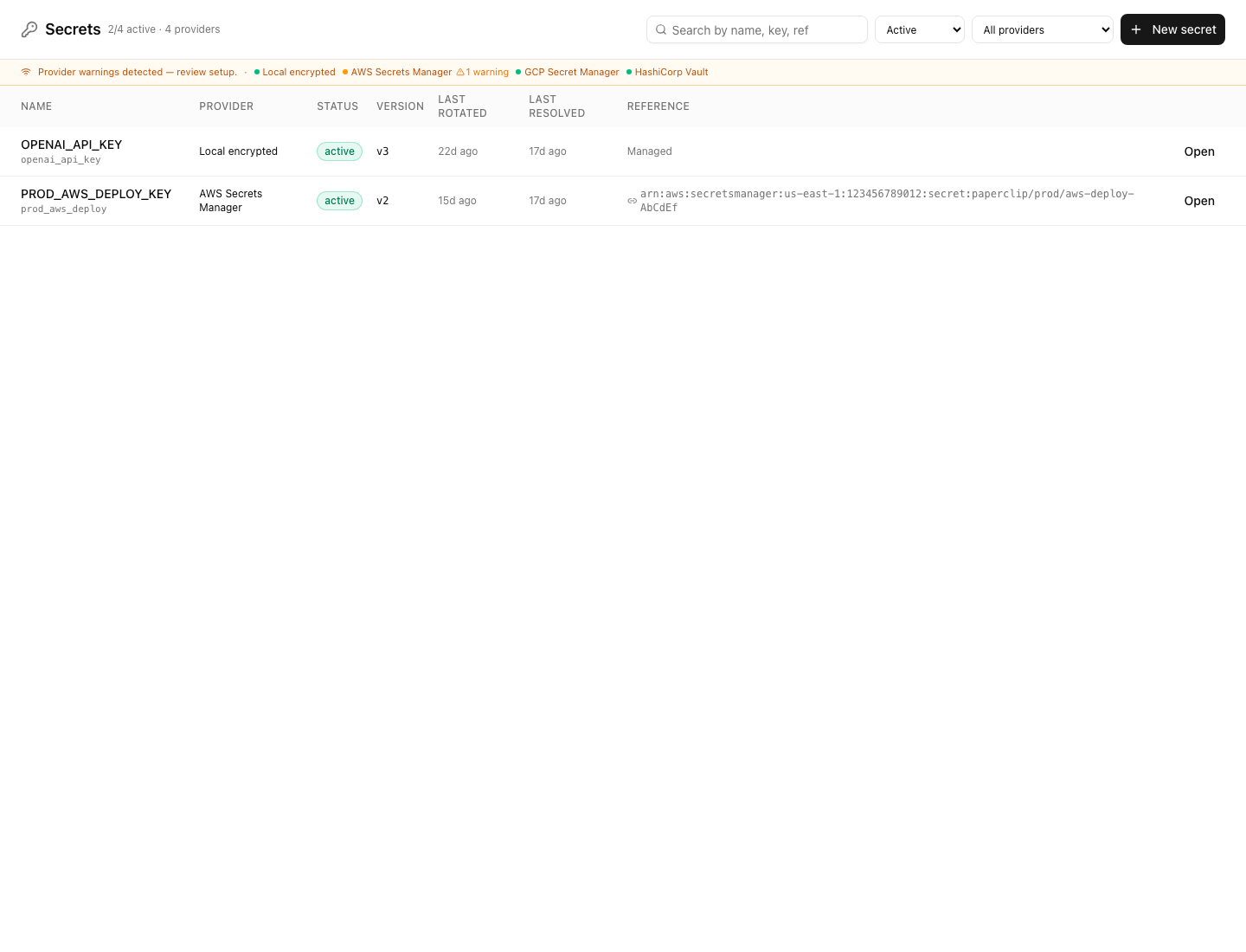 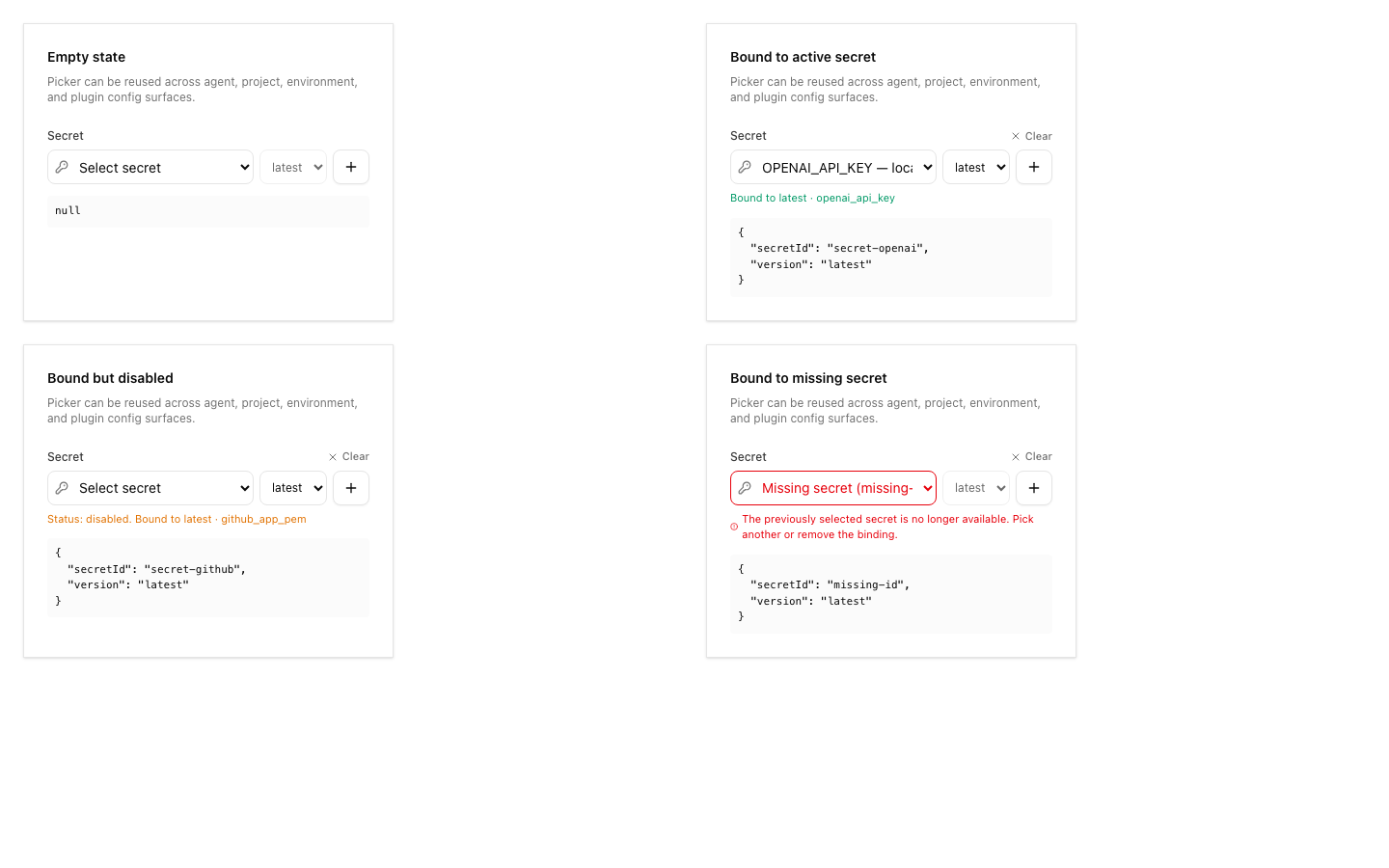 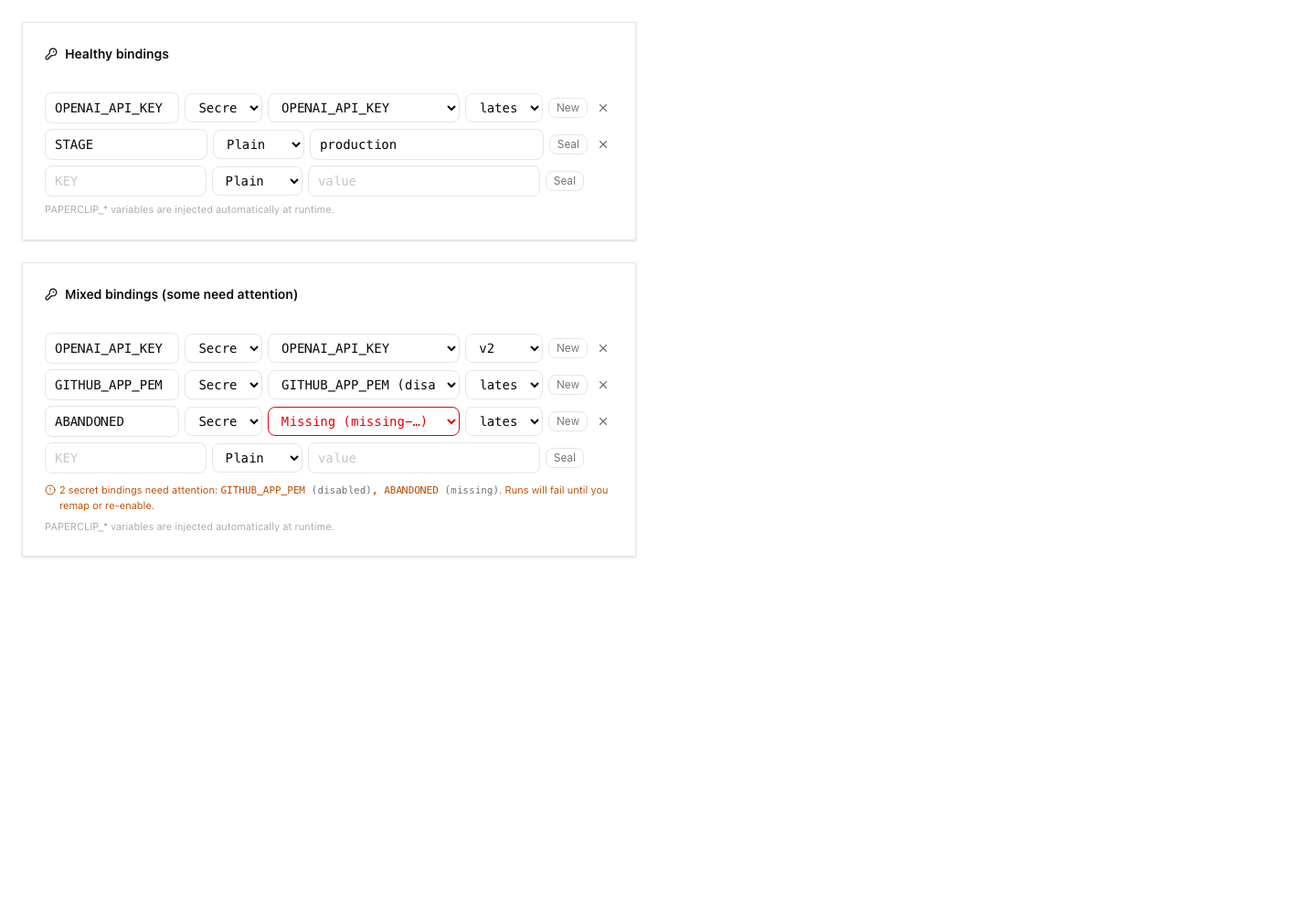 ## Risks - Migration risk: this adds new secret provider tables and extends existing secret rows. The migrations were checked for monotonic ordering and idempotent guards, but reviewers should still inspect upgrade behavior carefully. - Provider risk: AWS support uses direct SigV4 requests. Automated tests cover signing, request timeouts, vault-config selection, namespace guardrails, pending-version archival, sanitized provider errors, and service-level cleanup paths. A real-vault AWS smoke test remains deployment validation for an operator with AWS credentials rather than an unverified merge blocker in this local branch. - UI risk: the Secrets page and import dialog are large new surfaces; screenshots are included above for reviewer inspection. - Verification risk: the full local stable test command hit parallel-load timing failures, although the exact failed files passed when rerun directly. - Operational risk: remote import intentionally avoids plaintext reads; operators must understand that imported external references resolve at runtime and may fail if AWS permissions change. > For core feature work, check [`ROADMAP.md`](ROADMAP.md) first and discuss it in `#dev` before opening the PR. Feature PRs that overlap with planned core work may need to be redirected — check the roadmap first. See `CONTRIBUTING.md`. ## Model Used - OpenAI Codex, GPT-5 coding agent with local shell/tool use in the Paperclip worktree. Exact context-window size was not exposed by the runtime. ## Checklist - [x] I have included a thinking path that traces from project context to this change - [x] I have specified the model used (with version and capability details) - [x] I have checked ROADMAP.md and confirmed this PR does not duplicate planned core work - [ ] I have run tests locally and they pass - [x] I have added or updated tests where applicable - [x] If this change affects the UI, I have included before/after screenshots - [x] I have updated relevant documentation to reflect my changes - [x] I have considered and documented any risks above - [x] I will address all Greptile and reviewer comments before requesting merge --------- Co-authored-by: Paperclip <noreply@paperclip.ing> Co-authored-by: Claude Sonnet 4.6 <noreply@anthropic.com> |
||
|
Dotta
|
772fc92619 |
Add issue controls and retry-now recovery (#5426)
## Thinking Path > - Paperclip orchestrates AI agents for zero-human companies > - Issue operators need clear controls for execution settings, model overrides, and recovery retries > - Existing issue properties hid useful adapter override state and did not expose a board-triggered retry for scheduled heartbeat recovery > - Scheduled retries also need to respect the same safety gates as normal execution instead of bypassing budget, review, pause, dependency, or terminal-state checks > - This pull request adds the issue property controls and retry-now surfaces together because they share the issue details/properties UI > - The benefit is that operators can inspect and adjust issue execution settings and safely trigger pending scheduled recovery without hidden control-plane behavior ## What Changed - Adds editable issue assignee model override controls in `IssueProperties`, with focused coverage. - Removes the stale workspace tasks link from issue properties. - Adds a scheduled retry `retry-now` backend path and shared response types. - Adds main-pane and properties-pane scheduled retry UI, backed by a shared `useRetryNowMutation` hook. - Adds suppression coverage for budget hard stops, review participant changes, subtree pause holds, unresolved blockers, terminal issues, and company scoping. - Updates the `IssueProperties` test harness with toast actions required by the retry-now hook. ## Verification - `pnpm exec vitest run ui/src/components/IssueProperties.test.tsx ui/src/components/IssueScheduledRetryCard.test.tsx` — 31 passed. - `pnpm exec vitest run server/src/__tests__/issue-scheduled-retry-routes.test.ts` — exited 0, but this host skipped the embedded Postgres route tests with: `Postgres init script exited with code null. Please check the logs for extra info. The data directory might already exist.` - Pairwise merge check against the assigned-backlog PR branch completed without conflicts via `git merge --no-commit --no-ff` in a temporary worktree. ### Visual verification screenshots Storybook story: `Product/Issue Scheduled retry surfaces / ScheduledRetrySurfaces`.   ## Risks - Medium: this touches issue execution/retry behavior, so CI should run the embedded Postgres route tests on a host that can initialize Postgres. - Low-to-medium UI risk around duplicated retry-now entry points; both surfaces share one mutation hook to keep behavior consistent. > For core feature work, check [`ROADMAP.md`](ROADMAP.md) first and discuss it in `#dev` before opening the PR. Feature PRs that overlap with planned core work may need to be redirected — check the roadmap first. See `CONTRIBUTING.md`. ## Model Used - OpenAI Codex coding agent, GPT-5 model family (`gpt-5`), tool-enabled Paperclip heartbeat environment. Context window and internal reasoning mode are not exposed by the runtime. ## Checklist - [x] I have included a thinking path that traces from project context to this change - [x] I have specified the model used (with version and capability details) - [x] I have checked ROADMAP.md and confirmed this PR does not duplicate planned core work - [x] I have run tests locally and they pass - [x] I have added or updated tests where applicable - [x] If this change affects the UI, I have included before/after screenshots - [x] I have updated relevant documentation to reflect my changes - [x] I have considered and documented any risks above - [x] I will address all Greptile and reviewer comments before requesting merge --------- Co-authored-by: Paperclip <noreply@paperclip.ing> |
||
|
Dotta
|
a1b30c9f35 |
Add planning mode for issue work (#5353)
## Thinking Path > - Paperclip is a control plane for autonomous AI companies. > - Issues are the core unit of work, and issue comments are how board users and agents coordinate execution. > - Some issue conversations need to produce plans and approvals instead of immediate implementation work. > - The existing issue contract did not distinguish standard execution comments from planning-oriented issue work. > - This pull request adds an issue work-mode contract and board UI affordances for standard vs planning mode. > - The benefit is that planning-mode issues can be created, displayed, discussed, and carried through agent heartbeat context without losing the normal issue workflow. ## What Changed - Added `standard` / `planning` issue work-mode contracts across DB, shared validators/types, server issue flows, plugin protocol, and adapter heartbeat payloads. - Added an idempotent `0081_optimal_dormammu` migration for `issues.work_mode`, ordered after current `public-gh/master` migrations. - Updated heartbeat/context summaries and issue-thread interaction behavior so planning work mode is preserved when creating suggested follow-up issues. - Added UI support for planning-mode issue creation, issue rows, detail composer styling, and composer work-mode toggles. - Added focused server/shared/UI tests plus a Playwright visual verification spec for planning-mode surfaces. - Rebased the branch onto current `public-gh/master` and added durable planning-mode screenshots under `doc/assets/pap-3368/`. ## Verification - `pnpm --filter @paperclipai/db run check:migrations` - `pnpm exec vitest run --project @paperclipai/shared packages/shared/src/validators/issue.test.ts` - `pnpm exec vitest run --project @paperclipai/server server/src/__tests__/heartbeat-context-summary.test.ts server/src/__tests__/issue-thread-interactions-service.test.ts server/src/__tests__/issues-goal-context-routes.test.ts --pool=forks --poolOptions.forks.isolate=true` - `pnpm exec vitest run --project @paperclipai/ui ui/src/components/IssueChatThread.test.tsx ui/src/components/NewIssueDialog.test.tsx ui/src/components/IssueRow.test.tsx ui/src/pages/IssueDetail.test.tsx` - `pnpm exec vitest run --project @paperclipai/adapter-utils packages/adapter-utils/src/server-utils.test.ts` - `PAPERCLIP_E2E_SKIP_LLM=true npx playwright test --config tests/e2e/playwright.config.ts tests/e2e/planning-mode-visual-verification.spec.ts` ## Screenshots Desktop planning detail: 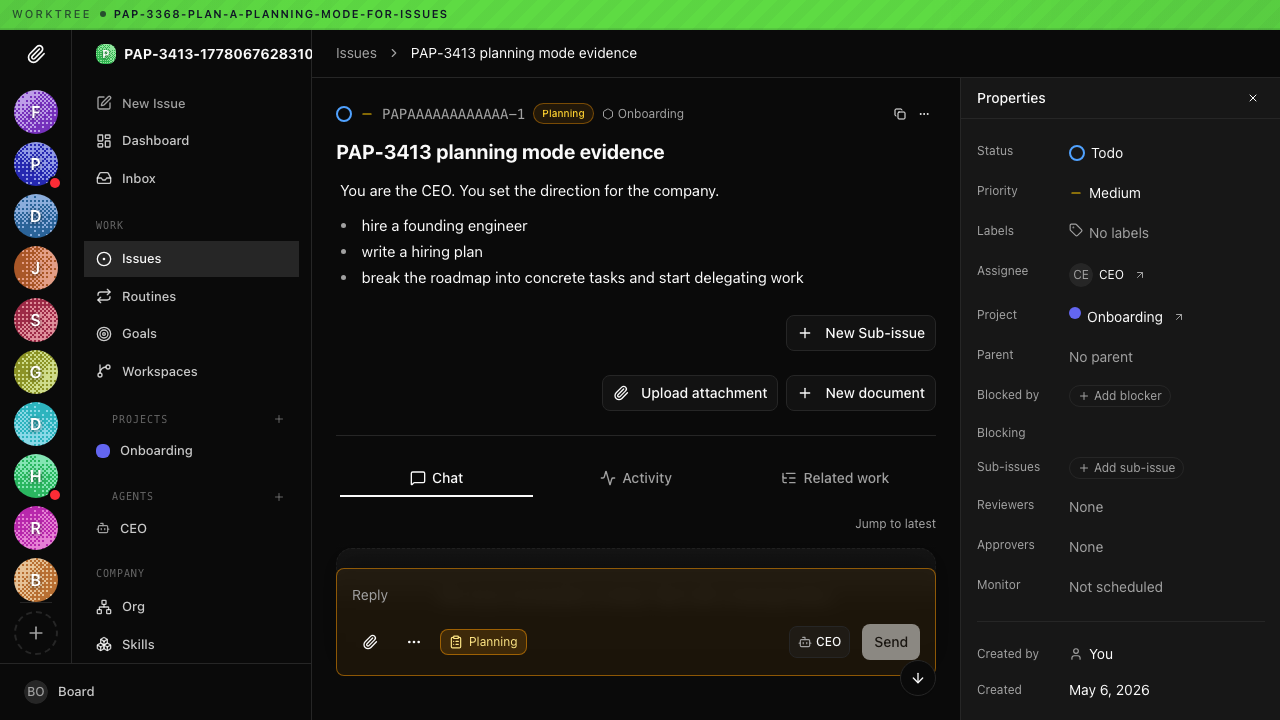 Desktop planning row:  Desktop staged standard toggle:  Mobile planning detail:  Mobile planning row:  ## Risks - Medium migration risk: this adds a non-null issue column. The migration uses `ADD COLUMN IF NOT EXISTS` so installations that applied an older branch-local migration number can still apply the final numbered migration safely. - Medium contract risk: issue payloads, plugin payloads, and adapter heartbeat payloads now include work mode; compatibility is handled by defaulting missing values to `standard`. - UI risk is moderate because composer controls changed; focused component tests and visual e2e coverage exercise standard vs planning display and toggle behavior. > For core feature work, check [`ROADMAP.md`](ROADMAP.md) first and discuss it in `#dev` before opening the PR. Feature PRs that overlap with planned core work may need to be redirected — check the roadmap first. See `CONTRIBUTING.md`. ## Model Used - OpenAI Codex, GPT-5 coding agent in a local Paperclip worktree, with shell/tool use. Exact context-window size is not exposed in this runtime. ## Checklist - [x] I have included a thinking path that traces from project context to this change - [x] I have specified the model used (with version and capability details) - [x] I have checked ROADMAP.md and confirmed this PR does not duplicate planned core work - [x] I have run tests locally and they pass - [x] I have added or updated tests where applicable - [x] If this change affects the UI, I have included before/after screenshots - [x] I have updated relevant documentation to reflect my changes - [x] I have considered and documented any risks above - [x] I will address all Greptile and reviewer comments before requesting merge --------- Co-authored-by: Paperclip <noreply@paperclip.ing> |
||
|
Dotta
|
454edfe81e |
Add recovery handoff system notices (#5289)
## Thinking Path > - Paperclip orchestrates AI agents for zero-human companies. > - Agent runs can end productively while the source issue still lacks a durable final disposition. > - That leaves the control plane unsure whether to resume, escalate, or close the work. > - Issue comments also need a presentation contract so system-authored recovery notices can render as first-class thread messages without overloading normal comments. > - This pull request adds successful-run handoff recovery, comment presentation metadata, and system notice rendering. > - The benefit is stricter task liveness with clearer operator-facing recovery state. ## What Changed - Added successful-run handoff decisions, wake payloads, escalation behavior, and recovery tests. - Added issue comment presentation metadata with migration `0078_white_darwin.sql` and shared/server/company portability support. - Rendered recovery/system notices in issue chat with dedicated UI components, fixtures, tests, and storybook/lab coverage. - Included the current recovery model-profile hint patch so automatic recovery follow-ups use the cheap profile. ## Verification - `pnpm install --frozen-lockfile` - `pnpm exec vitest run server/src/services/recovery/successful-run-handoff.test.ts ui/src/components/SystemNotice.test.tsx ui/src/lib/system-notice-comment.test.ts ui/src/components/IssueChatThreadSystemNotice.test.tsx` ## Risks - Migration-bearing PR: merge this before any other branch that might later add a migration. - The branch touches both recovery services and issue-thread rendering, so review should pay attention to recovery wake idempotency and comment metadata compatibility. ## Model Used - OpenAI GPT-5 Codex via Paperclip `codex_local` adapter, with shell/git/GitHub CLI tool use. ## Checklist - [x] I have included a thinking path that traces from project context to this change - [x] I have specified the model used (with version and capability details) - [x] I have checked ROADMAP.md and confirmed this PR does not duplicate planned core work - [x] I have run tests locally and they pass - [x] I have added or updated tests where applicable - [x] If this change affects the UI, I have included before/after screenshots - [x] I have updated relevant documentation to reflect my changes - [x] I have considered and documented any risks above - [x] I will address all Greptile and reviewer comments before requesting merge --------- Co-authored-by: Paperclip <noreply@paperclip.ing> |
||
|
Devin Foley
|
90631b09b3 |
Let adapters declare runtime command spec for remote provisioning (#5141)
## Thinking Path

> - Paperclip orchestrates AI agents for zero-human companies, running
adapter
> commands like `claude`, `codex`, `pi` either locally or on remote
runtimes
>   (SSH hosts, sandboxes, etc.)
> - On a fresh remote runtime — particularly an ephemeral sandbox — the
> adapter's CLI may not be installed yet. Today operators handle this
via
> external configuration (e.g. a project-level `provisionCommand` shell
> script) that has to know about every adapter the operator might want
to use
> - This means every adapter has its own well-known npm package, but
operators
>   end up writing duplicate provision shell scripts that paste together
> `npm install -g @anthropic-ai/claude-code`, `npm install -g
@openai/codex`,
>   etc. — knowledge the adapter itself already has
> - This PR moves that knowledge into the adapter modules: each adapter
declares
> how its runtime command should be detected and (if applicable)
installed
> via `getRuntimeCommandSpec(config)`. The execution path runs the
adapter's
> own install command on remote sandbox targets before launching, so a
fresh
> sandbox bootstraps itself instead of requiring a hand-written
provision script
> - The benefit is fewer footguns for operators provisioning remote
runtimes,
>   and a clean place for new adapters to plug in their install recipe

## What Changed

- New types in `packages/adapter-utils/src/types.ts`:
    - `AdapterRuntimeCommandSpec` describing `command`, optional
      `detectCommand`, and optional `installCommand`
    - Optional `getRuntimeCommandSpec(config)` on `ServerAdapterModule`
- Optional `runtimeCommandSpec` on `AdapterExecutionContext` so adapters
      receive the resolved spec at execute time
- New helper `ensureAdapterExecutionTargetRuntimeCommandInstalled(...)`
in
`packages/adapter-utils/src/execution-target.ts` that runs the install
command
on remote targets when `transport === "sandbox"`. SSH and local targets
are
  no-ops. Throws on timeout or non-zero exit so failures surface early.
- Each of `claude-local`, `codex-local`, `cursor-local`, `gemini-local`,
  `opencode-local`, `pi-local`'s `execute.ts` now reads
`ctx.runtimeCommandSpec?.installCommand` and calls the helper before
launching
  the adapter command.
- `server/src/adapters/registry.ts` declares `getRuntimeCommandSpec` for
each
  adapter:
- claude/codex/gemini/opencode/pi-local: `npm install -g <package>`
recipe via
a shared `buildNpmRuntimeCommandSpec` helper, with a defensive guard
that
only auto-installs when the configured `command` matches the well-known
      fallback (custom binaries are left alone).
- cursor-local: declares `command` only; no auto-install (no public npm
      package), preserving the existing manual setup.
- `server/src/services/heartbeat.ts` resolves the spec via
`adapter.getRuntimeCommandSpec?.(runtimeConfig)` and passes it through
to
  `AdapterExecutionContext`.
- Tests added in `execution-target.test.ts` (~75 lines), e2b
`plugin.test.ts` (~32 lines), and `environment-run-orchestrator.test.ts`
  (~76 lines).

## Verification

- `pnpm --filter @paperclipai/adapter-utils test`
- `pnpm --filter @paperclipai/server test --
environment-run-orchestrator`
- `pnpm --filter @paperclipai/sandbox-providers-e2b test`
- Manual QA: run an adapter (claude/codex/etc.) against a fresh
sandbox-backed
environment that does NOT have the adapter CLI pre-installed. Confirm
the
install runs once at the start of the agent run and the adapter then
launches
successfully. Re-run on the same sandbox; confirm the install command is
  idempotent and the second run starts faster.
- Confirm SSH and local execution paths are unaffected (gated by
  `transport === "sandbox"`).

## Risks

- Behavioural shift on sandbox runs: a new install step now runs at the
start
  of every sandbox agent run for adapters with `installCommand` set. The
install commands are idempotent (`if ! command -v X >/dev/null 2>&1;
then
npm install -g <pkg>; fi`), so this is fast on warm sandboxes. On a cold
  sandbox, the first run takes longer.
- Operators who used the legacy project-level `provisionCommand` to
install
adapter CLIs can drop that part of their script; the adapter handles it
now.
  Existing scripts continue to work — installs are idempotent.
- The cursor-local adapter has no auto-install (no public npm package).
  Behaviour for cursor-local on sandboxes is unchanged.
- New optional surface on `ServerAdapterModule`. Plugins that don't
implement
  `getRuntimeCommandSpec` retain previous behaviour (no auto-install).

## Model Used

- OpenAI GPT-5.4 (reasoning effort: high) via Codex CLI
- Provider: OpenAI
- Used to author the code changes in this PR

## Checklist

- [x] I have included a thinking path that traces from project context
to this change
- [x] I have specified the model used (with version and capability
details)
- [x] I have checked ROADMAP.md and confirmed this PR does not duplicate
planned core work
- [x] I have run tests locally and they pass
- [x] I have added or updated tests where applicable
- [ ] If this change affects the UI, I have included before/after
screenshots — N/A
- [ ] I have updated relevant documentation to reflect my changes — N/A
- [x] I have considered and documented any risks above
- [x] I will address all Greptile and reviewer comments before
requesting merge
|
||
|
Devin Foley
|
0e51fa2b0d |
Honor reuse-existing preference and assignee default environment in issue runs (#5139)
## Thinking Path > - Paperclip orchestrates AI agents for zero-human companies > - Agents run inside execution workspaces (a per-issue cwd + env), and an issue > can prefer to reuse an existing workspace or get a fresh one each time > - The heartbeat service was reading the existing workspace's config to derive > environment selection regardless of whether the issue actually wanted to reuse > it. So fresh-run issues were inheriting stale config from a workspace that was > about to be discarded > - Separately, when an issue is assigned to an agent, the issue's execution > workspace settings weren't picking up the agent's `defaultEnvironmentId`, > even though the agent's choice is the natural default for that issue > - This PR makes both selection paths honor the obvious source of truth: > workspace config flows only when the issue actually wants `reuse_existing`, > and the assignee agent's default environment is applied at assignment time if > nothing else is set on the issue > - The benefit is that re-running a flaky issue picks up the right environment > instead of inheriting the previous run's config, and assigning an agent to an > issue does the obvious thing without operator intervention ## What Changed - `server/src/services/heartbeat.ts`: introduce `reusableExecutionWorkspaceConfig` that is non-null only when `shouldReuseExisting` is true. Both `resolveExecutionWorkspaceEnvironmentId(...)` and `applyPersistedExecutionWorkspaceConfig(...)` now read from it instead of unconditionally consulting `existingExecutionWorkspace?.config`. Fresh-run issues no longer inherit stale environment config from an in-flight workspace about to be discarded. - `server/src/services/issues.ts`: when an issue update sets a new `assigneeAgentId` and isolated workspaces are enabled, populate `executionWorkspaceSettings.environmentId` from the assignee agent's `defaultEnvironmentId` if the issue doesn't have an explicit `environmentId` set yet. - Tests added in `heartbeat-plugin-environment.test.ts` (~216 lines) and `issues-service.test.ts` (~85 lines) covering both paths. ## Verification - `pnpm --filter @paperclipai/server test -- heartbeat-plugin-environment issues-service` - Manual QA: assign an issue to an agent that has a non-default `defaultEnvironmentId`, confirm the issue's workspace settings now include that environment id without operator intervention. Trigger a rerun on an issue whose existing workspace points at a stale environment, confirm the rerun uses the freshly-resolved environment. ## Risks - Behavioural shift on assignment: previously assigning an agent didn't propagate the agent's default environment to the issue. Now it does. Callers that explicitly want the issue to keep its existing/null environment must set `executionWorkspaceSettings.environmentId` themselves; the new logic only fires when no explicit value is set. - Behavioural shift on rerun: stale workspace config is no longer applied to fresh runs. Operators who relied on this implicit inheritance may see different environment selection on the first rerun after deploy. Mitigation: the explicit isssue settings and project policy are still honored as before. ## Model Used - OpenAI GPT-5.4 (reasoning effort: high) via Codex CLI - Provider: OpenAI - Used to author the code changes in this PR ## Checklist - [x] I have included a thinking path that traces from project context to this change - [x] I have specified the model used (with version and capability details) - [x] I have checked ROADMAP.md and confirmed this PR does not duplicate planned core work - [x] I have run tests locally and they pass - [x] I have added or updated tests where applicable - [ ] If this change affects the UI, I have included before/after screenshots — N/A (no UI changes) - [ ] I have updated relevant documentation to reflect my changes — N/A - [x] I have considered and documented any risks above - [x] I will address all Greptile and reviewer comments before requesting merge |
||
|
Dotta
|
15eac43b43 |
[codex] Retry max-turn exhausted heartbeats (#5096)
## Thinking Path > - Paperclip orchestrates AI agents for autonomous companies, and heartbeat execution is the control-plane loop that keeps assigned work moving. > - Max-turn exhaustion is a recoverable local-adapter stop condition for Claude and Gemini agents when a run needs another heartbeat to continue safely. > - The previous behavior could leave max-turn continuation details hard to inspect, and duplicate/stale continuation wakes could keep running after issue state changed. > - The adapter layer also needed to avoid trusting arbitrary stdout/stderr text as scheduler control metadata. > - This pull request adds bounded max-turn continuation scheduling, visible retry state, structured stop metadata handling, and stale/duplicate continuation guards. > - The benefit is safer automatic continuation after max-turn stops, clearer operator visibility, and fewer duplicate or stale agent runs. ## What Changed - Replaces closed PR #4952, whose head repository was deleted. - Rebases the recovered max-turn continuation branch onto current `paperclipai/paperclip:master`. - Adds max-turn continuation scheduling and retry-state plumbing for heartbeat runs. - Adds stale/duplicate continuation suppression when issue status, ownership, or execution locks change. - Normalizes Claude/Gemini max-turn detection around structured stop metadata instead of unstructured stdout/stderr text. - Surfaces max-turn continuation settings and retry visibility in the board UI. - Adds focused server, adapter, and UI tests for max-turn stop metadata, retry scheduling, stale queued-run invalidation, adapter parsing/execution, run ledger display, and agent config patching. ## Verification - `pnpm install --no-frozen-lockfile` to refresh local dependencies after rebasing onto current `master`. - `pnpm run preflight:workspace-links && pnpm exec vitest run server/src/__tests__/claude-local-adapter.test.ts server/src/__tests__/claude-local-execute.test.ts server/src/__tests__/gemini-local-adapter.test.ts server/src/__tests__/gemini-local-execute.test.ts server/src/__tests__/heartbeat-retry-scheduling.test.ts server/src/__tests__/heartbeat-stale-queue-invalidation.test.ts server/src/services/heartbeat-stop-metadata.test.ts ui/src/components/IssueRunLedger.test.tsx ui/src/lib/agent-config-patch.test.ts ui/src/lib/runRetryState.test.ts --testTimeout=20000` - `pnpm --filter @paperclipai/adapter-claude-local typecheck && pnpm --filter @paperclipai/adapter-gemini-local typecheck && pnpm --filter @paperclipai/server typecheck && pnpm --filter @paperclipai/ui typecheck` - UI screenshot note: the UI changes are limited to config/ledger state rendering rather than layout changes; component/unit coverage above verifies the rendered behavior. ## Risks - Medium behavior risk: heartbeat retry gating now suppresses max-turn continuations when issue state or execution locks drift, so any callers that relied on stale continuations running will now see cancellation instead. - Low adapter risk: Claude/Gemini unstructured text no longer triggers max-turn scheduler metadata, so only structured stop signals and Gemini exit code 53 are trusted. - No database migrations. > For core feature work, check [`ROADMAP.md`](ROADMAP.md) first and discuss it in `#dev` before opening the PR. Feature PRs that overlap with planned core work may need to be redirected — check the roadmap first. See `CONTRIBUTING.md`. ## Model Used - OpenAI Codex coding agent, GPT-5-class model, tool-enabled local repository editing and command execution. ## Checklist - [x] I have included a thinking path that traces from project context to this change - [x] I have specified the model used (with version and capability details) - [x] I have checked ROADMAP.md and confirmed this PR does not duplicate planned core work - [x] I have run tests locally and they pass - [x] I have added or updated tests where applicable - [x] If this change affects the UI, I have included before/after screenshots (not applicable: state/default rendering only; covered by component/unit tests) - [x] I have updated relevant documentation to reflect my changes (not applicable: no user-facing command or docs contract changed) - [x] I have considered and documented any risks above - [x] I will address all Greptile and reviewer comments before requesting merge --------- Co-authored-by: Paperclip <noreply@paperclip.ing> |
||
|
Dotta
|
57229d0f24 |
[codex] Add issue monitor liveness controls (#4988)
## Thinking Path > - Paperclip is a control plane for autonomous AI companies where work must stay observable, governable, and recoverable. > - The task/heartbeat subsystem owns agent execution continuity, issue state transitions, and visible recovery behavior. > - Waiting on an external service is not the same as being blocked when the assignee still owns a future check. > - The gap was that agents had no first-class one-shot monitor state for external-service waits, so recovery could look stalled or require ad hoc comments. > - This pull request adds bounded issue monitors that can wake the owner, clear exhausted waits, and produce explicit recovery behavior. > - It also surfaces monitor status in the board UI and documents when to use monitors versus `blocked`. > - The benefit is clearer liveness semantics for asynchronous waits without weakening single-assignee task ownership. ## What Changed - Added issue monitor fields, shared types, validators, constants, and an idempotent `0075` migration for scheduled monitor state. - Added server-side monitor scheduling, dispatch, recovery bounds, activity logging, and external-ref redaction. - Added board/agent route coverage for monitor permissions and child monitor scheduling. - Added issue detail/property UI for monitor state, a monitor activity card, and Storybook stories for review surfaces. - Documented monitor semantics and recovery policy behavior in `doc/execution-semantics.md`. - Addressed Greptile review feedback by preserving monitor state in skipped-stage builders and making board monitor saves send `scheduledBy: "board"`. ## Verification - `pnpm install --frozen-lockfile` - `pnpm run preflight:workspace-links && pnpm exec vitest run server/src/__tests__/issue-execution-policy-routes.test.ts server/src/__tests__/issue-execution-policy.test.ts server/src/__tests__/issue-monitor-scheduler.test.ts server/src/__tests__/recovery-classifiers.test.ts ui/src/components/IssueMonitorActivityCard.test.tsx ui/src/components/IssueProperties.test.tsx ui/src/lib/activity-format.test.ts` - First run passed 5 files and failed to collect 2 server suites because the worktree was missing the optional `acpx/runtime` dependency. - After `pnpm install --frozen-lockfile`, reran the 2 failed suites successfully. - `pnpm exec vitest run server/src/__tests__/issue-monitor-scheduler.test.ts server/src/__tests__/recovery-classifiers.test.ts` - `pnpm --filter @paperclipai/shared typecheck && pnpm --filter @paperclipai/db typecheck && pnpm --filter @paperclipai/server typecheck && pnpm --filter @paperclipai/ui typecheck` - `pnpm exec vitest run server/src/__tests__/issue-execution-policy.test.ts ui/src/components/IssueProperties.test.tsx` - `pnpm --filter @paperclipai/server typecheck && pnpm --filter @paperclipai/ui typecheck` - `pnpm exec vitest run ui/src/components/IssueMonitorActivityCard.test.tsx ui/src/components/IssueProperties.test.tsx` - `pnpm --filter @paperclipai/ui typecheck` - Storybook screenshot captured from `http://127.0.0.1:6006/iframe.html?viewMode=story&id=product-issue-monitor-surfaces--monitor-surfaces` with Playwright. ## Screenshots  ## Risks - Medium: this changes heartbeat recovery behavior for scheduled external-service waits, so regressions could affect wake timing or recovery issue creation. - Migration risk is reduced by using `IF NOT EXISTS` for the new issue monitor columns and index. - External monitor references are treated as secret-adjacent and are intentionally omitted from visible activity/wake payloads. > For core feature work, check [`ROADMAP.md`](ROADMAP.md) first and discuss it in `#dev` before opening the PR. Feature PRs that overlap with planned core work may need to be redirected — check the roadmap first. See `CONTRIBUTING.md`. ## Model Used - OpenAI Codex, GPT-5 coding agent with repository tool use and terminal execution. ## Checklist - [x] I have included a thinking path that traces from project context to this change - [x] I have specified the model used (with version and capability details) - [x] I have checked ROADMAP.md and confirmed this PR does not duplicate planned core work - [x] I have run tests locally and they pass - [x] I have added or updated tests where applicable - [x] If this change affects the UI, I have included before/after screenshots or Storybook review surfaces - [x] I have updated relevant documentation to reflect my changes - [x] I have considered and documented any risks above - [x] I will address all Greptile and reviewer comments before requesting merge --------- Co-authored-by: Paperclip <noreply@paperclip.ing> |
||
|
Dotta
|
3cd26a78fc |
[codex] Surface live run comment context (#4957)
## Thinking Path > - Paperclip orchestrates AI agents through issue comments and heartbeat runs > - The board UI needs to distinguish a comment that triggered a live run from comments queued after that run started > - The run payload already stores comment context, but active-run API responses did not expose the ids the UI needs > - Without those ids, the triggering comment can flash as queued while the agent is already responding to it > - This pull request exposes live-run comment context and teaches the optimistic comment helper to ignore the trigger comment > - The benefit is clearer issue-chat state during comment-triggered agent interruptions ## What Changed - Added `contextCommentId` and `contextWakeCommentId` to active/live run payloads. - Threaded those ids through server routes, heartbeat summaries, UI API types, and issue detail rendering. - Updated optimistic comment classification to avoid marking the triggering comment as queued. - Added server and UI regression coverage. ## Verification - `pnpm exec vitest run server/src/__tests__/agent-live-run-routes.test.ts ui/src/lib/optimistic-issue-comments.test.ts` ## Risks - Low-to-medium risk: adds optional fields to existing run payloads. Existing consumers should ignore unknown fields, and UI handling is null-safe. > For core feature work, check [`ROADMAP.md`](ROADMAP.md) first and discuss it in `#dev` before opening the PR. Feature PRs that overlap with planned core work may need to be redirected — check the roadmap first. See `CONTRIBUTING.md`. ## Model Used - OpenAI Codex, GPT-5 coding agent, tool use and local command execution. Exact context window was not exposed in the runtime. ## Checklist - [x] I have included a thinking path that traces from project context to this change - [x] I have specified the model used (with version and capability details) - [x] I have checked ROADMAP.md and confirmed this PR does not duplicate planned core work - [x] I have run tests locally and they pass - [x] I have added or updated tests where applicable - [ ] If this change affects the UI, I have included before/after screenshots - [x] I have updated relevant documentation to reflect my changes - [x] I have considered and documented any risks above - [x] I will address all Greptile and reviewer comments before requesting merge --------- Co-authored-by: Paperclip <noreply@paperclip.ing> |












