fc95699fdef5b1295a64904b3aa287713e26ff26
12 Commits
| Author | SHA1 | Message | Date | |
|---|---|---|---|---|
 Devin Foley Devin Foley
|
fc95699fde |
fix(server): enforce agent secret binding sync across lifecycle flows (#8307)
## Thinking Path > - Paperclip is the control plane people use to create, configure, and run AI agents for work. > - This change sits in the server-side agent lifecycle and secret-binding subsystem, where adapter config `env` entries can reference company secrets. > - An incident (while trying to configure a Novita sandbox) showed that an agent can reach a broken runtime state if `adapterConfig.env` contains `secret_ref` entries but the matching `company_secret_bindings` rows are missing. > - The immediate run-path guard and error-surfacing work made the failure diagnosable, but they did not fully prevent new broken agents from being created. > - The risk came from create and approval flows being responsible for remembering to sync bindings at each call site, which is easy to miss as new flows are added. > - This pull request moves the invariant into `agentService` create/update/activate paths, keeps the existing hire-flow fix, and adds regression coverage for create, update, and legacy pending-approval recovery. > - The benefit is that agent secret binding integrity is enforced closer to the data mutation point, so future callers inherit the protection automatically. ## Linked Issues or Issue Description Refs #8309 ### What happened? A Paperclip agent could persist `adapterConfig.env` `secret_ref` entries without matching agent-scoped `company_secret_bindings` rows. When that happened, the config UI could still look configured, but the real run path failed pre-dispatch because the secret was not actually bound to that agent. ### Expected behavior Every normal agent create, config-update, and pending-approval activation flow should leave the agent with secret bindings that match its persisted secret-ref env config. ### Steps to reproduce 1. Create or activate an agent through a flow that persists `adapterConfig.env` secret refs without synchronizing `company_secret_bindings`. 2. Observe that the config state can still appear populated. 3. Start a run for that agent. 4. Observe that pre-dispatch binding validation fails because the secret reference exists but the agent binding does not. ### Deployment mode Local dev (`pnpm dev`) ### Installation method Built from source (`pnpm dev` / `pnpm build`) ### Agent adapter(s) involved - Claude Code - Not adapter-specific (core bug) ### Database mode Embedded PGlite / embedded local dev database flow ### Access context Board (human operator) created or approved the agent; agent runtime later consumed the config. ### Additional context This PR focuses on preventing new broken states from normal service flows and on backfilling the covered legacy pending-approval activation path. ## What Changed - Kept the existing branch-local hire-flow fix that synchronized bindings for route and approval paths. - Moved the binding integrity invariant into `agentService.create()`, `agentService.update()` when `adapterConfig` changes, and `agentService.activatePendingApproval()`. - Added `server/src/__tests__/agents-service-secret-bindings.test.ts` covering create-time sync, update-time resync, and backfill for legacy pending-approval agents. - Removed now-redundant route-layer and approval-layer binding sync calls once the service layer became authoritative. - Simplified the affected unit tests so route/approval tests no longer assert service-owned binding writes directly. ## Verification - `pnpm --filter @paperclipai/server typecheck` - `pnpm exec vitest run server/src/__tests__/agents-service-secret-bindings.test.ts server/src/__tests__/approvals-service.test.ts server/src/__tests__/agent-skills-routes.test.ts` ## Risks - Low to medium risk. - This changes where secret-binding synchronization is enforced, so any unexpected caller that relied on upper-layer manual sync behavior could behave differently. - Agent create/update/activation flows now perform binding synchronization consistently, which adds binding-table writes at those mutation points. - This PR does not retroactively scan and heal every already-broken historical agent row; it prevents and backfills through the covered service flows. > For core feature work, check [`ROADMAP.md`](ROADMAP.md) first and discuss it in `#dev` before opening the PR. Feature PRs that overlap with planned core work may need to be redirected — check the roadmap first. See `CONTRIBUTING.md`. ## Model Used - OpenAI Codex / GPT-5 Codex class model via `codex_local` - Session model family: GPT-5 Codex - Tool-assisted coding with shell, git, HTTP, and local test execution - Reasoning mode: medium interactive tool-use workflow ## Checklist - [x] I have included a thinking path that traces from project context to this change - [x] I have specified the model used (with version and capability details) - [x] I have checked ROADMAP.md and confirmed this PR does not duplicate planned core work - [x] I have searched GitHub for duplicate or related PRs and linked them above - [x] I have either (a) linked existing issues with `Fixes: #` / `Closes #` / `Refs #` OR (b) described the issue in-PR following the relevant issue template - [x] I have run tests locally and they pass - [x] I have added or updated tests where applicable - [x] If this change affects the UI, I have included before/after screenshots - [x] I have updated relevant documentation to reflect my changes - [x] I have considered and documented any risks above - [x] All Paperclip CI gates are green - [x] Greptile is 5/5 with no open P2s, recommendations, or follow-ups - [x] I will address all Greptile and reviewer comments before requesting merge --------- Co-authored-by: Paperclip <noreply@paperclip.ing> |
||
|
Devin Foley
|
04173b341d |
fix: resolve secret refs before sandbox draft probes (#8256)
## Thinking Path > - Paperclip is the control plane operators use to manage agent execution environments, including plugin-declared sandbox providers. > - The failing user path here was `Test draft` for an unsaved sandbox environment using a schema field marked `format: "secret-ref"`. > - Saved environments already resolve secret refs before provider use, but the unsaved probe path was forwarding the selected secret UUID directly to the provider, which made Novita draft probes fail. > - Fixing that safely required a probe-only secret resolution path with explicit actor authorization and audit context, because an unsaved draft has no persisted environment binding to authorize against. > - Once that was fixed, CI and review surfaced follow-up hardening work: preserve actor source through the draft-probe path, prevent late heartbeat finalization from overwriting already-terminal runs, avoid duplicate successful-run handoff wakes for comment-driven runs, make SSH git ref updates tolerate concurrent managed-runtime restores, and keep the skills catalog build from failing on transient GitHub errors for pinned references. > - The result is that Novita draft probes now behave like saved environments, the new secret access path is constrained and audited, and the PR is green end-to-end with Greptile at 5/5. ## Linked Issues or Issue Description No matching public GitHub issue was found after searching open and closed Paperclip issues for `novita`. Related PR search found [#8255](https://github.com/paperclipai/paperclip/pull/8255), but it addresses Novita/dev-SDK linking rather than this draft probe bug. Bug summary: - What happened? When a board user configured a sandbox environment backed by a schema-driven plugin provider such as Novita, selecting an existing company secret for `apiKey` and clicking `Test draft` failed because the probe received the secret UUID instead of the resolved secret value. - Expected behavior `Test draft` should resolve secret-ref fields before calling the provider probe, just like the saved runtime path does. - Steps to reproduce 1. Open `Company Settings -> Environments`. 2. Create or edit a `Sandbox` environment using a provider with a `format: "secret-ref"` field such as `Novita Agent Sandbox`. 3. Select an existing company secret for `apiKey`. 4. Click `Test draft`. 5. Observe the probe failure before this patch. - Paperclip version or commit Reproduced on a local `master` dev checkout; fixed and verified on branch commit `ed982d0c0`. - Deployment mode Local dev (`pnpm dev`). - Installation method Built from source (`pnpm dev` / `pnpm build`). - Agent adapter(s) involved Not adapter-specific in the core bug path; affects schema-driven sandbox provider plugins such as Novita. - Database mode Not database-related. - Access context Board (human operator). - Node.js version `v25.6.1`. - Operating system `macOS 15.7.4`. - Relevant logs or output The user-visible failure was `Novita sandbox probe failed` during `Test draft`. ## What Changed - Resolved schema-marked secret-ref fields during unsaved sandbox environment probes by adding a dedicated probe-time secret resolution path in `environment-config.ts`. - Passed `companyId` plus the full authenticated actor context into the draft probe normalization route so secret resolution stays company-scoped, authorized, and auditable. - Hardened ephemeral secret resolution so unsaved probes require `secrets:read`, preserve the original actor source (`local_implicit`, `agent_jwt`, etc.), and emit usable audit metadata. - Added a conditional heartbeat run-status update so late adapter completions cannot overwrite runs that were already cancelled or otherwise terminal. - Skipped successful-run handoff synthesis for comment-driven wakes, which removes the extra wake/run that was breaking `heartbeat-comment-wake-batching`. - Retried managed-runtime SSH git ref updates on concurrent ref-lock races instead of failing the restore path. - Reused the previous skills-catalog manifest entry when a pinned GitHub reference fails with a recoverable transient error during CI catalog generation. - Added focused regression coverage for the draft probe, ephemeral secret access, heartbeat handoff behavior, SSH ref-lock races, and catalog fallback behavior. ## Verification - `pnpm vitest run server/src/__tests__/environment-routes.test.ts` - `pnpm vitest run server/src/__tests__/secrets-service.test.ts` - `pnpm vitest run server/src/__tests__/heartbeat-comment-wake-batching.test.ts` - `pnpm vitest run server/src/services/recovery/successful-run-handoff.test.ts` - `pnpm vitest run server/src/__tests__/openclaw-gateway-adapter.test.ts` - `pnpm exec vitest run packages/adapter-utils/src/ssh-fixture.test.ts -t "merges concurrent remote commits through the managed runtime restore path"` - `pnpm exec vitest run packages/skills-catalog/src/catalog-builder.test.ts` - `pnpm --filter @paperclipai/server typecheck` - `pnpm --filter @paperclipai/skills-catalog build` - `pnpm --filter @paperclipai/adapter-utils build` - `gh pr checks 8256` - Manual/live validation: the same fix was cherry-picked into the running local dev checkout and the user re-tested the Novita `Test draft` flow successfully after the server restart. ## Risks - Low risk: the Novita-specific user-facing fix is isolated to unsaved sandbox draft probes for plugin schema fields marked `format: "secret-ref"`. - The new ephemeral secret resolution path is intentionally stricter than the original broken behavior; regressions would most likely show up as denied draft probes rather than accidental secret exposure. - The heartbeat, SSH, and catalog changes are all defensive; if they regress, they should affect test/CI orchestration paths rather than persisted company data. ## Model Used - OpenAI Codex Local (`codex_local` in Paperclip). The runtime does not expose the exact backend model ID in agent metadata. GPT-5-class coding model with shell/tool use, repository editing, test execution, GitHub review handling, and issue-thread coordination. ## Checklist - [x] I have included a thinking path that traces from project context to this change - [x] I have specified the model used (with version and capability details) - [x] I have checked ROADMAP.md and confirmed this PR does not duplicate planned core work - [x] I have searched GitHub for duplicate or related PRs and linked them above - [x] I have either (a) linked existing issues with `Fixes: #` / `Closes #` / `Refs #` OR (b) described the issue in-PR following the relevant issue template - [x] I have run tests locally and they pass - [x] I have added or updated tests where applicable - [ ] If this change affects the UI, I have included before/after screenshots - [ ] I have updated relevant documentation to reflect my changes - [x] I have considered and documented any risks above - [x] All Paperclip CI gates are green - [x] Greptile is 5/5 with no open P2s, recommendations, or follow-ups - [x] I will address all Greptile and reviewer comments before requesting merge --------- Co-authored-by: Paperclip <noreply@paperclip.ing> |
||
|
Dotta
|
dbebf30c89 |
Add low-trust review containment (#7530)
## Thinking Path > - Paperclip is a control plane for AI-agent companies, so execution policy and trust boundaries are part of the product's safety contract. > - Low-trust review work needs narrower authority than normal same-company agents because hostile PRs, comments, attachments, and generated output can carry prompt-injection payloads. > - The current V1 shape gives trusted workers broad company context, which is useful for normal execution but too permissive for a reviewer assigned to hostile content. > - This branch adds a `low_trust_review` preset, source-trust tagging, route-level containment, and quarantine handling so low-trust output does not automatically flow into higher-trust wake context. > - The branch has been rebased onto current `origin/master`, and the low-trust migration was renumbered to `0097_low_trust_source_trust.sql` to avoid collisions with existing `0091` through `0096` migrations. > - Greptile feedback was addressed by tightening low-trust detection, preserving project-level trust policy checks, fixing issue-kind promotion lookup, removing duplicate post-lease isolation assertion, documenting fail-closed source-trust behavior, bounding ancestry checks, enforcing runtime issue context for CEOs, awaiting accepted-plan monitor authorization, and making low-trust issue source-trust tagging atomic. > - The benefit is a first production slice of deny-by-default review containment with regression coverage for the main control-plane pivot surfaces. Fixes #7531. ## What Changed - Added shared trust-policy types and validators, plus database/source-trust fields for issues, comments, documents, and work products. - Implemented server enforcement for low-trust issue scope, agent self-view redaction, secret/plugin/runtime denial paths, promotion checks, and quarantined continuation/wake context. - Added focused low-trust regression tests for resolver behavior, source trust, route authorization, heartbeat preflight ordering, runtime containment, and quarantine redaction. - Added board UI affordances for selecting/reviewing the low-trust preset and surfacing source-trust badges in relevant issue views. - Added `doc/LOW-TRUST-PRESETS.md`, updated `doc/SPEC-implementation.md`, and committed the low-trust review contract plan under `doc/plans/`. - Rebasing note: the original `0097_low_trust_source_trust.sql` migration was renamed to `0097_low_trust_source_trust.sql`; the SQL uses `ADD COLUMN IF NOT EXISTS` so users who already applied the old-numbered migration are not broken by the renumbered migration. ## Verification - Rebased branch onto current `origin/master` and force-pushed with lease to `origin/PAP-10211-low-trust-agent` at head `2719f31e3`. - Confirmed the PR diff does not include `pnpm-lock.yaml` or `.github/workflows` changes. - Resolved upstream UI/comment conflicts by preserving deleted-comment tombstone behavior and low-trust source-trust badges/metadata. - Renumbered the low-trust source-trust migration to `0097_low_trust_source_trust.sql`; the SQL uses `ADD COLUMN IF NOT EXISTS` so users who already applied an old-numbered copy are not broken. - `pnpm exec vitest run ui/src/lib/issue-chat-messages.test.ts server/src/__tests__/heartbeat-workspace-session.test.ts` - `pnpm exec vitest run server/src/__tests__/source-trust.test.ts server/src/__tests__/workspace-runtime-service-authz.test.ts ui/src/lib/trust-policy-ui.test.ts ui/src/components/TrustPresetSection.test.tsx` - `pnpm run typecheck:build-gaps` - `git diff --check` - GitHub checks pass on head `2719f31e3`: build, typecheck/release registry, general tests, serialized server suites, e2e, canary, verify, policy/review, Socket, and Snyk. - Greptile Review passes with Confidence Score 5/5 and zero unresolved Greptile review threads. - No design screenshots/images were added because the task explicitly says not to add them unless they are specifically part of the work. ## Risks - Medium risk: this touches shared trust-policy contracts, server authorization paths, heartbeat context generation, migration metadata, and UI preset controls. - Low-trust containment is intentionally deny-by-default; legitimate future review workflows may need explicit allowlisted exceptions. - Plugin/runtime/security surfaces are broad, so regression tests cover the current known routes but future integrations must route through the same containment layer. - The PR is ready for review; GitHub checks are green and Greptile is 5/5. > For core feature work, check [`ROADMAP.md`](ROADMAP.md) first and discuss it in `#dev` before opening the PR. Feature PRs that overlap with planned core work may need to be redirected — check the roadmap first. See `CONTRIBUTING.md`. ## Model Used - OpenAI Codex, GPT-5 coding agent, tool-enabled shell and GitHub CLI workflow. ## Checklist - [x] I have included a thinking path that traces from project context to this change - [x] I have specified the model used (with version and capability details) - [x] I have checked ROADMAP.md and confirmed this PR does not duplicate planned core work - [x] I have run tests locally and they pass - [x] I have added or updated tests where applicable - [x] UI changes are covered by focused tests; no screenshots were added per task instruction not to add design images unless specifically required - [x] I have updated relevant documentation to reflect my changes - [x] I have considered and documented any risks above - [x] I will address all Greptile and reviewer comments before requesting merge --------- Co-authored-by: Paperclip <noreply@paperclip.ing> |
||
|
Dotta
|
d67347be77 |
[codex] Provider vault secrets UX (#6381)
## Thinking Path > - Paperclip orchestrates AI agents that need scoped, auditable access to secrets > - Hosted and external deployments need provider vault configuration without exposing secret values in Paperclip metadata > - AWS Secrets Manager vault setup previously required too much manual operator knowledge > - Provider vault discovery and removal belong together as an independent secrets-management improvement > - This pull request adds AWS provider vault discovery/prefill plus vault removal flows > - The benefit is a safer operator path for configuring external secret storage before higher-level cloud workflows depend on it ## What Changed - Added shared validators/types for AWS provider vault discovery payloads and safe provider metadata. - Implemented AWS provider vault discovery preview on the server. - Added provider vault removal service/route behavior. - Added Secrets page UI for discovery prefill, removal messaging, and related rendering coverage. - Added Storybook provider-vault fixtures and captured screenshots for the new UX states. ## Verification - `pnpm install --frozen-lockfile --ignore-scripts` - `pnpm exec vitest run packages/shared/src/validators/secret.test.ts server/src/__tests__/aws-secrets-manager-provider.test.ts server/src/__tests__/secrets-routes.test.ts server/src/__tests__/secrets-service.test.ts ui/src/pages/Secrets.render.test.tsx` - Result: 4 files passed, 1 embedded Postgres-backed file skipped on this host because local Postgres init was unavailable. - `pnpm --filter @paperclipai/ui exec vitest run src/pages/Secrets.render.test.tsx` - `pnpm --filter @paperclipai/ui typecheck` - Storybook screenshot capture against `Product/Secrets` on `http://127.0.0.1:60381/iframe.html?id=product-secrets--secrets-inventory&viewMode=story&globals=theme:dark` ## Screenshots Provider vaults tab after this change: 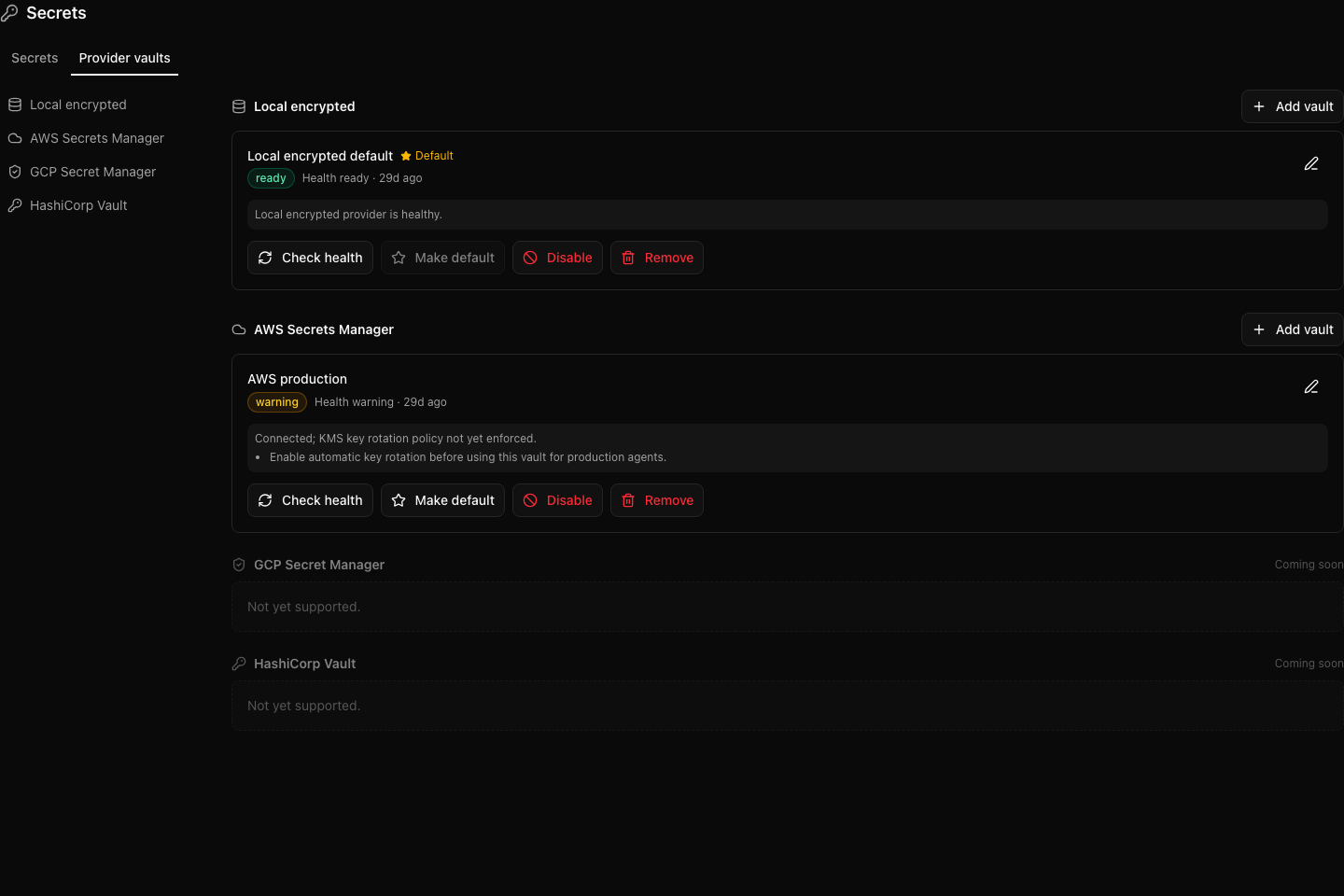 AWS discovery candidate flow: 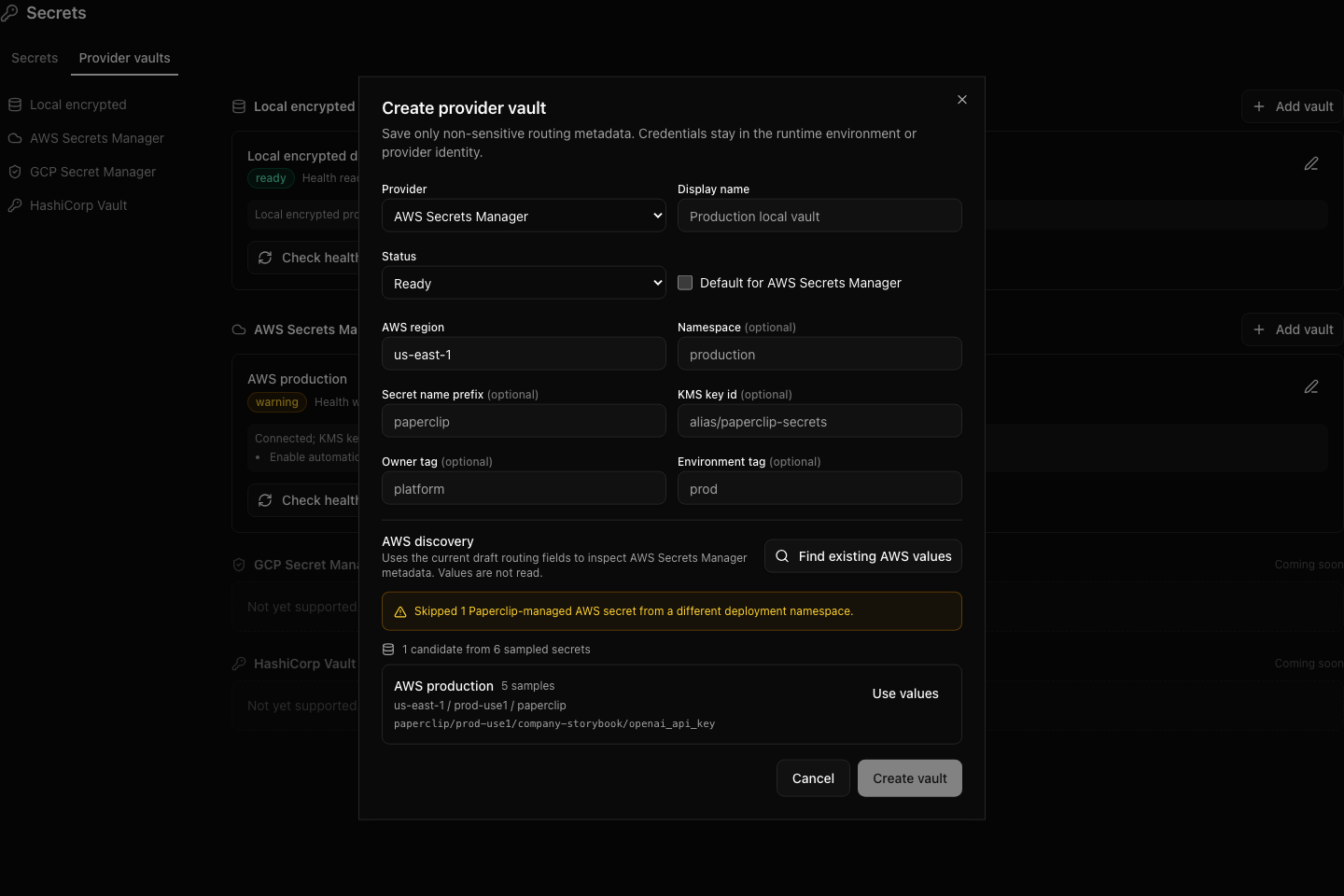 Provider vault removal confirmation: 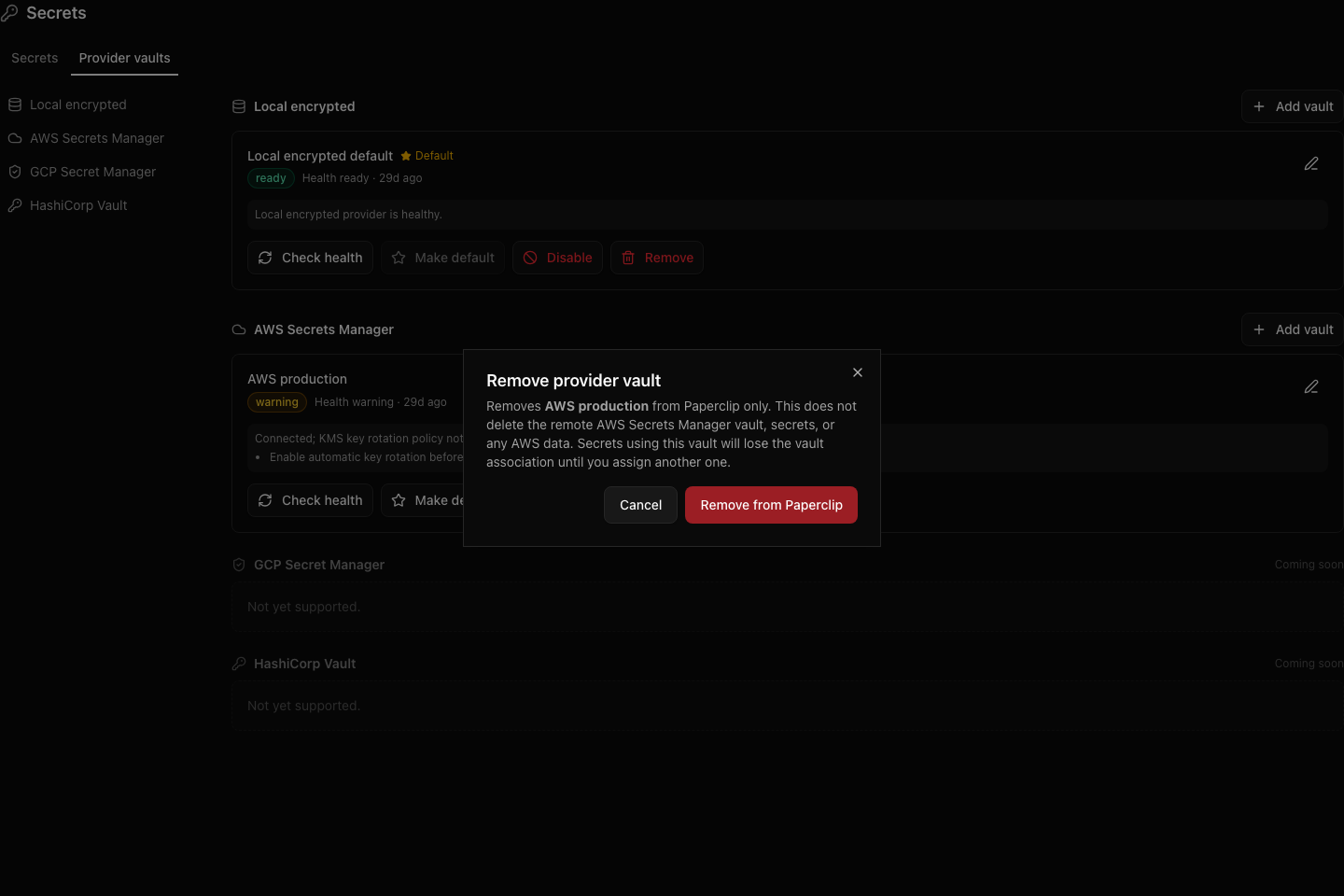 ## Risks - Secret provider metadata handling must remain non-sensitive; validators reject credential-bearing Vault URLs and sensitive AWS discovery keys. - AWS discovery depends on deployment credentials being configured correctly outside Paperclip-managed company secrets. > For core feature work, check [`ROADMAP.md`](ROADMAP.md) first and discuss it in `#dev` before opening the PR. Feature PRs that overlap with planned core work may need to be redirected — check the roadmap first. See `CONTRIBUTING.md`. ## Model Used - OpenAI Codex, GPT-5-based coding agent with local shell/git/tool use. Exact hosted model ID and context-window size are not exposed by the local Paperclip adapter runtime. ## Checklist - [x] I have included a thinking path that traces from project context to this change - [x] I have specified the model used (with version and capability details) - [x] I have checked ROADMAP.md and confirmed this PR does not duplicate planned core work - [x] I have run tests locally and they pass - [x] I have added or updated tests where applicable - [x] If this change affects the UI, I have included before/after screenshots - [x] I have updated relevant documentation to reflect my changes - [x] I have considered and documented any risks above - [x] I will address all Greptile and reviewer comments before requesting merge --------- Co-authored-by: Paperclip <noreply@paperclip.ing> |
||
|
Dotta
|
705c1b8d81 |
[codex] Add routine env secrets support (#6212)
## Thinking Path > - Paperclip orchestrates AI agents for zero-human companies. > - Scheduled routines are the control-plane path for recurring agent work. > - Routines already had dispatch/history, but their runtime environment did not carry routine-owned secret bindings through execution. > - Operators need routine-specific secrets that can override project/agent env without exposing secret values in history, logs, or access events. > - This pull request adds the routine env runtime contract, wires it into execution, and makes the routine UI/history surfaces show safe secret metadata. > - The benefit is that routine executions can use scoped secret refs predictably while preserving company boundaries and auditability. ## What Changed - Added routine env persistence/runtime support, including `routines.env`, `routine_runs.routine_revision_id`, revision snapshots, and idempotent migration `0086_routine_env_runtime_contract`. - Resolved routine env during heartbeat adapter config assembly with precedence `agent < project < routine` and secret access events recorded against the routine consumer. - Added secret binding synchronization for routine create/update/restore flows and guarded cross-company, missing, disabled, and deleted secret cases. - Added a Secrets tab to routine detail, env/secret history diff rendering, and Storybook coverage for the new UI states. - Added server/UI regression tests, including an embedded-Postgres QA path for routine secret execution and restore behavior. - Updated implementation/database docs for routine env and secret-binding behavior. ## Verification - `pnpm install --frozen-lockfile` after rebasing onto `public-gh/master` to refresh workspace links for the newly-added upstream Grok adapter package. - `pnpm exec vitest run server/src/__tests__/heartbeat-project-env.test.ts server/src/__tests__/routines-service.test.ts server/src/__tests__/secrets-service.test.ts server/src/__tests__/qa-routine-secrets-e2e.test.ts ui/src/components/RoutineHistoryTab.test.tsx` passed: 5 files, 92 tests. - `pnpm -r typecheck` passed across the workspace. - `pnpm build` passed. Vite emitted the existing large-chunk/dynamic-import warnings. - UI screenshots were captured locally during QA in `artifacts/pap-9521/` and `artifacts/pap-9522/`; generated screenshots are not committed to avoid adding binary artifacts to the repo. ## Risks - Migration risk is limited by `IF NOT EXISTS` guards for the new columns, FK, and index, and the migration is ordered as `0086` immediately after upstream `0085`. - Runtime behavior changes env precedence for routine executions by adding routine env as the highest-precedence layer; tests cover agent/project/routine precedence. - Secret handling is security-sensitive; tests cover value-free manifests/events/errors, disabled/missing/deleted secrets, and cross-company rejection. - UI history now renders routine env/secret diffs; tests and Storybook stories cover the main rendering paths. > For core feature work, check [`ROADMAP.md`](ROADMAP.md) first and discuss it in `#dev` before opening the PR. Feature PRs that overlap with planned core work may need to be redirected — check the roadmap first. See `CONTRIBUTING.md`. ## Model Used - OpenAI Codex coding agent based on GPT-5, with shell/tool use and medium reasoning effort. ## Checklist - [x] I have included a thinking path that traces from project context to this change - [x] I have specified the model used (with version and capability details) - [x] I have checked ROADMAP.md and confirmed this PR does not duplicate planned core work - [x] I have run tests locally and they pass - [x] I have added or updated tests where applicable - [x] If this change affects the UI, I have included before/after screenshots - [x] I have updated relevant documentation to reflect my changes - [x] I have considered and documented any risks above - [x] I will address all Greptile and reviewer comments before requesting merge --------- Co-authored-by: Paperclip <noreply@paperclip.ing> |
||
|
Dotta
|
778e775c35 |
Add secrets provider vaults and remote import (#5429)
## Thinking Path > - Paperclip orchestrates AI-agent companies and needs secrets handling to work across local development, hosted operators, and governed agent execution. > - The affected subsystem is the company-scoped secrets control plane: database schema, server services/routes, CLI workflows, and the Secrets settings UI. > - The gap was that secrets were local-only and operators could not manage provider vaults or import existing remote references without exposing plaintext. > - This branch adds provider vault configuration plus an AWS Secrets Manager remote-import path while preserving company boundaries, binding context, and audit trails. > - I kept the PR to a single branch PR, removed unrelated lockfile/package drift, rebased the full branch onto the current `public-gh/master`, and addressed fresh Greptile findings. > - The benefit is a reviewable implementation of provider-backed secrets with focused tests covering provider selection, import conflicts, deleted secret reuse, rotation guards, and AWS signing behavior. ## What Changed - Added provider vault support for company secrets, including provider config storage, default vault handling, health checks, binding usage, access events, and remote import preview/commit. - Added an AWS Secrets Manager provider using SigV4 request signing, bounded request timeouts, namespace guardrails, cached runtime credential resolution, and external-reference linking without plaintext reads. - Added Secrets UI surfaces for vault management and remote import, plus CLI/API documentation for setup and operations. - Stabilized routine webhook secret binding paths and SSH environment-driver fixture bindings discovered during verification. - Addressed Greptile and CI findings: no lockfile/package drift, monotonic migration metadata, disabled-vault default races, soft-deleted secret hiding/recreate behavior, remove behavior with disabled vaults, soft-deleted external-reference re-import, non-active rotation guards, managed-secret soft deletion through PATCH, and per-call AWS SDK credential client churn. - Rebased this branch onto `public-gh/master` at `0e1a5828` and force-pushed with lease to keep this as the single PR for the branch. ## Verification - `git fetch public-gh master` - `git rebase public-gh/master` - `git diff --name-only public-gh/master...HEAD | grep '^pnpm-lock\.yaml$' || true` confirmed `pnpm-lock.yaml` is not in the PR diff. - Confirmed migration ordering: master ends at `0081_optimal_dormammu`; this PR adds `0082_dry_vision` and `0083_company_secret_provider_configs`. - Inspected migrations for repeat safety: new tables/indexes use `IF NOT EXISTS`; foreign keys are guarded by `DO $$ ... IF NOT EXISTS`; column additions use `ADD COLUMN IF NOT EXISTS`. - `pnpm -r typecheck` passed before the Greptile follow-up commits. - `pnpm test:run` ran the full stable Vitest path before the Greptile follow-up commits; it completed with 3 timing-related failures under parallel load: `codex-local-execute.test.ts`, `cursor-local-execute.test.ts`, and `environment-service.test.ts`. - `pnpm --filter @paperclipai/server exec vitest run src/__tests__/codex-local-execute.test.ts src/__tests__/cursor-local-execute.test.ts src/__tests__/environment-service.test.ts` passed on targeted rerun (`24/24`). - `pnpm build` passed before the Greptile follow-up commits. Vite reported existing chunk-size/dynamic-import warnings. - After Greptile follow-up commits: `pnpm --filter @paperclipai/server exec vitest run src/__tests__/secrets-service.test.ts` passed (`26/26`). - After Greptile follow-up commits: `pnpm --filter @paperclipai/server exec vitest run src/__tests__/aws-secrets-manager-provider.test.ts src/__tests__/secrets-service.test.ts` passed (`39/39`). - After Greptile follow-up commits: `pnpm --filter @paperclipai/server typecheck` passed. - Captured Storybook screenshots from `ui/storybook-static` for visual review. - Latest PR checks on `5ca3a5cf`: `policy`, serialized server suites 1/4-4/4, `Canary Dry Run`, `e2e`, `security/snyk`, and `Greptile Review` pass; aggregate `verify` is still registering the completed child checks. - Greptile review loop continued through the latest requested pass; all Greptile review threads are resolved and the latest `Greptile Review` check on `5ca3a5cf` passed with 0 comments added. ## Screenshots Before: the provider-vault and remote-import surfaces did not exist on `master`; these are after-state screenshots from the Storybook fixtures. 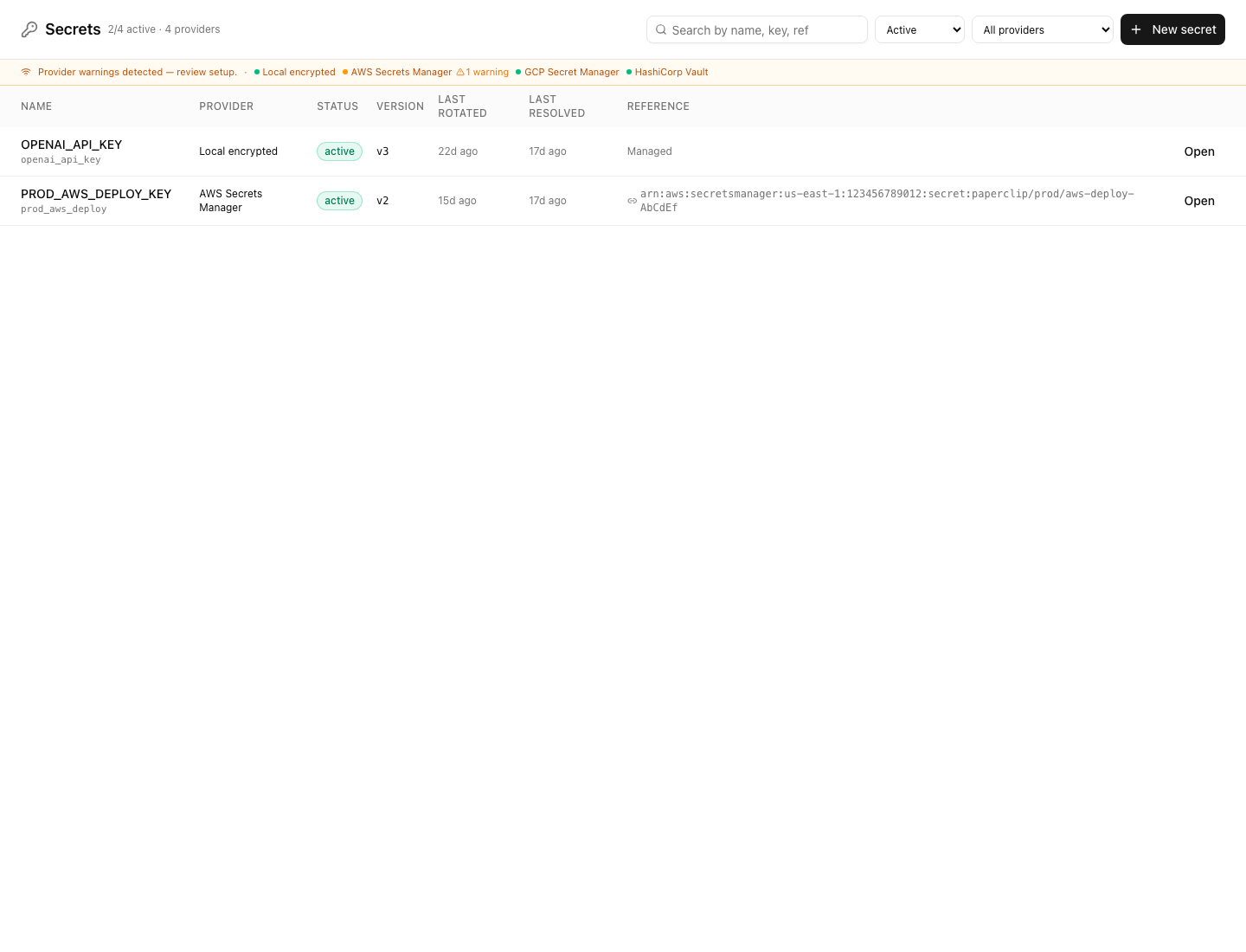 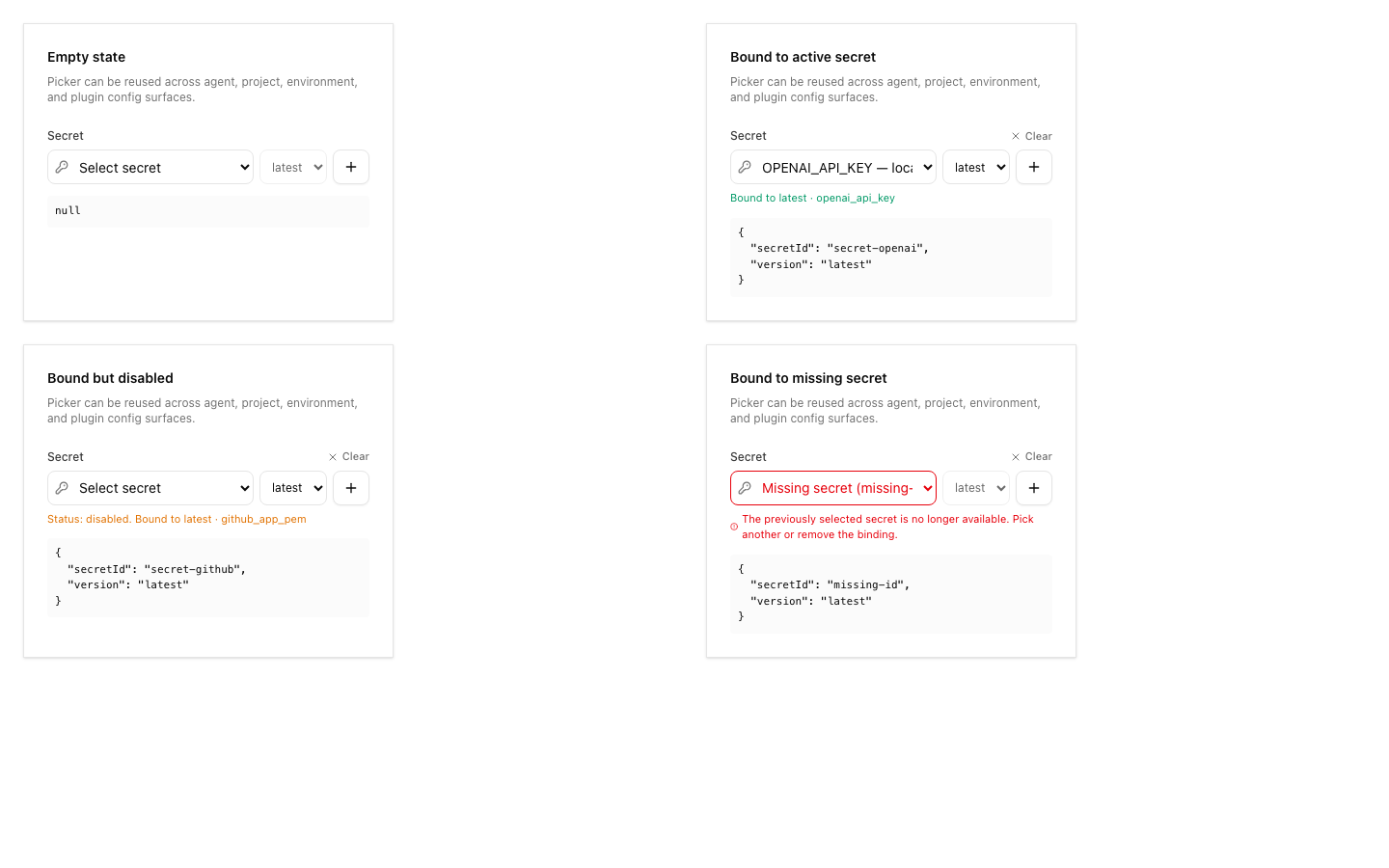 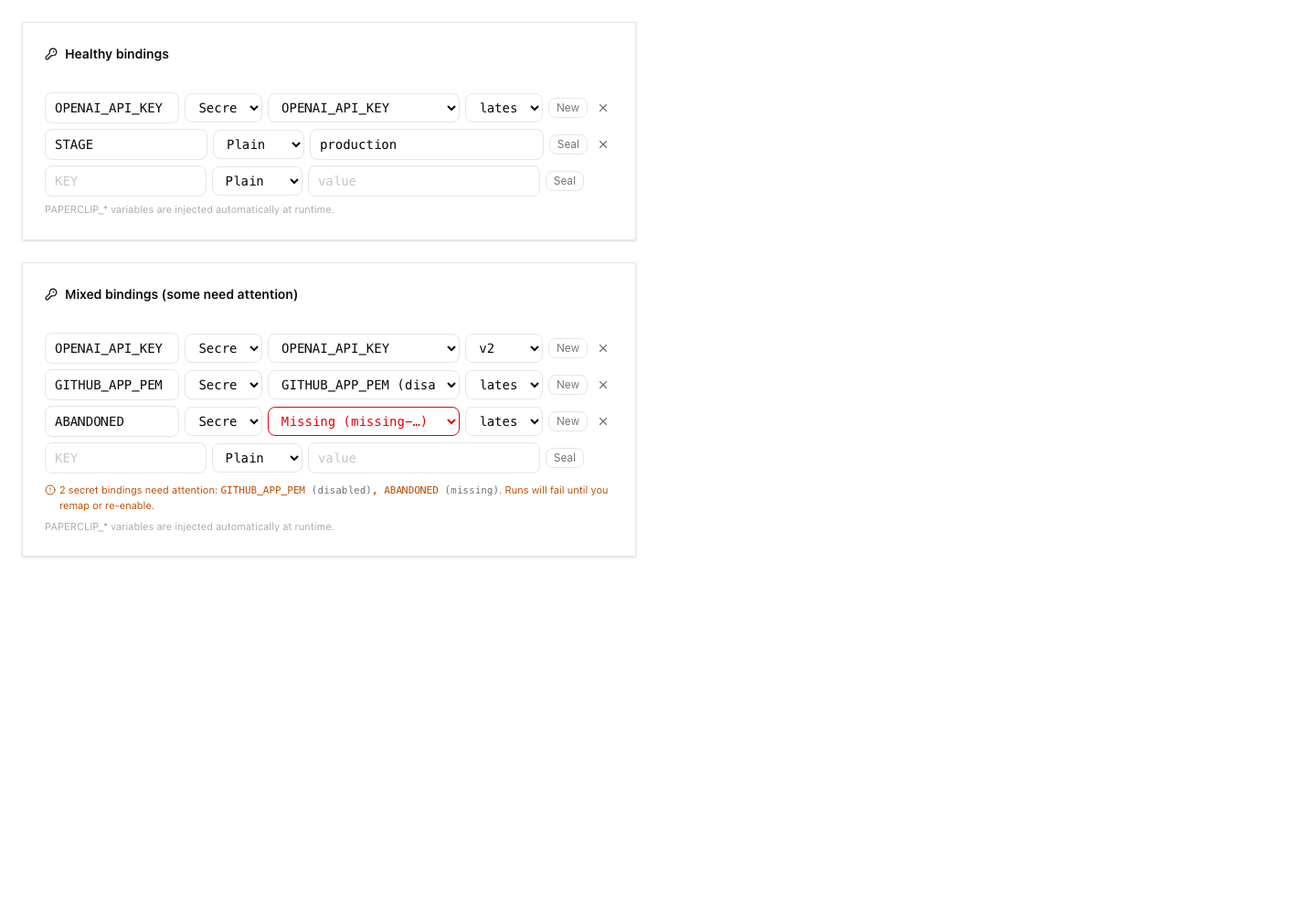 ## Risks - Migration risk: this adds new secret provider tables and extends existing secret rows. The migrations were checked for monotonic ordering and idempotent guards, but reviewers should still inspect upgrade behavior carefully. - Provider risk: AWS support uses direct SigV4 requests. Automated tests cover signing, request timeouts, vault-config selection, namespace guardrails, pending-version archival, sanitized provider errors, and service-level cleanup paths. A real-vault AWS smoke test remains deployment validation for an operator with AWS credentials rather than an unverified merge blocker in this local branch. - UI risk: the Secrets page and import dialog are large new surfaces; screenshots are included above for reviewer inspection. - Verification risk: the full local stable test command hit parallel-load timing failures, although the exact failed files passed when rerun directly. - Operational risk: remote import intentionally avoids plaintext reads; operators must understand that imported external references resolve at runtime and may fail if AWS permissions change. > For core feature work, check [`ROADMAP.md`](ROADMAP.md) first and discuss it in `#dev` before opening the PR. Feature PRs that overlap with planned core work may need to be redirected — check the roadmap first. See `CONTRIBUTING.md`. ## Model Used - OpenAI Codex, GPT-5 coding agent with local shell/tool use in the Paperclip worktree. Exact context-window size was not exposed by the runtime. ## Checklist - [x] I have included a thinking path that traces from project context to this change - [x] I have specified the model used (with version and capability details) - [x] I have checked ROADMAP.md and confirmed this PR does not duplicate planned core work - [ ] I have run tests locally and they pass - [x] I have added or updated tests where applicable - [x] If this change affects the UI, I have included before/after screenshots - [x] I have updated relevant documentation to reflect my changes - [x] I have considered and documented any risks above - [x] I will address all Greptile and reviewer comments before requesting merge --------- Co-authored-by: Paperclip <noreply@paperclip.ing> Co-authored-by: Claude Sonnet 4.6 <noreply@anthropic.com> |
||
|
dotta
|
8f23270f35 |
Add project-level environment variables
Co-Authored-By: Paperclip <noreply@paperclip.ing> |
||
|
dotta
|
8f5196f7d6 |
Add routines automation workflows
Co-Authored-By: Paperclip <noreply@paperclip.ing> |
||
|
Matt Van Horn
|
61966fba1f |
fix(secrets): add secretKeys tracking to resolveEnvBindings for consistent redaction
resolveEnvBindings now returns { env, secretKeys } matching the pattern
already used by resolveAdapterConfigForRuntime, so any caller can redact
secret-sourced values by provenance rather than key-name heuristics alone.

Co-Authored-By: Claude Opus 4.6 <noreply@anthropic.com>
|
||
|
Matt Van Horn
|
977f5570be |
fix(server): redact secret-sourced env vars in run logs by provenance
resolveAdapterConfigForRuntime now returns a secretKeys set tracking which env vars came from secret_ref bindings. The onAdapterMeta callback uses this to redact them regardless of key name. Fixes #234 Co-Authored-By: Claude Opus 4.6 <noreply@anthropic.com> |
||
|
Dotta
|
f60c1001ec |
refactor: rename packages to @paperclipai and CLI binary to paperclipai
Rename all workspace packages from @paperclip/* to @paperclipai/* and the CLI binary from `paperclip` to `paperclipai` in preparation for npm publishing. Bump CLI version to 0.1.0 and add package metadata (description, keywords, license, repository, files). Update all imports, documentation, user-facing messages, and tests accordingly. Co-Authored-By: Claude Opus 4.6 <noreply@anthropic.com> |
||
|
Forgotten
|
11901ae5d8 |
Implement secrets service with local encryption, redaction, and runtime resolution
Add AES-256-GCM local encrypted secrets provider with auto-generated master key, stub providers for AWS/GCP/Vault, and a secrets service that normalizes adapter configs (converting sensitive inline values to secret refs in strict mode) and resolves secret refs back to plain values at runtime. Extract redaction utilities from agent routes into shared module. Redact sensitive values in activity logs, config revisions, and approval payloads. Block rollback of revisions containing redacted secrets. Filter hidden issues from list queries. Co-Authored-By: Claude Opus 4.6 <noreply@anthropic.com> |





