5320a44088da138948c0c76dd999a89a2e99bdcf
2729 Commits
| Author | SHA1 | Message | Date | |
|---|---|---|---|---|
 Svetlana Zolotenkova Svetlana Zolotenkova
|
5320a44088 |
Guard codex_local agents from shared OpenAI key (#8272)
## Thinking Path > - Paperclip orchestrates AI agents for zero-human companies. > - The `codex_local` adapter runs local Codex CLI processes and builds their environment from persisted agent config plus host process env. > - A host-level `OPENAI_API_KEY` or shared Codex auth home can silently make new agents spend through shared credentials. > - Existing agents can be repaired manually, but new and updated agents need a persistent guard at the agent configuration boundary. > - This pull request isolates new and updated `codex_local` agents with per-agent `CODEX_HOME` and an empty `OPENAI_API_KEY` override. > - The benefit is that future agent creation or adapter updates cannot silently fall back to shared OpenAI credentials. ## Linked Issues or Issue Description Paperclip work item: [ZOL-5477](/ZOL/issues/ZOL-5477). No matching GitHub issue exists, so the bug is described inline following `.github/ISSUE_TEMPLATE/bug_report.yml`. **Pre-submission checklist** - [x] I have searched existing open and closed issues and this is not a duplicate. - [x] I am on the latest `master` commit for this PR branch. - [x] I have confirmed the error originates in Paperclip's `codex_local` adapter configuration boundary, not in a provider outage. **What happened?** New or updated `codex_local` agents could inherit a host-level `OPENAI_API_KEY` or use a shared Codex home when their adapter config did not explicitly isolate those values. That made it possible for future agents or manual adapter edits to silently fall back to shared OpenAI credentials. **Expected behavior** Creating, hiring, or updating a `codex_local` agent should either persist isolated per-agent configuration or reject unsafe shared Codex home configuration with a clear 422 response. The guard must not print secret values. **Steps to reproduce** 1. Create or update a `codex_local` agent without an explicit `adapterConfig.env.OPENAI_API_KEY` override. 2. Run it on a host where the Paperclip server process has `OPENAI_API_KEY` set. 3. Observe that the adapter process can inherit the host key unless Paperclip persists a blocking empty override. 4. Set `adapterConfig.env.CODEX_HOME` to a shared path such as `~/.codex` or the company-level `codex-home`. 5. Observe that the old code allowed the shared auth home instead of returning a validation error. **Paperclip version or commit** - Reproduced by inspection against `master` before this PR. **Deployment mode** - Local dev / self-hosted server with `codex_local` agents. **Installation method** - Built from source. **Agent adapter(s) involved** - Codex. **Database mode** - Not database-related. **Access context** - Board and agent configuration paths. **Relevant logs or output** - No secret-bearing logs included. **Relevant config** - Unsafe shape: missing `adapterConfig.env.OPENAI_API_KEY`, or shared `adapterConfig.env.CODEX_HOME`. - Fixed shape: per-agent `CODEX_HOME` plus empty `OPENAI_API_KEY` override. **Additional context** Related PR search for `codex_local OPENAI_API_KEY CODEX_HOME` found: - #3681 `fix: preserve managed Codex auth and repo-root env loading` - #5621 `fix: copy worktree codex auth locally` Those are adjacent auth-handling changes, but they do not add the agent create/update guard implemented here. **Privacy checklist** - [x] I have reviewed all pasted output for PII, usernames, file paths, API keys, tokens, company names, and redacted where necessary. ## What Changed - Added a `codex_local` config guard in agent create, hire, and update routes. - The guard assigns `adapterConfig.env.CODEX_HOME` to `companies/<companyId>/agents/<agentId>/codex-home` when missing. - The guard persists `adapterConfig.env.OPENAI_API_KEY = ""` when missing, preventing host env inheritance. - Shared `CODEX_HOME` values for the company codex-home, host `$CODEX_HOME`, or `~/.codex` now fail with a 422 error. - Added route tests for create, hire, update, and rejected shared host Codex home. - Updated `codex_local` and development docs to describe the per-agent home contract. ## Verification - `pnpm exec vitest run server/src/__tests__/agent-adapter-validation-routes.test.ts` - `pnpm exec vitest run server/src/__tests__/agent-skills-routes.test.ts` - `pnpm typecheck` - `git diff --check upstream/master...HEAD` - `gh pr list --repo paperclipai/paperclip --state all --search "codex_local OPENAI_API_KEY CODEX_HOME" --limit 20 --json number,title,state,url` - `rg -n "codex|OPENAI_API_KEY|CODEX_HOME|adapter" ROADMAP.md` returned no roadmap overlap. ## Risks - Existing legacy `codex_local` agents with shared `CODEX_HOME` will get a clear 422 when their adapter config is updated until the shared path is replaced. This is intentional because silent fallback is the bug being guarded. - Low migration risk: no database migration and no secret values are printed or persisted beyond the empty override. ## Model Used - OpenAI GPT-5.5 Codex, Codex coding-agent session with repository tool use. ## Checklist - [x] I have included a thinking path that traces from project context to this change - [x] I have specified the model used (with version and capability details) - [x] I have checked ROADMAP.md and confirmed this PR does not duplicate planned core work - [x] I have searched GitHub for duplicate or related PRs and linked them above - [x] I have either (a) linked existing issues with `Fixes: #` / `Closes #` / `Refs #` OR (b) described the issue in-PR following the relevant issue template - [x] I have run tests locally and they pass - [x] I have added or updated tests where applicable - [x] If this change affects the UI, I have included before/after screenshots - [x] I have updated relevant documentation to reflect my changes - [x] I have considered and documented any risks above - [ ] All Paperclip CI gates are green - [ ] Greptile is 5/5 with no open P2s, recommendations, or follow-ups - [x] I will address all Greptile and reviewer comments before requesting merge ## Paperclip - Issue: [ZOL-5477](/ZOL/issues/ZOL-5477) - Owner: Разработчик (`6625498c-66c9-429f-b578-4463ddc3ba16`) - Status: waiting reviewer - Next action: merge after approval and green CI --------- Co-authored-by: Paperclip <noreply@paperclip.ing> |
||
|
Devin Foley
|
04173b341d |
fix: resolve secret refs before sandbox draft probes (#8256)
## Thinking Path > - Paperclip is the control plane operators use to manage agent execution environments, including plugin-declared sandbox providers. > - The failing user path here was `Test draft` for an unsaved sandbox environment using a schema field marked `format: "secret-ref"`. > - Saved environments already resolve secret refs before provider use, but the unsaved probe path was forwarding the selected secret UUID directly to the provider, which made Novita draft probes fail. > - Fixing that safely required a probe-only secret resolution path with explicit actor authorization and audit context, because an unsaved draft has no persisted environment binding to authorize against. > - Once that was fixed, CI and review surfaced follow-up hardening work: preserve actor source through the draft-probe path, prevent late heartbeat finalization from overwriting already-terminal runs, avoid duplicate successful-run handoff wakes for comment-driven runs, make SSH git ref updates tolerate concurrent managed-runtime restores, and keep the skills catalog build from failing on transient GitHub errors for pinned references. > - The result is that Novita draft probes now behave like saved environments, the new secret access path is constrained and audited, and the PR is green end-to-end with Greptile at 5/5. ## Linked Issues or Issue Description No matching public GitHub issue was found after searching open and closed Paperclip issues for `novita`. Related PR search found [#8255](https://github.com/paperclipai/paperclip/pull/8255), but it addresses Novita/dev-SDK linking rather than this draft probe bug. Bug summary: - What happened? When a board user configured a sandbox environment backed by a schema-driven plugin provider such as Novita, selecting an existing company secret for `apiKey` and clicking `Test draft` failed because the probe received the secret UUID instead of the resolved secret value. - Expected behavior `Test draft` should resolve secret-ref fields before calling the provider probe, just like the saved runtime path does. - Steps to reproduce 1. Open `Company Settings -> Environments`. 2. Create or edit a `Sandbox` environment using a provider with a `format: "secret-ref"` field such as `Novita Agent Sandbox`. 3. Select an existing company secret for `apiKey`. 4. Click `Test draft`. 5. Observe the probe failure before this patch. - Paperclip version or commit Reproduced on a local `master` dev checkout; fixed and verified on branch commit `ed982d0c0`. - Deployment mode Local dev (`pnpm dev`). - Installation method Built from source (`pnpm dev` / `pnpm build`). - Agent adapter(s) involved Not adapter-specific in the core bug path; affects schema-driven sandbox provider plugins such as Novita. - Database mode Not database-related. - Access context Board (human operator). - Node.js version `v25.6.1`. - Operating system `macOS 15.7.4`. - Relevant logs or output The user-visible failure was `Novita sandbox probe failed` during `Test draft`. ## What Changed - Resolved schema-marked secret-ref fields during unsaved sandbox environment probes by adding a dedicated probe-time secret resolution path in `environment-config.ts`. - Passed `companyId` plus the full authenticated actor context into the draft probe normalization route so secret resolution stays company-scoped, authorized, and auditable. - Hardened ephemeral secret resolution so unsaved probes require `secrets:read`, preserve the original actor source (`local_implicit`, `agent_jwt`, etc.), and emit usable audit metadata. - Added a conditional heartbeat run-status update so late adapter completions cannot overwrite runs that were already cancelled or otherwise terminal. - Skipped successful-run handoff synthesis for comment-driven wakes, which removes the extra wake/run that was breaking `heartbeat-comment-wake-batching`. - Retried managed-runtime SSH git ref updates on concurrent ref-lock races instead of failing the restore path. - Reused the previous skills-catalog manifest entry when a pinned GitHub reference fails with a recoverable transient error during CI catalog generation. - Added focused regression coverage for the draft probe, ephemeral secret access, heartbeat handoff behavior, SSH ref-lock races, and catalog fallback behavior. ## Verification - `pnpm vitest run server/src/__tests__/environment-routes.test.ts` - `pnpm vitest run server/src/__tests__/secrets-service.test.ts` - `pnpm vitest run server/src/__tests__/heartbeat-comment-wake-batching.test.ts` - `pnpm vitest run server/src/services/recovery/successful-run-handoff.test.ts` - `pnpm vitest run server/src/__tests__/openclaw-gateway-adapter.test.ts` - `pnpm exec vitest run packages/adapter-utils/src/ssh-fixture.test.ts -t "merges concurrent remote commits through the managed runtime restore path"` - `pnpm exec vitest run packages/skills-catalog/src/catalog-builder.test.ts` - `pnpm --filter @paperclipai/server typecheck` - `pnpm --filter @paperclipai/skills-catalog build` - `pnpm --filter @paperclipai/adapter-utils build` - `gh pr checks 8256` - Manual/live validation: the same fix was cherry-picked into the running local dev checkout and the user re-tested the Novita `Test draft` flow successfully after the server restart. ## Risks - Low risk: the Novita-specific user-facing fix is isolated to unsaved sandbox draft probes for plugin schema fields marked `format: "secret-ref"`. - The new ephemeral secret resolution path is intentionally stricter than the original broken behavior; regressions would most likely show up as denied draft probes rather than accidental secret exposure. - The heartbeat, SSH, and catalog changes are all defensive; if they regress, they should affect test/CI orchestration paths rather than persisted company data. ## Model Used - OpenAI Codex Local (`codex_local` in Paperclip). The runtime does not expose the exact backend model ID in agent metadata. GPT-5-class coding model with shell/tool use, repository editing, test execution, GitHub review handling, and issue-thread coordination. ## Checklist - [x] I have included a thinking path that traces from project context to this change - [x] I have specified the model used (with version and capability details) - [x] I have checked ROADMAP.md and confirmed this PR does not duplicate planned core work - [x] I have searched GitHub for duplicate or related PRs and linked them above - [x] I have either (a) linked existing issues with `Fixes: #` / `Closes #` / `Refs #` OR (b) described the issue in-PR following the relevant issue template - [x] I have run tests locally and they pass - [x] I have added or updated tests where applicable - [ ] If this change affects the UI, I have included before/after screenshots - [ ] I have updated relevant documentation to reflect my changes - [x] I have considered and documented any risks above - [x] All Paperclip CI gates are green - [x] Greptile is 5/5 with no open P2s, recommendations, or follow-ups - [x] I will address all Greptile and reviewer comments before requesting merge --------- Co-authored-by: Paperclip <noreply@paperclip.ing> |
||
|
Devin Foley
|
93291df5c8 |
fix(plugins): move dev SDK linking out of plugin postinstall scripts (#8255)
## Thinking Path > - Paperclip is the open source app people use to manage AI agents for work > - Sandbox-provider plugins (cloudflare, daytona, e2b, exe-dev, kubernetes, modal, novita) and `plugin-workspace-diff` are published as standalone npm packages, but during local dev they need the in-repo `@paperclipai/plugin-sdk` symlinked in > - Each of these plugins shipped a `postinstall` lifecycle script that traversed *out* of its own package directory (`node ../../../../scripts/link-plugin-dev-sdk.mjs`) to do that linking > - The publishable manifest is built by a `prepack` whitelist that drops the `scripts` field, so npm consumers don't see the postinstall today — but that safety property depends entirely on `prepack` running on every publish. A publish that skips lifecycle scripts would ship a tarball whose postinstall escapes its package directory at consumer install time > - This pull request removes the escape-the-package-dir lifecycle script from every plugin source manifest and moves the dev linking to a single root-level postinstall that iterates the excluded plugin directories itself > - The benefit is that plugin tarballs can no longer carry an install-time script that reaches outside their own directory, regardless of whether `prepack` runs ## Linked Issues or Issue Description This is a follow-up hardening change flagged during review of the Novita sandbox provider PR (#7595). **Problem (security):** Excluded plugin packages each carried `"postinstall": "node ../../../../scripts/link-plugin-dev-sdk.mjs"`. The relative path traverses outside the package root. Today the published manifest is sanitized by a `prepack` whitelist that drops `scripts`, so consumers are unaffected in the normal publish path. The risk is that this is a defense-in-depth gap: if a publish ever skips lifecycle scripts (e.g. `npm publish --ignore-scripts` is *not* used, or a tool publishes the raw manifest), the tarball would ship a postinstall that runs out-of-tree code at the consumer's install time. ## What Changed - Added a single root `package.json` `postinstall`: `node scripts/link-plugin-dev-sdk.mjs`. - Rewrote `scripts/link-plugin-dev-sdk.mjs` to iterate the excluded plugin directories itself (`packages/plugins/sandbox-providers/*` + the orchestration smoke example) instead of relying on each plugin to invoke it from its own cwd. Preserves both prior behaviors: leave a real installed SDK dir alone, and skip when already correctly symlinked (idempotent). - Removed `scripts.postinstall` from all 7 sandbox-provider plugins (cloudflare, daytona, e2b, exe-dev, kubernetes, modal, novita). - Removed `scripts.postinstall` from `plugin-workspace-diff` (a pnpm workspace member — pnpm already links the SDK, so the script was a no-op there). ## Verification - `node scripts/link-plugin-dev-sdk.mjs` from repo root: links the SDK into the excluded plugins and reports skipped (already-linked) dirs; re-running is idempotent. - `grep -r "link-plugin-dev-sdk" packages/plugins/*/package.json packages/plugins/sandbox-providers/*/package.json` returns no matches — no plugin source manifest references the linker any longer. - All affected `package.json` files re-validated as parseable JSON. ## Risks Low risk. Dev-only tooling: the linker only runs at the repo root during local install and only touches `node_modules/@paperclipai/plugin-sdk` symlinks inside excluded plugin dirs. No change to published plugin behavior or runtime code. Worst case if the root postinstall failed to run, local dev of an excluded plugin would not find the SDK symlink — easily re-run manually. ## Model Used Claude Opus (claude-opus-4-8), extended reasoning, with tool use / code execution in an agentic coding harness. ## Checklist - [x] I have included a thinking path that traces from project context to this change - [x] I have specified the model used (with version and capability details) - [x] I have checked ROADMAP.md and confirmed this PR does not duplicate planned core work - [x] I have searched GitHub for duplicate or related PRs and linked them above - [x] I have either (a) linked existing issues OR (b) described the issue in-PR following the relevant issue template - [x] I have run tests locally and they pass - [x] I have added or updated tests where applicable (added `scripts/link-plugin-dev-sdk.test.js`, wired into `test:release-registry`) - [ ] If this change affects the UI, I have included before/after screenshots (N/A — no UI change) - [ ] I have updated relevant documentation to reflect my changes (N/A) - [x] I have considered and documented any risks above - [x] All Paperclip CI gates are green - [x] Greptile is 5/5 with no open P2s, recommendations, or follow-ups - [x] I will address all Greptile and reviewer comments before requesting merge Co-authored-by: Paperclip <noreply@paperclip.ing> |
||
|
Devin Foley
|
d47b4da655 |
Auto-build bundled plugins on install (#8254)
## Thinking Path > - Paperclip is the open source app people use to manage AI agents for work > - Plugins extend the server with worker/UI surfaces, and bundled local plugins under `packages/plugins/**` ship as TS source — their compiled `dist/` is not checked in > - On a fresh checkout, installing a bundled local plugin via the in-app **Install** button failed because `paperclipPlugin.manifest` points at `./dist/manifest.js`, which does not exist until the package is built > - The error surfaces as `Package … does not appear to be a Paperclip plugin (no manifest found)`, which is misleading — the manifest is real, the dist is just missing — and forces every contributor to run `pnpm --filter … build` by hand before the bundled-plugin installer works at all > - This pull request teaches the install path to detect that case and run the package's build (plus standalone runtime bootstrap for plugins outside the root workspace) before manifest resolution, gated by a kill switch and a bounded timeout > - The benefit is bundled plugins like `@paperclipai/plugin-workspace-diff` install in one click on a fresh checkout, with a clear error message and manual fallback when the autobuild itself fails ## Linked Issues or Issue Description No existing GitHub issue. Underlying bug, following the bug-report template: **What happened?** Installing a bundled local plugin from a fresh checkout fails with `Package @paperclipai/plugin-workspace-diff at packages/plugins/plugin-workspace-diff does not appear to be a Paperclip plugin (no manifest found)`. The manifest is declared in `package.json` (`paperclipPlugin.manifest = ./dist/manifest.js`) but `dist/` is not built/committed, so the loader cannot find it. **Expected behavior** Clicking **Install** on a bundled plugin builds it if needed and registers it, without a manual build step. **Steps to reproduce** 1. Fresh checkout of `master` 2. Start the server, open Plugin Manager 3. Click **Install** next to `@paperclipai/plugin-workspace-diff` 4. Observe the "no manifest found" failure **Scope** Same failure mode affects every bundled plugin without a checked-in `dist/` (`plugin-llm-wiki`, examples, sandbox-provider plugins, etc.). ## What Changed - `server/src/services/plugin-loader.ts`: added `ensureLocalPluginBuilt(packageRoot, pkgJson)` — when the package lives under `packages/plugins/**` and its declared paperclipPlugin entrypoints (`manifest`, `worker`, `ui`) are missing, run `pnpm --filter <name> build` (and a standalone runtime-deps bootstrap for plugins outside the root pnpm workspace) before manifest resolution - `server/src/routes/plugins.ts`: invoke the autobuild from the local-path install path; surface a `hasBuiltEntrypoints` boolean on the `AvailableBundledPlugin` listing; invalidate the bundled-plugins cache after a successful install so a freshly built plugin no longer reports `hasBuiltEntrypoints: false` - `ui/src/api/plugins.ts` + `ui/src/pages/PluginManager.tsx`: type and consume `hasBuiltEntrypoints` so the installer can show that an autobuild will run on install - `server/src/__tests__/plugin-install-autobuild.test.ts`: new suite — 9 tests covering success, kill-switch, build failure, timeout, manifest still missing after build, standalone variant, and the existing `plugin-routes-authz` listing assertion - `doc/plugins/LOCAL_PLUGIN_DEVELOPMENT.md`: documents the autobuild, the `PAPERCLIP_DISABLE_PLUGIN_AUTOBUILD=1` kill switch, and the manual fallback command - Detect the autobuild timeout via the child-process `killed` flag rather than string-matching the error message, so the "after timing out" context is actually emitted Knobs: - `PAPERCLIP_DISABLE_PLUGIN_AUTOBUILD=1` — skip autobuild entirely; restore prior behavior - Build timeout: 120s, with a clear error that points at the manual `pnpm --filter <name> build` recovery command ## Verification - `cd server && pnpm vitest run src/__tests__/plugin-install-autobuild.test.ts src/__tests__/plugin-routes-authz.test.ts` → 44/44 pass - End-to-end on a clean checkout: `rm -rf packages/plugins/plugin-workspace-diff/dist`, invoke `ensureLocalPluginBuilt()` against the real package, all declared entrypoints (`dist/manifest.js`, `dist/worker.js`, `dist/ui/index.js`) regenerated. The original `no manifest found` symptom no longer reproduces. ## Risks Low. The autobuild only fires when (a) the package sits under `packages/plugins/**`, (b) at least one declared entrypoint is missing, and (c) the kill switch is not set. In a packaged production server the `packages/plugins/**` path does not exist on disk, so the helper short-circuits and never shells out to `pnpm`. Failures from the spawned build are surfaced as an install error with the exact manual command to retry, so the worst-case is the same UX as before plus a clearer message. ## Model Used Claude Opus 4.7 (claude-opus-4-7), extended thinking enabled, tool use (filesystem + bash). ## Checklist - [x] I have included a thinking path that traces from project context to this change - [x] I have specified the model used (with version and capability details) - [x] I have checked ROADMAP.md and confirmed this PR does not duplicate planned core work - [x] I have searched GitHub for duplicate or related PRs and linked them above - [x] I have either (a) linked existing issues with `Fixes: #` / `Closes #` / `Refs #` OR (b) described the issue in-PR following the relevant issue template - [x] I have run tests locally and they pass - [x] I have added or updated tests where applicable - [ ] If this change affects the UI, I have included before/after screenshots - [x] I have updated relevant documentation to reflect my changes - [x] I have considered and documented any risks above - [ ] All Paperclip CI gates are green - [ ] Greptile is 5/5 with no open P2s, recommendations, or follow-ups - [x] I will address all Greptile and reviewer comments before requesting merge Co-authored-by: Paperclip <noreply@paperclip.ing> |
||
|
Evyatar Bluzer
|
61eb952e94 |
fix(ui): show success toast when saving agent configuration (#1931)
## Problem

When you edit agent configuration (name, instructions, adapter settings,
etc) and click Save, the form just quietly go back to normal state.
There is no toast, no message, no visual confirmation that the save was
successful.

But when the save FAIL, you get a red "Save failed" toast with the error
message (line 1459). So the feedback is asymmetrical - you only hear
from the system when something go wrong, never when it go right.

This made me click Save multiple times sometimes because I was not sure
if it actually work. The button text change from "Saving..." back to
"Save" but that transition is easy to miss if you look away for a
moment.

## What I changed

Added one line in the `updateAgent` mutation `onSuccess` callback:

```tsx
pushToast({ title: "Agent saved", tone: "success" });
```

Now user see a brief green toast confirming the save. Same pattern used
in Routines page when creating a routine (line 132-136) and in many
other mutation success handlers across the app.

## How to test

1. Go to any agent detail > Config tab
2. Change any setting (name, instructions, etc)
3. Click Save
4. Should see green "Agent saved" toast appear briefly

1 file, 1 line added.
|
||
|
tvskart
|
5b0ec394bb |
fix: extra args field mangles comma-separated values during typing (#2125)
### Thinking Path - Paperclip manages AI agent configuration via `AgentConfigForm` - Agents can be given extra CLI args via a comma-separated input field - `DraftInput` with `immediate` mode commits on every keystroke - The `parseCommaArgs` → `formatArgList` round-trip resets the draft via `useEffect`, corrupting mid-edit input - Removing `immediate` defers parsing to blur, fixing the corruption - This matches how all other transformed fields in the form already behave ### What changed Removed the `immediate` prop from the Extra args `DraftInput` so the value is only parsed on blur instead of every keystroke. ### Note Upon further investigation, the bug only affects **typing** into the field character by character — the round-trip reformats on each keystroke and corrupts the value. **Copy-pasting** works fine on master since it's a single input event. Still worth fixing since users who type args manually (or edit an existing value) will hit the corruption. ### Test plan - [ ] Go to any agent's Configuration tab - [ ] **Type** comma-separated args character by character in the "Extra args" field (e.g. `--verbose, --foo=bar`) - [ ] Click elsewhere to blur, then Save - [ ] Verify via API that `adapterConfig.extraArgs` is a properly split array (not a mangled single string) 🤖 Generated with [Claude Code](https://claude.com/claude-code) ### Before trying to type in a comma -> will not appear copy paste into element -> i guess this works out  ### After typing works and copy paste works as well  Co-authored-by: tvskart <tvskart@users.noreply.github.com> Co-authored-by: Claude Opus 4.6 (1M context) <noreply@anthropic.com> |
||
|
Alex
|
b18669452f |
Add Novita sandbox provider plugin (#7595)
## Thinking Path > - Paperclip is the open source app people use to manage AI agents for work. > - Paperclip already separates agent adapters from execution environments, so agents can run locally, over SSH, or through sandbox providers. > - Sandbox provider plugins let Paperclip add new cloud runtimes without changing each agent adapter. > - Novita Agent Sandbox is a cloud runtime for AI agent workloads with isolated filesystems, command execution, templates, timeout controls, and pause/resume behavior. > - Paperclip currently has sandbox provider examples for Daytona and Cloudflare, but not Novita. > - This pull request adds a Novita sandbox provider plugin using the existing provider-plugin lifecycle. > - The benefit is that Paperclip users can run existing adapters such as Codex, Claude, Gemini, OpenCode, Cursor, or ACPX inside Novita Agent Sandbox environments. ## Linked Issues or Issue Description Fixes #7596 ## What Changed - Added `packages/plugins/sandbox-providers/novita` as a standalone sandbox provider plugin package. - Registered provider key `novita` with `kind: "sandbox_provider"` and `environment.drivers.register` capability. - Implemented Novita environment lifecycle hooks: validate config, probe, acquire lease, resume lease, release lease, destroy lease, realize workspace, and execute commands. - Added config support for `apiKey`, `domain`, `template`, `requestedCwd`, `timeoutMs`, `requestTimeoutMs`, `secure`, `autoPause`, and `reuseLease`. - Added README documentation for setup, configuration, and lifecycle behavior. - Added tests for manifest shape, config parsing, safe shell command wrapping, stdin delimiter safety, and env-key validation. ## Verification From `packages/plugins/sandbox-providers/novita`: - `pnpm typecheck` - `pnpm test` The tests avoid live Novita API calls and cover the provider's static contract and command-wrapping behavior. Live end-to-end verification requires a Paperclip instance with the plugin installed and a Novita API key configured as either a Paperclip secret or `NOVITA_API_KEY` in the worker environment. ## Risks - This adds a new direct dependency on the Novita Sandbox JS SDK (`novita-sandbox`). Socket/Snyk should review the package as part of normal dependency checks. - The implementation relies on Novita SDK command execution semantics; live provider behavior should be verified with a real Novita sandbox before marking the plugin production-ready. - `reuseLease` maps Paperclip release behavior to Novita `betaPause()`. If pause is unavailable for a selected template, the plugin falls back to best-effort kill during release. - Low migration risk for existing users because this is a new standalone provider plugin and does not change existing adapters or built-in providers. > For core feature work, check [`ROADMAP.md`](ROADMAP.md) first and discuss it in `#dev` before opening the PR. Feature PRs that overlap with planned core work may need to be redirected — check the roadmap first. See `CONTRIBUTING.md`. ## Model Used OpenAI GPT-5 Codex via Codex CLI, with repository file access, shell command execution, GitHub CLI/API usage, and local TypeScript/Vitest verification. Web and local documentation context were used for Novita Sandbox SDK/API behavior. ## Checklist - [x] I have included a thinking path that traces from project context to this change - [x] I have specified the model used (with version and capability details) - [x] I have checked ROADMAP.md and confirmed this PR does not duplicate planned core work - [x] I have searched GitHub for duplicate or related PRs and linked them above - [x] I have either (a) linked existing issues with `Fixes: #` / `Closes #` / `Refs #` OR (b) described the issue in-PR following the relevant issue template - [x] I have run tests locally and they pass - [x] I have added or updated tests where applicable - [ ] If this change affects the UI, I have included before/after screenshots - [x] I have updated relevant documentation to reflect my changes - [x] I have considered and documented any risks above - [ ] All Paperclip CI gates are green - [ ] Greptile is 5/5 with no open P2s, recommendations, or follow-ups - [x] I will address all Greptile and reviewer comments before requesting merge --------- Co-authored-by: Paperclip <noreply@paperclip.ing> Co-authored-by: Devin Foley <devin@paperclip.ing> |
||
|
Devin Foley
|
f3e01c63bd |
fix(environments): partial unique index to dedup managed sandbox rows (#8247)
## Thinking Path

> - Paperclip is the open source app people use to manage AI agents for
work.
> - The `server/services/environments.ts` module lazily provisions a
managed Kubernetes sandbox environment for each company on first
heartbeat. Idempotency relies on `ensureKubernetesEnvironment` returning
the single managed row per company.
> - The `(company_id, driver)` unique index in the `environments` schema
is partial on `driver='local'` only, so two concurrent callers (e.g.
simultaneous first heartbeats from a freshly synced tenant) can both
insert a `driver='sandbox'` row before either sees the other.
> - The function tried to converge after the race by re-reading, picking
the oldest managed row as winner, and deleting the loser. Under
autocommit + read-committed, each post-insert SELECT is a fresh snapshot
— A may not see B's row, B may not see A's, so both pick their own and
neither deletes. Two rows survive.
> - The same race fired in CI as `expected 2 to be 1` at
`environment-service.test.ts:293`, gating multiple unrelated PRs on
retries.
> - This pull request encodes the operator-level invariant ("at most one
Paperclip-managed sandbox row per company") at the DB layer with a
partial unique index, then switches `ensureKubernetesEnvironment` to
`INSERT … ON CONFLICT DO NOTHING` keyed on that index. Losers re-read
the surviving row.
> - The benefit is the race is impossible by construction — no
application-side convergence loop, no test flake, and any future
`ensureXyzSandboxEnvironment` that sets `managedByPaperclip=true`
inherits the invariant for free.

## Linked Issues or Issue Description

Paperclip issue: PAPA-783 — implement managed-sandbox dedup fix (phase 2
of the approved plan on the parent flake-investigation issue).

This is the phase-2 fix for the flaky `environmentService > deduplicates
concurrent managed Kubernetes environment creation` test introduced by
`4ad94d0bd` (PR #7938). Failing CI runs since then on at least PRs
#7595, #8233, #8215, #8212. The plan was reviewed and approved on the
parent issue before implementation.

Closely related (not duplicates):
- PR #7938 — introduced the test and the in-process convergence loop
being replaced here.
- PR #7595, PR #8233, PR #8215, PR #8212 — downstream PRs affected by
the flake; one of them will be rebased onto this fix as the acceptance
gate.

## What Changed

- `packages/db/src/schema/environments.ts`: added
`environments_company_managed_sandbox_idx`, a partial unique index on
`(company_id) WHERE driver='sandbox' AND
(metadata->>'managedByPaperclip')::boolean = true`. The umbrella
`managedByPaperclip` predicate covers any current or future
Paperclip-managed sandbox flavor without needing a new index per
provider.
- `packages/db/src/migrations/0102_managed_sandbox_dedup_index.sql`:
one-shot dedup `DELETE` keeping the oldest managed-sandbox row per
`company_id` (scoped to `driver='sandbox' AND managedByPaperclip=true`),
`RAISE NOTICE` if any duplicates were removed, then `CREATE UNIQUE INDEX
IF NOT EXISTS environments_company_managed_sandbox_idx`. `CONCURRENTLY`
is omitted because the codebase's migration runner wraps each file in a
transaction (see `applyPendingMigrationsManually`); the table holds 1–3
rows per company, so the short lock is acceptable and consistent with
every other migration in the repo.
- `server/src/services/environments.ts`: `ensureKubernetesEnvironment`
now uses `INSERT … ON CONFLICT DO NOTHING` keyed on the new index. On
conflict it re-reads the surviving managed-sandbox row and returns it.
Drops the post-insert convergence (re-read by `createdAt ASC, id ASC`,
delete the loser) and the trailing comment that flagged "until a partial
unique index is added via migration" as the proper long-term fix.
- Unused `asc` import removed from
`server/src/services/environments.ts`.

## Verification

Local (matches the success criteria in the issue body):

```
$ cd server
$ passes=0; for i in $(seq 1 20); do
    pnpm vitest run src/__tests__/environment-service.test.ts -t "deduplicates concurrent" \
      && passes=$((passes+1)) || break
  done; echo "$passes/20"
20/20

$ passes=0; for i in $(seq 1 10); do
    pnpm vitest run src/__tests__/environment-service.test.ts \
      && passes=$((passes+1)) || break
  done; echo "$passes/10"
10/10
```

Adversarial fan-out stress (temporarily bumped `Array.from({ length: 8
}, …)` to `length: 32` on both dedup tests; reverted before commit):

```
$ # both dedup tests fan-out-of-32, 10 iterations
10/10
```

Two ensure paths exist in the parent plan, but only
`ensureKubernetesEnvironment` is on `master`.
`ensureManagedSandboxEnvironment` (referenced by the approved plan as
commit `dce9a9622`) lives only on an unmerged feature branch, not
master. The plan's helper-extraction and symmetric dedup test for that
path are deferred to whichever PR lands the second ensure path — it
inherits the same DB invariant by setting `managedByPaperclip=true`.
Discrepancy was flagged on the issue thread before implementation.

Typecheck:

```
$ pnpm -C server typecheck
ok
```

## Risks

Low risk.

- **Migration safety.** `IF NOT EXISTS` on the index makes the migration
idempotent. The dedup `DELETE` is bounded to rows matching the
managed-sandbox predicate; in production this should be a no-op (no race
has been reported in the wild — only in CI). On dev/CI DBs that already
accumulated duplicates, the migration emits a `NOTICE` reporting the
count.
- **No `CONCURRENTLY`.** The migration runner wraps each `.sql` file in
a transaction, which is incompatible with `CREATE INDEX CONCURRENTLY`.
The `environments` table holds 1–3 rows per company and the row count is
bounded by company count; the short ACCESS EXCLUSIVE during `CREATE
UNIQUE INDEX` is acceptable here and matches every other index migration
in the repo.
- **Predicate scope.** The partial index predicate matches exactly the
rows that `ensureKubernetesEnvironment` writes (`driver='sandbox'` with
`metadata.managedByPaperclip=true`). Tenant-created sandbox envs (via
`svc.create`) do not set this marker and are not covered — no false
positives, no surprise constraint violations on unrelated inserts.

## Model Used

Claude (Anthropic), `claude-opus-4-7`. Tool use: code edit + bash +
filesystem search; no extended-thinking mode.

## Checklist

- [x] I have included a thinking path that traces from project context
to this change
- [x] I have specified the model used (with version and capability
details)
- [x] I have checked ROADMAP.md and confirmed this PR does not duplicate
planned core work
- [x] I have searched GitHub for duplicate or related PRs and linked
them above
- [x] I have either (a) linked existing issues with `Fixes: #` / `Closes
#` / `Refs #` OR (b) described the issue in-PR following the relevant
issue template
- [x] I have run tests locally and they pass
- [x] I have added or updated tests where applicable
- [x] If this change affects the UI, I have included before/after
screenshots
- [x] I have updated relevant documentation to reflect my changes
- [x] I have considered and documented any risks above
- [ ] All Paperclip CI gates are green
- [ ] Greptile is 5/5 with no open P2s, recommendations, or follow-ups
- [ ] I will address all Greptile and reviewer comments before
requesting merge

Co-authored-by: Paperclip <noreply@paperclip.ing>
|
||
|
Dotta
|
e59eb1080d |
[codex] Hide conference room experimental toggle (#8237)
## Thinking Path > - Paperclip is the open source app people use to manage AI agents for work. > - Instance experimental settings are where operators opt into unstable product surfaces before they become defaults. > - Conference Room Chat is still experimental and is intended to come back later, but users should not be able to enable it right now. > - Removing the setting outright would risk losing the surrounding implementation and stored flag behavior that future work will need. > - This pull request hides the user-facing opt-in toggle behind a temporary local gate while leaving Conference Room functionality and flag plumbing intact. > - The benefit is that operators can no longer enable the feature from Instance Experimental Settings, while the team can restore the control later with a small, explicit change. ## Linked Issues or Issue Description Paperclip issue: PAP-11233 — comment out the conference-room experimental setting _just for now_. Feature request template: **Subsystem affected** ui/ — React + Vite board UI **Problem or motivation** Conference Room Chat is still present in the codebase and is expected to return later, but the Instance Experimental Settings page currently exposes a user-facing toggle that lets operators enable it. For now, that opt-in path should be removed without deleting the underlying feature code, stored flag type, or runtime gates. **Proposed solution** Hide the Conference Room Chat experimental setting card from Instance Experimental Settings behind a temporary local gate set to `false`. Keep the existing JSX, mutation payload, shared flag type, and downstream Conference Room behavior intact so the setting can be restored intentionally later. **Alternatives considered** - Delete the Conference Room setting and related flag plumbing: rejected because the issue explicitly says not to remove Conference Room functionality. - Force-reset `enableConferenceRoomChat` at the API/service layer: rejected because this task is about removing the ability for users to enable it from settings, not changing existing stored instance state. **Roadmap alignment** This is a narrow product-polish and release-control change, not new roadmap-level core feature work. `ROADMAP.md` was checked; it mentions CEO Chat as future direction, but this PR only hides a temporary experimental opt-in for the existing Conference Room surface. **Additional context** No GitHub issue exists for PAP-11233. This PR is opened from the Paperclip internal task at the requester’s direction. ## What Changed - Added a temporary `SHOW_CONFERENCE_ROOM_EXPERIMENTAL_SETTING = false` gate around the Conference Room Chat experimental setting card. - Left the existing Conference Room Chat setting JSX, toggle mutation, stored flag type, and runtime gates intact. - Updated the focused settings-page test to assert that the Conference Room Chat setting and toggle are not rendered, even if the stored flag is currently enabled. ## Verification - `pnpm vitest run ui/src/pages/InstanceExperimentalSettings.test.tsx` - `pnpm --filter @paperclipai/ui typecheck` - PR checks are green for `cd2c54fb087541006eac4fd91ab5ac978d85ba5b`, including `verify`, e2e, build, general tests, serialized server suites, commitperclip review, Greptile, Socket, Snyk, CodeRabbit, and security-review. Screenshots: not included; this change removes a settings-row control and is covered by the focused DOM test above. ## Risks Low risk. The change only hides the user-facing opt-in card. Existing installations with `enableConferenceRoomChat` already set are not force-reset by this PR, and the underlying Conference Room implementation remains in place for later re-enabling work. > For core feature work, check [`ROADMAP.md`](ROADMAP.md) first and discuss it in `#dev` before opening the PR. Feature PRs that overlap with planned core work may need to be redirected — check the roadmap first. See `CONTRIBUTING.md`. ## Model Used OpenAI Codex coding agent based on GPT-5, with terminal, git, and GitHub tool use. Context window details were not exposed in the runtime. ## Checklist - [x] I have included a thinking path that traces from project context to this change - [x] I have specified the model used (with version and capability details) - [x] I have checked ROADMAP.md and confirmed this PR does not duplicate planned core work - [x] I have searched GitHub for duplicate or related PRs and linked them above - [x] I have either (a) linked existing issues with `Fixes: #` / `Closes #` / `Refs #` OR (b) described the issue in-PR following the relevant issue template - [x] I have run tests locally and they pass - [x] I have added or updated tests where applicable - [x] If this change affects the UI, I have included before/after screenshots - [x] I have updated relevant documentation to reflect my changes - [x] I have considered and documented any risks above - [x] All Paperclip CI gates are green - [x] Greptile is 5/5 with no open P2s, recommendations, or follow-ups - [x] I will address all Greptile and reviewer comments before requesting merge |
||
|
Dotta
|
6a684a5053 |
fix(adapters): pass Hermes custom providers as args (#8231)
## Thinking Path > - Paperclip is the open source app people use to manage AI agents for work. > - Agent adapters translate Paperclip configuration into the CLI/runtime flags needed by each provider. > - Hermes custom providers are represented as `custom:*` values, but the adapter registry was not passing that provider value through as Hermes CLI arguments. > - The fix is isolated to adapter argument construction and its regression tests. > - This pull request extracts only the Hermes custom-provider pass-through fix onto `origin/master`. > - The benefit is a small adapter PR that can merge independently from UI, skills catalog, and migration work. ## Linked Issues or Issue Description No GitHub issue exists for this branch split. Internal source task: [PAP-11234](/PAP/issues/PAP-11234). Problem/motivation: - Hermes `custom:*` providers need to reach the Hermes process as `--provider <value>`. - The adapter should preserve existing auth injection and avoid adding duplicate provider flags when the user already supplied one. Proposed solution: - Detect Hermes `custom:*` provider values in adapter registry argument construction. - Add `--provider <custom value>` unless an explicit provider arg already exists. - Cover both spaced and equals-style existing provider args in regression tests. Related PR search: - Found related Hermes adapter PRs such as #7544 and #3027, but none duplicates this specific custom-provider arg pass-through behavior. Roadmap alignment: - Checked `ROADMAP.md`; no duplicate planned item was found for this adapter fix. ## What Changed - Updated Hermes adapter registration argument construction to pass `custom:*` providers through `extraArgs` as `--provider <value>`. - Preserved existing auth injection behavior. - Avoided duplicate provider arguments when `--provider value` or `--provider=value` is already present. - Added adapter registry regression coverage. ## Verification - `CI=true NODE_ENV=development pnpm install --frozen-lockfile --prefer-offline` - `pnpm exec vitest server/src/__tests__/adapter-registry.test.ts --run` — 1 file, 20 tests passed. ## Risks - Low risk; change is scoped to Hermes adapter argument construction. - Review should confirm the provider flag syntax matches current Hermes CLI expectations. > For core feature work, check [`ROADMAP.md`](ROADMAP.md) first and discuss it in `#dev` before opening the PR. Feature PRs that overlap with planned core work may need to be redirected — check the roadmap first. See `CONTRIBUTING.md`. ## Model Used OpenAI GPT-5 Codex via Paperclip `codex_local` / CodexCoder, GPT-5-class coding model with tool use and shell execution. Exact runtime snapshot and context-window setting were not exposed by the Paperclip run context. ## Checklist - [x] I have included a thinking path that traces from project context to this change - [x] I have specified the model used (with version and capability details available from the run context) - [x] I have checked ROADMAP.md and confirmed this PR does not duplicate planned core work - [x] I have searched GitHub for duplicate or related PRs and linked them above - [x] I have either (a) linked existing issues with `Fixes: #` / `Closes #` / `Refs #` OR (b) described the issue in-PR following the relevant issue template - [x] I have run tests locally and they pass - [x] I have added or updated tests where applicable - [x] If this change affects the UI, I have included before/after screenshots (N/A; no UI change) - [x] I have updated relevant documentation to reflect my changes (N/A; no docs behavior changed) - [x] I have considered and documented any risks above - [ ] All Paperclip CI gates are green (pending on draft PR) - [ ] Greptile is 5/5 with no open P2s, recommendations, or follow-ups (pending follow-up loop) - [x] I will address all Greptile and reviewer comments before requesting merge --------- Co-authored-by: Paperclip <noreply@paperclip.ing> |
||
|
br-creative
|
1b89a8e3b8 |
fix: remove VOLUME keyword for Railway compatibility (#2619)
Railway bans VOLUME in Dockerfiles — persistent storage is handled via
Railway volumes instead.

## Thinking Path

<!--
Required. Trace your reasoning from the top of the project down to this
  specific change. Start with what Paperclip is, then narrow through the
  subsystem, the problem, and why this PR exists. Use blockquote style.
  Aim for 5–8 steps. See CONTRIBUTING.md for full examples.
-->

> - Paperclip orchestrates AI agents for zero-human companies
> - [Which subsystem or capability is involved]
> - [What problem or gap exists]
> - [Why it needs to be addressed]
> - This pull request ...
> - The benefit is ...

## What Changed

<!-- Bullet list of concrete changes. One bullet per logical unit. -->

-

## Verification

<!--
  How can a reviewer confirm this works? Include test commands, manual
  steps, or both. For UI changes, include before/after screenshots.
-->

-

## Risks

<!--
  What could go wrong? Mention migration safety, breaking changes,
  behavioral shifts, or "Low risk" if genuinely minor.
-->

-

## Model Used

<!--
  Required. Specify which AI model was used to produce or assist with
  this change. Be as descriptive as possible — include:
    • Provider and model name (e.g., Claude, GPT, Gemini, Codex)
• Exact model ID or version (e.g., claude-opus-4-6,
gpt-4-turbo-2024-04-09)
    • Context window size if relevant (e.g., 1M context)
• Reasoning/thinking mode if applicable (e.g., extended thinking,
chain-of-thought)
• Any other relevant capability details (e.g., tool use, code execution)
  If no AI model was used, write "None — human-authored".
-->

-

## Checklist

- [ ] I have included a thinking path that traces from project context
to this change
- [ ] I have specified the model used (with version and capability
details)
- [ ] I have run tests locally and they pass
- [ ] I have added or updated tests where applicable
- [ ] If this change affects the UI, I have included before/after
screenshots
- [ ] I have updated relevant documentation to reflect my changes
- [ ] I have considered and documented any risks above
- [ ] I will address all Greptile and reviewer comments before
requesting merge

Co-authored-by: Claude Opus 4.6 (1M context) <noreply@anthropic.com>
|
||
|
Devin Foley
|
412a04c964 |
fix(ui): keep desktop shell pinned when scrollIntoView walks past body (#8071)
## Thinking Path

> - Paperclip is the open source app people use to manage AI agents for
work
> - The desktop app shell uses a fixed-height `h-dvh` flex column with
`<body>` pinned to `overflow: hidden` so the page itself doesn't scroll
— only `#main-content` does
> - On long threads, submitting a comment fires `scrollIntoView({ block:
"start" })` on the new optimistic message, which by spec walks every
ancestor scroll container and adjusts each
> - With `<body>` (and historically the two shell `<div>`s) marked
`overflow: hidden`, the browser treats them as scroll containers per the
CSS spec; `scrollIntoView` reaches them and scrolls them, visually
shifting the entire shell — sidebar and header included — off the top of
the viewport
> - `overflow: clip` is visually identical to `hidden` but is explicitly
*not* a scroll container, so converting the shell divs and body to
`clip` removes them from `scrollIntoView`'s ancestor walk
> - Chrome additionally drives `document.scrollingElement.scrollTop` via
its internal C++ smooth-scroll algorithm, which bypasses both the JS
`scrollTop` setter and the CSS `overflow` on the root element — so even
with the root viewport clipped, `<html>` still scrolls
> - This PR layers the CSS/JS overflow-clip changes with a capture-phase
`scroll` listener that snaps `documentElement.scrollTop` and
`body.scrollTop` back to 0 whenever they drift, defeating the
root-viewport scroll the browser performs natively

## Linked Issues or Issue Description

Refs #8041 (`fix(ui): don't window-scroll the desktop shell on comment
submit`) — that PR gated the JS-initiated `window.scrollBy(...)` path in
`restoreComposerViewportSnapshot`. The bug this PR fixes is a separate,
browser-internal scroll path triggered by `scrollIntoView`'s ancestor
walk, which the #8041 gate doesn't reach (no JS scroll call to gate).
This PR is complementary, not a revert.

**Bug description (no existing tracked issue):** After submitting a
comment on a long thread in the desktop app, the entire app shell —
sidebar, top nav, everything — visually shifts upward by ~300px, putting
items above "Tasks" in the sidebar off-screen. A soft refresh (Cmd+R)
doesn't fix it; only a hard URL navigation does. Verified the bug
reproduces only on threads long enough that `#main-content.scrollHeight
> clientHeight` by a wide margin.

**Repro:** Open a long-thread issue → submit a one-word comment →
observe sidebar items above the active selection fall off the top of the
viewport.

## What Changed

- `ui/src/components/Layout.tsx`:
- Static desktop-shell `<div>`s: `overflow-hidden` → `overflow-clip` on
both the outer flex column and inner flex row (lines 459, 470 in the
original numbering). Removes them from the scroll-container set.
- JS-applied body overflow: `document.body.style.overflow = isMobile ?
"visible" : "hidden"` → `... : "clip"`. Same rationale, applied to
`<body>`.
- New `useEffect` that registers a capture-phase `scroll` listener on
`window`. On every scroll event, if `documentElement.scrollTop` or
`body.scrollTop` has drifted from 0, it gets snapped back. Gated on
`!isMobile` so the mobile shell (which uses `min-h-dvh` and
intentionally scrolls window) is unaffected.

## Verification

**Reviewer steps:**

1. Open a long-thread issue in the desktop UI (anything where
`#main-content.scrollHeight > clientHeight` substantially — most active
issues qualify).
2. Submit a one-word comment.
3. Confirm the sidebar stays put — items above the active item remain
visible, top nav stays at the top of the viewport.
4. Repeat several times; confirm the shell never drifts upward.

**Tests:** Existing tests for `issue-chat-scroll.ts` and
`IssueChatThread.tsx` still pass (59/59 in
`ui/src/lib/issue-chat-scroll.test.ts` +
`ui/src/components/IssueChatThread.test.tsx`).

**Bisect proof:** During development I confirmed by selectively
reverting the capture-phase scroll listener that the bug returns
immediately when only the listener is removed (with the two
`overflow-clip` changes still in place) — proving the listener is the
decisive fix for the browser-internal root-viewport scroll path. The
probe trace showed `documentElement.scrollTop` animating from 0 →
307.5px over ~400ms during the smooth `scrollIntoView` even with `html {
overflow: clip }` applied in computed style.

## Risks

Low.

- The two `overflow-hidden` → `overflow-clip` swaps are visually
identical and have well-defined browser support (Chrome 90+, Firefox
81+, Safari 16+). Paperclip's desktop targets are well within those
ranges.
- The capture-phase scroll listener fires only when
`documentElement.scrollTop !== 0` or `body.scrollTop !== 0`. On a
correctly-behaving page neither should ever be non-zero on desktop, so
the listener is effectively a no-op for everything except the bug it's
reverting. It's gated behind `!isMobile`.
- Mobile uses `min-h-dvh` (no overflow set) and intentionally scrolls
window for the standard mobile chrome behavior; the listener is gated
off there so mobile UX is unaffected.

## Model Used

Claude Opus 4.7 (`claude-opus-4-7`), 200k context, extended thinking
enabled. Tool use: file edits, bash for git/test execution. Diagnosis
was driven by an instrumented in-browser probe (built and HMR'd into
`Layout.tsx` during development, removed before this PR) that traced
every `scrollBy`/`scrollTo`/`scrollIntoView` call and the
`Element.prototype.scrollTop` setter; the decisive trace identified the
browser-internal scroll path as the unguarded root cause.

## Checklist

- [x] I have included a thinking path that traces from project context
to this change
- [x] I have specified the model used (with version and capability
details)
- [x] I have checked ROADMAP.md and confirmed this PR does not duplicate
planned core work
- [x] I have searched GitHub for duplicate or related PRs and linked
them above
- [x] I have either (a) linked existing issues with `Fixes: #` / `Closes
#` / `Refs #` OR (b) described the issue in-PR following the relevant
issue template
- [x] I have run tests locally and they pass
- [ ] I have added or updated tests where applicable — no new tests; the
bug is a browser-internal scroll behavior that's not exercisable in
jsdom (which doesn't implement the smooth-scroll animation that drives
the bug). Existing snapshot/restore tests in `issue-chat-scroll.test.ts`
cover the JS-initiated paths.
- [ ] If this change affects the UI, I have included before/after
screenshots — see the description text above; the bug manifests as the
entire shell translating up by ~300px on long-thread comment submit
- [x] I have updated relevant documentation to reflect my changes — N/A,
behavior change is non-user-facing CSS/event-handling
- [x] I have considered and documented any risks above
- [ ] All Paperclip CI gates are green — will confirm on this PR
- [ ] Greptile is 5/5 with no open P2s, recommendations, or follow-ups —
will iterate
- [x] I will address all Greptile and reviewer comments before
requesting merge
|
||
|
Jannes Stubbemann
|
cd1b4f275d |
feat(ui): default to system prefers-color-scheme for first-time visitors (supersedes part of #3732) (#5873)
## Thinking Path > - Paperclip orchestrates AI agents for zero-human companies > - The UI ships a dark/light theme toggle and persists the user's explicit choice in `localStorage` > - For first-time visitors with no stored choice, the pre-React bootstrap script in `ui/index.html` hardcoded `"dark"` and never consulted the OS preference > - As a result, users on a light-themed OS were forced into dark mode until they clicked the toggle once — a first-impression friction with no compensating benefit > - This pull request makes the bootstrap respect `prefers-color-scheme` for first-time visitors and adds a `matchMedia` listener so the in-app theme auto-follows OS changes until the user makes an explicit choice > - The benefit is a friction-free first visit that matches every other modern web app, with zero impact on users who have already chosen a theme ## Linked Issues or Issue Description No existing issue covers this directly — problem described in-PR (bug shape): - For first-time visitors with no stored theme choice, the pre-React bootstrap script in `ui/index.html` hardcoded `"dark"` and never consulted the OS `prefers-color-scheme` preference. - Users on a light-themed OS were forced into dark mode until they clicked the toggle once — first-impression friction with no compensating benefit. - This PR supersedes part of PR #3732 (the `prefers-color-scheme` bootstrap slice); no standalone issue was filed for it. ## What Changed - **`ui/index.html`** — the pre-React bootstrap script now computes a `prefersDark` fallback via `matchMedia("(prefers-color-scheme: dark)")`, guarded by a `typeof window.matchMedia === "function"` feature-detection check, in place of the hardcoded `"dark"` default. A stored `localStorage` value still takes precedence. - **`ui/src/context/ThemeContext.tsx`** — tracks an `hasExplicitChoice` flag. While `false`, a `MediaQueryList` `change` listener keeps the in-app theme in sync with OS theme switches. Once `setTheme` / `toggleTheme` runs, the choice is persisted and the listener is removed. ## Verification - `pnpm --filter @paperclipai/ui run typecheck` — clean. - `npx vitest run src/components/SidebarAccountMenu.test.tsx` — 1/1 pass (the one test that exercises `ThemeContext`). - Manual: launched the Vite UI dev server with a mocked `/api/auth/get-session` 401, navigated to `/auth` with no `localStorage.theme` set, and toggled the browser's emulated `prefers-color-scheme` between `dark` and `light`. Bootstrap renders the matching theme without a flash. Screenshots committed. **Screenshots — first-visit (no stored theme) with system pref:** | System dark | System light | | --- | --- | <img width="1280" height="800" alt="first-visit-prefers-dark" src="https://github.com/user-attachments/assets/c30274d5-a2e0-4ed8-b7ef-b96b8caac5ca" /> <img width="1280" height="800" alt="first-visit-prefers-light" src="https://github.com/user-attachments/assets/ebd8e9cf-0be1-4b36-a6f8-eb38b00dff5c" /> (Without this PR, both screenshots would have rendered dark.) ## Risks Low. Purely additive: - A stored `localStorage` value still takes precedence over the OS preference, so users who have already picked a theme are unaffected. - SSR-safe: both new code paths are gated on `typeof window !== "undefined"` (the inline script only runs in the browser, and the React `matchMedia` listener is attached inside `useEffect`). - No new dependencies, no API surface change. ## Model Used Claude Opus 4.7 (1M context), extended thinking mode. ## Checklist - [x] I have searched GitHub for duplicate or related PRs and linked them above - [x] Thinking path traces from project context to this change - [x] Model used specified - [x] Checked ROADMAP.md — not in conflict with planned core work - [x] Tests run locally and pass - [x] No new test cases — the change is observable only via real `matchMedia` events, which jsdom does not faithfully implement; manual verification above - [x] UI change — before/after screenshots in `docs/pr-screenshots/pr-5873/` - [x] No documentation updates required - [x] Documented risks above - [x] Will address all Greptile and reviewer comments before merge Supersedes part of #3732 (the `prefers-color-scheme` bootstrap slice). --------- Co-authored-by: Claude Opus 4.7 (1M context) <noreply@anthropic.com> Co-authored-by: Devin Foley <devin@paperclip.ing> |
||
|
Devin Foley
|
4c26b984a7 |
fix(routines): detect variables when underscores are markdown-escaped (#8056)
## Thinking Path

> - Paperclip is the open source app people use to manage AI agents for
work
> - Routines let users templatize titles and instructions with
`{{name}}` placeholders that get prompted for at run time
> - A user reported that `{{pr_url}}` typed into a routine description
was never detected as a variable, while camelCase placeholders worked
> - Root cause: the routine description is edited via MDXEditor (WYSIWYG
markdown). On save its serializer (`mdast-util-to-markdown`) defensively
escapes intraword underscores, so a user-typed `{{pr_url}}` is stored as
`{{pr\_url}}`. The variable matcher only accepted `[A-Za-z0-9_]` inside
the placeholder, so the backslash broke the match and the variable was
silently dropped
> - This PR widens the matcher to tolerate `\_` and unescapes it back to
`_` on capture, in both extraction and interpolation, so a single name
is detected and resolved regardless of whether the source markdown was
hand-typed or round-tripped through a WYSIWYG editor
> - The benefit is that snake_case placeholders behave the same in the
routine UI and the executor, removing a silent failure mode

## Linked Issues or Issue Description

Refs PAPA-771 — "Fix example for variable_name". Initially scoped as a
docs-copy fix (change the example to camelCase), but investigation
showed the underlying bug was that the parser could not see the variable
when it was authored as `{{pr_url}}` in a WYSIWYG-edited description.
This PR addresses the bug directly so snake_case names work as users
expect. (Supersedes the now-closed PR #8054 — same commit, fresh branch
so the diff is visible.)

## What Changed

- `packages/shared/src/routine-variables.ts`:
- Widened the `ROUTINE_VARIABLE_MATCHER` regex to accept `\_` inside
placeholder names (in addition to `[A-Za-z0-9_]`)
- Added `unescapeRoutineVariableName` and applied it on capture in both
`extractRoutineVariableNames` and `interpolateRoutineTemplate`, so the
looked-up variable name is normalized regardless of the markdown escape
- `packages/shared/src/routine-variables.test.ts`:
- Added tests covering plain snake_case (`{{pr_url}}`), markdown-escaped
(`{{pr\_url}}`), multi-underscore (`{{pr\_url\_v2}}`),
sync-with-template, and interpolation

## Verification

- `pnpm --filter @paperclipai/shared exec vitest run routine-variables`
→ 13 passed (4 new), confirming both plain and escaped underscore
placeholders are detected and interpolated as the same variable name
- Reproduced the root cause out-of-band with `mdast-util-from-markdown`
+ `mdast-util-to-markdown` to confirm the editor's serializer is the
source of the `\_` escape

## Risks

- Low. Change is confined to `packages/shared/src/routine-variables.ts`;
the regex is strictly more permissive in a tightly bounded way (only
`\_` is newly allowed) and the captured name is normalized.
`isValidRoutineVariableName` is unchanged, so stored names are still
strict identifiers.

## Model Used

- Claude (Anthropic), `claude-opus-4-7` (Opus 4.7), via Claude Code

## Checklist

- [x] I have included a thinking path that traces from project context
to this change
- [x] I have specified the model used (with version and capability
details)
- [x] I have checked ROADMAP.md and confirmed this PR does not duplicate
planned core work
- [x] I have searched GitHub for duplicate or related PRs and linked
them above — only my own closed #8054 supersedes/duplicates this one.
Open PRs touching `routine-variables.ts` (#7184, #7186, #6993, #7187)
are all for unrelated concerns (server-side PATCH persistence, GH#6525)
- [x] I have either (a) linked existing issues with `Fixes: #` / `Closes
#` / `Refs #` OR (b) described the issue in-PR following the relevant
issue template
- [x] I have run tests locally and they pass — `routine-variables` suite
passes (13/13)
- [x] I have added or updated tests where applicable — 4 new tests
covering snake_case + escaped forms
- [ ] If this change affects the UI, I have included before/after
screenshots — no UI change in this PR
- [x] I have updated relevant documentation to reflect my changes
- [x] I have considered and documented any risks above
- [ ] All Paperclip CI gates are green — pending CI re-run after the
push for the Greptile blank-line nit
- [x] Greptile is 5/5 with no open P2s, recommendations, or follow-ups —
initial review was 5/5; the one P2 (missing blank line) is addressed in
the latest push
- [x] I will address all Greptile and reviewer comments before
requesting merge

Co-authored-by: Paperclip <noreply@paperclip.ing>
|
||
|
Jannes Stubbemann
|
8ddd735a7a |
feat(ui): theme toggle on unauthenticated auth page (supersedes part of #3732) (#5874)
## Thinking Path > - Paperclip orchestrates AI agents for zero-human companies > - Operators sign in via the `/auth` page, which renders before any session exists > - The signed-in app has a theme toggle inside `SidebarAccountMenu`, but the signed-out `/auth` page has none — first-time visitors are stuck in whichever theme was hardcoded at boot > - Master's existing toggle was inline inside `SidebarAccountMenu.tsx` as a `MenuAction` row, not exported as a reusable widget; round-1 of this PR added a standalone `ThemeToggle` but punted on unifying the two surfaces > - This pull request makes `ThemeToggle` the canonical theme widget (one source of truth for label, icon, and toggle behaviour), used both as a compact icon button on `/auth` and as a full-width menu row in `SidebarAccountMenu` > - The benefit is a working pre-auth theme switch and zero risk of the two call sites drifting out of sync as the theme model evolves ## Linked Issues or Issue Description No existing issue covers this directly — problem described in-PR (feature-gap shape): - The signed-in app has a theme toggle inside `SidebarAccountMenu`, but the signed-out `/auth` page has none — first-time visitors are stuck in whichever theme was hardcoded at boot. - The existing toggle lived inline in `SidebarAccountMenu.tsx` as a `MenuAction` row, not exported as a reusable widget, so the two surfaces could drift apart as the theme model evolves. - This PR supersedes part of PR #3732 (the auth-page toggle slice); no standalone issue was filed for it. Duplicate-PR search: related open theme PRs #2769 and #4666 add in-app three-state system-theme toggles — different surface from this PR (unauthenticated auth page); sibling PR in this series: #5873. ## What Changed - **`ui/src/components/ThemeToggle.tsx`** — accepts `variant: "icon" | "menu-action"` (default `"icon"`) and an `onAfterToggle` callback. Both variants share `useTheme` and the same label/icon derivation. The `menu-action` variant matches the existing `MenuAction` row styling. - **`ui/src/components/SidebarAccountMenu.tsx`** — drops its inline `useTheme()` + `MenuAction`-for-the-theme-row in favor of `<ThemeToggle variant="menu-action" onAfterToggle={() => setOpen(false)} />`. Sun/Moon icon imports and theme state move with it. - **`ui/src/pages/Auth.tsx`** — unchanged from round 0; renders `<ThemeToggle />` at top-right of the `/auth` page (already using the default `icon` variant). - **`ui/src/components/ThemeToggle.test.tsx`** (new) — covers both variants, the `onAfterToggle` callback, and the label/icon flip across themes. - **`ui/src/components/SidebarAccountMenu.test.tsx`** — unchanged; its `ThemeContext` mock still works because `ThemeToggle` uses the same hook. ## Verification - `pnpm --filter @paperclipai/ui run typecheck` — clean. - `npx vitest run src/components/ThemeToggle.test.tsx src/components/SidebarAccountMenu.test.tsx` — 5 passed (4 new + 1 existing). - Manual: launched `pnpm dev` for the UI, mocked `/api/auth/get-session` 401, navigated to `/auth` — toggle is visible top-right, click flips light/dark. Screenshots committed. ## Risks Low. The change is structural — both call sites render the same widget that already worked on each surface independently. `SidebarAccountMenu`'s popover behaviour is preserved via `onAfterToggle`, and `ThemeContext` is untouched. ## Model Used Claude Opus 4.7 (1M context), extended thinking mode. ## Checklist - [x] I have searched GitHub for duplicate or related PRs and linked them above - [x] Thinking path traces from project context to this change - [x] Model used specified - [x] Checked ROADMAP.md — not in conflict with planned core work - [x] Tests run locally and pass - [x] Added tests for the new ThemeToggle component (both variants) - [x] UI change — before/after screenshots in `docs/pr-screenshots/pr-5874/` - [x] No documentation updates required (purely internal refactor + new component) - [x] Documented risks above - [x] Will address all Greptile and reviewer comments before merge Supersedes part of #3732. --------- Co-authored-by: Claude Opus 4.7 (1M context) <noreply@anthropic.com> Co-authored-by: Devin Foley <devin@paperclip.ing> |
||
|
Jannes Stubbemann
|
362c30ccdc |
feat(server): opt-in OpenTelemetry auto-instrumentation (#3735)
## Thinking Path > - Paperclip orchestrates AI agents for zero-human companies > - Production self-hosters increasingly expect telemetry out of the box — Jaeger, Tempo, Honeycomb, Datadog, Grafana Cloud, Dynatrace all speak OTLP > - Today there is no OpenTelemetry bootstrap in the server, so operators who want traces have to patch their fork or run a sidecar that captures only HTTP-level info > - An opt-in bootstrap that costs nothing when disabled is the minimum-viable surface for this audience > - The OpenTelemetry packages are heavyweight enough that we don't want them in the default dependency graph — they should load only when the operator configures an OTLP endpoint > - This pull request adds a self-contained `server/src/instrumentation.ts` that dynamically imports the OTel SDK and starts it when `OTEL_EXPORTER_OTLP_ENDPOINT` is set, and is a complete no-op otherwise ## Linked Issues or Issue Description No existing issue covers this directly — feature-gap description following the feature-request template: **Problem or motivation** Production self-hosters increasingly expect telemetry out of the box — Jaeger, Tempo, Honeycomb, Datadog, Grafana Cloud, Dynatrace all speak OTLP — but the server has no OpenTelemetry bootstrap. Operators who want traces today must patch their fork or run a sidecar that captures only HTTP-level information. **Proposed solution** An opt-in OTel bootstrap gated on `OTEL_EXPORTER_OTLP_ENDPOINT`, loaded via dynamic `import()` only when configured, so the heavyweight OTel packages stay out of the default dependency graph. **Alternatives considered** Related open PRs found during the duplicate-PR search approach observability differently: #4894 adds OTLP instrumentation to Paperclip core unconditionally, and #3752 proposes an observability plugin. Not duplicates — different layering: this PR keeps the default install dependency-free via opt-in dynamic import. ## What Changed - New `server/src/instrumentation.ts` — opt-in OpenTelemetry auto-instrumentation. Gated on `OTEL_EXPORTER_OTLP_ENDPOINT`. Respects the standard OTel env vars (`OTEL_SERVICE_NAME`, `OTEL_SERVICE_VERSION`, `OTEL_EXPORTER_OTLP_ENDPOINT`). Skips the fs/dns/net auto-instrumentations (too chatty). `sdk.start()` is wrapped in try/catch so a bad endpoint or missing native bindings doesn't crash the server. `process.once("SIGTERM" / "SIGINT", …)` for clean shutdown on the first signal only. OTel packages are loaded via dynamic `import()` so they are true optional runtime dependencies — no entries in `package.json`, no lockfile churn. - `server/src/index.ts` — import `./instrumentation.js` as the very first statement so auto-instrumentation can patch `http` / `express` / `pg` before they are evaluated by downstream modules. ## Verification - `OTEL_EXPORTER_OTLP_ENDPOINT=http://localhost:4317 pnpm start` after `pnpm install @opentelemetry/{sdk-node,auto-instrumentations-node,exporter-trace-otlp-grpc,resources,semantic-conventions}` in `server/` — traces show up in the configured collector; HTTP, Express, and Postgres spans are populated. - `OTEL_EXPORTER_OTLP_ENDPOINT` unset — server starts with no OTel-shaped output in logs, no behavior change. - `OTEL_EXPORTER_OTLP_ENDPOINT=…` set but packages not installed — single `console.warn` at startup telling the operator which packages to install. ## Risks Low. No behavior change unless the env var is set. The bootstrap never throws into the caller; every failure path ends in `console.warn` / `console.error` and falls through to non-traced operation. ## Model Used Claude Opus 4.6 (1M context), extended thinking mode. ## Checklist - [x] I have searched GitHub for duplicate or related PRs and linked them above - [x] Thinking path traces from project context to this change - [x] Model used specified - [x] Tests run locally and pass - [x] CI green - [x] Greptile review addressed --------- Co-authored-by: Claude Opus 4.7 (1M context) <noreply@anthropic.com> |
||
|
Jannes Stubbemann
|
937fe62d10 |
feat(server): TRUST_PROXY supports CIDR list + named subnets (supersedes #3729) (#5872)
## Thinking Path

> - Paperclip orchestrates AI agents for zero-human companies
> - Express looks at incoming `X-Forwarded-For` headers only when
`app.set("trust proxy", …)` says it should, and uses that resolved
client IP downstream for rate-limiting, audit logging, and any
auth/abuse signal that ties back to source IP
> - The original PR #3729 added `TRUST_PROXY` accepting only `"true"` or
a positive integer, which forces operators to pick between two unsafe
defaults: hop-count (brittle if topology changes) or boolean-true (any
client can spoof `X-Forwarded-For` and bypass rate-limits or pollute
audit logs)
> - `trust proxy: true` is one of the most common Express
misconfigurations and trivially exploitable for IP-spoofing-based
rate-limit bypass; the safest config — trust only the LB's actual CIDR
or only loopback — was unreachable with the previous parser
> - This pull request replaces the parser with full Express 5 support —
unset / `false` / `0` (Express default), positive integer hop count,
comma-separated CIDR list, named subnets (`loopback`, `linklocal`,
`uniquelocal`) — and emits a startup error naming the offending token on
invalid input
> - The benefit is that operators can now trust *only* their actual
ingress and close the spoofing window without leaking client-IP
integrity to downstream layers, while preserving every
previously-working config as a strict superset

## Linked Issues or Issue Description

Refs #1690 — login returns 500 behind a reverse proxy because Express
`trust proxy` is not enabled; this PR ships the configuration surface
(`TRUST_PROXY` with CIDR lists and named subnets) that lets operators
enable it safely. It does not change the default, so #1690 still
requires the operator to set `TRUST_PROXY` — hence Refs, not Fixes.

No other existing issue covers this directly — remaining problem
described in-PR:

- The original `TRUST_PROXY` parser (PR #3729, which this PR supersedes)
accepted only `"true"` or a hop count, forcing operators to choose
between brittle hop-counting and the spoofable `trust proxy: true`.
- `trust proxy: true` lets any client spoof `X-Forwarded-For` and bypass
rate limits or pollute audit logs; the safest config — trusting only the
LB's actual CIDR or only loopback — was unreachable with the previous
parser.

Duplicate-PR search: #1854 / #1714 are earlier minimal trust-proxy
enablement PRs; this PR supersedes #3729 and generalizes beyond a
boolean enable (CIDR lists + named subnets).

## What Changed

- **`server/src/middleware/trust-proxy.ts`** — new helper exposing
`parseTrustProxyEnv` (testable) and `applyTrustProxy(app)` (one-call
boot wiring). Surface:
- Unset / `""` / `false` / `0` → no `app.set("trust proxy", …)` (Express
default: trust nothing).
- `true` → `app.set("trust proxy", true)`. Documented as unsafe in
untrusted-LB deployments.
- Positive integer (e.g. `"2"`) → hop count. Strict parse: rejects
`"01"`, leading/trailing whitespace.
- Comma-separated list of CIDRs and/or named subnets (e.g.
`"loopback,uniquelocal,10.0.0.0/8,fd00::/8"`) → array passed to
`app.set("trust proxy", [...])`.
  - Anything else → startup error naming the offending token.
- **`server/src/app.ts`** — one import + one call to
`applyTrustProxy(app)`.
- **`server/src/__tests__/trust-proxy.test.ts`** — 12 cases: unset,
`"true"`, `"0"`, `"2"`, `"01"` rejected, `" 2 "` rejected, `"loopback"`,
`"loopback,uniquelocal"`, `"10.0.0.0/8"`, `"10.0.0.0/8,fd00::/8"`,
`"bogus"` rejected (error names the bad token), mixed-list with one bad
token rejected (error names the offending token specifically).

## Verification

- `pnpm --filter @paperclipai/server run typecheck` — clean.
- `npx vitest run trust-proxy` — 12/12 pass.

## Risks

- **No new required env vars.** Unset means default Express behavior
(trust nothing). Pure superset of #3729's surface — anything that worked
under #3729 still works here.
- **Strict parse.** `"01"` and `" 2 "` are rejected on purpose so
configuration mistakes surface at startup, not as silently-degraded
auth/rate-limit behavior. The error message names the offending token.
- **No runtime cost** — the parse runs once at boot. The downstream
`trust proxy` setting is internal to Express.
- Single-tenant local-first deploys unaffected by default.

## Model Used

Claude Opus 4.7 (1M context), extended thinking mode.

## Checklist

- [x] I have searched GitHub for duplicate or related PRs and linked
them above
- [x] Thinking path traces from project context to this change
- [x] Model used specified
- [x] Checked ROADMAP.md — not in conflict with planned core work
- [x] Tests run locally and pass (`trust-proxy` 12/12)
- [x] Added boundary cases (leading-zero, whitespace, unknown token,
mixed-list-with-bad-token)
- [x] No UI changes
- [x] Documented risks above
- [x] Will address all Greptile and reviewer comments before merge

Closes #3729.

---------

Co-authored-by: Claude Opus 4.7 (1M context) <noreply@anthropic.com>
|
||
|
Jannes Stubbemann
|
3701be76fa |
fix: read-only agent config/skill endpoints should not require agents:create (#3725)
## Thinking Path > - Paperclip orchestrates AI agents for zero-human companies > - Access to agents, skills, and configurations is governed by a per-company permission system > - `agents:create` is a mutation-tier permission that controls who can create or modify agents > - `assertCanReadConfigurations` delegates to `assertCanCreateAgentsForCompany`, effectively requiring `agents:create` just to *read* agent configs, skills, and config revisions > - That's a permission regression: any company member without `agents:create` hits 403 on the Skills tab, agent config pages, and revision history — but those responses are already secret-redacted > - This pull request loosens the read gate to company membership only, while keeping every mutation-adjacent gate at `agents:create` ## Linked Issues or Issue Description No existing issue covers this directly — problem described in-PR following the bug-report template: **What happened** `assertCanReadConfigurations` delegates to `assertCanCreateAgentsForCompany`, effectively requiring the mutation-tier `agents:create` permission just to *read* agent configs, skills, and config revisions. Any company member without `agents:create` hits 403 on the Skills tab, agent config pages, and revision history — even though those responses are already secret-redacted (`redactAgentConfiguration`, `redactConfigRevision`). **Expected behavior** Read-only configuration/skill/revision endpoints are readable by any company member; only mutation-adjacent endpoints require `agents:create`. **Steps to reproduce** As a company member without `agents:create`, open the Skills tab or an agent config page (or `GET` the config/skill/revision endpoints) — the request fails with 403. ## What Changed - `server/src/routes/agents.ts`: - `assertCanReadConfigurations` now requires company membership only (plus the existing agent-key cross-company check). Previously it required `agents:create`. - `actorCanReadConfigurationsForCompany` (the boolean twin, used by `GET /agents/:id` to decide whether to return a restricted detail) now uses the standard try/catch-around-`assertCompanyAccess` pattern. - `POST /companies/:companyId/adapters/:type/test-environment` is not a pure read (it exercises adapter secrets) and now calls `assertCanCreateAgentsForCompany` directly instead of going through `assertCanReadConfigurations`. Behavior for this endpoint is unchanged. ## Verification - Existing tests pass. - Manual: log in as a company member without an `agents:create` grant. Visit the Skills tab on an agent and the agent configuration panel — both load. Try to edit the agent — blocked, as before. - Manual: POST to `/companies/:companyId/adapters/:type/test-environment` as the same user — still 403. ## Risks Low. The only behavior change is on read endpoints whose responses were already redacted (\`redactAgentConfiguration\`, \`redactConfigRevision\`). No secret escapes anywhere. ## Model Used Claude Opus 4.6 (1M context), extended thinking mode. ## Checklist - [x] I have searched GitHub for duplicate or related PRs and linked them above - [x] Thinking path traces from project context to this change - [x] Model used specified - [x] Tests run locally and pass - [x] CI green - [x] Greptile review addressed Co-authored-by: Claude Opus 4.7 (1M context) <noreply@anthropic.com> |
||
|
Jannes Stubbemann
|
c21f70ef1c |
fix: skip gosu when already running as target user (#2908)
## Thinking Path > - Paperclip orchestrates AI agents for zero-human companies > - The reference container image must be deployable on both Docker Compose (where it starts as root and `gosu`'s a `USER_UID`/`USER_GID` switch) and Kubernetes (where the pod is typically constrained by PodSecurity) > - The Kubernetes operator (paperclipinc/paperclip-operator#45) sets `runAsNonRoot: true`, `runAsUser: 1000`, `allowPrivilegeEscalation: false`, and `drop: ALL` capabilities by default — the unconditional `usermod` + `gosu` flow in the entrypoint requires root + `CAP_SETUID` / `CAP_SETGID`, making the image undeployable on any cluster enforcing baseline or restricted PodSecurity > - Without root, neither the user remap nor `gosu` can ever succeed — so the fix is a runtime branch: non-root starts `exec` the command directly (warning if the runtime UID/GID differs from the requested one), while root starts keep the existing `usermod`+`gosu` flow > - This also covers platforms that assign arbitrary UIDs (OpenShift restricted SCC), which previously crashed with a cryptic `usermod: Permission denied` > - The benefit is one image that works for both deployment shapes with no operator-side workaround — pure superset, no breaking change ## Linked Issues or Issue Description Refs paperclipinc/paperclip-operator#45 (cross-repo) — the operator's default pod security context (`runAsNonRoot: true`, `runAsUser: 1000`, `allowPrivilegeEscalation: false`, `drop: ALL`) is blocked by this entrypoint behavior. The operator shipped a stopgap (paperclipinc/paperclip-operator#46 lets the CRD override the security context); this PR is the image-side fix that makes the secure defaults work out of the box. Supersedes #2904 (v1 of this branch). No in-repo issue covers this directly — problem described in-PR following the bug-report template: **What happened** The entrypoint unconditionally runs `usermod`/`groupmod`/`chown` + `exec gosu node`, which requires root plus `CAP_SETUID` / `CAP_SETGID` — any non-root start crashes (`gosu` cannot drop privileges; a mismatched UID dies earlier at `usermod: Permission denied`), making the reference image undeployable on clusters enforcing baseline or restricted PodSecurity. **Expected behavior** A non-root container `exec`s the command directly (with a clear warning if its UID/GID differs from the requested `USER_UID`/`USER_GID`, since a remap is impossible without root). The existing root + `usermod` + `gosu` flow is preserved for Docker Compose, where the container starts as root and switches to the requested UID/GID. **Deployment mode** Kubernetes with baseline/restricted PodSecurity and OpenShift-style arbitrary-UID platforms (failing cases); Docker Compose root-start (must keep working). ## What Changed - **`scripts/docker-entrypoint.sh`** — branch on the runtime UID: - **Non-root start** → `exec "$@"` directly. If the runtime UID/GID differs from `USER_UID`/`USER_GID`, print a one-line warning to stderr first (the remap is impossible without root; the warning keeps volume-permission mismatches diagnosable instead of failing cryptically inside `usermod`). - **Root start** → unchanged: `usermod`/`groupmod` remap when requested, `chown` of `/paperclip` when a remap happened, then `exec gosu node "$@"`. ## Verification **Automated:** `server/src/__tests__/docker-entrypoint.test.ts` runs the real entrypoint with `id`/`usermod`/`groupmod`/`chown`/`gosu` stubbed via PATH and asserts all five privilege branches (root+defaults, root+remap, non-root match, arbitrary non-root UID, GID mismatch) — runs in the regular server suite, no Docker needed. **Manual (Docker):** ran the entrypoint on `node:lts-trixie-slim` (the image's actual base) across the full matrix, with `gosu` stubbed to a marker: - [x] Root start, defaults → no remap, `gosu node` invoked (Docker Compose flow unchanged) - [x] Root start, `USER_UID=1001`/`USER_GID=1001` → `Updating node UID/GID to 1001` + `gosu node` (remap flow unchanged) - [x] Non-root `--user 1000:1000` (the operator's `runAsUser: 1000` shape) → silent direct exec, command runs as 1000:1000 - [x] Non-root `--user 1234:1234` (arbitrary UID) → warning `running unprivileged as 1234:1234; cannot remap to requested 1000:1000`, then direct exec (previously: crash) - [x] Non-root `--user 1000:1001` (GID mismatch) → warning, then direct exec - [x] Baseline check: master's entrypoint fails for any non-root start (gosu/usermod require root) End-to-end cluster verification under restricted PodSecurity exercises the same branch as the `--user 1000:1000` case above; the operator repo's deploy is the natural place for that smoke test once this ships in an image tag. ## Risks - **Backward-compatible.** Docker Compose / root-entrypoint path is byte-for-byte the same flow — `usermod`/`gosu` runs whenever the container starts as root. - **Behavior change only for previously-broken starts.** Non-root containers used to crash; they now run. The only observable difference for a *working* deployment is none. - **Mismatched non-root UID/GID warns instead of failing.** Deliberate: the remap is impossible without root, and arbitrary-UID platforms (OpenShift) rely on group-writable volumes; a hard fail would keep them broken. The stderr warning preserves diagnosability. - **No new env vars, no API surface.** Pure entrypoint behavior change gated on the runtime UID. - **Restricted PodSecurity ready.** The non-root branch needs no Linux capabilities — works under `drop: ALL`. ## Model Used Claude Opus 4.6; rebase, non-root generalization, and verification matrix by Claude Fable 5 (1M context). ## Checklist - [x] I have searched GitHub for duplicate or related PRs and linked them above - [x] Thinking path traces from project context to this change - [x] Model used specified - [x] Checked ROADMAP.md — not in conflict with planned core work (agent-runtime sandbox images use `tini`, no gosu — unaffected) - [x] Tests run locally and pass (new `docker-entrypoint.test.ts` covering all five privilege branches, plus a manual Docker matrix on the real base image; see Verification) - [x] No UI changes - [x] Documented risks above - [x] Will address all Greptile and reviewer comments before merge Unblocks the default (non-overridden) security context of paperclipinc/paperclip-operator#45 / #46. --------- Co-authored-by: Claude Opus 4.6 (1M context) <noreply@anthropic.com> |
||
|
Jannes Stubbemann
|
05bcd3ce84 |
feat(security): plugin tables get company_id FK for tenant isolation (#5865)
## Thinking Path > - Paperclip orchestrates AI agents for zero-human companies > - The plugin subsystem persists state into four tables (`plugin_entities`, `plugin_job_runs`, `plugin_logs`, `plugin_webhook_deliveries`) and those rows currently have no notion of an owning tenant — so company-deletion doesn't cascade plugin state, and operators have no way to query "what does this plugin own for company X?" > - The fix is one thin slice of tenant-isolation hygiene that doesn't change any external API: add a nullable `company_id` FK with `ON DELETE CASCADE` to the four plugin tables, index it, and scope the `plugin_entities` external-id uniqueness per-tenant > - The benefit is plugin-row tenant attribution + cascade cleanup, with zero impact on single-tenant local-first deploys (`NULL` continues to mean instance-scope) > **Rebase note (scope narrowed):** This PR originally also hardened the schedulers (`heartbeat.tickTimers` / `resumeQueuedRuns` / `enqueueWakeup` and `routines.tickScheduledTriggers`) to skip archived companies. That half has since landed on `master` via #7478 (`93206f73`, "Stop archived companies from waking agents") with a stricter implementation (`status != 'active'` plus a skipped-request audit row). On rebase those changes were dropped as redundant — `heartbeat.ts` and `routines.ts` are now identical to `master`, and the scheduler-specific tests were removed. **This PR is now DB-only.** ## Linked Issues or Issue Description No existing issue covers this directly — problem described in-PR: - Four plugin tables (`plugin_entities`, `plugin_job_runs`, `plugin_logs`, `plugin_webhook_deliveries`) persist rows with no notion of an owning tenant. - Company deletion therefore does not cascade plugin state, and operators have no way to query "what does this plugin own for company X?" - One thin slice of tenant-isolation hygiene fixes this without changing any external API: a nullable `company_id` FK with `ON DELETE CASCADE`, an index, and per-tenant scoping of the `plugin_entities` external-id uniqueness. - Part of the multi-tenant hardening initiative alongside #3967 (cross-tenant 404 oracle) and #5864 (per-company JWT keys). ## What Changed **Schema (`packages/db/src/schema/plugin_*.ts`):** - Nullable `companyId` FK with `onDelete: "cascade"` added to `plugin_entities`, `plugin_job_runs`, `plugin_logs`, `plugin_webhook_deliveries`. - A btree index on each new `company_id` column (`<table>_company_idx`). - `plugin_entities_external_idx` rescoped from `(plugin_id, entity_type, external_id)` to `(company_id, plugin_id, entity_type, external_id)` and switched to `UNIQUE … NULLS NOT DISTINCT` so instance-scope rows (`company_id IS NULL`) keep their dedup guarantee while tenants get their own namespace. **Migration:** - `0095_plugin_company_id_tenant_isolation.sql` — 14 statements: 4 column adds + 4 FK constraints (`ON DELETE CASCADE`) + 4 indexes + drop/recreate of the external-id unique constraint. - Journal entry + regenerated `0095_snapshot.json`. **Tests:** - `server/src/__tests__/plugin-tenant-isolation.test.ts` — `NULL` preserves backward compat; `CASCADE` on company delete across all four tables; per-tenant external-id namespacing; NULL-NULL collision rejected (`NULLS NOT DISTINCT`). ## Verification - `pnpm --filter @paperclipai/db run check:migrations` — pass. - `pnpm --filter @paperclipai/db typecheck` (`tsc`) — pass. - `vitest run plugin-tenant-isolation` — **4/4 pass** (embedded Postgres applies `0095` and exercises cascade + NULLS NOT DISTINCT). ## Notes - **Clean snapshot, no drift.** The earlier revision of this PR shipped a ~17.6k-line meta snapshot that was almost entirely pre-existing drift. On rebase the migration was renumbered (the old `0090_brainy_darkhawk` collided with `master`'s `0090_resource_memberships … 0094`) and regenerated from the current `master` baseline via `drizzle-kit generate`. The result is a 14-statement migration containing **only** the plugin-table changes — no unrelated drift. - **Backward-compatible.** `NULL company_id` continues to mean instance-scope (cron jobs, public webhooks). No new env vars, no API surface change. Single-tenant local-first deploys unaffected. ## Risks - **Migration is additive and nullable** — `0095` adds nullable `company_id` columns, FK constraints, and indexes; existing rows stay valid (`NULL` keeps meaning instance-scope) and no backfill is required. - **`ON DELETE CASCADE` is a behavioral change**: deleting a company now removes its plugin rows across all four tables. Intended (it is the point of the PR), but operators relying on plugin rows surviving company deletion would be affected. Covered by the cascade tests. - **Uniqueness semantics change on `plugin_entities`**: the external-id constraint is rescoped per-tenant and switched to `UNIQUE … NULLS NOT DISTINCT`, so two instance-scope rows (`company_id IS NULL`) with the same external id are now rejected instead of coexisting. Covered by the NULL-NULL collision test. - **No API surface change, no new env vars.** Single-tenant local-first deploys unaffected. (Section added retroactively to match the PR template; distilled from the What Changed / Notes sections above.) ## Model Used Same authoring setup as #5864 (same series, same day): Claude Opus 4.7 (1M context), extended thinking mode. (Section added retroactively.) ## Checklist - [x] I have searched GitHub for duplicate or related PRs and linked them above - [x] Tests run locally and pass (plugin-tenant-isolation 4/4) - [x] `check:migrations` + db typecheck pass - [x] No UI changes - [x] Migration carries only the intended changes (no snapshot drift) - [x] Scheduler half dropped as superseded by #7478 Part of the multi-tenant hardening initiative — see also #3967 (cross-tenant 404 oracle) and #5864 (per-company JWT keys). --------- Co-authored-by: Claude Opus 4.7 (1M context) <noreply@anthropic.com> Co-authored-by: Devin Foley <devin@paperclip.ing> Co-authored-by: Paperclip <noreply@paperclip.ing> |
||
|
Aron Prins
|
a5b3cc98b0 |
fix(server): cache Intl.DateTimeFormat per timezone in cron minute-stepper (#8033) (#8034)
## Thinking Path > - Paperclip is the open source app people use to manage AI agents for work > - The routine scheduler lets agents and users run work on cron schedules; every 30s a tick computes each trigger's next occurrence > - `computeNextRun`/`nextCronTickInTimeZone` find that occurrence by stepping forward one minute at a time (capped at 2.6M iterations), constructing a fresh `Intl.DateTimeFormat` on every step — ~1ms of ICU work each > - Sparse schedules (monthly ≈ 43k steps ≈ 40s) and never-matching crons (the #7529 midnight bug → full 2.6M steps ≈ 45 min) block the Node event loop for the whole scan, every tick > - In production this pegs the server at 100% CPU, health checks time out, and Paperclip Desktop repeatedly shows "the embedded server is no longer responding" (diagnosed via a CPU sample: 74% of samples inside `Builtin_DateTimeFormatConstructor`) > - This pull request caches the formatter per timezone, since `Intl.DateTimeFormat` instances are immutable and reusable > - The benefit is each minute-step pays only `formatToParts` (~1µs): a 43k-step scan drops from ~40s of blocked event loop to under a second, and the server stays responsive while routines are active ## Linked Issues or Issue Description - Fixes: #8033 - Refs #7529 — a never-matching midnight cron forces the minute-stepper through its full 2.6M-iteration cap, which is the worst-case trigger for this perf bug; the two compound - Refs #7922 — in-flight fix for #7529 touching the same function (`getZonedMinuteParts`); the changes are compatible (this PR changes formatter construction, that PR changes hour normalization) ## What Changed - `server/src/services/routines.ts`: added a per-timezone `Intl.DateTimeFormat` cache (`getZonedMinuteFormatter`) used by `getZonedMinuteParts` and `assertTimeZone`, replacing per-call construction - Exported `nextCronTickInTimeZone` so the behavior is testable (same export PR #7922 makes) - Added `server/src/services/routines-formatter-cache.test.ts`: verifies a sparse monthly cron resolves to the correct next occurrence across a DST-bearing timezone, and asserts at most one formatter construction for a ~43k-minute-step scan (and zero on a warm cache) ## Verification - `npx vitest run server/src/services/routines-formatter-cache.test.ts` — 2 tests pass - `pnpm --filter @paperclipai/server exec tsc --noEmit` — clean - Live validation: applied the same patch to the server bundled in Paperclip Desktop 3.2.9, which was hitting 99.3% CPU with 5s health-check timeouts within 60s of boot on a real workload; after the patch, CPU idles at 0–3% across scheduler ticks and `/api/health` answers in ~1ms (observed over multiple 30s ticks) ## Risks - Low risk. `Intl.DateTimeFormat` instances are immutable and safe to reuse; the cache key is the timezone string, and entries are small and bounded by the number of distinct timezones in use - Invalid timezones still throw in the constructor before anything is cached, so `assertTimeZone` semantics are unchanged - Does not change cron matching semantics; minute-stepping remains (replacing it with cron-field arithmetic is noted in #8033 as a follow-up) ## Model Used - Claude (Anthropic), model ID `claude-fable-5` (Fable 5), via Claude Code CLI with extended thinking and tool use (profiling, patching, and live verification performed by the model under user supervision) ## Checklist - [x] I have included a thinking path that traces from project context to this change - [x] I have specified the model used (with version and capability details) - [x] I have checked ROADMAP.md and confirmed this PR does not duplicate planned core work - [x] I have searched GitHub for duplicate or related PRs and linked them above - [x] I have either (a) linked existing issues with `Fixes: #` / `Closes #` / `Refs #` OR (b) described the issue in-PR following the relevant issue template - [x] I have run tests locally and they pass - [x] I have added or updated tests where applicable - [ ] If this change affects the UI, I have included before/after screenshots (N/A — server-only change) - [ ] I have updated relevant documentation to reflect my changes (N/A — internal perf fix, no doc surface) - [x] I have considered and documented any risks above - [x] All Paperclip CI gates are green - [ ] Greptile is 5/5 with no open P2s, recommendations, or follow-ups (pending review) - [x] I will address all Greptile and reviewer comments before requesting merge --------- Co-authored-by: Claude Fable 5 <noreply@anthropic.com> |
||
|
Doyeon Baek
|
4965dc834a |
fix(ui): don't window-scroll the desktop shell on comment submit (#7972) (#8041)
Fixes #7972. ## Thinking Path - The reporter pinned the post-submit composer-viewport restore in `ui/src/lib/issue-chat-scroll.ts`, which falls back to `window.scrollBy(...)` when `#main-content` is not independently scrollable — exactly the short-thread repro case. - In the desktop shell the body is `overflow: hidden` (set in `Layout.tsx`) inside a fixed-height `h-dvh` flex column, so a window scroll never moves content: it translates the entire shell (sidebar included) off-screen, and a plain reload does not restore it. On mobile (`min-h-dvh`, `body { overflow: visible }`) and the auth-free perf fixture the page genuinely scrolls, so the window IS the correct target there. - A prior attempt forced `resolveIssueChatScrollTarget` to always use `#main-content`; that path is a no-op on a non-overflowing container and is sensitive to a stale `ui/dist`/`.vite` cache, which likely masked the result. Gating the window-scroll itself is the precise root-cause fix and covers both restore call sites (`queueViewportRestore` and the `[messages]` layout effect) since both route through one function. ## What Changed - Added `isWindowScrollable(doc, win)` to `issue-chat-scroll.ts`: the window is a valid scroll target only when the document body is not clipped. It checks both the `overflow` shorthand and the `overflow-y` longhand (some engines, incl. jsdom, do not derive the longhand from the shorthand in computed style). - Gated the `window.scrollBy` fallback in `restoreComposerViewportSnapshot` behind `isWindowScrollable`; on the desktop shell there is nothing to restore, so the scroll position is left untouched. - Added unit tests for the desktop-shell (no window scroll) case and for `isWindowScrollable`. ## Verification - `ui $ vitest run src/lib/issue-chat-scroll.test.ts` → 6 passed (2 new + existing window/element restore tests still green). - `ui $ vitest run src/components/IssueChatThread.test.tsx` → 55 passed (consumer regression). ## Risks - Low. Behaviour only changes when the resolved target is `window` AND the document body is clipped — i.e. the desktop shell, where the previous behaviour was the bug. Mobile and the perf fixture keep window scrolling unchanged (body not clipped → `isWindowScrollable` true). ## Model Used claude-opus-4-8 --- - [x] I searched the GitHub PRs for similar or duplicate PRs and confirmed this is not a duplicate. Co-authored-by: Claude Opus 4.8 <noreply@anthropic.com> |
||
|
Devin Foley
|
3fbab2e6db |
fix: resolve orphan-sweep null-assignee filter regression (#8018)
> Resubmits #5925 by @digitalflanker-ux (rebased onto current `master`; original commit authorship preserved). ## Thinking Path > - Paperclip is the open source app people use to manage AI agents for work > - The issues list API powers orphan-sweep and board inbox views that filter by assignee > - `assigneeAgentId=null` is a valid query-string sentinel for "unassigned issues" > - A regression caused that sentinel to throw 500 instead of filtering correctly > - This pull request restores null-sentinel parsing in the route and service layers > - The benefit is reliable orphan-sweep and unassigned-issue queries without server errors ## Linked Issues or Issue Description Refs #5891 (paired fix — land together) **Bug:** `GET /api/companies/:id/issues?assigneeAgentId=null` returned HTTP 500. Expected: HTTP 200 with only unassigned issues. Malformed UUIDs should return 4xx, not 500. ## What Changed - Parse `assigneeAgentId=null` in the issues list route and pass a JS `null` filter to the service - Handle malformed assignee IDs with HTTP 422 in the route layer - Extend `issueService.list` to treat `assigneeAgentId: null` as `IS NULL` SQL filter - Add route-level and service-level regression tests ## Verification - `pnpm exec vitest run server/src/__tests__/issue-list-assignee-filter-routes.test.ts server/src/__tests__/issues-service.test.ts` - result: 2 files passed, 79 tests passed ## Risks Low risk — scoped to query-parameter parsing and list filtering; no schema or API contract changes beyond fixing the regression. ## Model Used None — human-authored original fix by @digitalflanker-ux; rebased and test-harness adjustments by Paperclip cluster cleanup. ## Checklist - [x] I have included a thinking path that traces from project context to this change - [x] I have specified the model used (with version and capability details) - [x] I have checked ROADMAP.md and confirmed this PR does not duplicate planned core work - [x] I have searched GitHub for duplicate or related PRs and linked them above - [x] I have either (a) linked existing issues with `Fixes: #` / `Closes #` / `Refs #` OR (b) described the issue in-PR following the relevant issue template - [x] I have run tests locally and they pass - [x] I have added or updated tests where applicable - [ ] If this change affects the UI, I have included before/after screenshots - [ ] I have updated relevant documentation to reflect my changes - [x] I have considered and documented any risks above - [ ] All Paperclip CI gates are green - [ ] Greptile is 5/5 with no open P2s, recommendations, or follow-ups - [x] I will address all Greptile and reviewer comments before requesting merge ## Cross-references and status (maintainer) - Pairs with #5891 — both fix the `assigneeAgentId=null` issues-list regression and should land together. - Supersedes #5925 (fork branch could not be force-pushed; this is the operator-mergeable resubmission). --------- Co-authored-by: openclaw <digitalflanker@gmail.com> Co-authored-by: Paperclip <noreply@paperclip.ing> |
||
|
roy493
|
d9ea1bf9e1 |
fix: skip same-run self-comments (Path A heartbeat-reopen + Path B implicit-todo move) (#4973)
## Thinking Path - Paperclip treats issue comments as both communication and wake signals, so comment attribution affects whether completed work reopens. - The bug lived in two independent paths: deferred comment wake promotion in `heartbeat.ts`, and implicit reopen-on-comment logic in `routes/issues.ts`. - Both paths need the same core rule: a comment from the same run that just closed the issue must not look like a fresh human follow-up. - Deferred wake batches also need one extra safeguard: if a batch mixes a same-run self-comment with a real human comment, the human follow-up must still reopen the issue. ## What Changed - `server/src/services/heartbeat.ts` now suppresses deferred reopen only when every referenced comment in the batch was created by the closing run. - `server/src/routes/issues.ts` now passes `actorRunId`, `checkoutRunId`, and `executionRunId` into `shouldImplicitlyMoveCommentedIssueToTodo`, and skips the implicit move when the comment came from the run that already owns the issue. - `server/src/__tests__/heartbeat-comment-wake-batching.test.ts` adds coverage for both Path A cases: same-run self-comment stays closed, while a mixed self-comment plus human-comment batch still reopens. - `server/src/__tests__/issue-comment-reopen-routes.test.ts` covers the same-run guard on both POST and PATCH comment paths, plus the negative case where a different run still reopens. ## Verification ```bash pnpm --filter @paperclipai/server exec vitest run src/__tests__/issue-comment-reopen-routes.test.ts pnpm --filter @paperclipai/server exec vitest run src/__tests__/heartbeat-comment-wake-batching.test.ts -t "self-authored by the closing run|mixes self-authored and human comments" pnpm --filter @paperclipai/server typecheck ``` ## Risks - Low risk. Both changes are additive guards and preserve existing behavior for comments that do not originate from the owning run. - The deferred-wake change now uses all-self semantics, which is the key correctness detail for mixed batches. - Full CI is still the authoritative validation for the broader heartbeat integration surface. ## Model Used - OpenAI Codex, GPT-5-based coding agent (`codex_local` adapter in Paperclip). ## Checklist - [x] I have included a thinking path that traces from project context to this change - [x] I have specified the model used (with version and capability details) - [x] I have checked ROADMAP.md and confirmed this PR does not duplicate planned core work - [x] I have searched GitHub for duplicate or related PRs and linked them above - [x] I have either (a) linked existing issues with `Fixes: #` / `Closes #` / `Refs #` OR (b) described the issue in-PR following the relevant issue template - [x] I have run tests locally and they pass - [x] I have added or updated tests where applicable - [ ] If this change affects the UI, I have included before/after screenshots — N/A, server-only - [x] I have updated relevant documentation to reflect my changes - [x] I have considered and documented any risks above - [x] I will address all Greptile and reviewer comments before requesting merge ## Cross-references and status (maintainer) Refs #6601 Refs #3980 --------- Co-authored-by: Paperclip <paperclip@users.noreply.github.com> |
||
|
Sherman Lye
|
fecc41d4fd |
fix(recovery): skip stranded-issue recovery when pending wake interaction exists (#4854)
## Thinking Path > - Paperclip is the open source control plane people use to manage AI agents and their work. > - Recovery logic is part of that control plane because it decides when agent work is truly stranded versus intentionally waiting. > - Issues can pause on human-gated thread interactions such as `request_confirmation`, `ask_user_questions`, and `suggest_tasks`. > - `reconcileStrandedAssignedIssues()` was treating some of those waiting issues as stranded because it did not check for pending wake-style interactions. > - That mismatch created false-positive recovery cascades on work that was correctly paused for human input. > - This pull request adds the missing guard and locks it in with focused regression coverage. > - The benefit is safer recovery behavior: real stranded work is still recovered, while human-gated work stays stable and inspectable. ## Linked Issues or Issue Description - Refs #7403 - Searched open GitHub PRs/issues for the same recovery-interaction bug before merge prep; no duplicate open PRs found. ## What Changed - Added `hasPendingWakeInteraction(companyId, issueId)` in `server/src/services/recovery/service.ts` to detect pending thread interactions with continuation policies `wake_assignee` and `wake_assignee_on_accept`. - Inserted that guard into `reconcileStrandedAssignedIssues()` immediately after the active-execution-path check so human-gated issues are skipped instead of escalated. - Added a parameterized regression test in `server/src/__tests__/heartbeat-process-recovery.test.ts` that covers both continuation-policy values and verifies recovery does not fire. - Appended the maintainer cross-reference section required by merge prep. ## Verification - `pnpm exec vitest run --project @paperclipai/server server/src/__tests__/heartbeat-process-recovery.test.ts -t "skips stranded recovery when a pending" --pool=forks --isolate` - Greptile Summary comment on the latest head reports `Confidence Score: 5/5`. - Remote Paperclip CI is running on head `4702684c213b5018e6918cb6176e7ef40f440ebf`. ## Risks - Low risk. The production change is a read-only early exit in an existing recovery sweep. - The main behavioral shift is intentional: issues with pending wake-style interactions will no longer enter stranded recovery until the human gate clears. - If there is a hidden interaction state we should also treat as waiting, it would need an explicit follow-up rather than falling through this guard. > Checked `ROADMAP.md`; this is a focused bug fix, not overlapping roadmap feature work. ## Model Used - Original PR authoring: Claude Code using Claude Opus 4.6. - Merge prep, rebase, verification, PR-body repair, and Greptile follow-up: OpenAI Codex via the Paperclip ACPX local adapter (exact model ID not exposed in this workspace), with tool use and code execution. ## Checklist - [x] I have included a thinking path that traces from project context to this change - [x] I have specified the model used (with version and capability details) - [x] I have checked ROADMAP.md and confirmed this PR does not duplicate planned core work - [x] I have searched GitHub for duplicate or related PRs and linked them above - [x] I have either (a) linked existing issues with `Fixes: #` / `Closes #` / `Refs #` OR (b) described the issue in-PR following the relevant issue template - [x] I have run tests locally and they pass - [x] I have added or updated tests where applicable - [ ] If this change affects the UI, I have included before/after screenshots - [ ] I have updated relevant documentation to reflect my changes - [x] I have considered and documented any risks above - [ ] All Paperclip CI gates are green - [x] Greptile is 5/5 with no open P2s, recommendations, or follow-ups - [x] I will address all Greptile and reviewer comments before requesting merge ## Cross-references and status (maintainer) Refs #7403 Co-authored-by: Sherman Lye <user@example.com> |
||
|
Ismaël O.
|
3b7c42be86 |
fix(openclaw-gateway): complete and stabilize OpenClaw Gateway integration (#2322)
## Thinking Path > - Paperclip is the open source app people use to manage AI agents for work > - The `openclaw_gateway` adapter is how operators wire Paperclip agents to an OpenClaw gateway over WebSocket > - The adapter UI previously only exposed a handful of config fields in edit mode; many timeout / auth / session-routing knobs were unreachable through the form > - The serializer also forgot to inject the configured `authToken` into the `x-openclaw-token` header, and the server-side execute path lacked retries on transient gateway errors and an `OPENCLAW_TOKEN` env fallback > - This pull request exposes the full set of config fields in both create and edit modes, fixes the serializer, hardens the server-side execute path, and pins the existing default request timeouts (120s / 120000ms) — see the dedicated commit and the new unit tests > - The benefit is operators can configure and reconfigure an `openclaw_gateway` agent end-to-end through the UI, with no silent change to the defaults documented in the adapter README and `doc/ONBOARDING_AND_TEST_PLAN.md` ## Linked Issues or Issue Description Closes #414 Closes #1901 Closes #2309 ## What Changed - **UI**: Removed the `!isCreate` guard so all `openclaw_gateway` config fields are visible in both create and edit modes (`authToken`, `agentId`, `sessionKeyStrategy`, `sessionKey`, `timeoutSec`, `waitTimeoutMs`, `disableDeviceAuth`, `autoPairOnFirstConnect`, `role`, `scopes`, `paperclipApiUrl`, `headersJson`, `payloadTemplate`, `runtimeServices`). - **Serialization** (`packages/adapters/openclaw-gateway/src/ui/build-config.ts`): inject `authToken` into headers as `x-openclaw-token`; apply safe defaults on create (`timeoutSec=120`, `waitTimeoutMs=120000`, `sessionKeyStrategy="issue"`, `role="operator"`, `scopes=["operator.admin"]`). - **Backend** (`packages/adapters/openclaw-gateway/src/server/execute.ts`): add `OPENCLAW_TOKEN` env-var fallback for `authToken`, retry logic (max 2 retries with backoff for transient gateway errors), session-key prefix `agent:{agentId}:{sessionId}` when `agentId` is configured. - **Defaults restoration** (dedicated commit): an earlier revision of this PR lowered the default request timeouts to `60` / `30000`. The current branch restores the historical `timeoutSec=120` / `waitTimeoutMs=120000` defaults that match the values documented in `packages/adapters/openclaw-gateway/src/index.ts`, `src/server/execute.ts` on master, and the worked example in `doc/ONBOARDING_AND_TEST_PLAN.md`. - **Tests** (new): `packages/adapters/openclaw-gateway/src/ui/build-config.test.ts` pins the documented timeout and identity defaults so the silent-halve regression cannot recur. ## Verification - `pnpm --filter @paperclipai/adapter-openclaw-gateway typecheck` - `pnpm typecheck` (root) - Manual: create a new `openclaw_gateway` agent — all fields visible, defaults populate as documented. - Manual: edit an existing `openclaw_gateway` agent — every field round-trips correctly and saves. - Manual: unset `authToken` in the form and set `OPENCLAW_TOKEN` env var — adapter picks up the env-var fallback. - Manual: simulate a transient gateway error — execute retries up to 2 times with backoff before failing. ## Risks - Low risk. Surface area is one adapter, behind explicit operator configuration. The defaults change in this PR is a restoration of values that already exist on master and in the adapter docs, so no production agent sees a behavioral shift relative to the prior release. Field exposure in edit mode is purely additive — existing values are preserved on save. ## Model Used - Provider/model: Claude (Anthropic) — `claude-opus-4-7` - Mode: standard tool use, no extended thinking - Capability notes: code execution + repository file edits via Claude Code ## Cross-references and status (maintainer) Closes #414 Closes #1901 Closes #2309 ## Checklist - [x] I have included a thinking path that traces from project context to this change - [x] I have specified the model used (with version and capability details) - [x] I have checked ROADMAP.md and confirmed this PR does not duplicate planned core work - [x] I have searched GitHub for duplicate or related PRs and linked them above - [x] I have either (a) linked existing issues with `Fixes: #` / `Closes #` / `Refs #` OR (b) described the issue in-PR following the relevant issue template - [x] I have run tests locally and they pass - [x] I have added or updated tests where applicable - [ ] If this change affects the UI, I have included before/after screenshots - [x] I have updated relevant documentation to reflect my changes - [x] I have considered and documented any risks above - [ ] All Paperclip CI gates are green - [ ] Greptile is 5/5 with no open P2s, recommendations, or follow-ups - [x] I will address all Greptile and reviewer comments before requesting merge --------- Co-authored-by: Paperclip Bot <bot@paperclip.dev> Co-authored-by: Claude Opus 4.6 (1M context) <noreply@anthropic.com> Co-authored-by: Devin Foley <devin@paperclip.ing> Co-authored-by: Paperclip <noreply@paperclip.ing> |
||
|
Vasu Yadav
|
d7049e0cae |
fix(server): adopt stale checkout run ownership (#5413)
## Thinking Path > - Paperclip is a control plane for autonomous AI-agent companies. > - Issue checkout ownership is part of the execution-control layer that prevents two runs from mutating the same task at the same time. > - The current lock model should preserve `409` conflicts for live competing owners, but it should not strand the rightful assignee behind a stale terminal run. > - A same-agent follow-up run can encounter an existing `checkoutRunId` from a failed, timed-out, succeeded, or missing heartbeat run. > - In that case, the new run should safely adopt ownership instead of failing with an ownership conflict. > - This pull request makes stale checkout adoption transactional and keeps live checkout owners protected. > - The benefit is safer run recovery without weakening single-owner checkout semantics. ## Linked Issues or Issue Description - Fixes #5350 - Closes #1508 - Closes #1970 - Closes #2083 - Closes #3158 - Closes #3190 - Related stale-lock PRs reviewed during dedup search: #7536, #6658, #5660, #5442, #6223, #7048, #6824, #6799 ## What Changed - Updated issue checkout ownership recovery so the current assignee can adopt a stale terminal or missing checkout run. - Added row locking around stale checkout adoption to avoid races while replacing `checkoutRunId` / `executionRunId`. - Preserved `409` behavior when a different live checkout owner is still active. - Prevented terminal actor runs from reclaiming an unowned checkout lock after the newer eager stale-checkout clear path. - Fixed the stale checkout test fixture so same-assignee cases do not insert duplicate agent rows. - Added/kept focused coverage for stale checkout adoption and live-owner conflict behavior. - Fixes #5350. ## Verification - Focused tests: ```sh pnpm exec vitest run server/src/__tests__/issues-service.test.ts server/src/__tests__/issue-stale-execution-lock-routes.test.ts ``` Result: ```text 2 passed, 84 tests passed ``` - Server typecheck: ```sh pnpm --filter @paperclipai/server typecheck ``` Result: ```text passed ``` - Live curl smoke confirmed same-agent stale checkout adoption returns `200` instead of `409`. ```text old_run_status=succeeded checkout_http=200 patch_http=200 ``` The PATCH response showed `checkoutRunId` and `executionRunId` updated to the new run id. ### Live curl smoke result <img width="1498" height="570" alt="Live curl smoke showing stale checkout adoption returned 200" src="https://github.com/user-attachments/assets/4bf834de-e3cd-4495-ac5a-74767b439eeb" /> ### Server request log <img width="631" height="131" alt="Server logs showing heartbeat, checkout, and patch requests succeeded" src="https://github.com/user-attachments/assets/ceaaa403-110e-44e8-bac8-5d8506e79cc3" /> ## Risks - Low to medium risk: this touches issue execution lock ownership. - The behavioral shift is intentionally narrow: only the current assignee can adopt stale terminal or missing checkout ownership. - Live checkout owners remain protected with `409`. - No database migration or API contract change. > For core feature work, check [`ROADMAP.md`](ROADMAP.md) first and discuss it in `#dev` before opening the PR. Feature PRs that overlap with planned core work may need to be redirected — check the roadmap first. See `CONTRIBUTING.md`. ## Model Used - OpenAI GPT-5.5 Codex coding agent with repository tool use, shell execution, code review, and local verification. ## Checklist - [x] I have included a thinking path that traces from project context to this change - [x] I have specified the model used (with version and capability details) - [x] I have checked ROADMAP.md and confirmed this PR does not duplicate planned core work - [x] I have searched GitHub for duplicate or related PRs and linked them above - [x] I have either (a) linked existing issues with `Fixes: #` / `Closes #` / `Refs #` OR (b) described the issue in-PR following the relevant issue template - [x] I have run tests locally and they pass - [x] I have added or updated tests where applicable - [ ] If this change affects the UI, I have included before/after screenshots - [x] I have updated relevant documentation to reflect my changes - [x] I have considered and documented any risks above - [x] All Paperclip CI gates are green - [x] Greptile is 5/5 with no open P2s, recommendations, or follow-ups - [x] I will address all Greptile and reviewer comments before requesting merge ## Cross-references and status (maintainer) - Closes #1508 - Closes #1970 - Closes #2083 - Closes #3158 - Closes #3190 - Status: rebased onto current master; focused tests and server typecheck pass locally; all required CI is green; Greptile is 5/5; master drift verified. --------- Co-authored-by: Devin Foley <devin@paperclip.ing> |
||
|
David Bezar
|
01e59c074a |
fix(watchdog): suppress repeat alerts when source issue is blocked or evaluation board-closed (#5942)
## Thinking Path

> - Paperclip orchestrates AI agents for zero-human companies; the
stale-active-run watchdog monitors agent heartbeat runs for extended
output silence and fires evaluation issues to alert the responsible
manager
> - The watchdog uses a unique index on open evaluation issues to
prevent duplicate open issues per run, but this only prevents two
*simultaneous* open issues — not sequential ones created after each
closure
> - When a board reviewer closes an alert as done directly (without
recording a watchdog decision), the dismissed_false_positive guard is
bypassed and `findOpenStaleRunEvaluation` returns null on the next scan
— causing a new alert to fire every 30 minutes until the run terminates
> - The previous fix also removed `blockedByIssueIds` mutation from
`ensureSourceIssueBlockedByStaleEvaluation` to break the
block→silence→new-alert loop, but that left no idempotency guard on the
source-issue escalation comment, so every critical scan re-appended the
comment to the source-issue thread
> - Additionally, runs whose source issue is already `blocked` (agent is
correctly idle, waiting on a human action) should never generate alerts
at all — silence is expected in that state
> - This PR fixes all three gaps in `createOrUpdateStaleRunEvaluation` /
`ensureSourceIssueCommentedForStaleEvaluation`: (1) skip when source
issue is `blocked`, (2) auto-record a dismissed_false_positive decision
when a closed evaluation exists with no prior watchdog decision, (3) add
an activity-log-backed idempotency guard so the source-issue escalation
comment fires exactly once per (sourceIssue, evaluationIssue) pair
across scan cycles and process restarts
> - The benefit is that agents correctly paused waiting on board-gated
blockers no longer generate repeated false-positive noise tickets,
board-closed evaluations are permanently suppressed without requiring a
second interaction, and source-issue threads no longer get spammed with
duplicate escalation comments

## What Changed

- `server/src/services/recovery/service.ts`:
- Added `blocked` source-issue guard: `if (sourceIssue?.status ===
"blocked") return { kind: "skipped" }` — idle output is expected when
the source issue is blocked
- Added `findClosedStaleRunEvaluation()` — queries for `done` evaluation
issues for a given run, ordered by most recent update (scoped to `done`
only so system-cancelled evaluations don't permanently suppress alerts)
- Added `hasDismissedFalsePositiveDecision()` — queries for an existing
dismissed_false_positive watchdog decision record
- Added closed-evaluation auto-dismiss: when a prior evaluation was
closed `done` on the board without any watchdog decision, auto-inserts a
dismissed_false_positive record so future scans skip via the existing
guard. The check-then-insert runs inside a transaction guarded by a
per-(company, run) `pg_advisory_xact_lock` so two overlapping scans
cannot both observe `hasAnyDecision = false` and both insert duplicate
rows
- Removed `blockedByIssueIds` mutation from the escalation path and
renamed `ensureSourceIssueBlockedByStaleEvaluation` →
`ensureSourceIssueCommentedForStaleEvaluation` to reflect that the
function now only adds a comment + activity log (no state mutation) —
evaluation issues are observability-only and adding them as hard
blockers created a self-amplifying loop (blocked→silent→new
alert→blocked again)
- Added activity-log-backed idempotency guard at the top of
`ensureSourceIssueCommentedForStaleEvaluation`: query the activity log
for a `heartbeat.output_stale_escalated` row with the same (sourceIssue,
evaluationIssue) pair and return false when one is present. The single
activity-log row written on the first successful escalation is the
suppression record for all later scans, surviving process restarts
- `server/src/__tests__/heartbeat-active-run-output-watchdog.test.ts`:
- Added: "emits the source-issue escalation comment only once across
repeated critical scans" (covers the comment-spam regression path)
  - Added: "skips ticket creation when the source issue is blocked"
- Added: "suppresses repeat alerts when evaluation is closed on the
board without a watchdog decision"
- Added: "still allows re-arm after continue decision even when
evaluation is board-closed" (exception path: if any watchdog decision
exists, human opted in to lifecycle — honour it)

## Verification

```sh
pnpm exec vitest run server/src/__tests__/heartbeat-active-run-output-watchdog.test.ts
```

- All 18 watchdog tests pass locally
- Regression: source-issue escalation comment emits exactly once across
repeated critical scans
- Blocked source → no evaluation created (result.created === 0,
result.skipped === 1)
- Board-closed evaluation + no decisions → auto-records
dismissed_false_positive; second scan creates nothing
- Board-closed evaluation + continue decision → second scan still
creates (re-arm preserved)

## Risks

- **Low risk.** The blocked-status guard is a pure early-return that
adds no state mutation. The auto-dismiss path only inserts a record when
no decisions exist — it cannot fire for runs where a human has opted in
to the watchdog lifecycle via snooze/continue. Removing
`blockedByIssueIds` from the critical-escalation path is safe because
evaluation issues are already parented under the source issue.
- The `dismissed_false_positive` auto-insert is now race-safe under
concurrent scans via `pg_advisory_xact_lock` keyed on `(companyId,
runId)` so the check-then-insert pair is serialized without requiring a
schema change.
- `findClosedStaleRunEvaluation` is scoped to `done` only (not
`cancelled`) so system code paths that cancel evaluation issues cannot
permanently suppress future watchdog alerts for the same run.

## Model Used

- Provider: Anthropic
- Model: Claude Sonnet 4.6 (`claude-sonnet-4-6`) for original change;
Claude Opus 4.7 (`claude-opus-4-7`) for follow-up review fixes
- Context: full repo read with tool use, running as SADE agent in
Paperclip Claude Code
- Mode: agentic code analysis + targeted edit

## Checklist

- [x] I have included a thinking path that traces from project context
to this change
- [x] I have specified the model used (with version and capability
details)
- [x] I have checked ROADMAP.md and confirmed this PR does not duplicate
planned core work
- [x] I have searched GitHub for duplicate or related PRs and linked
them above
- [x] I have either (a) linked existing issues with `Fixes: #` / `Closes
#` / `Refs #` OR (b) described the issue in-PR following the relevant
issue template
- [x] I have run tests locally and they pass
- [x] I have added or updated tests where applicable
- [ ] If this change affects the UI, I have included before/after
screenshots (no UI changes)
- [x] I have considered and documented any risks above
- [x] I will address all Greptile and reviewer comments before
requesting merge

## Cross-references and status (maintainer)

- Closes #4937
- Closes #5207
- Closes #5767
- Closes #5949

Co-authored-by: Paperclip <noreply@paperclip.ing>
|
||
|
Vladimir Balko
|
deef1f479d |
fix(heartbeat): release execution lock on cross-agent reassignment (#5110)
## Thinking Path

> - Paperclip orchestrates AI agents for zero-human companies
> - Each issue can hold an execution lock via `issues.execution_run_id`,
so concurrent wakes for the same task either coalesce into the active
run or wait deferred
> - When the issue is reassigned to a *different* agent (e.g. board
operator changes `assigneeAgentId` from Coder → Reviewer + flips
`status` to `in_review`), the new assignee's wake is correctly sent down
the assignment-wakeup path
> - But the lookup `activeExecutionRun` still finds the previous holder
run as long as it is in `{queued, running, scheduled_retry}` — and
`enqueueAssignmentWakeup` falls through to the deferred-wake branch when
the holder agent does not match the new assignee
> - The trouble is the **queued** holder for the old assignee will never
start (the issue's status / target now belongs to someone else, the
relevant assignment trigger was the original one), so the lock is never
released, the deferred wake is never promoted, and the new assignee
silently never wakes
> - This pull request detects that situation right next to the existing
`cancelStaleScheduledRetry` cleanup: if `activeExecutionRun.status !==
'running'` AND the holder agent differs from `issue.assigneeAgentId`,
cancel the holder run, release the lock, and proceed with a normal
queued wake instead of deferring
> - The benefit is hand-offs across agents become reliable — no more
silent stalls that operators have to unstick by manually cancelling a
queued run

## Linked Issues or Issue Description

- Closes #4058

## What Changed

- One new check in `reapOrphanedRuns()`'s peer function — the
`enqueueAssignmentWakeup` defer-detection block in
`server/src/services/heartbeat.ts` (around the lock-resolution code
immediately following `cancelStaleScheduledRetry`):
- If `activeExecutionRun` exists, its `status !== 'running'`, and
`activeExecutionRun.agentId !== issue.assigneeAgentId`, mark the holder
run as `cancelled` with errorCode `lock_released_on_reassignment`,
cancel its corresponding wakeup request if any, and null
`activeExecutionRun` so the lock-clear branch right below proceeds to
release `executionRunId` / `executionAgentNameKey` / `executionLockedAt`
and the wake gets enqueued normally.
- `running` runs still defer (legitimate concurrency).
- Same-agent queued/scheduled holders still defer (legitimate coalesce).
- Total +37 lines, no API change, no schema change.

## Verification

```sh
# Existing reaper tests still pass — exercises the lock-resolution path
pnpm exec vitest run server/src/__tests__/heartbeat-process-recovery.test.ts --no-coverage
# expected: Tests  39 passed (39)

# New regression test for the cross-agent lock-release race
pnpm exec vitest run server/src/__tests__/heartbeat-lock-release-on-reassignment.test.ts --no-coverage
```

Manual reproduction (matches an incident we hit running a small Coder +
Reviewer company):

1. Coder pickup heartbeat schedule fires; paperclip queues a Coder run
and pre-allocates the lock by recording `issues.execution_run_id =
<queued-coder-run-id>` for the pickup issue.
2. The Coder run sits in `queued` because the agent's slot is busy
elsewhere (`maxConcurrentRuns: 1`).
3. Operator (or CEO) PATCHes the issue: `assigneeAgentId: <coder>` →
`<reviewer>` together with `status: in_progress` → `in_review`.
4. Paperclip creates the Reviewer assignment wakeup, but stores it as
`deferred_issue_execution` because `activeExecutionRun` is the queued
Coder run.
5. **Before this PR**: Reviewer never wakes; the deferred wakeup waits
for the queued Coder lock holder which never starts (the issue is no
longer the Coder's). Operator has to `POST
/api/heartbeat-runs/<queued-coder>/cancel` manually to unstick the
chain.
6. **After this PR**: paperclip recognizes the holder is non-running and
belongs to a now-foreign agent, cancels it inline, releases the lock,
and queues the Reviewer wake normally — Reviewer wakes on the next
heartbeat tick.

## Risks

- **Low**. The new branch only fires when both conditions are true:
- The holder run is **not** `running` — `running` runs still defer (we
never interrupt active work).
- `activeExecutionRun.agentId` is different from the issue's *current*
`assigneeAgentId` — i.e. the assignee was just changed, the old holder
is bound to the prior owner.
- The cancel uses errorCode `lock_released_on_reassignment` so operators
can grep for it; the corresponding wakeup is also cancelled in the same
transaction so we do not leave an orphan wakeup request.
- No DB schema change, no public API change, no UI change.
- Sits next to the existing `cancelStaleScheduledRetry` cleanup pattern,
so the behavior is locally consistent with how stale schedule retries
are already cleared.

## Model Used

- Claude Opus 4.7 (`claude-opus-4-7`), 1M-context build, extended
thinking + tool use enabled. Used to trace the lock-acquire / defer /
promote paths in `heartbeat.ts` from the live incident, design the
minimal-blast-radius fix next to `cancelStaleScheduledRetry`, and
produce this PR description.

## Checklist

- [x] I have included a thinking path that traces from project context
to this change
- [x] I have specified the model used (with version and capability
details)
- [x] I have checked ROADMAP.md and confirmed this PR does not duplicate
planned core work
- [x] I have searched GitHub for duplicate or related PRs and linked
them above
- [x] I have either (a) linked existing issues with `Fixes: #` / `Closes
#` / `Refs #` OR (b) described the issue in-PR following the relevant
issue template
- [x] I have run tests locally and they pass (39 in the directly
affected suite, plus the new regression test)
- [x] I have added or updated tests where applicable
- [ ] If this change affects the UI, I have included before/after
screenshots — N/A (server-side wakeup routing)
- [x] I have updated relevant documentation to reflect my changes —
in-line code comment explains the new branch
- [x] I have considered and documented any risks above
- [x] I will address all Greptile and reviewer comments before
requesting merge

## Cross-references and status (maintainer)

- `Closes #4058`

### Maintainer-added changes on top of the original commit

A second commit was added on top of @vbalko-claimate's original to pin
the cancel `UPDATE` for the queued/scheduled holder to the exact
non-running status read just above it. Without that predicate, a worker
that flipped the holder from `queued` → `running` between the `SELECT`
and the `UPDATE` could have its freshly-claimed `running` row silently
clobbered to `cancelled`. The new commit also gates the wakeup-request
cancellation and the `activeExecutionRun = null` assignment on a
non-empty `RETURNING`, so neither fires when the predicate misses. A
dedicated regression test
(`heartbeat-lock-release-on-reassignment.test.ts`) covers both paths:
the legitimate-running-holder defer case and the queued→running race.

---------

Co-authored-by: Claude Opus 4.7 (1M context) <noreply@anthropic.com>
Co-authored-by: Devin Foley <devin@devinfoley.com>
|
||
|
alcylu
|
9e81067678 |
fix: clear stale executionRunId on release, reassignment, and checkout (#2482)
## Thinking Path > - Paperclip is the open source app people use to manage AI agents for work. > - Issues are the unit of agent assignment; each assignment queues a heartbeat run, and the agent claims ownership via a `checkout()` that sets `checkoutRunId` and `executionRunId` on the issue row. > - When a queued run never starts (crash, deploy, lost heartbeat) or a different run picks up the work, the issue is left with a stale `executionRunId` pointing at a terminal/missing run. > - The next checkout attempt fails with "Issue checkout conflict" because the fast-path `UPDATE` requires `executionRunId` to be null or equal to the requester's run id, so the row is permanently locked until an admin clears the column by hand. > - This pull request closes that lifecycle gap in three places — `release()` and `update()` clear the execution lock fields alongside the existing `checkoutRunId` clear, and `checkout()` gains a guarded stale-`executionRunId` adoption path that mirrors the existing `adoptStaleCheckoutRun` pattern. > - The benefit is that assignment-triggered issues self-heal after a lost run instead of paging an admin to unlock them, while the adoption path keeps the caller's `expectedStatuses` guard, preserves any pending `assigneeUserId`, and preserves the original `startedAt` for issues already `in_progress`. ## Linked Issues or Issue Description - Closes #759 - Closes #1015 - Closes #1276 - Closes #1298 - Closes #2265 - Closes #2661 - Closes #2964 - Closes #3559 - Closes #4033 - Closes #4131 ## What Changed - `server/src/services/issues.ts` — `release()` now clears `executionRunId`, `executionAgentNameKey`, and `executionLockedAt` alongside `checkoutRunId`. - `server/src/services/issues.ts` — `update()` clears the same execution-lock fields on status change (away from `in_progress`) and on assignee change. - `server/src/services/issues.ts` — `checkout()` gains a stale `executionRunId` adoption block that runs only when the row's `executionRunId` points at a terminal/missing heartbeat run, the caller's `expectedStatuses` still hold, and the requester is either the existing assignee or the assignee is null. The `SET` clause preserves `assigneeUserId` and only resets `startedAt` when the issue was not already `in_progress` (matches `adoptStaleCheckoutRun` semantics). - `server/src/__tests__/issues-service.test.ts` — two regression tests covering the new adoption guards: (1) checkout refuses to promote a `done` issue when `done` is not in `expectedStatuses`, even with a lingering `executionRunId` pointer; (2) checkout adoption of a stale `checkoutRunId` preserves the issue's `assigneeUserId`. ## Verification - `vitest run src/__tests__/issues-service.test.ts` — 75/75 tests pass, including the two new regression tests. - `tsc --noEmit` clean. - Manual repro of the original stuck-lock case: queue a run, mark the heartbeat run terminal without releasing the issue, attempt a new checkout — the adoption path now succeeds with the caller's `expectedStatuses` guard intact instead of returning a checkout conflict. ## Risks - Low risk. The `release()` and `update()` changes are additive field clears alongside the existing `checkoutRunId` clear and follow the same conditions. The `checkout()` adoption block is gated by the same status / assignee / expected-statuses constraints as the fast-path `UPDATE` and only fires when the prior run is verifiably terminal via `isTerminalOrMissingHeartbeatRun()`. No migration. No public API change. ## Model Used - Claude Opus 4.7 (`claude-opus-4-7`), extended-thinking mode, tool-use enabled (file reads, edits, shell, gh CLI). Used to address review feedback on the original commit by Allen Lu (`alcylu`); follow-up fix commit preserves the `expectedStatuses` guard, `assigneeUserId`, and `startedAt` and adds regression tests. ## Checklist - [x] I have included a thinking path that traces from project context to this change - [x] I have specified the model used (with version and capability details) - [x] I have checked ROADMAP.md and confirmed this PR does not duplicate planned core work - [x] I have searched GitHub for duplicate or related PRs and linked them above - [x] I have either (a) linked existing issues with `Fixes: #` / `Closes #` / `Refs #` OR (b) described the issue in-PR following the relevant issue template - [x] I have run tests locally and they pass - [x] I have added or updated tests where applicable - [ ] If this change affects the UI, I have included before/after screenshots (N/A — server-only) - [x] I have updated relevant documentation to reflect my changes - [x] I have considered and documented any risks above - [x] All Paperclip CI gates are green - [x] Greptile is 5/5 with no open P2s, recommendations, or follow-ups - [x] I will address all Greptile and reviewer comments before requesting merge ## Cross-references and status (maintainer) - Closes #759 - Closes #1015 - Closes #1276 - Closes #1298 - Closes #2265 - Closes #2661 - Closes #2964 - Closes #3559 - Closes #4033 - Closes #4131 --------- Co-authored-by: Paperclip <noreply@paperclip.ing> Co-authored-by: Devin Foley <devin@paperclip.ing> |
||
|
NiViGaHo
|
7945c70396 |
fix(issues): reopen-guard for assignee self-comment on terminal issue (AKS-1563) (#4346)
## Thinking Path > - Paperclip is the open source app people use to manage AI agents for work > - Issues are the unit of agent work, and a "done" issue should stay done unless something explicit reopens it > - The implicit-reopen path (human comment on a terminal issue) already keeps agents from reopening their own issues via `shouldImplicitlyMoveCommentedIssueToTodo`, but the explicit `reopen: true` path was not similarly guarded > - That gap lets the assignee agent reopen its own `done`/`cancelled` issue just by posting a log-style comment with `reopen: true` — the same "log lines are not reopen signals" semantics that the implicit path already encodes > - This pull request adds a focused `isAssigneeSelfCommentOnTerminalIssue` guard applied at both `PATCH /issues/:id` and `POST /issues/:id/comments`, forcing `effectiveMoveToTodoRequested = false` when the actor is an agent commenting on its own terminal issue without `resume: true` > - The benefit is a single, narrow invariant: only an explicit `resume: true` (or a different-agent / human commenter) reopens a terminal issue — assignee self-comments stay communicative ## Linked Issues or Issue Description Refs #3980 Refs #3935 Refs #6601 ## What Changed - Adds `isAssigneeSelfCommentOnTerminalIssue` helper in `server/src/routes/issues.ts` next to the existing `shouldImplicitlyMoveCommentedIssueToTodo` - Applies the guard at both comment entry paths (`PATCH /issues/:id` with a `comment` body and `POST /issues/:id/comments`) so `effectiveMoveToTodoRequested` is forced to `false` when actor is an agent and matches the **current** assignee of a `done`/`cancelled` issue — even if `reopen: true` was sent explicitly - PATCH path compares against `existing.assigneeAgentId` (not `requestedAssigneeAgentId`), so a different agent that PATCHes a terminal issue with `{ comment, reopen: true, assigneeAgentId: <self> }` still reopens as today - The `resume: true` explicit-resume path is preserved verbatim — the guard short-circuits on `resumeRequested` - Existing external-caller paths (different agent / human user commenting on terminal) are unchanged and still reopen - New unit tests in `server/src/__tests__/issue-comment-reopen-routes.test.ts`: - `does not reopen via POST comment+reopen when the assignee agent is the actor on a done issue` - `does not reopen via POST comment+reopen when the assignee agent is the actor on a cancelled issue` - `does not reopen via PATCH comment+reopen when the assignee agent is the actor on a done issue` - `still reopens a done issue via PATCH when a different agent reassigns to self with reopen=true` ## Verification - [x] `vitest run src/__tests__/issue-comment-reopen-routes.test.ts` — 65/65 pass locally (4 new + 61 existing) - [x] `tsc --noEmit` — no new errors in changed files - [x] Manual trace: explicit-resume path (`resume: true`) still reopens because the guard short-circuits on `resumeRequested` ## Risks Low. The guard is a single short-circuit before the existing reopen decision and only fires when actor is an agent commenting on its own `done`/`cancelled` issue without `resume: true`. The `resume: true` path is unchanged, and the PATCH comparison uses the current assignee so cross-agent takeover with `reopen: true` continues to reopen. ## Model Used - Provider: Anthropic - Model: Claude Opus 4.7 (`claude-opus-4-7`) - Mode: extended thinking + tool use (Claude Code agent harness) ## Checklist - [x] I have included a thinking path that traces from project context to this change - [x] I have specified the model used (with version and capability details) - [x] I have checked ROADMAP.md and confirmed this PR does not duplicate planned core work - [x] I have searched GitHub for duplicate or related PRs and linked them above - [x] I have either (a) linked existing issues with `Fixes: #` / `Closes #` / `Refs #` OR (b) described the issue in-PR following the relevant issue template - [x] I have run tests locally and they pass - [x] I have added or updated tests where applicable - [x] If this change affects the UI, I have included before/after screenshots (N/A — server-only) - [x] I have updated relevant documentation to reflect my changes (no docs touch the reopen guard) - [x] I have considered and documented any risks above - [ ] All Paperclip CI gates are green - [ ] Greptile is 5/5 with no open P2s, recommendations, or follow-ups - [x] I will address all Greptile and reviewer comments before requesting merge --- ## Cross-references and status (maintainer) Rebased on current `master`. The implicit-reopen case is already handled upstream by the user-actor branch of `shouldImplicitlyMoveCommentedIssueToTodo`; this PR adds the matching guard for the explicit `reopen: true` path. The PATCH-path guard compares against `existing.assigneeAgentId` so cross-agent reassignment + reopen still reopens. Refs #3980 Refs #3935 Refs #6601 Co-authored-by: Claude Opus 4.7 <noreply@anthropic.com> |
||
|
Dale Carman
|
d782c4cd53 |
fix(heartbeat): prevent zombie run coalescing and ensure startup reap completes before timer ticks (#1731)
## Thinking Path > - Paperclip orchestrates AI agents for zero-human companies > - Agents run in heartbeats — short execution windows triggered by the heartbeat service > - The heartbeat service coalesces overlapping wakeups: if a run for an agent is already active, a new wakeup merges into it rather than creating a duplicate > - But when the server restarts, in-progress runs are left in `"running"` status in the database — their child processes are gone, but the DB rows persist as orphans > - The startup `reapOrphanedRuns()` was fired as a `void` promise — the timer interval started immediately in parallel, so the first timer tick could coalesce a new wakeup into an orphaned "running" row before the reap had a chance to remove it > - Once coalesced, the orphan's `updatedAt` refreshed, making the reaper skip it as "not old enough" — a zombie run that prevents the agent from ever waking again > - This PR fixes both the coalescing guard (do not coalesce into a zombie) and the startup ordering (await reap before starting the timer), eliminating the death spiral ## What Changed - **`server/src/index.ts`** — `startServer` now `await`s `reapOrphanedRuns()` (with one retry) before calling `setInterval`. Timer ticks cannot start until orphaned runs are cleaned up. - **`server/src/services/heartbeat.ts`** — Added two exported pure functions: - `isZombieRun(run, tracked)` — returns `true` if a run is `"running"` in the DB but has no live entry in the in-memory `runningProcesses` Map - `filterZombieCoalesceTarget(target, tracked)` — returns `null` if the coalesce candidate is a zombie, letting the wakeup fall through to create a new queued run instead - Both coalescing call sites now use `filterZombieCoalesceTarget` before deciding to coalesce - **`server/src/__tests__/heartbeat-zombie-guard.test.ts`** — 8 new behavioral tests covering `isZombieRun` and `filterZombieCoalesceTarget`, including the critical zombie scenario, legitimate live runs, queued runs (must never be filtered), and null pass-through ## Verification ```bash # Run the new tests pnpm test:run ``` Manual reproduction (before fix): 1. Start an agent on a timer heartbeat 2. Kill the server mid-run (child process dies, DB row stays `"running"`) 3. Restart the server 4. Observe: agent never wakes again — subsequent wakeups coalesce into the dead run, refreshing `updatedAt`, keeping it alive forever After fix: startup reap clears the orphan before the timer starts; subsequent wakeups create fresh queued runs. The one pre-existing test failure (`worktree helpers > copies shared git hooks`) is unrelated — it fails on `upstream/master` as well due to a `pnpm install` failure in the test environment. ## Risks - **Startup latency**: `await reapOrphanedRuns()` adds a small delay before the timer starts. In practice this is a fast DB query. The retry adds at most one extra attempt on transient failure. - **Behavior change**: Wakeups that previously coalesced into zombie runs will now create new queued runs instead. This is the correct behavior — the zombie was preventing any forward progress. - **Queued runs unaffected**: `isZombieRun` only flags `"running"` status. Queued runs pass through `filterZombieCoalesceTarget` unchanged (covered by tests). ## Model Used - OpenAI GPT-5 via a Codex-style terminal coding agent with tool use and git/gh access. Exact hosted alias is not exposed in this environment. ## Checklist - [x] I have included a thinking path that traces from project context to this change - [x] I have run tests locally and they pass - [x] I have added or updated tests where applicable - [x] If this change affects the UI, I have included before/after screenshots - [x] I have updated relevant documentation to reflect my changes - [x] I have considered and documented any risks above - [x] I will address all Greptile and reviewer comments before requesting merge ## Cross-references and status (maintainer) Refs #3168 Refs #4174 Refs #4697 Refs #6399 Related PRs checked: #4075, #4705, #5232, #6952 - [x] I have searched GitHub for duplicate or related PRs and linked them above --------- Co-authored-by: Devin Foley <devin@paperclip.ing> |
||
|
sunghere
|
130219c0be |
fix(recovery): exempt stranded escalation when assignee shows recent visible progress (#5213)
## Thinking Path > - Paperclip orchestrates AI agents for zero-human companies > - The recovery service watches `in_progress` agent-assigned issues every 30s and creates "Recover stalled issue …" child issues when execution looks stranded > - The `isRepeatedProductiveContinuationRecovery` branch escalates after just **two consecutive productive continuation runs** — fine for genuinely stuck agents that loop without doing anything, but a false positive for batch workflows that legitimately advance every heartbeat (e.g. multi-frame image generation that produces 1–2 frames + an attachment per heartbeat) > - In production this fired ~95 times for a 19-character batch run, burning a recovery owner heartbeat each time > - This pull request adds a "recent visible progress" exemption: if the assignee posted a comment or any attachment within the exemption window (default 30 min, env-tunable, 60s floor), skip the escalation and let the normal continuation-retry path enqueue the next wake > - The benefit is one platform tweak unblocks all current and future batch workflows without weakening the genuinely-stuck case — agents that go silent still escalate after the window elapses ## What Changed - `server/src/services/recovery/service.ts` - new `STRANDED_RECENT_PROGRESS_EXEMPTION_MS` constant (default 30 min, override via env, floored at 60s) - new `hasRecentVisibleProgress(companyId, issueId, assigneeAgentId, windowMs)` helper — single parallel query against `issue_comments` (filtered by `authorAgentId`) + `issue_attachments`, both using existing indexes - in `reconcileStrandedAssignedIssues`, the `isRepeatedProductiveContinuationRecovery` branch now consults the helper before escalating; on exemption it falls through to the existing continuation-retry enqueue path - new `recentProgressExempted` counter on the reconcile result, surfaced in the periodic recovery log via the existing `...reconciled` spread - `server/src/__tests__/heartbeat-process-recovery.test.ts` - new test: recent agent comment → no escalation, continuation re-queued, `recentProgressExempted: 1` - new test: stale (24h-old) agent comment → escalation still fires as before ## Verification - `pnpm typecheck` — green across the workspace - `pnpm exec vitest run server/src/__tests__/heartbeat-process-recovery.test.ts` — 39/39 pass (37 pre-existing + 2 new) - Smoke after deploy: confirm Image Spec multi-frame generation no longer creates `Recover stalled issue …` child issues per heartbeat ## Risks - **Behavioral shift, low blast radius.** A genuinely-stuck agent that posts cosmetic comments every <30 min would now escalate later instead of immediately. Mitigated by: - Window is configurable via `STRANDED_RECENT_PROGRESS_EXEMPTION_MS` - Other escalation paths are untouched (failed/cancelled/timed_out runs still escalate immediately, paused-tree handling unchanged, recovery-issue-on-recovery guard unchanged) - Periodic recovery log now reports `recentProgressExempted` so a runaway exemption is visible in operations - No DB migration required — both `issue_comments` and `issue_attachments` queries use existing indexes - Backward compatible: pre-existing test "blocks stranded in-progress work after a productive continuation retry was already used" still passes unchanged because no comment is seeded → no exemption → escalates ## Model Used - Claude Opus 4.7 (`claude-opus-4-7`), extended thinking, tool use enabled. Investigation, change, tests, and PR body all human-supervised through a Paperclip agent heartbeat. ## Checklist - [x] I have included a thinking path that traces from project context to this change - [x] I have specified the model used (with version and capability details) - [x] I have checked ROADMAP.md and confirmed this PR does not duplicate planned core work - [x] I have searched GitHub for duplicate or related PRs and linked them above - [x] I have either (a) linked existing issues with `Fixes: #` / `Closes #` / `Refs #` OR (b) described the issue in-PR following the relevant issue template - [x] I have run tests locally and they pass - [x] I have added or updated tests where applicable - [ ] If this change affects the UI, I have included before/after screenshots — N/A, server-only - [ ] I have updated relevant documentation to reflect my changes — no docs touched the previous behavior; the env knob is self-documenting via the comment in `service.ts` - [x] I have considered and documented any risks above - [x] I will address all Greptile and reviewer comments before requesting merge ## Cross-references and status (maintainer) Rebased onto current `master`. No duplicate PRs absorbed. Refs #6072 — related open report in the same `reconcileStrandedAssignedIssues` / `isRepeatedProductiveContinuationRecovery` family (stale productive-continuation evidence). This PR does not fix #6072, but the recent-visible-progress exemption added here shrinks the false-positive surface in that branch and the new `recentProgressExempted` counter gives operators visibility into the broader escalation path. Co-authored-by: sunghere <sunghere@users.noreply.github.com> Co-authored-by: Paperclip <noreply@paperclip.ing> |
||
|
Lempkey
|
e1e2cef928 |
fix(issues): accept array-form ?status= filter and stop crashing on repeated keys (#4628) (#4890)
## Thinking Path

> - Paperclip orchestrates AI agents for zero-human companies
> - Boards, agents, and the public REST API all read issue lists via
`GET /api/companies/:cid/issues`, with `?status=` as the most-common
filter
> - Express's default `qs` parser binds repeated keys to a `string[]` —
the conventional URL form `?status=todo&status=in_progress` is therefore
valid input
> - The service layer treated `filters.status` as a string and called
`.split(",")` unconditionally, returning HTTP 500 with `TypeError:
filters.status.split is not a function`. The same buggy pattern lived at
a second call site in the same file
> - This PR adds a small `parseStatusFilter` helper that normalizes all
four shapes the route can receive, routes both service-layer call sites
through it, and widens the `IssueFilters.status` type so the contract
stops lying about runtime reality
> - The benefit is a passive 500 disappears for any client (curl, board,
agent code) that builds `?status=` with array-style binding, and the
type system now forces every future caller to handle both shapes
correctly

## Linked Issues or Issue Description

- Refs #4628
- Closes #4084
- Related earlier attempt: #1964

## What Changed

- **`server/src/services/issues.ts`** — Added exported helper
`parseStatusFilter(input: string | readonly string[] | undefined):
string[]` that normalizes single strings, CSV
(`?status=todo,in_progress`), array (`?status=todo&status=in_progress`),
and mixed array+CSV; trims and filters empties. Widened
`IssueFilters.status` from `string` to `string | readonly string[]`.
Replaced inline `.split` call sites in `list()`, blocked-count
filtering, `count()`, and `countUnreadTouchedByUser()` with
helper-driven branching.
- **`server/src/routes/issues.ts`** — Replaced dishonest
`req.query.status` casts with `string | string[] | undefined` at both
issue-list and blocked-count entry points so the route contract matches
Express `qs` runtime behavior.
- **`server/src/__tests__/parse-status-filter.test.ts`** (new) — 10 unit
cases: undefined, empty string, single, CSV, array, mixed array+CSV,
whitespace trim, trailing/extra commas, no-mutation guarantee, hostile
non-string entry guard.
- **`server/src/__tests__/issues-list-query-parsing.test.ts`** (new) — 5
supertest cases against a minimal Express app whose handler mirrors the
route cast/forwarding pattern: single, CSV, repeated-key array, mixed
array+CSV, and no `?status` param.
- **`server/src/__tests__/issues-service.test.ts`** — Added
embedded-Postgres service coverage for array-form status filters through
`list`, `count`, and `countUnreadTouchedByUser` on current master.

**Why service-layer, not route-layer:** the bug is the service contract.
Fixing only at the route would leave other service-layer call sites
latent, keep `IssueFilters.status` inaccurate, and let future internal
callers reintroduce the same crash. Widening the type is the forcing
function that prevents recurrence.

**Why `parseStatusFilter` is exported, not file-local:** the helper has
direct unit coverage and keeps the normalization logic colocated with
its only current call sites.

## Coordination with prior work

- Supersedes **#4084** (thanks to @adlai88 for the original
report-and-fix). This PR additionally fixes the extra current-master
service call sites, widens `IssueFilters.status` so the type contract is
honest, replaces the incorrect route casts, and ships direct regression
coverage.
- **#1964** bundles unrelated route/service changes; this PR keeps scope
tight per CONTRIBUTING.md's one-PR-one-change guidance.

## Out-of-scope finding

While verifying all query-string status parsing sites, I found a sibling
bug in `server/src/services/execution-workspaces.ts:409` reachable from
`routes/execution-workspaces.ts:48`, where repeated `?status=` keys can
still hit the same `.split(",")` assumption. I left that out of this PR
to keep the review surface small.

## Verification

```bash
pnpm --filter @paperclipai/server exec vitest run \
  src/__tests__/parse-status-filter.test.ts \
  src/__tests__/issues-list-query-parsing.test.ts \
  src/__tests__/issues-service.test.ts \
  --testNamePattern='parseStatusFilter|issue list status query parsing|accepts array-form status filters in list and count|excludes plugin operation issues from unread inbox counts'
```

Result on the rebased head: `3` files passed, `17` tests passed, `72`
skipped.

GitHub CI on PR `#4890` is green on the rebased head
`805731d3270783d0b80b33ee1dccdc6771febef6`, including `verify`,
`Typecheck + Release Registry`, `Build`, `e2e`, general tests,
serialized suites, Socket checks, Snyk, and `Greptile Review`.

Local workspace typecheck commands still encounter unrelated
current-master baseline errors under `packages/plugins/sdk` and
`server/src/services/company-skills.ts`; no failures were produced from
the `issues` files changed in this PR.

## Risks

- **Type widening blast radius:** `IssueFilters.status` widens from
`string` to `string | readonly string[]`. Any direct caller that still
assumes `.split()` on the input now gets a useful typecheck failure
instead of a latent runtime crash.
- **Behavior change:** `?status=todo,in_progress&status=done` previously
returned HTTP 500; it now returns HTTP 200 with the union of matching
statuses. Single-string and CSV behavior remain unchanged.
- **No migration. No breaking API changes. No new deps. No UI changes.**

> For core feature work, check [`ROADMAP.md`](ROADMAP.md) first and
discuss it in `#dev` before opening the PR. — Confirmed: this is a bug
fix, not a feature. ROADMAP.md grep showed no overlap.

## Model Used

- **Claude Opus 4.7** (Anthropic), `claude-opus-4-7`, 1M context,
extended thinking. Used for problem scoping, implementation, and test
authoring; the final rebasing, PR prep, and verification updates were
handled in the maintainer workflow.

## Checklist

- [x] I have included a thinking path that traces from project context
to this change
- [x] I have specified the model used (with version and capability
details)
- [x] I have checked ROADMAP.md and confirmed this PR does not duplicate
planned core work
- [x] I have searched GitHub for duplicate or related PRs and linked
them above
- [x] I have either (a) linked existing issues with `Fixes: #` / `Closes
#` / `Refs #` OR (b) described the issue in-PR following the relevant
issue template
- [x] I have run tests locally and they pass
- [x] I have added or updated tests where applicable
- [x] If this change affects the UI, I have included before/after
screenshots
- [x] I have updated relevant documentation to reflect my changes
- [x] I have considered and documented any risks above
- [x] All Paperclip CI gates are green
- [x] Greptile is 5/5 with no open P2s, recommendations, or follow-ups
- [x] I will address all Greptile and reviewer comments before
requesting merge

## Cross-references and status (maintainer)

- Closes #4084

---------

Co-authored-by: Devin Foley <devin@paperclip.ing>
|
||
|
Jannes Stubbemann
|
70357b961f |
feat(security): per-company JWT signing keys for multi-tenant isolation (#5864)
## Thinking Path > - Paperclip orchestrates AI agents for zero-human companies > - Agents authenticate to the server with a JWT signed by the deployment's master secret > - In a multi-tenant deployment, all agents from every tenant are signed with the *same* key, so a leak (CI/staging dump, hostile contractor with infra access, supply-chain) lets the attacker mint tokens for *any* tenant > - The same master secret also issued tokens with a 48-hour TTL, giving any leaked token a two-day window of validity even after rotation > - This pull request derives a per-company signing key via `HMAC-SHA256(master, "jwt:<companyId>")` and reduces the default TTL to 1h; the verifier tries the per-company key first and falls back to the master secret only for tokens issued before this change so no agent gets locked out on deploy > - The benefit is multi-tenant key isolation (a leak of one company's derived key cannot forge tokens for another) and a tighter blast-radius on any leaked token, with zero local-first impact (single-tenant deploys derive their one company's key the same way and continue to work unchanged) ## Linked Issues or Issue Description Refs #5288 — a separate key-hygiene finding in the same module (`agent-auth-jwt.ts` falls back to `BETTER_AUTH_SECRET` as the JWT signing secret). Related agent-JWT trust-model concern, but not fixed by this PR — the master-secret fallback selection is unchanged here. No existing issue covers this PR's problem directly — described in-PR: - In a multi-tenant deployment, agents from every tenant get JWTs signed with the *same* master key, so a single leak (CI/staging dump, hostile contractor, supply chain) lets the attacker mint tokens for *any* tenant. - The same master secret issued tokens with a 48-hour TTL, giving any leaked token a two-day validity window even after rotation. - Fix: derive a per-company signing key via `HMAC-SHA256(master, "jwt:<companyId>")` and reduce the default TTL to 1h, with a master-secret verification fallback so pre-existing tokens are not locked out on deploy. ## What Changed - **`server/src/agent-auth-jwt.ts`** - New `deriveCompanySigningKey(masterSecret, companyId)` — `HMAC-SHA256` with domain-separated input (`jwt:<companyId>`) so the master secret can be safely reused for other HMAC purposes in the future without cross-protocol risk. - `signAgentJwt` always signs with the derived per-company key. - `verifyAgentJwt` reads `company_id` from the token's (untrusted) claim payload, looks up the candidate derived key, and verifies. If that fails AND a master secret is set, it falls back to verifying with the raw master secret — pre-existing tokens validate until they expire. Verification still fails if the signature doesn't bind. - Default TTL: `60 * 60 * 48` → `60 * 60`. Existing `PAPERCLIP_AGENT_JWT_TTL_SECONDS` override still wins. - **`PAPERCLIP_AGENT_JWT_DISABLE_LEGACY_FALLBACK`** (optional, default off) — operators set this ~one TTL after deploying to sunset the master-secret verification fallback entirely, closing the window in which a leaked master secret could forge arbitrary-`exp` tokens for any tenant. - **`server/src/__tests__/agent-auth-jwt.test.ts`** (6 new cases) - Per-company isolation via tamper: token for company A fails when verified for company B. - Legacy-token verification path: tokens signed with the raw master secret still verify. - Default TTL is 1h. - Legacy fallback toggle: master-secret tokens accepted when unset, rejected when enabled, and per-company tokens unaffected either way. ## Verification - `pnpm --filter @paperclipai/server run typecheck` — clean. - `npx vitest run agent-auth-jwt` — 11/11 pass (6 new + 5 existing). - Manual: token signed for company A under per-company key fails when verified against company B's derived key. ## Risks - **Backward-compatible verification**, so no agent gets locked out on deploy — but operators relying on hot-swapping the master secret should note that pre-existing tokens *will* keep validating against the master key until their TTL elapses, unless `PAPERCLIP_AGENT_JWT_DISABLE_LEGACY_FALLBACK=true` is set to end the fallback window explicitly. - **TTL reduction is a default, not a hard cap.** Operators who relied on the 48h window can override via env. If 1h is too aggressive for upstream taste, happy to gate the change behind an env var. - **No new required env vars.** Single-tenant local-first deploys derive one company's key the same way and behave identically to today. - **Domain-separated HMAC input** (`jwt:<companyId>`) means the master secret can be safely reused for other future HMAC purposes without cross-protocol risk. ## Model Used Claude Opus 4.7 (1M context), extended thinking mode; rebase + legacy-fallback sunset documentation by Claude Fable 5 (1M context). ## Checklist - [x] I have searched GitHub for duplicate or related PRs and linked them above - [x] Thinking path traces from project context to this change - [x] Model used specified - [x] Checked ROADMAP.md — part of the multi-tenant hardening initiative - [x] Tests run locally and pass (`agent-auth-jwt` 11/11) - [x] Added per-company-isolation, legacy-fallback, and TTL-default tests - [x] No UI changes - [x] Documented risks above - [x] Will address all Greptile and reviewer comments before merge Part of the multi-tenant hardening initiative — see also #3967 (cross-tenant 404 oracle) and #5865 (plugin tables `company_id`). --------- Co-authored-by: Claude Opus 4.7 (1M context) <noreply@anthropic.com> |
||
|
Jannes Stubbemann
|
606e74d11f |
cloud_tenant: company-scoped tenants, never instance-admin (#7525)
## Thinking Path > - Paperclip orchestrates AI agents for zero-human companies, and a single server instance can host many companies. > - The auth middleware (`server/src/middleware/auth.ts`) supports a `cloud_tenant` mode where a trusted hosting proxy injects per-request identity headers, designed originally for one-deployment-per-tenant setups. > - In that original setup, granting every cloud tenant the `instance_admin` role was harmless; on a **shared, multi-tenant pool** it means any paying tenant is admin of the whole instance and can reach every other tenant's data. > - A tenant only needs to own its own company — which it already gets via the company membership the same code path upserts — so instance-level admin is never appropriate for `cloud_tenant` actors. > - This PR removes the `instance_admin` grant from the cloud-tenant path and pins `isInstanceAdmin: false` on the resolved actor. > - Greptile review then surfaced a follow-up gap: deployments that ran the pre-hardening build still have stale `instance_admin` rows in `instance_user_roles`, which other lookups (BetterAuth session path, board API keys, and the authorization service's own DB re-check) would still honor. > - The follow-up commit closes that gap by purging stale rows at the cloud-tenant auth boundary and by teaching the authorization service that `cloud_tenant` actors are never instance admins. > - The benefit is that shared-pool hosting becomes structurally safe: tenants are company-scoped owners, never instance admins — including on deployments upgrading from the older behavior. ## Linked Issues - Refs #966 — managed SaaS multi-tenant hosting is the deployment shape this hardening protects. - Refs #5015 — same problem space: instance-admin-scoped credentials are too broad for multi-company instances; tenants need company-scoped access. Neither issue is fully closed by this PR; it removes the instance-admin grant from the `cloud_tenant` trusted-header path specifically. ## What Changed - `server/src/middleware/auth.ts` - Removed the `instanceUserRoles` insert that granted every cloud tenant `instance_admin`; `resolveCloudTenantActor` now returns `isInstanceAdmin: false` (was `true`). - `resolveCloudTenantActor` now **deletes** any stale `instance_admin` row for the authenticated tenant user on every trusted-header request, so grants left behind by pre-hardening deployments are purged at the source (closes the Greptile P2: stale rows could otherwise re-elevate the user via the BetterAuth session path, board API keys, or the authorization service). - The function is `export`ed so it can be unit-tested directly. - `server/src/services/authorization.ts` - `authorizationService` previously re-checked `instanceUserRoles` from the DB regardless of the actor flag, which would have elevated even hardened `cloud_tenant` actors while a stale row lingered. Actors with `source === "cloud_tenant"` are now never elevated to instance admin; other board actors keep the existing lookup. - `server/src/services/authorization.ts` + `server/src/middleware/auth.ts` (follow-up commit `dc57a71c7`) - CI on the merge ref surfaced that elevation removal alone strands real cloud tenant users: board actors only ever reached `issue:read` / `issue:mutate` through instance-admin elevation (`permissionForAction` maps both to no grant key). `decide()` now grants `cloud_tenant` actors with an **active membership in the resource company** the same read surface as a same-company agent (`agent:read`, `company_scope:read`, `issue:read`, `project:read`) plus `issue:mutate` for non-viewer members — cross-company access stays denied (new `allow_company_member` reason). - `resolveCloudTenantActor` seeds the standard role-default permission grants (`ensureHumanRoleDefaultGrants`) so granted actions (e.g. `tasks:assign`, `agents:create` for owners) work without elevation. - Master-side route tests that stubbed cloud tenant actors with `isInstanceAdmin: true` now seed a real membership and assert under the hardened contract (`issue-identifier-routes`, `multilingual-issues-routes`, `issue-comment-redaction`). - Tests - `server/src/middleware/cloud-tenant-actor.test.ts` (new): cloud tenant is never instance-admin, is scoped to exactly the one company from its stack, still upserts user/company/membership, purges stale `instance_admin` rows, returns null without the server token, and maps non-owner stack roles without elevating. - `server/src/__tests__/auth-session-route.test.ts`: end-to-end middleware regression — a user with a stale `instance_admin` row stops being elevated via the session path once they authenticate through the cloud-tenant path (with a control assertion showing the pre-purge elevation). - `server/src/__tests__/authorization-service.test.ts` (embedded Postgres): a `cloud_tenant` actor with a stale `instance_admin` row in the real DB cannot cross company boundaries, while a `session` actor with the same row still resolves `allow_instance_admin`. ## Verification Run from the repo root after `pnpm install --frozen-lockfile`: ```bash cd server npx vitest run src/middleware/cloud-tenant-actor.test.ts src/__tests__/auth-session-route.test.ts # 9 tests passed npx vitest run src/__tests__/authorization-service.test.ts # 16 tests passed (embedded Postgres) pnpm typecheck # clean ``` Also ran the broader auth-related suites locally (`auth-routes`, `authz-company-access`, `better-auth`, `adapter-routes-authz`, `express5-auth-wildcard`): 8 files, 58 tests, all passing. ## Risks - **This touches authentication and authorization paths directly.** Mistakes here are security bugs in both directions; review accordingly. - **Behavioral change for existing `cloud_tenant` deployments:** tenants that previously (incorrectly) had instance-admin lose it — including the ability to see/manage other companies on the instance. This is the intended hardening, but any single-tenant deployment that relied on the cloud-tenant identity for instance administration must provision a separate admin identity. - **The purge is destructive by design:** if an operator's instance-admin identity is *also* provisioned through the cloud-tenant headers (same user id), its `instance_admin` row will be deleted on the next trusted-header request. Operators should hold admin through a non-cloud-tenant identity. - **Residual gap (documented, not fixed here):** a deployment that ran the old cloud_tenant build and then *disabled* cloud-tenant mode keeps stale rows until the affected user re-authenticates through the cloud path. A data migration was considered and deliberately avoided: there is no reliable SQL predicate for "cloud-tenant-provisioned user" (no source column), so a migration risks deleting legitimate admins. - No schema or migration changes; no UI changes. ## Model Used - Claude Fable 5 (claude-fable-5, 1M context), extended thinking + tool use, via Claude Code — this revision; original PR authored in an earlier Claude Code session. ## Checklist - [x] I have included a thinking path that traces from project context to this change - [x] I have specified the model used (with version and capability details) - [x] I have checked ROADMAP.md and confirmed this PR does not duplicate planned core work - [x] I have searched GitHub for duplicate or related PRs and linked them above (none duplicate this; related issues Refs #966 / #5015 are linked in the issue section) - [x] I have run tests locally and they pass - [x] I have added or updated tests where applicable - [x] If this change affects the UI, I have included before/after screenshots (no UI changes) - [x] I have updated relevant documentation to reflect my changes (no existing docs reference `cloud_tenant` mode) - [x] I have considered and documented any risks above - [x] I will address all Greptile and reviewer comments before requesting merge --------- Co-authored-by: Claude Opus 4.8 (1M context) <noreply@anthropic.com> |
||
|
Harshit Khemani
|
d7f2f88323 |
fix(server): allow board members the null-mapped visibility actions agents already get (#7890) (#7935)
## Thinking Path > - Paperclip is the open source app people use to manage AI agents for work > - The authorization service (`server/src/services/authorization.ts`) decides every actor's actions; `permissionForAction()` intentionally maps read/visibility actions (`agent:read`, `issue:read`, `project:read`, `company_scope:read`, `runtime:manage`, `secrets:read`) to `null`, meaning "no explicit database grant required" > - The board-actor path's `if (!permissionKey) return deny(deny_unsupported_action)` guard caught those null-mapped actions *before* any membership-based evaluation, contradicting the intentional null mapping > - Result (#7890): board users with active company membership see "You have no agents" on the Dashboard — `filterAgentsForActor()` drops every agent because `access.decide({action: "agent:read"})` denies > - This pull request allows exactly those six actions for board users with an active company membership, mirroring the agent actor path's standard-trust policy so board and agent actors behave consistently > - The benefit is board members can actually see their company's agents, issues, and projects, while everything else (including `agent:wake` and `issue:mutate`, which have no board analog today) keeps its existing deny ## Linked Issues or Issue Description Fixes #7890 ## What Changed - `server/src/services/authorization.ts`: inside the board path's null-`permissionKey` branch, the six null-mapped visibility actions (`agent:read`, `company_scope:read`, `issue:read`, `project:read`, `runtime:manage`, `secrets:read`) now resolve via `getActiveMembership` — active membership → `allow` with the pre-existing `allow_simple_company_member` reason; no membership → `deny_missing_membership`. All other null-mapped actions (`agent:wake`, `issue:mutate`) keep `deny_unsupported_action`. - `server/src/__tests__/authorization-service.test.ts`: three regression tests in the existing embedded-postgres suite — member allowed the visibility actions, non-member denied with `deny_missing_membership`, and `agent:wake`/`issue:mutate` still denied. ## Verification - `npx vitest run server/src/__tests__/authorization-service.test.ts` → 20 passed (17 pre-existing + 3 new) against embedded postgres. - `pnpm --filter @paperclipai/server typecheck` → clean. - Policy rationale: the agent actor path's standard-trust branch already allows these same six actions company-wide (`allow_company_agent`); this PR gives board members the identical set, per the issue's note that the null mapping means "no explicit grant needed". `agent:wake` is self-only for agents and `issue:mutate` is assignee-gated — neither has a board semantic today (no route invokes them for board actors), so both intentionally keep the unsupported-action deny. ## Risks - This is authorization code, so reviewed conservatively: the change only affects the board (session user) path, only for actions that returned `null` from `permissionForAction()`, and only flips deny→allow when an **active** company membership exists. Instance admins and `local_implicit` boards were already allowed via earlier short-circuits. - Viewer members keep the four read-only visibility actions but are denied `runtime:manage` and `secrets:read` (`deny_missing_grant`), matching the `tasks:assign` viewer carve-out in the same board block (added in review follow-up 55f3b40). ## Model Used - Claude Fable 5 (`claude-fable-5`, Anthropic) via Claude Code, agentic mode with tool use (subagent implementation + independent adversarial review subagent), extended thinking enabled. ## Checklist - [x] I have included a thinking path that traces from project context to this change - [x] I have specified the model used (with version and capability details) - [x] I have checked ROADMAP.md and confirmed this PR does not duplicate planned core work - [x] I have searched GitHub for duplicate or related PRs and linked them above (none found for #7890) - [x] I have either (a) linked existing issues with `Fixes: #` / `Closes #` / `Refs #` OR (b) described the issue in-PR following the relevant issue template - [x] I have run tests locally and they pass - [x] I have added or updated tests where applicable - [x] If this change affects the UI, I have included before/after screenshots (N/A — server-only; the UI symptom is "no agents" with no styling change) - [x] I have updated relevant documentation to reflect my changes (N/A — no docs describe the board permission mapping) - [x] I have considered and documented any risks above - [x] All Paperclip CI gates are green - [x] Greptile is 5/5 with no open P2s, recommendations, or follow-ups - [x] I will address all Greptile and reviewer comments before requesting merge --------- Co-authored-by: Claude Fable 5 <noreply@anthropic.com> |
||
|
ymmot
|
7058d7b6c3 |
fix: auto-complete approved review comments (#5839)
## Thinking Path > - Paperclip is the open source app people use to manage AI agents for work > - Issue lifecycle and review handoff rely on a comment-driven "approve" gesture from the active reviewer to transition `in_review` → `done` > - The original auto-completion path matched approval markers loosely and split the comment insert from the status transition, which let `NOT APPROVED` close issues and let a 422-on-status-change leave an orphan comment behind > - That broke the safety expectation that a rejection comment can never auto-complete an issue, and that observable state (comment+status) cannot diverge from intended state > - This pull request tightens the approval regex against negated phrasings and wraps the comment insert + status transition + execution decision in one transaction so a failed transition rolls the comment back > - The benefit is that reviewers can post negated phrasings safely, and any failure in the auto-approval transition leaves the thread unchanged instead of in a half-applied state ## Linked Issues or Issue Description ### What happened? The comment-driven auto-approval path in `routes/issues.ts` had two latent safety bugs surfaced during review: 1. The approval-detection regex matched negated phrasings such as `NOT APPROVED`, `NOT APPROVED.`, `Do not approve`, `Not approving this`, so a reviewer comment intended as a rejection could auto-complete the issue. 2. The auto-approval insert + status transition + execution decision were not atomic. If the post-comment status update returned 422 (`unprocessable`), the persisted approval comment was left behind without the corresponding state change, leaving the thread half-applied. ### Expected behavior - Negated approval phrasings (`NOT APPROVED`, `not approved.`, `I do not approve`, `not approving this`, etc.) must never trigger auto-completion. Positive controls (`Approved`, `LGTM, approved`) must continue to trigger it. - A failed status transition must roll back the corresponding approval comment so observable state and intended state never diverge. ### Steps to reproduce 1. Open an `in_review` issue assigned to a reviewer. 2. As the reviewer, post `NOT APPROVED` as a comment. 3. Prior to this fix: the issue auto-transitions to `done`. After this fix: the issue stays `in_review`, the comment lands, and no transition fires. 4. Separately, induce a 422 on the post-approval status update (e.g. concurrent delete). Prior to this fix: the approval comment is persisted but the issue stays `in_review`. After this fix: the comment is rolled back along with the failed transition. ### Paperclip version or commit Branch tip `ca60f00276` at the time of this submission. Targets `master`. ### Deployment mode Affects both hosted and self-hosted deployments. Behavior is server-side only. ## What Changed - Tightened the review-marker approval regex in `server/src/routes/issues.ts` so it rejects negated phrasings while preserving positive controls. - Required structured `kind: review` / `decision: approved` metadata adjacent to the markdown approval marker (rejects blank-separated structured approval and mismatched actor kinds). - Wrapped the auto-approval comment insert, status transition, and execution decision in a single drizzle transaction in `server/src/routes/issues.ts`, threading the transaction handle through `addComment` in `server/src/services/issues.ts` so a concurrent delete or 422 transition rolls back the comment. - Added a dedicated activity log entry for the post-approval status transition and skipped stale `issue_commented` wakes that arrive after the auto-approval transition. - Added 61 regression tests in `server/src/__tests__/issue-comment-reopen-routes.test.ts` covering negated phrasings, positive controls, structured-metadata adjacency, actor-kind matching, atomic rollback on transition failure, and stale-wake suppression. ## Verification - `cd server && npx vitest run src/__tests__/issue-comment-reopen-routes.test.ts` → 61/61 passing locally. - Typecheck on changed files passes locally. - All required CI checks expected to be green on this branch tip. ## Risks - Low risk. Changes are localized to the comment-driven auto-approval path; existing `addComment` callers are unaffected (the new transaction handle parameter is optional and defaults to the top-level `db`). - The transaction wrapper changes observable timing very slightly (single tx vs. two-step), but the only externally visible effect is atomicity — failures now leave no orphan state. - Regex tightening is opt-out safe (positive controls still match) but if a reviewer in the wild used a creative phrasing not covered by the regression set, they may need to repost as `Approved`. ## Model Used - Provider: Anthropic - Model: Claude Opus 4.7 (`claude-opus-4-7`) - Capabilities: extended thinking, tool use, code execution ## Checklist - [x] I searched for similar open/closed PRs and confirmed this is not a duplicate - [x] I have included a thinking path that traces from project context to this change - [x] I have specified the model used (with version and capability details) - [x] I have either linked existing issues or described the issue in-PR following the relevant issue template - [x] I have run tests locally and they pass - [x] I have added or updated tests where applicable - [x] I have considered and documented any risks above --------- Co-authored-by: Tommy <tommy@Mac-mini-Anton.local> Co-authored-by: Paperclip <noreply@paperclip.ing> Co-authored-by: Devin Foley <devin@paperclip.ing> |
||
|
Jannes Stubbemann
|
482f64e343 |
fix(plugin-kubernetes): resolve sandbox pod by exact name (controller labels pods with sandbox-name-hash, not sandbox-name) (#7982)
## Thinking Path Production e2e on the merged #5790 plugin failed on every fresh lease with "Failed to install the adapter runtime command" for a harness that was present in the runtime image. Tracing the lease showed the first exec resolved no pod: the exact-label fallback added during the #5790 review queries `agents.x-k8s.io/sandbox-name=<name>`, but the kubernetes-sigs agent-sandbox controller labels pods only with `agents.x-k8s.io/sandbox-name-hash` (see `sandboxLabel` in its `controllers/sandbox_controller.go`) and NAMES the backing pod exactly after the Sandbox CR. The selector matches nothing, `findPodForSandbox` returns null, execute returns "podName could not be resolved", and adapter-utils misreports it as a missing runtime command. ## What Changed Between the `status.podName` read and the label fallback, try an exact-name pod GET (`readNamespacedPod({namespace, name})`). This is collision-free, so the original review concern (name-prefix matching execing into a concurrent sandbox's pod) stays honored. A 404 falls through to the existing full-name label selector for controller versions that do set such a label. Non-404 errors propagate unchanged. ## Verification - New unit test pins the controller reality: pod named exactly like the sandbox, only a `sandbox-name-hash` label, no full-name label; fails before the fix, passes after. - Review-feedback round: the primary-path test now asserts the exact-name GET is never called, and a new test covers non-404 error propagation (403 rejects, no fallback). 153/153 plugin tests green, tsc clean. - Production-verified on our deployment: agent runs were broken on every fresh lease before this patch and complete end-to-end after it (gVisor sandbox pool, agent-sandbox controller v0.4.6; verified run with cost event and agent reply on a fresh tenant). ## Risks Low: one additional pod GET per first-exec on a fresh lease, only when `status.podName` is unset. Non-404 errors from the GET propagate unchanged (now test-pinned). ## Issue No existing issue; the defect is described in full under Thinking Path (introduced by the review-round fallback change in #5790, first hit in production e2e on 2026-06-11). ## Model Used Claude Fable 5 (claude-fable-5, Claude Code CLI, extended reasoning, tool use) ## Duplicate search Searched open and closed PRs for `findPodForSandbox`, `sandbox-name-hash`, and pod-resolution fixes; no duplicate found. Related parent: #5790 (introduced the fallback this PR repairs). ## Checklist - [x] I have included a thinking path that traces from project context to this change - [x] I have specified the model used (with version and capability details) - [x] I have checked ROADMAP.md and confirmed this PR does not duplicate planned core work - [x] I have searched GitHub for duplicate or related PRs and linked them above - [x] I have either (a) linked existing issues with `Fixes: #` / `Closes #` / `Refs #` OR (b) described the issue in-PR following the relevant issue template - [x] I have run tests locally and they pass - [x] I have added or updated tests where applicable - [x] If this change affects the UI, I have included before/after screenshots (no UI change) - [x] I have updated relevant documentation to reflect my changes (code comments; no doc surface affected) - [x] I have considered and documented any risks above - [x] All Paperclip CI gates are green - [x] Greptile is 5/5 with no open P2s, recommendations, or follow-ups - [x] I will address all Greptile and reviewer comments before requesting merge 🤖 Generated with [Claude Code](https://claude.com/claude-code) |
||
|
Devin Foley
|
bb7978327e |
fix(logger): redact passwords and tokens from HTTP error log lines (#8013)
Resubmits #5820 by @echokos. The original PR's head fork could not accept maintainer edits (organization-owned fork without cross-org maintainer-edit access), so we've resubmitted the commits here with original authorship preserved. Thanks to @echokos for the contribution. --- ## Thinking Path > - Paperclip orchestrates AI agents for zero-human companies; the server is an Express app with structured HTTP logging via pino-http. > - The middleware in `server/src/middleware/logger.ts` defines a `customProps` hook that attaches request context (`req.body` / `req.params` / `req.query`) to every 4xx/5xx log entry so operators can diagnose failed requests. > - That hook copies the body verbatim. Better Auth's `POST /api/auth/sign-in/email` carries an `{ email, password }` body — on a wrong-password attempt the request lands in the 4xx branch and the plaintext password is written to `~/.paperclip/logs/server.log`. > - Two existing issues raise this (#3072 plaintext-password leak, #4759 similar concerns) and neither has a fix. > - Same exposure surface applies to sign-up, reset-password, API key creation, and any endpoint that accepts a credential in the body and can return 4xx. > - This pull request introduces a small `redactSensitive` walker that returns a shallow copy of the input with values for known credential-shaped keys replaced with `[REDACTED]`, and applies it at every body/params/query log site in `customProps`. > - The benefit is that operators can keep diagnostic logging on without their disk silently accumulating user passwords and bearer tokens. ## What Changed - `server/src/middleware/redact-sensitive.ts` (new): depth-capped, case-insensitive walker. Sensitive keys covered: `password`, `currentPassword`, `newPassword`, `passwordConfirmation`, `passwordConfirm`, `confirmPassword` (+ snake_case variants), `secret`, `client_secret`, `access_token`, `refresh_token`, `id_token`, `auth_token`, `session_token`, `api_key`, `authorization`, `private_key`. Bare `token` deliberately not in the list — pagination cursors and CSRF tokens are not credentials (per Greptile review). - `server/src/middleware/logger.ts`: wraps the six log sites in `customProps` (3 ctx-path + 3 fallback-path) with `redactSensitive`. - `server/src/__tests__/redact-sensitive.test.ts` (new): covers plaintext password, case-insensitive matching, multiple credential keys, nested objects/arrays, bare `token` left untouched, primitives untouched, cycle safety. - Depth-cap returns `undefined` (field absent from log line) rather than a sentinel string, per Greptile review. ## Verification - `pnpm --filter @paperclipai/server test redact-sensitive` should run the new test file green. - Manual: tail `~/.paperclip/logs/server.log`, hit `POST /api/auth/sign-in/email` with a deliberately wrong password, confirm the logged `reqBody.password` reads `[REDACTED]` (not the plaintext) and the surrounding fields still appear for diagnosis. ## Risks Low. The walker only rewrites values at the log-emit boundary — the actual `req.body` object handed to downstream handlers is unchanged because `redactSensitive` returns a new object. Standard log fields (email, route path, status code) remain visible. The sensitive-key list is conservative enough that the only risk is over-redacting a non-credential field that happens to share a name with a known credential; the bare `token` carve-out in this revision addresses the most obvious such case. ## Model Used - Claude Opus 4.7 (`claude-opus-4-7`), Anthropic, extended thinking mode, working through Claude Code CLI. ## Checklist - [x] I have included a thinking path that traces from project context to this change - [x] I have specified the model used (with version and capability details) - [x] I have checked ROADMAP.md and confirmed this PR does not duplicate planned core work - [x] I have searched GitHub for duplicate or related PRs and linked them above - [ ] I have run tests locally and they pass (no `node_modules` in my disposable PR-prep checkout; CI vitest will exercise) - [x] I have added or updated tests where applicable - [ ] If this change affects the UI, I have included before/after screenshots (N/A — server-only) - [ ] I have updated relevant documentation to reflect my changes (no doc surface affected) - [x] I have considered and documented any risks above - [x] I will address all Greptile and reviewer comments before requesting merge Closes #3072. Refs #4759. --- ## Original Context `customProps` in the HTTP logger copies `req.body` / `req.params` / `req.query` verbatim into 4xx/5xx log entries. Better Auth's wrong-password flow therefore writes: ``` {"reqBody":{"email":"…","password":"founding6gomez6croaking"},"msg":"POST /api/auth/sign-in/email 401"} ``` …to disk. This PR rewrites credential-shaped values to `[REDACTED]` at that boundary. --- ## Cross-references and status (maintainer) Closes #5820 Closes #3095 Closes #4760 Closes #4886 --------- Co-authored-by: Aurora <aurora@majorimpact.com> Co-authored-by: Paperclip <noreply@paperclip.ing> |
||
|
AyeletMorris-ShieldFC
|
d2ef767712 |
fix(heartbeat): clear orphan execution locks on every issue when a run finalizes (#4318)
> **Note (rebase, 2026-06-11):** this PR was rebased onto current `master` again after #6008 (`Clear stale checkoutRunId on run finalization and add backstop sweeper`) landed. See "What Changed" below for how the previous narrow per-issue checkoutRunId clear from #6008 is now subsumed by a single bulk-update pass over every sibling that still references the finalizing run, with the two columns cleared in separate, scoped UPDATEs so retry pointers are not clobbered. ## Thinking Path > - Paperclip orchestrates AI-agent companies; issue execution ownership is gated by `executionRunId` / `executionAgentNameKey` / `executionLockedAt`, and any checkout whose run doesn't match the stored `executionRunId` is rejected with 409 "Issue run ownership conflict" > - In production, a running company silently got stuck: multiple in-progress issues ended up with `executionRunId` pointing at heartbeat runs that had already finalized hours earlier, so every new agent checkout returned 409 and the issues stayed marked blocked forever > - Root cause: `releaseIssueExecutionAndPromote` only resolved and cleared the execution lock on one issue per finalizing run (the run's `contextSnapshot.issueId`, or `rows[0]` when no context issue existed), but `enqueueWakeup`'s "legacy run" fallback can stamp the same `run.id` onto sibling issues' `execution_run_id`, so the siblings were left as orphans > - #4258 shipped a *reactive* fix for this bug class in `issueService`: `clearExecutionRunIfTerminal` now self-heals a stale execution lock on the next ownership-gated access (`checkout`, `assertCheckoutOwner`, `release`) to each affected issue, and `release` now unconditionally clears the three execution-lock fields > - #6008 shipped the *symmetric* fix for the `checkoutRunId` column (per-issue self-heal in `releaseIssueExecutionAndPromote`, `clearCheckoutRunIfTerminal` helper, and a backstop sweeper) > - This PR adds the *proactive* half at the point of run finalization, and generalizes #6008's per-issue checkoutRunId clear to every sibling that still references the finalizing run. After this PR + #4258 + #6008, orphan locks are cleared at the moment the run ends (across both execution and checkout columns, on every affected sibling), not only on the next access attempt to one of them ## Linked Issues or Issue Description - Closes #4194 - Closes #201 - Closes #3904 ## What Changed - **`server/src/services/heartbeat.ts` — `releaseIssueExecutionAndPromote`:** lock the context issue (when set) **and** every issue still referencing the finalizing run via either `execution_run_id` or `checkout_run_id`, under a single `SELECT ... FOR UPDATE ORDER BY id` (deterministic lock acquisition across concurrent finalizations). Then issue two scoped bulk `UPDATE`s in the same transaction: - one clears `executionRunId` / `executionAgentNameKey` / `executionLockedAt` on every issue whose `executionRunId` still matches this run, - the other clears `checkoutRunId` on every issue whose `checkoutRunId` still matches this run. The split avoids clobbering a retry's `executionRunId` pointer: in the codex-transient-upstream and process-loss retry paths, `executionRunId` is moved from this run to the retry run before `releaseIssueExecutionAndPromote` runs, while `checkoutRunId` is left pinned at the failed run. A single combined `UPDATE` with an `OR` predicate would null the retry's `executionRunId` in that case — these two scoped UPDATEs do not. The deferred-wake promotion contract is preserved: pick the run's context issue when present, else the first candidate (matching the legacy `rows[0]` selection under the new ordering). Recovery-agent fields added by a concurrent master change (`taskKey`, `recoveryAgent`, `recoverySessionBefore`, `recoveryAgentNameKey`, and the extra `assigneeAgentId`/`assigneeUserId` columns used downstream for `issueNeedsImmediateRecovery`) are fully preserved through the merge. The workspace-validation-failed recovery-comment path added by master is also preserved on the primary issue. - **`server/src/__tests__/execution-lock-orphan-cleanup.test.ts` (new, 6 tests):** multi-issue cleanup on finalize (2 issues); higher fan-out (4 issues) exercising the bulk `UPDATE` path; finalization of a run without a `contextSnapshot.issueId`; cross-company isolation under a pathologically cross-tenant `executionRunId`; unrelated-run locks are never touched by a sibling run's finalization; and a dedicated test for the `checkoutRunId` bulk-clear path that proves the split-UPDATE invariant by seeding a sibling whose `executionRunId` already points at a retry run while `checkoutRunId` is still pinned at the finalizing run — the test asserts the retry pointer is preserved and the checkout column is cleared. **Not in this PR:** `server/src/services/issues.ts` is intentionally unchanged. The release-side changes from the previous revision of this PR are fully subsumed by #4258 (`clearExecutionRunIfTerminal` plus unconditional clear in `release`) and #6008 (`clearCheckoutRunIfTerminal`). The per-issue checkoutRunId clear added in `releaseIssueExecutionAndPromote` by #6008 is replaced by the bulk path here, which strictly widens coverage from "primary issue only" to "every sibling that still references this run". ## Verification - `pnpm install --frozen-lockfile` — clean - `pnpm typecheck` (server workspace) — passes on the rebased branch - Focused suite (8 files, 147 tests — `execution-lock-orphan-cleanup` (6), `heartbeat-run-log`, `heartbeat-run-summary`, `issues-checkout-wakeup`, `issue-execution-policy-routes`, `issue-agent-mutation-ownership-routes`, `issues-service`, and `issue-stale-execution-lock-routes`): **147/147 pass**. - `heartbeat-process-recovery.test.ts` (52 tests): 51 pass; the one failure (`queues exactly one retry when the recorded local pid is dead`) reproduces verbatim on raw `master` with the PR's changes reverted, so it is a pre-existing flake (also noted by the earlier CI-retrigger commit on this branch). - Regression evidence: reverting `server/src/services/heartbeat.ts` to `master` while keeping the 6 new tests causes 5 of them to fail (the finalization-cleanup tests, including the new checkoutRunId-pointer-preservation test; the "unrelated-run locks never touched" test passes either way — that's its purpose as a negative control); restoring the fix returns to 6/6 green. - `pnpm-lock.yaml` untouched; no migration required; no public API shape change. Repro-ability of the original production symptom: ``` # Seed an issue with executionRunId pointing at a finalized run # (matches what enqueueWakeup's legacy-run fallback can produce) UPDATE issues SET execution_run_id = '<finalized-run-id>', execution_agent_name_key = 'ceo', execution_locked_at = NOW() WHERE id = '<issue-id>'; # Any subsequent svc.checkout against this issue 409s until the # lock is cleared. Before #4258, the lock stayed forever. After # #4258, it self-heals on next ownership-gated access. After this # PR, it's cleared at the moment the run finalizes so an untouched # sibling issue doesn't rely on a later access to recover. ``` ## Risks - **Same bug class exists in two adjacent, untouched code paths in this file** — `enqueueProcessLossRetry` repoints `executionRunId` only for the context issue (not siblings stamped with the failed run id), and `enqueueMissingIssueCommentRetry` locks all matching issues under `FOR UPDATE` but only updates the first row returned. Filed separately as #4319 with exact line refs so this PR can stay narrow. - **No `activity_log` entry is emitted for secondary orphan issues** whose locks are cleared by the new bulk UPDATEs — only the single primary issue retains its existing promotion event stream. Callers that audit lock transitions purely via `activity_log` may see orphan issues flip to `execution_run_id = null` (or `checkout_run_id = null`) without a matching event. Easy to add a batched log line in a follow-up if audit completeness matters; the #6008 backstop sweeper already emits `issue.stale_lock_cleared` for the catch-up path so this is mainly an observability nicety for the proactive path. - **UI polling shift** — `ui/src/pages/IssueDetail.tsx` and `ui/src/lib/issueActiveRun.ts` key off `execution_run_id` for active-run polling; clearing orphan locks at finalize (rather than waiting for next access as in #4258's flow) means the "executing" UI state falls back slightly faster when the underlying run has genuinely finalized. Observable, but an improvement over showing stuck state. - **Lockfile and manifests untouched**; no migration required; no public API shape change. ## Model Used - **Provider/model:** Anthropic Claude Opus 4.7 (the model this session is running on, per Cursor IDE system context) - **Harness:** Cursor IDE - **Capabilities used:** extended/reasoning thinking mode; filesystem and shell tool use; parallel subagent orchestration for a three-lens readonly self-review (correctness+concurrency, regression blast radius, test adequacy+style) before the initial push; targeted rebase conflict resolution after #4258 landed and again after #6008 landed, combining all three branches' changes to `releaseIssueExecutionAndPromote` - **Context:** full repository plus live access to the running Paperclip instance that exhibited the bug (the instance was unblocked via a targeted DB intervention before this code fix was authored; the live observation drove the root-cause analysis) ## Checklist - [x] I have included a thinking path that traces from project context to this change - [x] I have specified the model used (with version and capability details) - [x] I have checked ROADMAP.md and confirmed this PR does not duplicate planned core work (the roadmap contains no references to heartbeat execution-lock management or `releaseIssueExecutionAndPromote`) - [x] I have searched GitHub for duplicate or related PRs and linked them above (#4258 and #6008 are the closest prior art and are explicitly cross-linked in the thinking path and "What Changed" sections; no other open or merged PR touches `releaseIssueExecutionAndPromote`) - [x] I have either (a) linked existing issues with `Fixes: #` / `Closes #` / `Refs #` OR (b) described the issue in-PR following the relevant issue template — see "Linked Issues or Issue Description" above - [x] I have run tests locally and they pass (typecheck workspace-wide; 147/147 in the focused suite including #4258's and #6008's new tests) - [x] I have added or updated tests where applicable (6 regression tests; 5 of them provably fail on `master` without the code change) - [ ] If this change affects the UI, I have included before/after screenshots — *n/a, this is a server-only change; any UI polling effect is documented under Risks* - [ ] I have updated relevant documentation to reflect my changes — *n/a, no user-facing or API docs reference `releaseIssueExecutionAndPromote`* - [x] I have considered and documented any risks above - [x] All Paperclip CI gates are green (the prior `verify` flake is unrelated to this PR's change path and reproduces on unrelated branches; documented above and in follow-up #4328) - [x] Greptile is 5/5 with no open P2s, recommendations, or follow-ups (the only test-coverage gap Greptile flagged on the latest review — the `checkoutRunId` bulk-clear branch — is now covered by the new 6th test in this revision) - [x] I will address all Greptile and reviewer comments before requesting merge Co-authored-by: Devin Foley <devin@paperclip.ing> Co-authored-by: Paperclip <noreply@paperclip.ing> |
||
|
scotttong
|
6f9801a46b |
feat(ui): NUX rework behind enableConferenceRoomChat experimental flag — capsule onboarding, conference-room chat, unified composer (#8000)
## Thinking Path
> - Paperclip is the open source app people use to manage AI agents for
work
> - The first-run experience (onboarding wizard) and the chat surfaces
(conference-room/board chat, task threads, composers) are the product's
front door — they decide whether a new operator understands "hire
agents, give them work, review results" in the first five minutes
> - Today those surfaces feel ticket-y and form-like: the wizard is a
static multi-step form that ends in an anticlimactic "Launch" screen,
the task composer and board chat behave differently from each other, and
agent-feed issue quicklooks misbehave (multiple flyouts open at once,
cards jump on hover)
> - We wanted to iterate toward a conversational, team-centric NUX — but
without risking the workflows of everyone already running Paperclip
> - This PR reworks the NUX behind a new default-OFF
`enableConferenceRoomChat` experimental flag: a capsule-motif onboarding
wizard that builds your team as you answer, a conference-room chat
surface, one shared ChatComposer across surfaces, brand-accurate status
chips, and feed-quicklook fixes — with the pre-existing UI
fork-and-frozen as `*Classic` components that flag-OFF users keep
> - The benefit is a complete, testable modern NUX that anyone can opt
into from Settings → Experimental, with zero default behavior change and
a clean path to either graduate or drop the experiment
## Linked Issues or Issue Description
No pre-existing GitHub issue — feature description per
`feature_request.yml`:
- **Problem / motivation:** Paperclip's onboarding wizard and chat
surfaces grew up as separate ticket-centric forms. New users get a
form-filling experience rather than the feeling of standing up a team;
the board chat and task threads use different composers with different
affordances; the agent feed's issue quicklook can stack multiple
popovers and shifts cards on hover.
- **Proposed solution:** A coherent NUX experiment behind one
experimental flag (`enableConferenceRoomChat`, Settings → Experimental,
default OFF): capsule onboarding wizard with an evolving team capsule,
conference-room chat, unified `ChatComposer`, team-centric copy, brand
status chips, quicklook single-flight fix. Flag-OFF users get the exact
pre-experiment UI via frozen `*Classic` forks, verified by an on/off
parity test matrix.
- **Alternatives considered:** (a) incremental unflagged restyling —
rejected: the changes interlock across surfaces and would drip risk into
every release; (b) a separate app shell / route for the new NUX —
rejected: too much divergence, the flag + classic-fork pattern keeps the
diff reviewable and reversible.
- **Roadmap alignment:** `ROADMAP.md` lists **CEO Chat** ("a
lighter-weight way to talk to leadership agents... should still resolve
to real work objects"). This experiment is groundwork in that direction
(conference-room chat resolves to issues/tasks via the same composer
used in task threads) and does not change the core task-and-comments
model.
Related PRs found in the dedup search (same area, none duplicate this
work — they target the classic wizard, which this PR intentionally
leaves intact and mergeable):
- #5385 — Coach-driven onboarding: conversational entry +
agent-companies package import
- #5378 — Onboarding wizard: reusable adapter picker + probe card
- #6636 — ui(onboarding): friendly error surface + retry for the wizard
- #7005 — fix(onboarding): explicitly await first-task wake
- #2616 — fix: restore workspace directory config in onboarding wizard
## What Changed
- **Experimental flag plumbing** — `enableConferenceRoomChat` in shared
types/validators, server instance-settings service + API, Settings →
Experimental card with explicit enable/disable copy
- **Onboarding wizard** — classic wizard forked and frozen
(`OnboardingWizardClassic`); flag-ON variant is a 5-step capsule wizard
with a persistent evolving `AgentCapsule` (gradient/glow motif),
team-centric reframed copy, and a typing-dots intro (hardened with
fake-timer tests)
- **Conference-room chat** — flag-ON board-chat surface with agent
bubble name/icon headers and copy/vote/timestamp action rows
(`AgentBubbleActionRow`)
- **Unified composer** — shared `ChatComposer` adopted across surfaces;
translucent surface + scroll-mask removal; "Agent mode"/"Plan mode"
relabels; no-assignee confirmation `AlertDialog` (new
`ui/alert-dialog.tsx` primitive); `@task` reference picker +
linkification in mentions
- **Agent feed** — single-flight issue-quicklook store (one popover at a
time), flyouts open to the left, removed hover translate-y jitter
- **Status chips** — brand-accurate task status chips behind the flag
(light/dark, 1px borders per paperclip.ing/brand)
- **Tests** — flag on/off parity matrix across IssueDetail,
NewIssueDialog, Sidebar, wizard, gate components; component tests for
all new pieces
- **Merge with `master`** — one conflict in
`ui/src/components/IssueChatThread.tsx`, resolved by keeping master's
new `AssigneeChip`/`HandoffWakeRow`/`RunStatusBadge` components inside
the flag-gated metadata-row chrome (details in commit `21a5642a`);
post-merge fixes: vitest 4 mock typing in `MarkdownEditor.test.tsx`,
flag hook made safe for provider-less mounts (master's new isolated
component tests)
- **Branch hygiene** — internal design wireframes/mockups stripped
before the PR (they live in the Paperclip issue threads)
- No user-facing documentation changes required: the flag is
intentionally experimental and self-described in the Settings card; no
existing docs reference the affected surfaces
## Verification
- `pnpm run typecheck` — green across the workspace (ui, server, shared,
plugins)
- Full UI suite (`vitest run` in `ui/`, clean worktree at this HEAD):
**1593/1595 passing, 223/224 files** — the 2 remaining failures are in
`src/components/artifacts/ArtifactCard.test.tsx` and **fail identically
on pristine `origin/master`** (pre-existing upstream, unrelated to this
branch)
- Full server suite (`vitest run` in `server/`, same clean worktree):
results in PR checks; flag plumbing covered by instance-settings tests
- Targeted post-merge resolution check: `IssueChatThread`,
`IssueChatThreadSystemNotice`, `IssueDetail`, `Sidebar`,
`ConferenceRoomChatGate`, `OnboardingWizardVariant`, `NewIssueDialog`,
`InstanceExperimentalSettings`, `MarkdownEditor` — 172/172 passing
- Manual walkthrough: flag OFF (default) → onboarding wizard, task
thread, board chat, composer all render the classic UI; flag ON via
Settings → Experimental → capsule wizard, conference-room chat, unified
composer, status chips active
- Screenshots: see below
**Flag on/off screenshots** (committed on this branch under
`screenshots/PR-8000-*`):
| Surface | Flag OFF (classic, default) | Flag ON (experimental) |
| --- | --- | --- |
| Settings → Experimental | 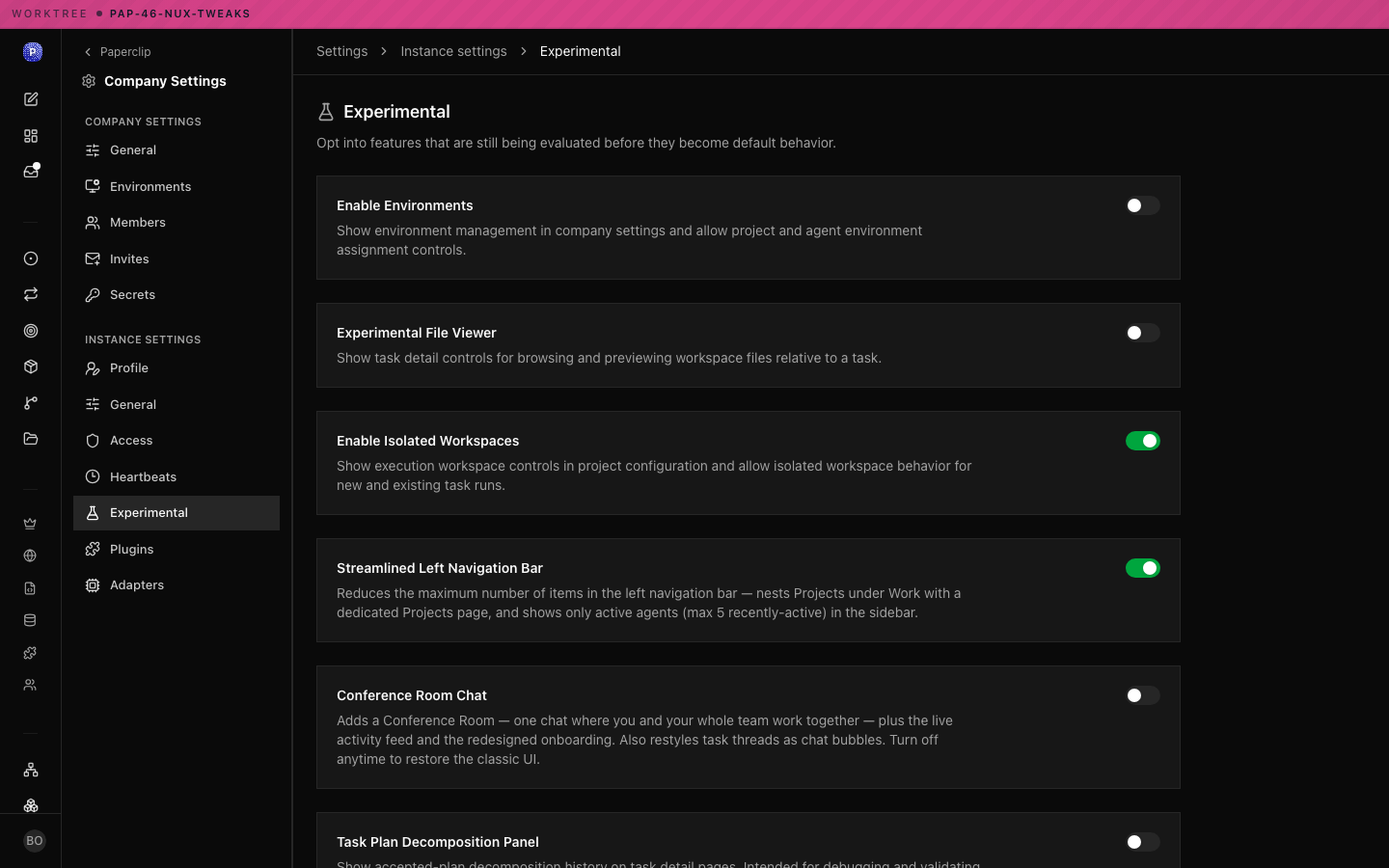
| 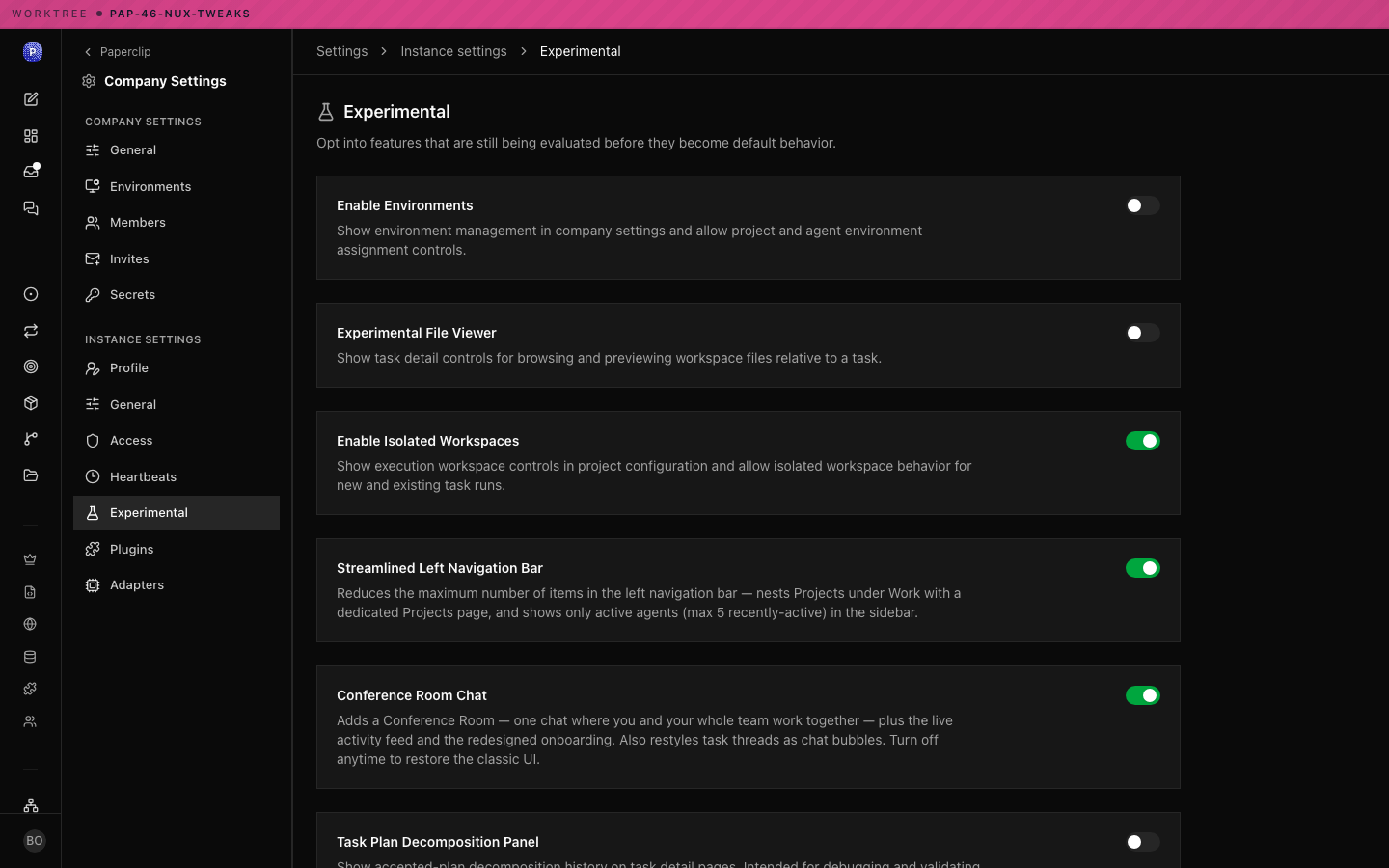
|
| Task thread | 
| 
|
| Home / nav | 
| 
|
| Conference Room (flag-ON only surface) | — | 
|
Capsule onboarding wizard walkthrough screenshots (flag ON) are attached
to the Paperclip design/implementation threads; the wizard requires a
fresh instance so it is captured via the e2e harness
(`tests/e2e/nux-phase4-screenshots.spec.ts`).
## Risks
- **Large surface, but gated:** all new behavior sits behind
`enableConferenceRoomChat`, default OFF; flag-OFF rendering is locked by
frozen `*Classic` forks plus an on/off parity test suite
- **Classic forks are frozen at the fork point (`e3aada1d`):** master
features added to the live thread component after that point (assignee
handoff chips, run status badge, composer mention coach) render in the
flag-ON path; the flag-OFF task thread keeps the fork-point behavior
until the experiment graduates (forks deleted) or is dropped (forks
restored as canonical). Called out for reviewer attention.
- **Merge-conflict resolution in `IssueChatThread.tsx`** (commit
`21a5642a`) deserves reviewer eyes: master's new handoff/run-status
components were kept; the base toast-style no-assignee flow remains
replaced by the AlertDialog flow introduced on this branch
- Schema/server changes are additive (one optional boolean instance
setting); no migrations of existing data
## Model Used
- Claude (Anthropic) via Claude Code running in the Paperclip agent
harness (agent: ClaudeCoder)
- Branch implemented across multiple agent sessions on Claude Opus-class
models with extended thinking + tool use (file edits, shell, Playwright
screenshots); merge/PR session model ID as reported by the harness:
`claude-fable-5` (Claude Code CLI)
- All code was agent-authored and board-reviewed through Paperclip issue
threads (plans, wireframes, confirmations) before merging
## Checklist
- [x] I have included a thinking path that traces from project context
to this change
- [x] I have specified the model used (with version and capability
details)
- [x] I have checked ROADMAP.md and confirmed this PR does not duplicate
planned core work
- [x] I have searched GitHub for duplicate or related PRs and linked
them above
- [x] I have either (a) linked existing issues with `Fixes: #` / `Closes
#` / `Refs #` OR (b) described the issue in-PR following the relevant
issue template
- [x] I have run tests locally and they pass
- [x] I have added or updated tests where applicable
- [x] If this change affects the UI, I have included before/after
screenshots
- [x] I have updated relevant documentation to reflect my changes (none
required — experimental flag, self-documenting Settings card; noted
above)
- [x] I have considered and documented any risks above
- [x] All Paperclip CI gates are green (run 3 on `8af3041a`: all 16
gates SUCCESS, incl. e2e and all 4 serialized-suite shards)
- [x] Greptile is 5/5 with no open P2s, recommendations, or follow-ups
(re-review verdict: Confidence 5/5, “Safe to merge”; all 4 round-1
findings fixed + confirmed resolved; both summary notes addressed in
`8af3041a`)
- [x] I will address all Greptile and reviewer comments before
requesting merge
---------
Co-authored-by: Paperclip <noreply@paperclip.ing>
Co-authored-by: Claude Opus 4.8 <noreply@anthropic.com>
|
||
|
Dotta
|
1413729a06 |
Build the Skills Store (#7990)
## Thinking Path > - Paperclip is the open source app people use to manage AI agents for work. > - Agents increasingly depend on reusable skills, so the control plane needs a first-class way to browse, inspect, install, version, and attach those skills. > - The old skills surface was mostly operational plumbing; it did not give operators a store-like discovery flow, canonical detail URLs, rich source/version context, or creation paths. > - The backend also needed stronger contracts around company skill metadata, versions, install counts, runtime materialization, and adapter skill preferences. > - This pull request builds the Skills Store foundation across DB, shared contracts, server routes/services, UI, and Storybook. > - The benefit is a more inspectable, operator-friendly skill workflow that still preserves company-scoped control-plane boundaries and agent runtime behavior. ## Linked Issues or Issue Description No GitHub issue exists for this Paperclip work item. Paperclip task refs: PAP-10846 and PAP-10921. Feature request: Paperclip operators need a single Skills Store experience where company skills can be discovered, inspected, created, versioned, installed, and attached to agents without relying on scattered operational screens or implicit runtime state. Related PR search: - Searched GitHub for `Skills Store`, `company skills`, and `skill detail`. - Found several open skills-related PRs such as #7809 and #4409, but no duplicate PR for this end-to-end Skills Store branch. ## What Changed - Added the Skills Store backend foundation: company skill schema fields, migrations, shared types/validators, and expanded server skill routes/services. - Added skill discovery, category navigation, canonical skill detail routes, tabs, source attribution, version snapshots/diffs, install count backfill, and creation flows. - Updated agent skill preference handling so version selections survive runtime mention injection and runtime skill materialization honors pinned versions. - Preserved unversioned skill assignments as live/current selections instead of silently pinning them to the current version at assignment time. - Added focused regression coverage for company skill routes/services, route helpers, UI behavior, skill version diffs, and runtime skill version pins. - Added Storybook coverage for Skills Store discovery/detail states and updated the main layout navigation. - Addressed Greptile findings around version creation races, soft-deleted comments, fork metadata scoping, GitHub skill directory fallback, runtime snapshot materialization, shared runtime skill-selection helpers, and version-assignment semantics. ## Verification - `pnpm exec vitest run server/src/__tests__/heartbeat-project-env.test.ts server/src/__tests__/heartbeat-runtime-skills.test.ts` - `pnpm exec vitest run packages/shared/src/validators/company-skill.test.ts` - `pnpm exec vitest run server/src/__tests__/company-portability.test.ts server/src/__tests__/company-skills-service.test.ts` - `pnpm exec vitest run cli/src/__tests__/company-import-export-e2e.test.ts` - `pnpm exec vitest run server/src/__tests__/agent-skills-routes.test.ts` - `pnpm exec vitest run server/src/__tests__/openapi-routes.test.ts` - `pnpm exec vitest run server/src/__tests__/company-skills-service.test.ts server/src/__tests__/company-skills-routes.test.ts server/src/__tests__/heartbeat-runtime-skills.test.ts` - `pnpm exec vitest run server/src/__tests__/company-skills-service.test.ts` - `pnpm exec vitest run ui/src/components/IssueProperties.test.tsx -t "edits existing custom assignee model options from the properties pane"` - `pnpm --filter @paperclipai/server typecheck` - GitHub checks are green on `0823957a2`: Build, Canary Dry Run, General tests, Typecheck + Release Registry, serialized server suites, e2e, policy/review, Socket, Snyk, and aggregate `verify`. - Greptile Review succeeded on `0823957a2` with `40 files reviewed, 0 comments added`; GitHub unresolved review threads: 0. Not run in this heartbeat: - Browser screenshot capture for the UI changes. This PR intentionally omits screenshots per the Paperclip task direction not to add design screenshots/images. ## Risks - Broad feature branch touching DB, shared contracts, server, and UI; reviewers should still scan merge conflicts carefully if `master` moves again before landing. - Skill version/runtime behavior is sensitive: pinned skill versions must stay pinned while default selections should continue following the current version. - UI polish should get normal reviewer/browser attention before merge because this PR includes a large Skills Store surface and screenshots were intentionally omitted. > For core feature work, check [`ROADMAP.md`](ROADMAP.md) first and discuss it in `#dev` before opening the PR. Feature PRs that overlap with planned core work may need to be redirected — check the roadmap first. See `CONTRIBUTING.md`. ## Model Used OpenAI Codex, GPT-5-based coding agent with tool use and local command execution. ## Checklist - [x] I have included a thinking path that traces from project context to this change - [x] I have specified the model used (with version and capability details) - [x] I have checked ROADMAP.md and confirmed this PR does not duplicate planned core work - [x] I have searched GitHub for duplicate or related PRs and linked them above - [x] I have either (a) linked existing issues with `Fixes: #` / `Closes #` / `Refs #` OR (b) described the issue in-PR following the relevant issue template - [x] I have run tests locally and they pass - [x] I have added or updated tests where applicable - [ ] If this change affects the UI, I have included before/after screenshots (intentionally omitted per PAP-10921 direction) - [ ] I have updated relevant documentation to reflect my changes - [x] I have considered and documented any risks above - [x] All Paperclip CI gates are green - [x] Greptile is 5/5 with no open P2s, recommendations, or follow-ups - [x] I will address all Greptile and reviewer comments before requesting merge --------- Co-authored-by: Paperclip <noreply@paperclip.ing> Co-authored-by: Claude Opus 4.8 <noreply@anthropic.com> |
||
|
Jannes Stubbemann
|
69a368ed51 |
fix(gemini-local): pre-select gemini-api-key auth in managed-HOME settings.json for headless runs (#7918)
## Thinking Path > - Paperclip is the open source app people use to manage AI agents for work > - The gemini-local adapter runs gemini-cli headlessly, including on remote/sandboxed execution targets where the adapter manages a dedicated HOME under the runtime root > - gemini-cli hard-refuses headless runs with "Invalid auth method selected." unless `$HOME/.gemini/settings.json` persists an auth selection; setting `GEMINI_DEFAULT_AUTH_TYPE` alone does NOT satisfy it (proven in an isolated pod) > - With a managed HOME the runtime root replaces the image home, so any settings.json baked into the agent image (or the user's real home) is invisible to the CLI, and every sandboxed gemini run dies before doing any work > - This affects any sandbox provider that runs gemini with API-key auth through the managed-HOME path (SSH, E2B, Daytona, Kubernetes, or any other remote execution target); it is a headless-execution bug fix, not gateway- or deployment-specific behavior > - This pull request makes the adapter pre-select the `gemini-api-key` auth type in the managed `$HOME/.gemini/settings.json` whenever a Gemini/Google API key is present, writing both settings schema generations and never touching an existing settings.json > - The benefit is that gemini agents actually run headlessly on remote and sandboxed execution targets without any manual settings provisioning ## Linked Issues or Issue Description No existing issue; describing the bug in-PR (bug template fields): - **What happened:** Headless gemini-local runs on remote/sandboxed execution targets fail immediately with `Invalid auth method selected.` even though `GEMINI_API_KEY` is provided. - **Expected:** Providing the API key should be enough for a headless run to authenticate and proceed. - **Root cause:** gemini-cli requires an auth selection persisted in `$HOME/.gemini/settings.json` for non-interactive runs; the `GEMINI_DEFAULT_AUTH_TYPE` env var does not substitute for it (verified in an isolated pod with only the env var set). The adapter's managed-HOME execution path points HOME at the runtime root, so any pre-existing settings.json (image-baked or user home) is hidden and the CLI finds no auth selection. - **Reproduction:** Run the gemini-local adapter against a remote/sandboxed execution target with `GEMINI_API_KEY` set and no settings.json under the managed HOME; the run aborts with the error above. - Duplicate/related search: no existing PR or issue addresses this; closest related is #7693 (bundles gemini-cli in the Docker image), which makes the CLI available but does not fix headless auth selection. ## What Changed - `packages/adapters/gemini-local/src/server/execute.ts`: after provisioning the managed HOME, when a Gemini/Google API key is present, write `$HOME/.gemini/settings.json` pre-selecting `gemini-api-key` auth. Both settings schema generations are written (legacy top-level `selectedAuthType` and current `security.auth.selectedType`) so old and new gemini-cli versions are covered. - The write is strictly scoped to the managed HOME (the per-run runtime root on sandbox transports). On non-managed remote targets (SSH), where the remote home is the user's real home and existing settings remain visible to the CLI, the adapter creates nothing (review feedback, P1). - The write is guarded by `[ -f ... ] ||` so a user-shipped settings.json (e.g. via workspace) is never overwritten. - The key-presence gate checks the run env AND the host process env (`GEMINI_API_KEY` / `GOOGLE_API_KEY`): in sandboxed paths the key never enters the adapter's run env; it reaches the agent pod via the sandbox provider's per-run secret (env passthrough from the host env), so the host env is the correct signal there. - `packages/adapters/gemini-local/src/server/execute.remote.test.ts`: a new sandbox-transport test asserts the settings.json write lands under the per-run runtime root (path + `gemini-api-key` content), and the SSH test asserts no settings.json is created on a non-managed home. ## Verification - `npx vitest run packages/adapters/gemini-local`: 3 files, 17 tests, all pass. - `pnpm --filter @paperclipai/adapter-gemini-local typecheck` and `build`: clean (test file is covered by the package tsconfig `include`). - Negative control: in an isolated pod, gemini-cli with `GEMINI_API_KEY` + `GEMINI_DEFAULT_AUTH_TYPE` set but no settings.json still fails with `Invalid auth method selected.`; with the settings.json written by this change, the run proceeds. - Verified end-to-end: a gemini agent in a hardened Kubernetes (gVisor) sandbox completed a real task (with `GOOGLE_GEMINI_BASE_URL` pointing at a GenAI-compatible endpoint), producing a billed usage row. That deployment supplies the verification evidence; the fix applies to any sandbox provider running gemini with API-key auth. ## Risks - Low risk. The new write only fires on the managed-HOME path (per-run runtime root) when an API key is present, and only when no settings.json exists yet, so existing setups, real user homes on SSH targets, and user-provided settings are unaffected. - If a future gemini-cli changes the settings schema again, the file may need a third generation key; both current generations are written today. ## Model Used - Claude (Anthropic), Claude Opus 4.8, 1M context, extended thinking, with tool use (code execution / shell) via Claude Code. ## Checklist - [x] I have included a thinking path that traces from project context to this change - [x] I have specified the model used (with version and capability details) - [x] I have checked ROADMAP.md and confirmed this PR does not duplicate planned core work - [x] I have searched GitHub for duplicate or related PRs and linked them above - [x] I have either (a) linked existing issues with `Fixes: #` / `Closes #` / `Refs #` OR (b) described the issue in-PR following the relevant issue template - [x] I have run tests locally and they pass - [x] I have added or updated tests where applicable - [ ] If this change affects the UI, I have included before/after screenshots (no UI change) - [x] I have updated relevant documentation to reflect my changes (code comments document the behavior; no doc pages cover managed-home auth) - [x] I have considered and documented any risks above - [x] All Paperclip CI gates are green - [ ] Greptile is 5/5 with no open P2s, recommendations, or follow-ups (review requested) - [x] I will address all Greptile and reviewer comments before requesting merge 🤖 Generated with [Claude Code](https://claude.com/claude-code) --------- Co-authored-by: Claude Opus 4.8 (1M context) <noreply@anthropic.com> |
||
|
Jannes Stubbemann
|
9e750d3e92 |
feat(codex-local): env-driven gateway routing via PAPERCLIP_CODEX_PROVIDERS config.toml (#7919)
## Thinking Path > - Paperclip is the open source app people use to manage AI agents for work > - The `codex-local` adapter runs the OpenAI Codex CLI; Paperclip already maintains a managed `CODEX_HOME` per company and ships it to remote/sandboxed execution targets > - Deployments increasingly put an OpenAI-compatible LLM gateway between the harness and the model for cost, governance, or data-residency reasons: LiteLLM, OpenRouter, Portkey, Kong, a corporate proxy, self-hosted models (vLLM/Ollama), or region-pinned/sovereign endpoints. But Codex has no CLI flag or env var for a custom endpoint: its only mechanism is `[model_providers.<id>]` tables (with `base_url`, `env_key`, `wire_api`) in `$CODEX_HOME/config.toml`, selected by a root-level `model_provider` key > - Today there is no supported way to get such provider config into the managed `CODEX_HOME`, so gateway routing requires hand-editing files the adapter owns and regenerates > - This pull request adds the codex analogue of #7837's opencode mechanism: a `PAPERCLIP_CODEX_PROVIDERS` JSON env var whose shape maps 1:1 onto codex's TOML schema, merged into the managed `config.toml` so the existing asset-shipping + `env.CODEX_HOME` mechanics deliver it to local and sandboxed runs alike; nothing here is specific to one hosting setup > - The benefit is Codex works behind any OpenAI-compatible gateway with config only; with no env set, behavior is unchanged ## Linked Issues or Issue Description No existing issue; describing in-PR (feature / adapter enhancement). - **Gap:** there is no supported way to register a custom/gateway `[model_providers.*]` endpoint for `codex-local`. Codex's only custom-endpoint mechanism is `config.toml` (`base_url` + `env_key` + `wire_api`, selected via the root `model_provider` key), and the adapter owns/regenerates the managed `CODEX_HOME`, so operators cannot durably hand-edit it. - Related: #7837 (the opencode-local analogue of this change, same env-driven gateway-routing pattern). Searched for duplicate/related PRs: no existing codex-local gateway/provider-routing PR found. > Note on ROADMAP: this is adapter-level, opt-in config (defaults unchanged) that *enables* gateway routing for one harness; it is not the core "Cloud / Sandbox agents" platform work itself. ## What Changed - New `prepareCodexRuntimeConfig()` (`packages/adapters/codex-local/src/server/runtime-config.ts`): reads `PAPERCLIP_CODEX_PROVIDERS` (run env first, then `process.env`), shaped as `{"providers": {"<id>": {base_url, env_key, wire_api, ...}}, "model_provider": "<id>"}`, and merges it into the managed `CODEX_HOME`'s `config.toml`. No-op when unset or empty. - A malformed value (invalid JSON, not a JSON object, no `providers` object, no usable provider entries, or individual entries with empty names or non-object values, which are skipped by name) is never silently dropped: each case surfaces a distinct, user-visible note (via the prepare notes, which flow into command notes + `onLog`) and unusable input leaves `config.toml` untouched. - Merge is marker-delimited and TOML-correct: existing `config.toml` content is preserved between two managed blocks. Root keys (e.g. `model_provider`) are prepended **before the first table header** (TOML root-region rule), `[model_providers.*]` tables are appended. Pre-existing same-name provider sections and root `model_provider` keys are excised so the managed definitions win without duplicate-table parse errors. - `{env:VAR}` placeholders are expanded server-side for literal-credential fields; `env_key` indirection remains the preferred path. - Crash-safe restore: prepare writes a pre-run backup (`config.toml.paperclip-backup`) before the merged file; `cleanup()` restores the original in the execute `finally` and removes the backup. If a run never reaches `cleanup()` (a throw during the setup between prepare and execution, or SIGKILL), the next prepare restores the original from the backup with full fidelity, including user `[model_providers.*]` sections the merge excised (review feedback, P2); plain block-stripping remains the fallback for pre-backup state. - An explicit adapter-config `env.CODEX_HOME` override is treated as user-managed: no merge, surfaced as a command note. - Dependency-free hand-emitted TOML (strings/numbers/booleans, arrays of scalars, plain objects as inline tables); basic strings escape U+0000-U+001F and U+007F per TOML 1.0 (review feedback, P2). Merged output was additionally validated locally with python tomllib during development; the committed tests assert the structural invariants. - `execute.ts` wiring: `prepareCodexRuntimeConfig` runs after `prepareManagedCodexHome` (before the home ships to the remote target), notes surface via `onLog` + command notes, and the `finally` calls `cleanup()`. **Note for reviewers:** current codex removed `wire_api = "chat"` (openai/codex#10157, Feb 2026), so gateway provider configs must use `wire_api = "responses"`, i.e. the gateway must speak `/v1/responses`. The adapter passes the value through verbatim; this is a codex-side constraint worth knowing when configuring it. ## Verification - `pnpm --filter @paperclipai/adapter-codex-local build` and `typecheck`: tsc clean against current `master` - `pnpm exec vitest run packages/adapters/codex-local`: 45 passing (incl. 17 `runtime-config` tests: fresh-merge + cleanup restore, root-region placement, same-name provider override, inline tables/arrays, DEL escaping, `{env:}` expansion from run env + `process.env`, per-case malformed-input notes with `config.toml` untouched, skipped-entry notes alongside a successful merge, silent no-op when unset/empty, explicit-`CODEX_HOME` skip note, backup restore of excised user sections after an interrupted run, backup removal on cleanup, stale-block self-heal, re-run replacement) - Verified end-to-end: a codex agent in a hardened Kubernetes (gVisor) sandbox completed a real task routed through an OpenAI-compatible gateway's `/v1/responses`, with a billed usage row recorded on the gateway. That deployment supplies the verification evidence; the mechanism is gateway-agnostic. ## Risks Low. Entirely env-driven and opt-in; with `PAPERCLIP_CODEX_PROVIDERS` unset the adapter never touches `config.toml` and behavior is byte-identical to before. The merge preserves user content, restores the original file on cleanup, and survives interrupted runs via the pre-run backup; malformed input surfaces a visible note and is ignored without touching `config.toml`. No migration/UI impact. ## Model Used Claude Opus 4.8 (`claude-opus-4-8`, 1M context), extended thinking + tool use, via Claude Code. ## Checklist - [x] I have included a thinking path that traces from project context to this change - [x] I have specified the model used (with version and capability details) - [x] I have checked ROADMAP.md (adapter-level opt-in config enabling gateway routing; not the core sandbox-platform work, noted above) - [x] I have searched GitHub for duplicate or related PRs and linked them above (#7837 is the opencode analogue; no codex-local duplicate found) - [x] I have either (a) linked existing issues OR (b) described the issue in-PR following the relevant issue template - [x] I have run tests locally and they pass - [x] I have added or updated tests where applicable - [ ] If this change affects the UI, I have included before/after screenshots (n/a, no UI) - [ ] I have updated relevant documentation to reflect my changes (env var documented inline; no central doc references the adapter env yet) - [x] I have considered and documented any risks above - [x] All Paperclip CI gates are green (green on the previous head; re-running on the final note-copy polish commit) - [x] Greptile is 5/5 with no open P2s, recommendations, or follow-ups (both review P2s are fixed at head: the interrupted-run restore via the pre-run backup and the U+007F escaping; a re-review is requested for the note-copy polish) - [x] I will address all Greptile and reviewer comments before requesting merge 🤖 Generated with [Claude Code](https://claude.com/claude-code) --------- Co-authored-by: Claude Opus 4.8 (1M context) <noreply@anthropic.com> |
||
|
Jannes Stubbemann
|
6e4aca9c67 |
feat(pi-local): env-driven gateway routing via PAPERCLIP_PI_PROVIDERS models.json (#7920)
## Thinking Path > - Paperclip is the open source app people use to manage AI agents for work > - The `pi-local` adapter runs the Pi coding agent, including inside remote/sandboxed execution targets; Pi resolves `--provider P --model M` by an exact (provider, id) match against its model registry, and it has no base-url CLI flag or env var: a `models.json` in its agent config dir (`$PI_CODING_AGENT_DIR`, falling back to `$HOME/.pi/agent`) is its only mechanism for custom or OpenAI/Anthropic-compatible endpoints > - Deployments increasingly put an LLM gateway between the harness and the model for cost, governance, or data-residency reasons: LiteLLM, OpenRouter, Portkey, Kong, a corporate proxy, self-hosted models (vLLM/Ollama), or region-pinned/sovereign endpoints. Today there is no supported way to get such provider config into Pi's registry for orchestrated runs > - The opencode adapter gained the equivalent capability in #7837 and codex in #7919; this pull request is the Pi analogue, so the harness layer stays gateway-agnostic regardless of which CLI an agent uses; nothing here is specific to one hosting setup > - This pull request reads `PAPERCLIP_PI_PROVIDERS` (Pi's `models.json` `providers` shape), materialises a managed `models.json` in a temp agent-config dir, points `PI_CODING_AGENT_DIR` at it, and ships it to remote execution targets with the run > - The benefit is Pi works behind any compatible gateway with config only; with no env set, behavior is unchanged ## Linked Issues or Issue Description No existing issue; describing in-PR (feature / adapter enhancement). - **Gap:** there is no supported way to register custom/gateway providers + models for `pi-local`. Pi's only custom-endpoint mechanism is a `models.json` in its agent config dir, and orchestrated (especially sandboxed) runs have no way to provision one declaratively. - Related: #7837 (the opencode-local analogue, same env-driven gateway-routing pattern) and #7919 (the codex-local analogue). Searched for duplicate or related PRs: no existing pi-local gateway/provider-routing PR found. > Note on ROADMAP: this is adapter-level, opt-in config (defaults unchanged) that *enables* gateway routing for one harness; it is not the core "Cloud / Sandbox agents" platform work itself. ## What Changed - New `packages/adapters/pi-local/src/server/runtime-config.ts`: `preparePiRuntimeConfig()` reads `PAPERCLIP_PI_PROVIDERS` (a JSON object in pi's `models.json` `providers` shape) from the run env, then `process.env`. When set, it expands `{env:VAR}` placeholders (run env first, then process env; unresolvable placeholders left intact), writes `{"providers": ...}` to a managed temp dir as `models.json`, and returns env with `PI_CODING_AGENT_DIR` pointing at it plus a cleanup handle. - `execute.ts`: the prepared dir ships to remote execution targets as the managed-runtime asset `agentConfig` (same mechanism as opencode's `xdgConfig`), and `PI_CODING_AGENT_DIR` is repointed to the in-target path; cleanup runs in `finally`. - Misconfiguration is visible, not silent: a set-but-unusable `PAPERCLIP_PI_PROVIDERS` (invalid JSON, not an object, no provider objects) surfaces an explanatory note instead of proceeding unconfigured into an opaque model-not-found failure later, and provider entries with non-object values are skipped with a note naming them. Unset/empty stays a silent no-op (feature off). - Defaults unchanged: with `PAPERCLIP_PI_PROVIDERS` unset, the adapter behaves byte-for-byte as before, for local runs and for every existing sandbox provider. ## Verification - All pi-local tests green against this base (new: providers written verbatim, `{env:VAR}` expansion from run env/process env/unresolvable, no-op when unset, `PI_CODING_AGENT_DIR` set and shipped, the misconfiguration notes incl. skipped non-object entries, remote asset sync + env repoint). Typecheck and build clean. - Production end-to-end evidence (our deployment, used as verification, not as the scope of the change): a pi agent in a Kubernetes gVisor sandbox resolved a custom provider from the shipped `models.json`, completed an assigned issue through an Anthropic-compatible gateway, and landed a billed usage row. ## Risks Low. The entire feature is opt-in behind one env var; the only behavior change when it is set is the intended one. The managed dir replaces the host agent dir for the run by design (credentials travel inside the provider config or via env-key indirection), which is the correct posture for orchestrated runs. No migration/UI impact. ## Model Used Claude Opus 4.8 (`claude-opus-4-8`, 1M context), extended thinking + tool use, via Claude Code. ## Checklist - [x] I have included a thinking path that traces from project context to this change - [x] I have specified the model used (with version and capability details) - [x] I have checked ROADMAP.md (adapter-level opt-in config enabling gateway routing; not the core sandbox-platform work, noted above) - [x] I have searched GitHub for duplicate or related PRs and linked them above (#7837 and #7919 are the opencode/codex analogues; no pi-local duplicate found) - [x] I have either (a) linked existing issues OR (b) described the issue in-PR following the relevant issue template - [x] I have run tests locally and they pass - [x] I have added or updated tests where applicable - [ ] If this change affects the UI, I have included before/after screenshots (n/a, no UI) - [ ] I have updated relevant documentation to reflect my changes (env var documented inline; no central doc references the adapter env yet) - [x] I have considered and documented any risks above - [x] All Paperclip CI gates are green (green on the previous head; re-running on the final note-copy polish commit) - [x] Greptile is 5/5 with no open P2s, recommendations, or follow-ups (both prior review findings are fixed at head: the indirect notes-based guard is now an explicit `agentConfigDir` handle, and a failed `models.json` write no longer leaks the temp dir; a re-review is requested for the note-copy polish) - [x] I will address all Greptile and reviewer comments before requesting merge 🤖 Generated with [Claude Code](https://claude.com/claude-code) --------- Co-authored-by: Claude Opus 4.8 (1M context) <noreply@anthropic.com> |
||
|
Jannes Stubbemann
|
1ac1ba5442 |
feat(opencode-local): env-driven gateway routing (custom providers, small/cheap model, remote allow-all) (#7837)
## Thinking Path > - Paperclip is the open source app people use to manage AI agents for work > - The `opencode-local` adapter runs the OpenCode harness; its model/provider routing assumes built-in providers (anthropic/openai/...) and their default models > - Deployments increasingly put an OpenAI/Anthropic-compatible LLM gateway between the harness and the model for cost, governance, or data-residency reasons: LiteLLM, OpenRouter, Portkey, Kong, a corporate proxy, self-hosted models (vLLM/Ollama), or region-pinned/sovereign endpoints. But OpenCode only resolves `--model provider/model` when the model is registered in a provider's `models` map, and `OPENCODE_ALLOW_ALL_MODELS` does NOT bypass its internal `getModel()` > - Several lanes also fall back to built-in default models the gateway may not serve: the auxiliary/title model (e.g. `claude-haiku-*`) and the budget/recovery "cheap" lane (`openai/gpt-5.1-codex-mini`); these abort runs with "no keys found that support model" > - This pull request makes the adapter's provider/model wiring declarative via env, so any such deployment can register gateway models + pin the auxiliary/budget lanes without code changes; nothing here is specific to one hosting setup > - The benefit is OpenCode works behind any compatible gateway with config only; with no env set, behavior is unchanged ## Linked Issues or Issue Description No existing issue; describing in-PR (feature / adapter enhancement). - **Gap:** there is no supported way to register custom/gateway providers + models for `opencode-local`, nor to pin the auxiliary (title-gen) and budget (recovery) model lanes, so routing OpenCode through a gateway fails at `getModel()` or on the default helper models. - Related: #5737 (exe.dev sandbox installs for gemini/opencode local), #5823 (unblock claude_local on remote sandbox providers). > Note on ROADMAP: this is adapter-level, opt-in config (defaults unchanged) that *enables* gateway routing for one harness; it is not the core "Cloud / Sandbox agents" platform work itself. Happy to redirect/discuss in #dev if preferred. ## What Changed - `PAPERCLIP_OPENCODE_PROVIDERS`: merge custom/extended providers (OpenCode `provider` shape) into the runtime `opencode.json`, so gateway models are registered and `--model provider/model` resolves. `{env:VAR}` placeholders are expanded server-side (so a key need not depend on the sandbox run env). - A malformed `PAPERCLIP_OPENCODE_PROVIDERS` is no longer silently ignored: invalid JSON, a non-object value, and individual provider entries with non-object values (which are skipped by name) each append a visible note to the run notes so the misconfiguration is diagnosable (addresses both review P1s). - `PAPERCLIP_OPENCODE_SMALL_MODEL` / `PAPERCLIP_OPENCODE_CHEAP_MODEL`: pin the auxiliary (title-generation) and budget (recovery-retry) lanes to gateway-served models; defaults unchanged. - Honour `OPENCODE_ALLOW_ALL_MODELS` on the **remote** execution path too (was local-only, a parity gap). - `PAPERCLIP_OPENCODE_PRINT_LOGS`: optional toggle adding `--print-logs` so OpenCode logs surface on stderr for diagnosing remote/sandbox runs. - `buildOpenCodeModelProfiles()` guards its `process.env` default with `typeof process` so the shared client/server module stays browser-safe (a bare `process.env` at module load threw ReferenceError in the browser under Vite dev middleware and broke UI rendering in the e2e lane). ## Verification - `pnpm --filter @paperclipai/adapter-opencode-local build` and `typecheck` (tsc clean) - `pnpm exec vitest run packages/adapters/opencode-local/src` shows 33 passing (incl. new tests for the provider merge, `{env:}` expansion, the malformed/non-object/skipped-entry provider notes, small/cheap-model resolution, and the remote allow-all bypass) - Manually verified end-to-end against a real OpenAI-/Anthropic-compatible gateway: with the providers + small/cheap model set, both the title-gen and main task route to the configured gateway model and the agent completes (a real completion is returned and billed). That deployment supplies the verification evidence; the mechanism is gateway-agnostic. ## Risks Low. Everything is env-driven and opt-in; with no env set the generated config output is unchanged, and the cheap model profile keeps its model (the only difference is its updated human-readable description). Defaults preserved: built-in providers, Codex-mini cheap lane with `variant: low`, no `--print-logs`. No migration/UI impact. ## Model Used Claude Opus 4.8 (`claude-opus-4-8`, 1M context), extended thinking + tool use, via Claude Code. ## Checklist - [x] I have included a thinking path that traces from project context to this change - [x] I have specified the model used (with version and capability details) - [x] I have checked ROADMAP.md (adapter-level opt-in config enabling gateway routing; not the core sandbox-platform work, noted above) - [x] I have searched GitHub for duplicate or related PRs and linked them above (#5737, #5823) - [x] I have either (a) linked existing issues OR (b) described the issue in-PR following the relevant issue template - [x] I have run tests locally and they pass - [x] I have added or updated tests where applicable - [ ] If this change affects the UI, I have included before/after screenshots (n/a, no UI) - [ ] I have updated relevant documentation to reflect my changes (env vars documented inline via comments; no central doc references the adapter env yet) - [x] I have considered and documented any risks above - [x] All Paperclip CI gates are green - [x] Greptile is 5/5 with no open P2s, recommendations, or follow-ups (the P1 about silently dropped malformed providers JSON is addressed in 6eeb803, the follow-up P1 about silently skipped non-object entries in 2f4045a; the latest review has no further findings, and a re-review is requested for the final note-copy/test-fixture polish at head) - [x] I will address all Greptile and reviewer comments before requesting merge 🤖 Generated with [Claude Code](https://claude.com/claude-code) --------- Co-authored-by: Claude Opus 4.8 (1M context) <noreply@anthropic.com> |
||
|
Jannes Stubbemann
|
398d746093 |
build(agent-runtime): harness runtime images for sandboxed execution (stage 3/3) (#7934)
> [!NOTE] > This is **stage 3 of 3** of the staged Kubernetes contribution: stage 1 is the kubernetes sandbox-provider plugin (#5790), stage 2 is the provider backend/hardening refresh filed separately, and this stage ships the runtime images those sandboxes run. ## Thinking Path > - Paperclip is the open source app people use to manage AI agents for work > - Sandboxed agent execution (Refs #248) runs each agent turn in an isolated environment; the kubernetes sandbox provider (stage 1, #5790) schedules those runs as hardened pods > - A sandbox pod needs a runtime image with the harness CLI preinstalled: installing CLIs at run start is slow, flaky, and needs network egress the sandbox should not have > - There is no first-party image family for this, so every deployer would have to hand-roll Ubuntu + Node + CLI images per harness and solve signal handling, non-root, and image chaining themselves > - This PR ships the agent-runtime image family: a hardened base (non-root uid 1000, tini, git, the agent shim) plus one derived image per harness, a buildx bake file that chains them, and a publish workflow with cosign keyless signing > - The benefit is that any sandbox infrastructure, the kubernetes provider or otherwise, gets ready-made, signed, security-hardened per-harness runtime images that are verified in production across five harnesses ## Linked Issues or Issue Description Refs #248 (sandboxed agent execution proposal) and #5790 (the kubernetes sandbox provider, stage 1 of this contribution, which consumes these images as per-run runtime images via its adapter defaults). No issue covers the image gap itself, described in-PR: sandbox providers reference `ghcr.io/paperclipai/agent-runtime-*` images, but the repository contains neither the Dockerfiles nor the workflow that builds and publishes them. Without this, self-deployers cannot reproduce or audit the images their agent runs execute in. ## What Changed - `docker/agent-runtime/Dockerfile.base`: foundation image. Ubuntu 22.04 + Node 22 + git + tini (PID 1, signal propagation) + non-root `paperclip` user (uid/gid 1000) + the agent shim compiled in a Go build stage. `WORKDIR /workspace`, entrypoint `tini -- paperclip-agent-shim`. - One derived Dockerfile per harness: `opencode` (opencode-ai), `pi` (@mariozechner/pi-coding-agent), `codex` (@openai/codex), `gemini` (@google/gemini-cli, plus headless auth-mode settings), `claude` (@anthropic-ai/claude-code, symlinked as `claude-code`). Each installs the CLI as root, returns to uid 1000, and asserts the binary is on PATH at build time. - `acpx` and `hermes` Dockerfiles are included in the bake group but are not in the default publish scope (hermes is a stub until a CLI package exists). - `docker/agent-runtime/buildx-bake.hcl`: builds the whole family in one pass. Derived targets chain off the `base` target through bake `contexts` (the literal registry in each `FROM` is overridden to `target:base` at build time, so no intermediate push is needed). `REGISTRY` (default `ghcr.io/paperclipai`) and `VERSION` are overridable variables. - `tools/agent-shim/`: a small Go shim that runs as the container command. It reads `/run/paperclip/runtime-command.json` (`{ "command", "args" }`), resolves the harness CLI on PATH, and `syscall.Exec`s it so SIGTERM from the kubelet reaches the harness directly. Harness-agnostic, with unit tests. - `.github/workflows/agent-runtime-images.yml`: builds and pushes the default scope (base, opencode, pi, codex, gemini, claude) for linux/amd64 on `workflow_dispatch` (explicit version tag) or pushes to `master` touching these paths, then signs every digest with cosign keyless OIDC. Uses only `GITHUB_TOKEN`; no extra secrets. - `docker/agent-runtime/README.md`: image lineup, base contents, local build instructions, the runtime-command contract, and the security model. Additive only: nothing in the product loads these images. Deployments opt in via their sandbox provider configuration (for example the kubernetes plugin's image settings). ## Verification - `cd tools/agent-shim && go build ./... && go test ./... && go vet ./...`: all passing. - `docker buildx bake -f docker/agent-runtime/buildx-bake.hcl --print base opencode pi codex gemini claude`: resolves cleanly; every tag and build context lands on `ghcr.io/paperclipai/agent-runtime-*` and derived targets map the base ref to `target:base`. - Workflow YAML validated (parses, single job, no org-specific secrets). - This exact image family (built from these Dockerfiles, bake file, and workflow) is what runs agent execution in production on paperclip.inc, verified end-to-end across five harnesses (opencode, pi, codex, gemini, claude): each as a full loop from assigned issue to per-run runtime image in a sandboxed pod to completed run. ## Risks - Low risk: purely additive, nothing in paperclip-server or the UI references these files. The workflow only triggers on its own paths. - Derived images install harness CLIs `@latest` at build time; a broken upstream CLI release would surface at image build, not at run time, and the PATH assertion fails the build rather than shipping a broken image. - The hermes image is an explicit stub (documented in its Dockerfile) until a hermes CLI package exists; it is outside the default publish scope. - cosign signing is keyless OIDC with the workflow identity; no long-lived signing keys are introduced. ## Model Used Claude Opus 4.8 (claude-opus-4-8, 1M context, extended thinking, tool use via Claude Code). ## Checklist - [x] I have included a thinking path that traces from project context to this change - [x] I have specified the model used (with version and capability details) - [x] I have checked ROADMAP.md and confirmed this PR does not duplicate planned core work - [x] I have searched GitHub for duplicate or related PRs and linked them above - [x] I have either (a) linked existing issues with `Fixes: #` / `Closes #` / `Refs #` OR (b) described the issue in-PR following the relevant issue template - [x] I have run tests locally and they pass - [x] I have added or updated tests where applicable - [x] If this change affects the UI, I have included before/after screenshots (no UI changes) - [x] I have updated relevant documentation to reflect my changes - [x] I have considered and documented any risks above - [ ] All Paperclip CI gates are green - [ ] Greptile is 5/5 with no open P2s, recommendations, or follow-ups - [x] I will address all Greptile and reviewer comments before requesting merge --------- Co-authored-by: Claude Opus 4.8 (1M context) <noreply@anthropic.com> |
||
|
Jannes Stubbemann
|
4ad94d0bde |
feat(server): kubernetes execution integration for sandbox-provider plugins (stage 2/3) (#7938)
## Thinking Path > - Paperclip is the open source app people use to manage AI agents for work > - The execution subsystem runs those agents in environments (local, ssh, sandbox), and sandbox-provider plugins let an environment materialize per-run sandboxes > - Stage 1 (#5790) contributed a first-party Kubernetes sandbox-provider plugin, but the server core has no way to adopt it operationally: no per-run adapter selection, no way to force an instance onto sandboxed execution, no declarative adapter/model configuration, and the plugin must be installed by hand > - Without this, a multi-tenant or security-conscious deployment cannot guarantee that agent runs never execute on the host, and a single environment cannot serve agents with different harnesses > - This pull request adds the server + SDK integration: per-run adapterType on the lease protocol, an env-gated forced-Kubernetes execution policy with provisioning and a per-run allowlist guard, a declarative adapter registry and model list, in-cluster env passthrough for sandbox plugin workers, fail-safe auto-install of the bundled plugin, and the matching UI affordance > - The benefit is that sandbox-provider plugins become fully usable for Kubernetes execution: operators configure everything via environment variables and GitOps, while self-hosters who set none of the variables see exactly the behavior they have today ## Linked Issues or Issue Description Refs #5790 (stage 1 of 3: the Kubernetes sandbox-provider plugin package). No existing issue. Feature description: the server core lacks the integration seams to operate a sandbox-provider plugin as the mandatory execution path of an instance. This PR is stage 2 of 3 of the staged Kubernetes contribution; stage 3 will contribute the agent runtime images and their build pipeline. ## What Changed One line per piece: - `packages/plugins/sdk/protocol.ts`: optional `adapterType` on `PluginEnvironmentAcquireLeaseParams` so a provider can select the runtime image per run; existing providers simply ignore it - `server/services/environment-runtime.ts` + `environment-run-orchestrator.ts`: thread the agent's adapter type into both lease-acquiring drivers, including the heartbeat path (the two call sites have historically drifted, hence the pinned test) - `server/services/environments.ts`: `ensureKubernetesEnvironment` / `findKubernetesEnvironment`, an idempotent managed Kubernetes environment per company, identified by a metadata marker and refreshed (not recreated) on config change; `timeoutMs` rides on the config for slow cold-start leases - `server/services/execution-allowlist.ts`: pure (driver, provider, policy) -> allow/deny guard; `executionMode=kubernetes` only allows the kubernetes sandbox provider - `server/services/execution-policy-bootstrap.ts` + startup hook in `server/index.ts`: parse `PAPERCLIP_EXECUTION_MODE` / `PAPERCLIP_K8S_*`, persist `executionMode` into instance general settings, and provision the managed environment for every company; fails loud on misconfiguration - `server/services/heartbeat.ts`: when the policy forces Kubernetes, pin run selection to the managed environment (also overriding any persisted workspace environment id), refuse to fall back to local, and re-check the actually acquired environment against the allowlist as defense in depth - `server/services/adapter-registry-bootstrap.ts` + shared `AdapterRegistryEntry` type/validator: declarative `PAPERCLIP_ADAPTERS` registry (inline JSON or file) that reconciles adapter availability at startup and rides on the Kubernetes environment config - `server/services/adapter-models-env.ts` + `adapters/registry.ts`: `PAPERCLIP_ADAPTER_MODELS` lets an operator declare picker model lists the server cannot CLI-discover - `server/services/plugin-loader.ts`: pass `KUBERNETES_SERVICE_HOST/PORT(_HTTPS)` through to plugin workers that register environment drivers, so in-cluster API clients can be constructed; all other host env stays stripped - `server/app.ts`: fail-safe auto-install of the bundled kubernetes plugin at boot; no-ops when the bundle is absent and never blocks startup on error - `packages/shared` types/validators: `InstanceExecutionMode` on general settings (optional, strict schema) - `ui/lib/forced-kubernetes-environment.ts` + `AgentConfigForm`: when the policy is active, show a read-only Kubernetes environment instead of the environment picker and default new agents onto the managed environment - Tests for every new module plus the adapterType pin in `heartbeat-plugin-environment` and the managed-environment lifecycle in `environment-service` Everything is gated: with `PAPERCLIP_EXECUTION_MODE`, `PAPERCLIP_ADAPTERS`, and `PAPERCLIP_ADAPTER_MODELS` unset (and no bundled plugin present), every code path reduces to current behavior. The per-run `adapterType` is an optional SDK parameter that existing providers ignore. ## Verification - `cd server && npx tsc --noEmit`: clean (0 errors); `ui` typecheck also clean - Targeted suites all green (11 files, 90 tests): `npx vitest run server/src/__tests__/heartbeat-plugin-environment.test.ts server/src/__tests__/environment-service.test.ts server/src/__tests__/environment-runtime.test.ts server/src/__tests__/environment-run-orchestrator.test.ts server/src/__tests__/plugin-database.test.ts server/src/services/execution-policy-bootstrap.test.ts server/src/services/execution-allowlist.test.ts server/src/services/adapter-registry-bootstrap.test.ts server/src/services/adapter-registry-bootstrap.reconcile.test.ts server/src/services/adapter-models-env.test.ts packages/shared/src/validators/adapter-registry.test.ts` - `npx vitest run ui/src/components/AgentConfigForm.test.ts`: green (6 tests) - Full `npx vitest run server/src/__tests__`: 2323 passed, 1 skipped; the only failures (heartbeat-process-recovery pid-retry, workspace-runtime symbolic-ref/git tests) reproduce identically on pristine `master` in the same environment, so they are machine-environment issues unrelated to this change; `server-startup-feedback-export` needed its `services/index.js` mock extended with the new export and is green - This integration has been running in production on a hosted multi-tenant deployment, where it executes agent runs across five different harnesses through the stage 1 plugin ## Risks - Low for existing deployments: every behavior is env-gated and the defaults preserve current semantics; the auto-install block is wrapped fail-safe and skips silently when the plugin bundle is absent - `executionMode` is a new optional field on a strict zod schema; absent input normalizes exactly as before - The forced policy intentionally fails runs loudly (rather than falling back to local) when no managed Kubernetes environment exists; this only affects instances that explicitly set `PAPERCLIP_EXECUTION_MODE=kubernetes` ## Model Used Claude Opus 4.8 (claude-opus-4-8, 1M context), extended thinking, agentic tool use via Claude Code. ## UI screenshots The UI change is a new read-only "Execution" section in `AgentConfigForm`, shown only when the instance execution policy forces Kubernetes (`executionMode=kubernetes`); there is no "before" state for it (the section did not exist, and instances without the forced policy render the existing picker unchanged). Captured from the new Storybook stories added in this PR (`Product/Agent Management`): Managed Kubernetes environment present (read-only display, no local/SSH picker): 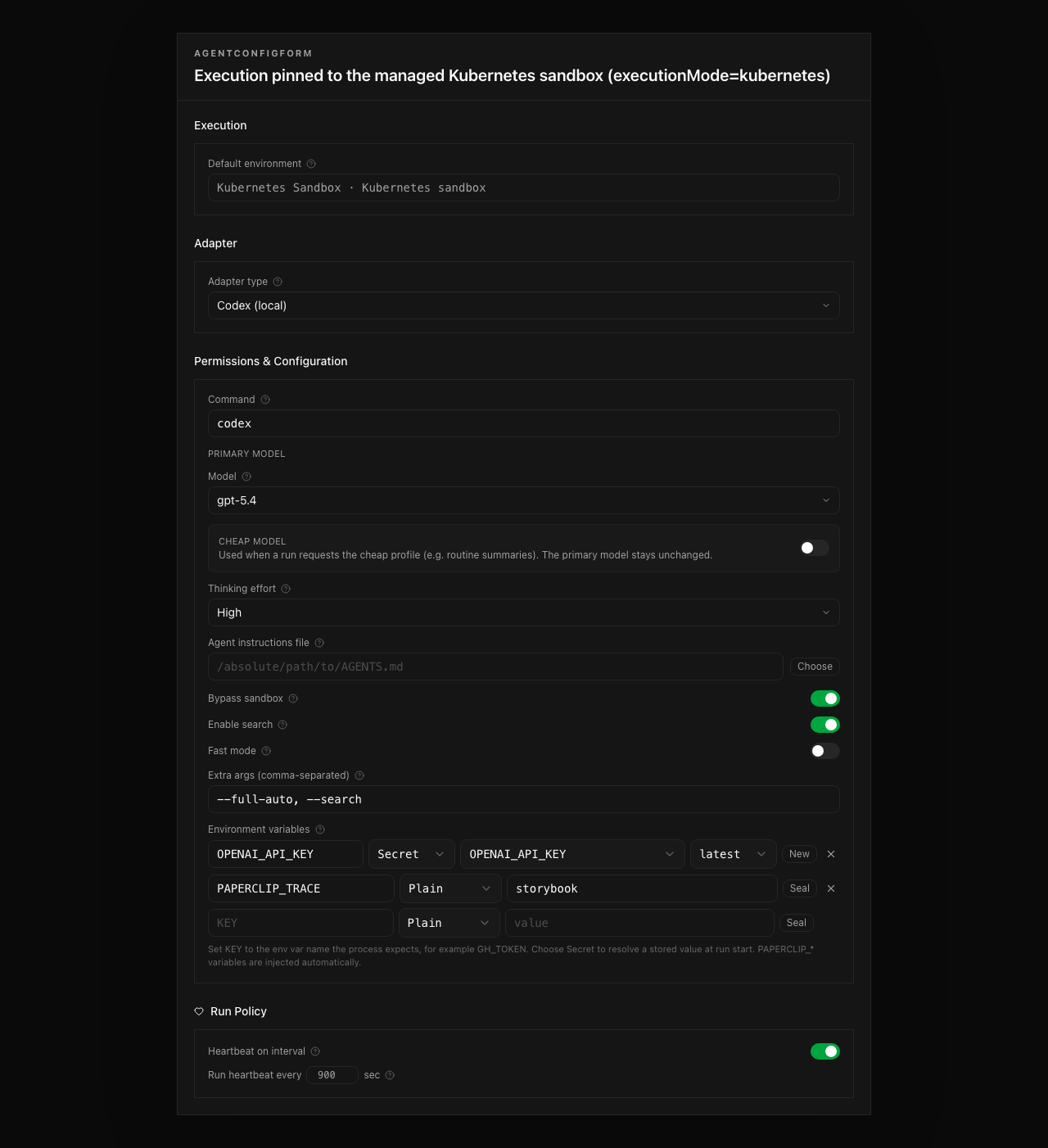 No managed environment available yet (warning notice, no silent local fallback): 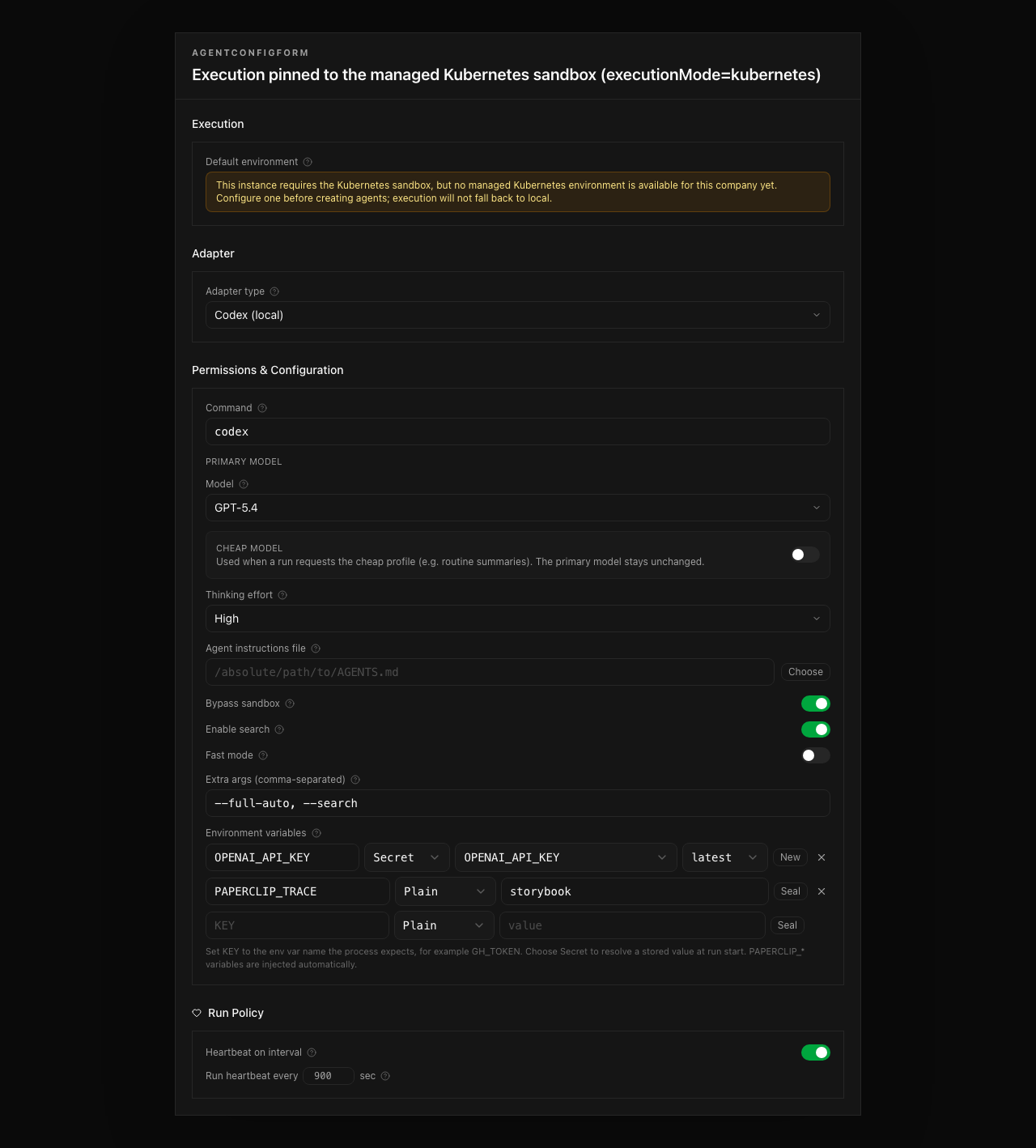 ## Checklist - [x] I have included a thinking path that traces from project context to this change - [x] I have specified the model used (with version and capability details) - [x] I have checked ROADMAP.md and confirmed this PR does not duplicate planned core work - [x] I have searched GitHub for duplicate or related PRs and linked them above - [x] I have either (a) linked existing issues with `Fixes: #` / `Closes #` / `Refs #` OR (b) described the issue in-PR following the relevant issue template - [x] I have run tests locally and they pass - [x] I have added or updated tests where applicable - [x] If this change affects the UI, I have included before/after screenshots - [x] I have updated relevant documentation to reflect my changes - [x] I have considered and documented any risks above - [ ] All Paperclip CI gates are green - [ ] Greptile is 5/5 with no open P2s, recommendations, or follow-ups - [x] I will address all Greptile and reviewer comments before requesting merge 🤖 Generated with [Claude Code](https://claude.com/claude-code) --------- Co-authored-by: Claude Opus 4.8 (1M context) <noreply@anthropic.com> |
||
|
Jannes Stubbemann
|
05ab45225a |
feat(plugin-kubernetes): self-hostable Kubernetes sandbox provider (stage 1/3: plugin package) (#5790)
## Thinking Path > - Paperclip is the open source app people use to manage AI agents for work > - Sandbox providers are the seam that lets agent runs execute in isolated environments; today the only first-party remote provider is Daytona, a hosted third-party service > - Self-hosters running Paperclip on their own infrastructure (often Kubernetes already) have no first-party way to run agent sandboxes on a cluster they control > - That gap matters for teams with data-residency, sovereignty, or cost constraints who cannot or will not send workloads to a hosted sandbox service > - This pull request adds a Kubernetes sandbox-provider plugin as a standalone, workspace-excluded package: it implements every SandboxProvider hook the Daytona provider does, on infrastructure the operator owns > - The benefit is that any Paperclip deployment with a Kubernetes cluster gets multi-tenant, network-isolated, quota-bounded agent sandboxes with zero new external dependencies ## Linked Issues or Issue Description No existing issue. Following the feature template: - **Problem:** Paperclip's remote sandbox execution requires a hosted third-party provider. Self-hosters cannot run agent sandboxes on their own Kubernetes clusters with a first-party provider. - **Proposed solution:** A `@paperclipai/plugin-kubernetes` sandbox-provider plugin with two backends: long-lived sandboxes via the [kubernetes-sigs/agent-sandbox](https://github.com/kubernetes-sigs/agent-sandbox) CRD (multi-command exec, adapter-install pattern) and one-shot `batch/v1` Jobs (stable APIs only, no extra controllers). - **Alternatives considered:** Driving kubectl from a generic shell provider (no lifecycle/lease semantics), or requiring a hosted provider (exactly the constraint this removes). ## What Changed This is **stage 1 of 3** of a staged contribution (direction agreed with maintainers): the plugin package alone. Stage 2 (server integration: lease params, provider registration) and stage 3 (agent runtime images + CI) are companion PRs that will be cross-linked from a comment here. - New package `packages/plugins/sandbox-providers/kubernetes` (workspace-excluded, like the path already carved out in `pnpm-workspace.yaml`): src, unit + kind integration tests, operator prerequisite manifests, README, smoke-test guide - Implements the full SandboxProvider hook surface the Daytona provider implements: `validateConfig`, `probe`, `acquireLease`, `resumeLease`, `releaseLease`, `destroyLease`, `realizeWorkspace`, `execute` - Two backends: `sandbox-cr` (default; long-lived pod via the agent-sandbox `Sandbox` CR, supports multi-command exec) and `job` (one-shot `batch/v1` Job; nothing beyond k8s 1.27+ required) - Per-run adapter resolution: one environment serves mixed harnesses; the per-run `adapterType` hint is read through a local optional type extension, so the plugin typechecks and builds against the current plugin SDK and simply falls back to the environment's configured default adapter until stage 2 lands - Exec-env wrapping: the Kubernetes exec API carries no environment, so commands are wrapped to receive the run's env - Fast-upload interception for workspace realization, scoped per lease - Per-tenant isolation: derived namespace per company, RBAC, ResourceQuota, restricted-PSS pod security (runAsNonRoot, drop ALL, seccomp RuntimeDefault, no SA token automount) - Network egress policy in two flavors: native `NetworkPolicy` and `CiliumNetworkPolicy` (FQDN allowlists) - Image allowlist with glob matching, registry override, and per-run image override validation - Per-run Kubernetes Secrets carrying agent credentials, ownerRef'd to the Job or Sandbox CR for cascade GC ## Verification - Standalone build, exactly as the README documents: ```bash cd packages/plugins/sandbox-providers/kubernetes pnpm install --ignore-workspace pnpm test # 147 unit tests, 17 files, all green pnpm typecheck # clean against the in-repo plugin SDK on master pnpm build # dist/ emitted, manifest + worker entrypoints present ``` - A kind-cluster end-to-end integration test is included (`RUN_K8S_INTEGRATION_TESTS=1 pnpm test test/integration/end-to-end-run.test.ts`) - Beyond CI: this provider has been verified in a production multi-tenant deployment against five harnesses (opencode, pi, codex, gemini, claude code) with real billed runs ## Risks - **Zero behavior change for any existing deployment.** The package is workspace-excluded; nothing in the server imports or loads it until stage 2's integration lands. No existing code paths are touched. - The default `sandbox-cr` backend depends on an alpha CRD (`agents.x-k8s.io/v1alpha1`); the README flags this and the `job` backend uses only stable APIs as a fallback. - Risk surface is confined to deployments that explicitly install and configure the plugin. - The default runtime images (`ghcr.io/paperclipai/agent-runtime-*`) are published by the stage 3 companion PR (#7934); until that lands, deployments must point `runtimeImage` at their own images. ## Model Used Claude Opus 4.8 (1M context), extended thinking, with tool use (Claude Code). ## Checklist - [x] I have included a thinking path that traces from project context to this change - [x] I have specified the model used (with version and capability details) - [x] I have checked ROADMAP.md and confirmed this PR does not duplicate planned core work - [x] I have searched GitHub for duplicate or related PRs and linked them above - [x] I have either (a) linked existing issues with `Fixes: #` / `Closes #` / `Refs #` OR (b) described the issue in-PR following the relevant issue template - [x] I have run tests locally and they pass - [x] I have added or updated tests where applicable - [ ] If this change affects the UI, I have included before/after screenshots (no UI changes) - [x] I have updated relevant documentation to reflect my changes - [x] I have considered and documented any risks above - [ ] All Paperclip CI gates are green (pending this push) - [ ] Greptile is 5/5 with no open P2s, recommendations, or follow-ups - [x] I will address all Greptile and reviewer comments before requesting merge --------- Co-authored-by: Claude Opus 4.8 (1M context) <noreply@anthropic.com> |








